Ruminations

My Beloved New York Mets

I’m going off topic today, because it’s my website and I’ll do what I want.

The New York Metropolitans, my beloved NY Mets, are currently 70-56.  Atop of the National League East at 6.5 games ahead of the Washington Nationals, Los Mets have their largest division lead since the September which shall not be named.  Because of their torrid winning ways, the Mets are garnering more and more attention as of late and it distresses me.

My Mets are underdogs.  They claw and they scratch and they make something out of nothing.  They engender a Stockholm-esque masochism that we Mets fans wear like a badge on our orange and blue sleeves.

My Mets are not a fashionable bandwagon juggernaut of superstars and refined culture.  That’s the other New York baseball club, and let’s keep it that way.

There is much baseball left to play, but for the first time in a while, my beloved New York Mets are in control of their own destiny.  I believe, but I’ve been burned many times before.  Nonetheless…

Let’s Go Mets!

JPG

Sound Effects and Internal Stresses

Two quick thoughts:

1.)  Today, I was hand ripping some red oak for the tray runners on the medium tool chest.  Without any music playing in the background (the album had ended mid rip), I was really tuned into the sound of the sawing.  Now I am 100% convinced (without any independent research) that when a foley walker or a sound guy in a movie needs a hand-sawing sound, it’s the sound of ripping 8/4 red oak with a 26″ panel saw.  Internet, prove me wrong.

2.)  No matter how dry a board is before you rip it, it’s going to warp (at least a little) due to internal stresses in the wood.  Sometimes, it’s pretty drastic (see below).  For this reason, I always scribe my cut lines for rough stock preparation at least an extra 1/8 inch fat of the finished dimensions (plus the extra 1/16 inch or so I cut on the waste side of the line).  That way, even if there is major flattening to do after the rip, there is enough material left for the finished dimensions.  The larger the board, the fatter I’ll make the first cuts.

At least it's bowed only, and not twisted.

The thinner piece is the waste from the first rip.  In order to make a 7/8 x 7/8 final board, the rough cut piece will be about 1×1 (after a second rip).

I had forgotten the smell of red oak.  It’s pleasant, if a bit coarse.  But for now, I am turning back to some weekend work before the Mets game.

JPG

The End of All Things (and the Beginning of Others)

Today is my last day at the only law firm I’ve known so far. I have called this firm home since 2008 (plus the summer of 2007), and the leaving is bittersweet.

On the one hand, I am leaving behind some wonderful, brilliant and caring people who have accepted me and my quirks for most of a decade. On the other hand, it was time to make a lifestyle change – the hours at a large Manhattan law firm are arduous and I’m looking forward to more time in the shop.

There will be a whole lot more of this.

There should be a whole lot more of this.

Once I join my new law firm in August, I should have a bit more time for woodworking and certainly added time for writing about woodworking.

Thanks for being a part of the Apartment Woodworker family.  Small changes and big things are ahead.

First thing tomorrow, I’m hitting up the lumber yard for some tool chest carcase pine. But for now, it’s time for a nap.

JPG

There is no magic

Any sufficiently advanced technology is indistinguishable from magic.

I would daresay this adage also applies to craftsmanship. What I can do with a plane or a saw or a chisel would be, to 25-year-old me, a miracle. What some people can so with carving tools or a lathe is, to 33-year-old me, absolute witchcraft.

And that is why we practice and toil. So that we can be the sorcerers of tomorrow.

JPG

Some Rando Dovetailing

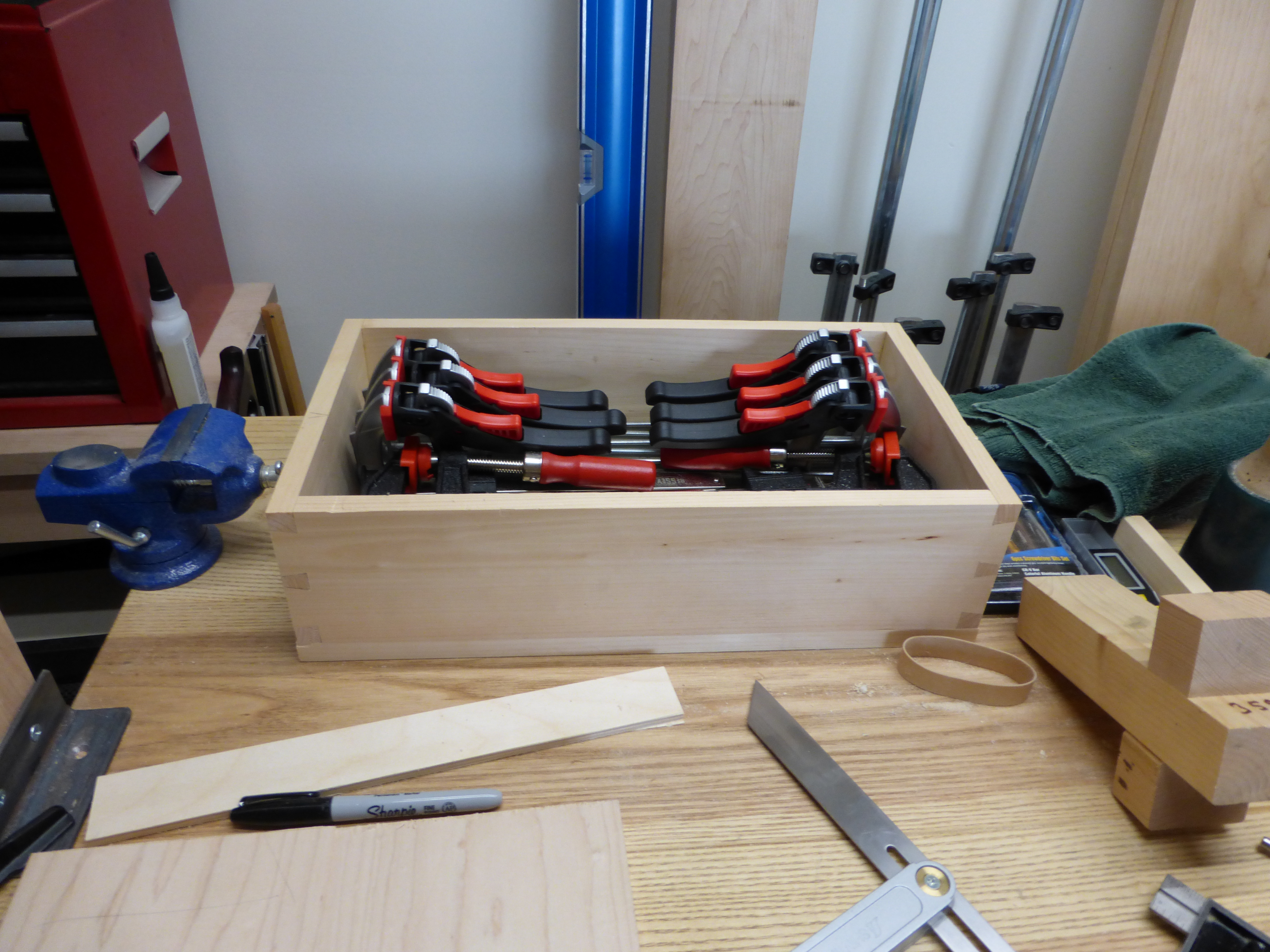
In prep for the medium-size wooden tool chest project, which I plan to knock out starting next week, I’ve been practicing my dovetails.  Some benchtop tool storage was far overdue, so I took the liberty of knocking together a few dovetailed boxes.

P1000140

Some “every day clamp” storage.  Don’t laugh at the bulk on my sharpening angle guide.  It’s super wieldy.  

And a "benchtop miscellany" tray (which will eventually be a benchtop chisel tray.

And a “benchtop miscellany” tray (which was specifically built to be a benchtop chisel tray for my eventual full-size workbench).

I don’t own a plow plane, so in each case, the bottom is simply glued and nailed to the tray frame (wire brads, until my cut nails arrive in the mail).  Don’t give into the hype: a heavy stone and a flat surface is sometimes all the clamp you need.

A heavy stone and a flat surface: sometimes all the clamp you need.

The lip is so the tray can be spring-clamped to my worktable top.  I’ll rip it off at some point and re-purpose the tray.

I’ve found the pre-sized, 1/4″ birch plywood you can buy at big box craft stores (e.g., Michael’s) is perfect for drawer bottoms.  Off the shelf, it has much less warp than a full 5′ x 5′ sheet from the lumber yard.  Plus, the inevitable offcuts make great battens and holdfast cushions.

There is also a 12.5″ x 18″ x 4″ box (corner detail seen below) that might actually end up being a drawer for something.  I’ve been experimenting with different pin sizes and techniques for hogging out waste (I’m back to the coping saw method) and they are the tightest I’ve ever cut dovetails thus far.

P1000137

Practice makes better.

Even if I opt for the rabbeted and nailed version of the tool chest, I’m glad to have gotten the dovetailing practice.  In addition, each of the boards used in these boxes was 100% hand-prepared.  No thickness planer for once.

Happy Bastille Day everyone!

JPG

Aescetic Aesthetic

Among my favorite movies is Peter Jackson’s Lord of the Rings trilogy. On the special features, there is a discussion of the design for the Elvish armor and weaponry, where the conceptual artists were trying to communicate an elegant simplicity that would permit Elvish designs to cease evolving. I have a similar approach to furniture design.

wpid-20150701_191413.jpg

Still need to thickness, glue up and attach the top.

Clean lines, attractive proportions and functional appointments.  That’s my design style.

JPG

P.S.  I know I’ve been sparse on posts, lately.  It’s been a tough couple weeks, and I hope to get back to more regular posting soon.  Thank you for bearing with me.

—-Bite

I first heard the term in the sailing context. “Boat-bite”: the bruises, cuts and pinches endured in the ordinary course of being out on the water.

I (voluntarily) don’t sail anymore, but a new “—–bite” has taken over my life. “Shop-bite”: the nicks, cuts and  pinches endured in the ordinary course of being in the woodworking shop.

Woodworking is inherently dangerous. Sharp blades and bare skin do not mix well. Nor do flying chips and unprotected eyeballs.  Handtool woodworking employs far fewer spinning blades of death than machine-based methods. Chips just don’t fly out from the chisel with the same velocity as from the  plunge router. But the risks are similar and injuries can and will happen.

I am fortunate to have never had a serious injury in the shop. My worst injury was slicing off the tip of my middle finger with a marking knife, just shy of the nail (it grew back). But I suffer from shop-bite regularly.

My usual injuries all relate to hand planing. I have a fairly loose grip on the knob, so I will often lose a chunk of skin on my palm or a finger between the work and the toe of the plane when starting a pass. And I still blister a bit during long stock preparation sessions.

I have a strictly-enforced ” sharps get put away when not in use” policy in my shop, so I’ve managed to significantly reduce edge-based injuries. I will still nick myself with a marking knife occasionally, but my finger-slicing incident scared me into great care when marking. To the extent I can, I mark at the start of a session, while my limbs are fresh.

“Shop-bite” is unavoidable, but with care and respect for the tools, serious injuries can be avoided.

JPG

Tangible Progress

Every now and again, I can feel myself leveling up at something.  Today was one of those days, when I cut what I consider to be the best-fitting joint I’ve ever cut.

wpid-20150530_112737.jpg

This angled-leg side table project is turning out quite well.

The feeling of a hand-cut joint coming together tightly and snugly is such a rush of accomplishment.  Mistakes are often made in the shop, but when everything works right, that’s what keeps me coming back.

JPG

Knot very Clear

The other morning, for 10 mins or so while I was waiting for a pair of pants to dry, I broke out the miter box and cut some boards to rough length for a couple different upcoming projects. The task at hand – digging through the pile of off-cut pine siding to find boards with clear sections of sufficient length – was a success. I now have knot-free boards aplenty, and the knotty off-off-cuts will become firewood for my brother.

wpid-20150515_203113.jpg

Perfectly burnable waste.

It got me thinking, though: what’s wrong with knots? I get it: dead knots and the holes they leave behind are a pain. But with live knots, aside from a bit of extra plane iron wear, what is the real impact, especially on the strength or stability of a board? Not much, and yet I obsess about clear stock. Everyone knows trees have knots, so what am I trying to hide?

Sometimes, though, I actually choose boards at the lumber yard specifically for their knots. A large live knot can have its own beauty, and a few small (stable) dead knots can add a rustic contrast to an otherwise modern piece.

Like everything else in woodworking, it’s a balance. Knotty wood is fine for some pieces and not for others. Knowing the difference is much more art than science.

JPG

The Immediacy of Pencil and Ruler

I commute to work, which means I spend a significant portion of each weekday on the train (up to 2.5 hours in the aggregate). Before I started woodworking, most of my train time was spent reading documents and catching up on emails.  Now, I try to bang out a new blog post (like this one) or put pencil to paper for a new furniture design whenever I can.

A while back, I started keeping a black composition notebook – like the ones for middle school creative writing class – with graph paper (instead of ruled) for my designs.  I’ve tinkered with Sketch-Up and other computer-aided design software before, but I keep coming back to the immediacy of pencil and ruler on graph paper.  That way, I transcribe the idea before the inspiration fades.

wpid-20150512_104012.jpg

The fastest design program of all!

Each design gets dated and in truth few actually get built. But it’s nice to have a tangible record of the varying levels of woodworking inspiration that hit me.  Each page is a snapshot of my small-space woodworking journey, telling the story of how my sensibilities and style have evolved over the past few years.  I may never get around to making most of these pieces, but that’s okay.  Many of my favorite or best (often not the same thing) designs are amalgamations of past ideas, gleaned from old sketches and made fresh.

A few plans are further refined before going into a binder I glibly refer to as my “portfolio”.  These designs I truly intend to revisit and execute one day.  When I free-build a piece of which I am particularly proud, I will reverse engineer a design to also include my portfolio.  In this way, I have for myself a neat repository of my best and favorite pieces.

JPG