woodworking in an apartment

What am I Ashamed of?

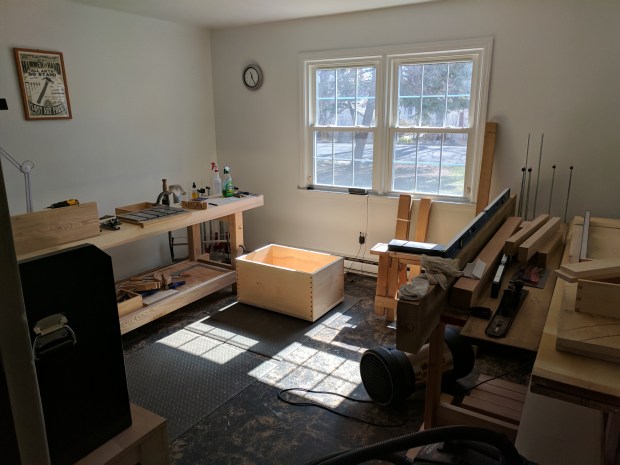
I’ve been building another chest and it’s coming along pretty well.  Overall dimensions are 30.25″ long x 20″ wide x 15.25″ high.  The inside dimensions are 28″ long x 18″ wide x 14.5″ deep.  Sound familiar?

wp-1488766823255.jpg

This one has rabbets and nails, not dovetails.

Several people have asked me what I’ve been building lately and every time I’ve said “a blanket chest”.  But is it?  It could easily be a tool chest.  I’m not sure it’s not a tool chest.

There are rabbets and nails at the corners, and there would be regardless of what the chest will hold.

wp-1488768898794.jpg

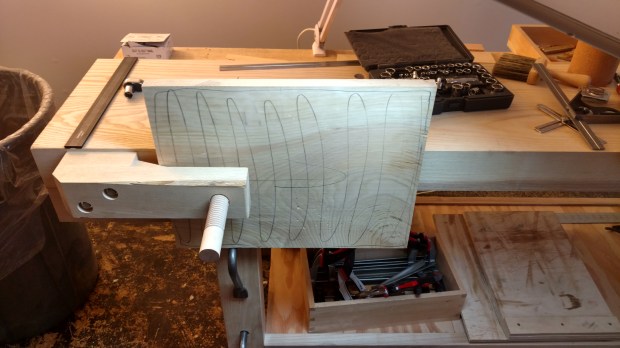
Sawn and split by hand, like always.

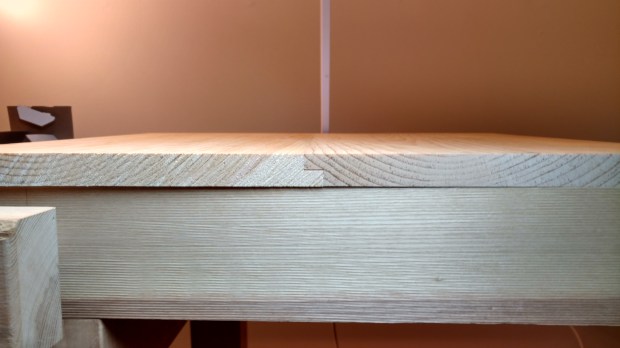
There are shiplaps for the floorboards, cut with my shop-made fillister plane.

wp-1488766830932.jpg

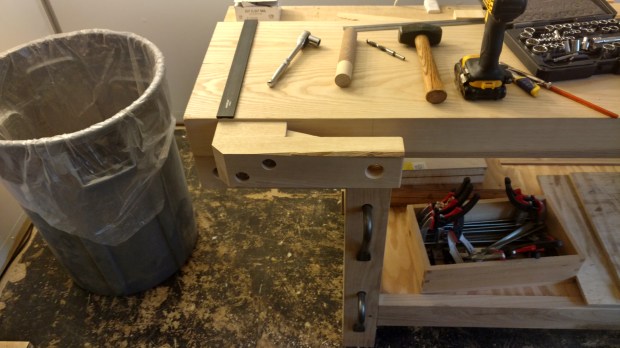
The toothed texture on the edge of the benchstop is very grippy.

And the chest will be painted, whether or not it holds hand planes or doilies.  So what’s the difference?  I think a tool chest has a proper skirt and dust seal, which isn’t necessary on a blanket chest.  The lids may differ a bit as well.

But maybe, just maybe, there isn’t any real difference other than in my mind.  I think I’m just ashamed that rather than build the furniture I need (like some more plant stands or a cat jungle gym for River), I’m building yet another chest.  But I like building chests and I’ve had these boards for over a year.

And who knows, it might really be a blanket chest this time.

JPG

Something Borrowed, Something Blue

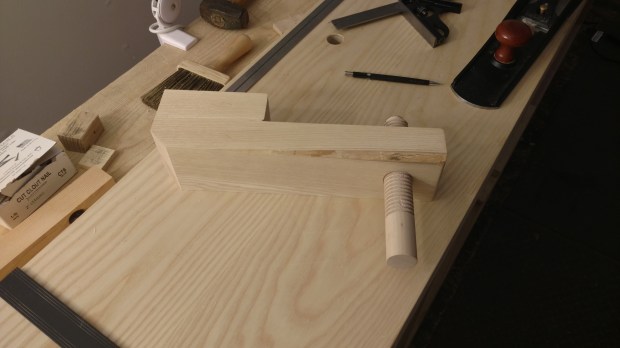
If you follow me on Twitter, you’ve probably already seen the finished crochet.  I’m very pleased with how it came out.  The screw holds like crazy and the EWP wedge doesn’t seem redundant.  But if I could do it again, I’d screw the wedge in from the outside.  I’ll have to remove the crochet to replace the wedge.

wp-1487514576999.jpg

Still no screw handle.

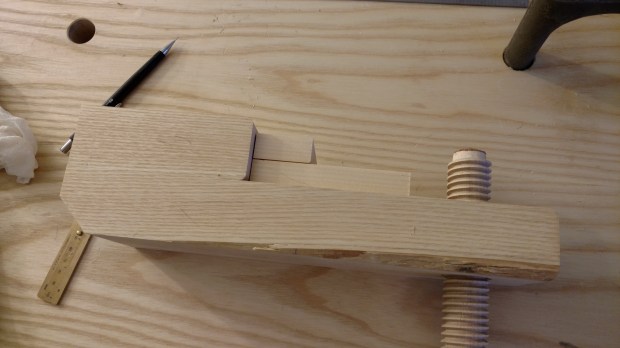
I struggled a bit with the placement of the crochet relative to the rest of the bench.  I finally settled on centering the screw over the leg, so the screw functions an awful lot like a shoulder vise.  Holdfasts in the leg, at 9 1/2″, 16″ and 22.5″ below the benchtop, respectively, support the work.

wp-1487514586965.jpg

I used 6″ 3/8 lag screws, and I think I burnt out my cordless drill in the process.

I did not incorporate a sliding deadman into this bench and I’m starting to think I should have.  I could retrofit one or make a moving deadman that locates on dog holes in the lower stretcher.  But I have another, more elegant solution in mind.  I need to do some patent research first.

wp-1487514596980.jpg

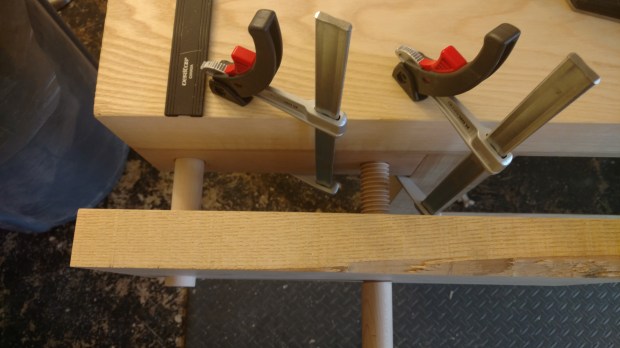
As of right now, I’d need a clamp to keep the right side from sagging.

All in all, I’m calling this one a win. It works.  I didn’t waste any materials.  And it didn’t take that long to throw together.

Now to make that screw handle.

JPG

That was Easy!

So it only took about an hour to knock together the bulk of the new crochet.

wp-1487073168749.jpg

Still haven’t made that screw hub.

Before I bolt it to the benchtop, however, I’d like to test a theory.  Crochets without screws work via a wedging action.  Even though mine has a screw, I’d still like to test out a wedge.  So I’m making a softwood insert.

wp-1487160599148.jpg

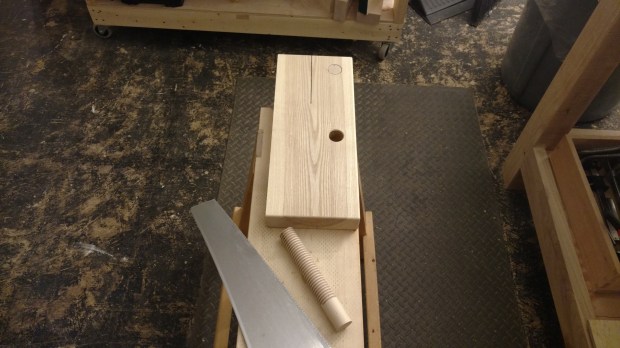
This is not the actual insert, but you get the idea.

I’ll likely just nail the wedge in place.  If it works, great.  If not, I’ll pry it out.  And when it wears out, I’ll pry it out and replace it.  And wear out, it will, because it’s Eastern White Pine, a species I picked over Douglas Fir because it won’t mar the work.

Does any of this sound crazy?  It’s starting to feel crazy.

JPG

DIY Bench Dogs

The dog holes on my workbench are 1″, to accommodate my Crucible Tool Holdfast, which I love more and more each day.  Well, except the legs, which use 3/4″ dog holes to accommodate my Gramercy Tools Holdfasts.  I love these holdfasts as well, but they have been relegated to deadman duty.  So when it came to time to get 1″ bench dogs, I had two choices: (i) drop $100+ on four metal dogs or (ii) spend $6 on an oak dowel and follow the instructions.  My woodworking budget for the week was already spent on quartersawn 8/4 white oak, so DIY bench dogs won out.  Three only took about half an hour to make, and most of that was sanding to fit.  I’ll add the bullet catches when they arrive this week.

wp-1487514561179.jpg

I used a bevel gauge to ensure the angle is exactly 2 degrees (not really).

Like any good project, I bloodied myself a bit making these.  60 grit sandpaper is basically sharp pebbles glued to a piece of paper, and my left thumb now looks like a miniature Freddy Krueger came after me.

Like I always say, if you don’t bleed for (on?) the project, it’s not real woodworking.

JPG

Getting on with it

Having admitted defeat, it only took me a little while to literally and figuratively pick up the pieces.  After salvaging the wooden peg on the failed face vise for use as another wooden screw, I had a choice: put the jaw aside for a rainy day, or use it right away.  Well, you know what they say: nothing gets the blood flowing like hand-ripping American hard woods of greater than 2″ thickness.

wp-1486953236768.jpg

Or, whatever.

I ended up with a board that is 3.25″ wide, 18.25″ long and 2″ thick.  A single pass through the thicknesser to clean up the saw cut and all that’s left is to cross cut it and glue it up.

wp-1486953240490.jpg

I’ll figure something out for the board with the holes.

What am I making, you ask?  I’m making that crochet, with the wooden screw.  Like I should have the first time before wasting five hours on a face vise that doesn’t hold.

wp-1486953243633.jpg

So far I’m at about 30 minutes, including the ripping.

All that’s left to do (after easing the corners) is drill and tap the hole in the beam and pre-drill for the lag bolts which will mount it to the face of the benchtop.

I’ve got a surprise planned for the hub on the wooden screw.  Much more understated than the last time.

But that will have to wait for now.

JPG

Glamour Shots

Does anyone remember glamour shots?  Those airbrushed-to-all-hell personal photos that could make anyone look good?  They were like the Barbara Walters interview of photos.  I’m sure they still exist, because human vanity still exists.

I ask for a very specific reason (and the title of this post is not arbitrary).  I finished the front vise on my new workbench.  And it’s beautiful.

wp-1486908580900.jpg

Soft focus and natural light only.

Aesthetically, it’s everything it’s supposed to be.  The lines are clean, the color match on the jaw and hub are fantastic, and the walnut handle offers a nice contrast.  And look how perfectly it cinches down to the benchtop!

wp-1486908584315.jpg

There is even a bit of wain to give it a rustic look.

But looks aren’t everything.  Truth is: the vise doesn’t work very well.  There is too much play in the maple guide peg, so the vice wracks in all directions.  It works okay with wide stock that can sit on the screw and the peg while I work an edge, but it’s useless for cinching narrow pieces at the top of the jaw.  It also works okay as a crochet for very wide stock that extends below the bottom of the law, but the maple peg wedges itself in the guide hole (like a holdfast) and it’s a pain to free up.

Could I find a metal collar to tighten the guide hole, or otherwise fiddle with it some more, and make the vise work better?  Probably.  Will I?  No.  It’s a sunk cost at this point.  I can re-purpose the jaw for something else and there is nothing wrong with the screw (although I would bet the hub gets trimmed down before it sees use again).  There’s a reason the vise nut is attached to the bench with only hide glue.

One of the hardest things in woodworking, and in life generally, is admitting failure and moving on.  My attempt at a completely wooden front vise has failed.

My heat gun and I are moving on.

JPG

New Face Vise

The one thing I’ve been without since I switched away from my Milkman’s Workbench is a true face vise.  A Moxon Vise is great for dovetailing and tenons, but it’s no good for everyday edge planing.  And while I prefer the tactile feedback of edge planing against a planing stop, it’s not feasible all the time.  I had planned on a simple crochet for my new workbench, but I remembered my threading kit and I figured I’d go for something a bit more elaborate.  Even if it is just a glorified crochet.

wp-1486305729234.jpg

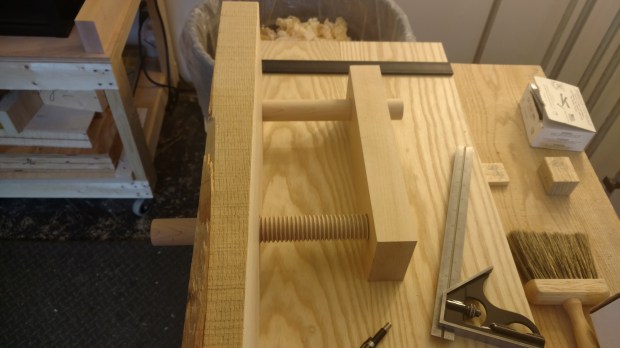
Not yet completed, but you get the idea.

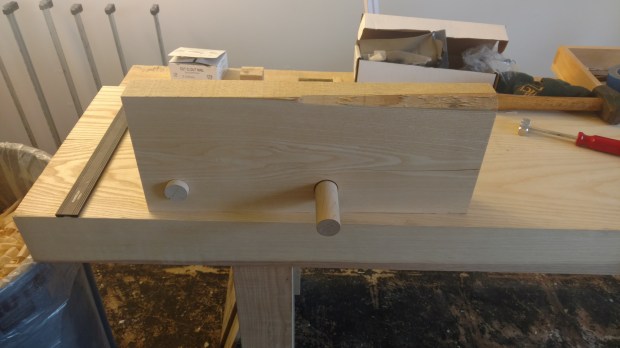
My face vise consists of four main parts: (i) an 8/4 maple nut, bored with one threaded hole and one clean hole; (ii) a 14″ long wooden screw, threaded from a 1.25″ hard maple dowel with a Beall Tool Company threading kit, which grabs the threaded hole; (iii) an 12″ long, 1.25″ hard maple dowel (unthreaded), which acts as a parallel guide in the clean hole in the nut; and (iv) an 8/4 ash jaw, bored with two clean holes, at 18.25″ overall.  The vise works on the same principle as a shoulder vise: the clean dowel, which is glued into the jaw, keeps the jaw from spinning freely while the screw clamps down.

wp-1486305706064.jpg

One, two, three, four.

Or, rather, it will work once I add the hub to the screw.  I don’t have a lathe, so I’m not sure yet what the hub will look like yet.  Part of me wants to make a simple octagonal hub (not unlike a Lake Erie Tool Works Moxon Vise).  Another part of me wants to go whole hog and make a circular hub with a garter and a handle passing through it (like a proper twin screw face vise).  You guys know me pretty well and can probably guess which way I’ll go.

wp-1486305723130.jpg

I’ve been saving this piece of ash for a proverbial rainy day.

Aside from the hub, the other process I haven’t worked out yet is how to attach it to the bench.  My strong inclination is to hide glue the nut to the underside (flush to the edge of the benchtop) and reinforce it with some angle iron.  I may one day replace this with a proper twin screw face vise, and I like the idea of being able to remove the nut without damaging it.  And there is still some assembly to do (I don’t have any epoxy, right now).

All of that will have to wait, though.  There is an American Football game to watch.

JPG


Putting On a Brave Face

It only took me a week to ruin my new workbench.  I’m trying to put on a brave face, but it’s no use.   I can’t even look myself in the mirror, I’m so ashamed.  I drilled the first holdfast hole in the bench, and it’s not plumb.  And it’s the hole farthest to the left.  The one for mortising over the leg.  I’ve got woe.

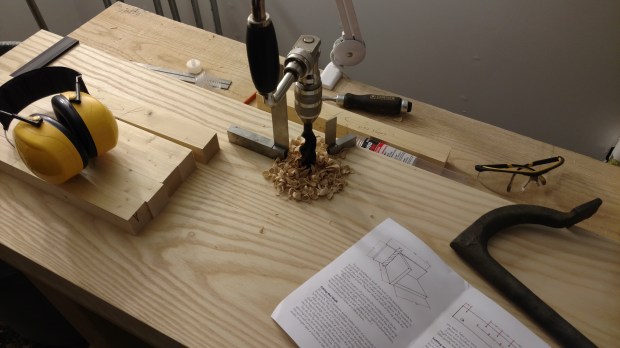
It’s entirely my fault, too.  Instead of reading the directions for my Crucible Holdfast, I chucked the recommended 1″ WoodOwl augur bit in a modern, three-jawed hand brace.  I was blown away by how easily the WoodOwl powered through the wood.  So much that I lost focus and canted the hole back to front.  I’d be lying if I said it wasn’t over 2° off plumb back to front (although negligibly canted left to right).

The directions recommend a corded drill and jig to keep the bit plumb.  Corded (I think) because (in my experience) the wobble of a brace and bit always results in an overlarge hole as it reams itself with every sweep of the brace.  Jig because it’s difficult to keep a bit that large from going out of plumb, no matter how little wobble you impart.  I utilized neither.

wp-1485572514951.jpg

I took a vanity picture during the process and can see the cant in the shot.

The result: the holdfast only holds in a 60° sweep pointed at the front edge of the bench.  It won’t grab at all when oriented lengthwise, either left or right.  It could be worse, but it still makes me sad.

I’m debating plugging the hole with epoxy and a 1″ oak dowel (plus an ash dutchman on the show face).  But that feels like a temper tantrum.  I should probably sleep on it another day.

JPG

Of Proverbial Lights and Tunnels

On every new project, there is a point at which the project passes from being a pile of boards to an actual thing.  It’s a magic moment that never fails to make me smile.  I hit one of those points over the weekend, while transferring the length measurements for one of the long stretchers on my new workbench.

wp-1484601303390.jpg

For the first time, to me anyway, it looks like an actual workbench.

There is one more long stretcher to surface, and four mortises and tenons to cut, but with any luck, the bench will be functional by Sunday.  Then it will just be a question of boring holes in the legs (for Gramercy Holdfasts) and in the benchtop (for bench dogs and my Crucible Tools Holdfast).

I’ve never made my own bench dogs before, so I’ll be excited to try it out.

JPG


Impulse Shopping

Every time I stop by the lumberyard, I find something I didn’t know I was looking for. This time, it was 31 linear feet of 12 x 5/4 eastern white pine, with very few knots. On sale. So for about US$60, I now have the boards for a carcase, lid and probably floor of an English floor chest. If I ever get around to building one. And if not, I’m sure I’ll find some other use.

My car smells amazing, right now.

I went to the lumber yard, btw, for a scrap of quarter-sawn white oak (seen in the middle).

JPG