Author: The Apartment Woodworker

The Apartment Woodworker is a weekly blog with insights, projects and tips for making the most of woodworking with hand tools in confined spaces.

Small Victories

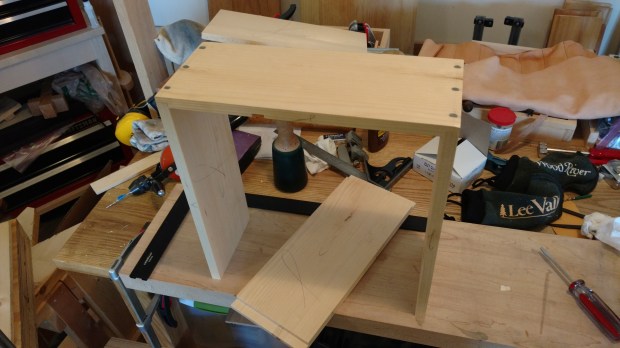
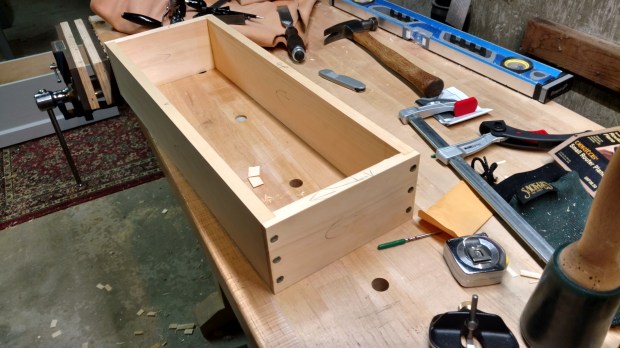
Sometimes I get a little impatient in my woodworking.  Case in point, a random dovetailed pine box I had always meant to section off for nail and screw storage.  Instead, it’s become a rabbeted and nailed box.

wp-1470433702381.jpg

Most of one, anyway.

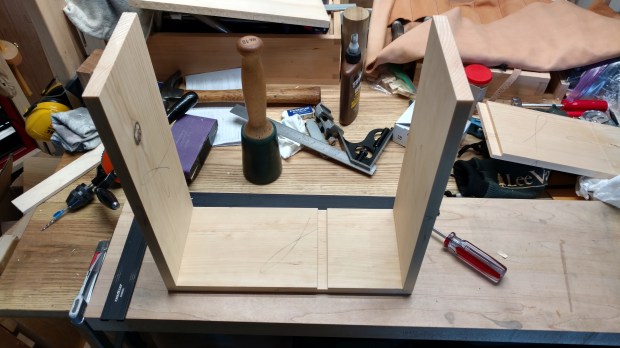
But I started nailing it together before I cut the rabbets for the dividers.  Lucky for me, I had a stroke of genius: make a single shelf (for a drawer) and hang it on the wall.  And what do you know, it not only fits console game cases on the bottom shelf, but the drawer will be large enough to hold console game controllers.

wp-1470433706050.jpg

Amazing how that works out.

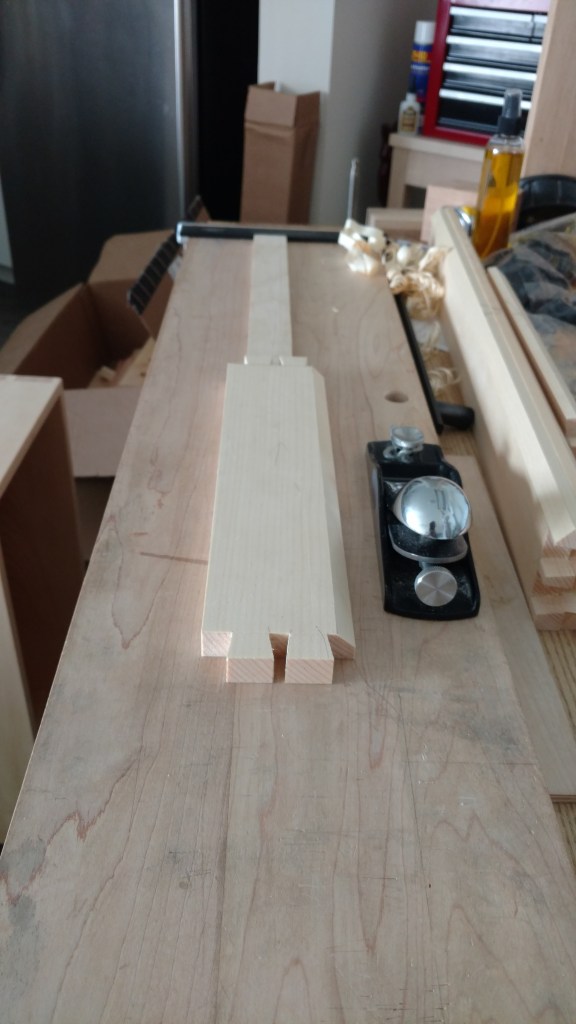
Since I had already nailed on two sides before I started cutting the rabbets, I couldn’t use a chisel other than in the vertical position.  My solution: use a block plane blade.  Surprisingly, the joint fits tight enough for the application.

I will post some pictures of the finished project when I’m done.

JPG

Travel Tool Chest Retrospective

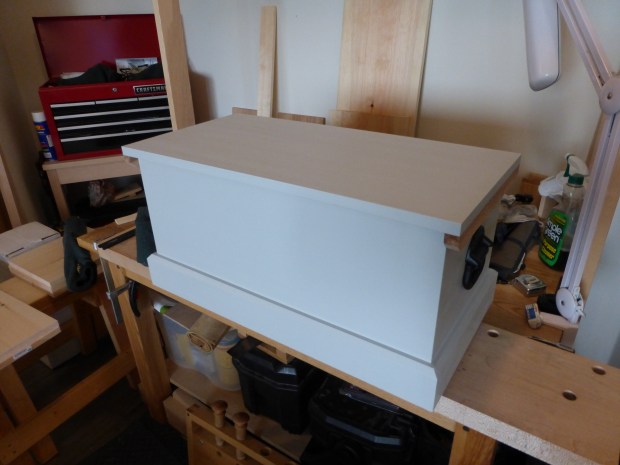
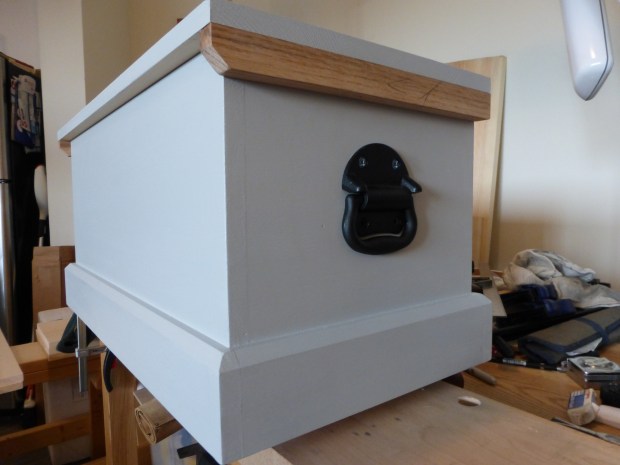
The final coat of paint went onto the travel tool chests over the weekend.  Net net: I am very pleased.

P1000320

The color is still a little blue for my taste.

For the first time in a long time, I have nothing bad to say about a completed project.  At least nothing bad to say about the design or the concept.  There is always something bad to say about my execution of the aforesaid (the lid is not on straight, yet again).  So rather than do my usual pros and cons, I will talk about what I’ve learned on this project.

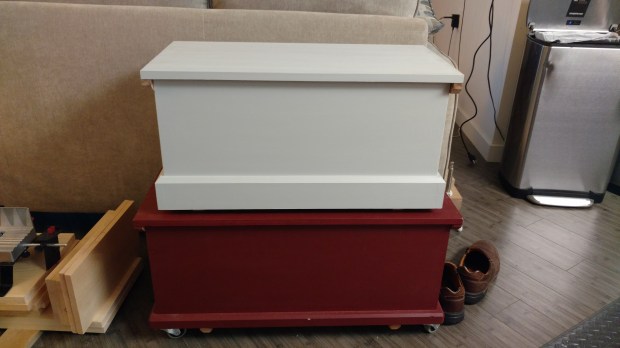
  • Geometry is a thing.  The dimensional difference between this tool chest and the original traveling tool tote is ostensibly minimal.  Compared to its predecessor, it’s 4″ shorter in length, barely 2″ less in width and essentially the same height.  But when we’re talking inches cubed, that adds up to a lot.  This thing is truly portable.  Filled to the gills, it’s not even a chore to carry around.  I’ve finally made a replacement for my nylon tool box.
wp-1469578005282.jpg

Doesn’t look like much, but do the math and you’ll see.

  • A wide skirt is a better skirt.  On my original traveling tool tote, the skirt was only 1.5″ wide.  With the 45″ chamfer, it’s basically all corners and has gotten beat to hell. In version 2.0, the skirt is over 3″ wide: quite a bit of surface area for deflecting blows.  Unlike its forebear, the skirt is a bit out of proportion to the lid.  But this is because I had meant to do a full dust deal (of approximately equal width to the skirt) and just got lazy in the end.
P1000321

Durability > all.

  • No casters for small tool chests.  The casters have worked out really well on version 1.0 and I meant to add casters to this project.  But I didn’t.  For two reasons, really.  The first is the spacing on the die-forged, headed nails holding on the floor boards precludes the caster feet from seating properly at the corners.  The second reason doesn’t really matter, does it?  At least it won’t roll around the trunk of car in use.
P1000322

These will have to do.

  • Grey is not for tool chests.  Or is it gray?  I don’t know anymore.  At least it’s easily distinguishable from my other tool chests.
P1000329

That’s the “sliding” tray to the bottom right.  It has about 1″ of travel.

I plan to immediately make another one of these (and this time, paint it black).  More on that later, though.

JPG

Basic Project: Rabbeted/Nailed Box

Today’s basic project, a rabbeted and nailed box, is a sub-project of my new traveling tool chest.  Although I alternate between through dovetails and rabbets/nails for carcases, when it comes to sliding trays for tool chests, I always go for rabbets/nails.  It’s faster, holds almost as well, and is a great way to practice hand-cut rabbets.  The project can be scaled to any length, width or depth you desire .  The tray pictured below is 8″ wide and 22 1/2″ long by 4 1/4″ high (4″ not including the tray bottom).

wp-1468700479189.jpg

Easy as can be.

moving fillister plane (with scoring spur) is great for cutting cross-grain rabbets, but I still enjoy the hell out of hand-splitting rabbets.  Hand-splitting is definitely not faster than using a dedicated plane, although in my experience it can be more accurate both in terms of depth and shoulder squareness.

Materials and tools for this project were as follows:

Materials:

Carcase ends:  4″ x 8″ x 5/8″ eastern white pine
Carcase sides: 4″ x 22 1/8″ x 5/8 eastern white pine
Tray Bottom: 8″ x 22 1/4″ x 14″ red oak
Carcase Nails: Dictum 40mm door nails
Bottom Nails: Tremont “Fine Finish” cut nails
Hide Glue

Tools:

Wide chisel (I used 1″)
Chisel Mallet
Marking Gauge
Router Plane (if you don’t have one, you can just use a chisel)
Dividers (a ruler and awl will work just as well)
Hammer

After you’ve prepared the pine stock for the carcase, first set your marking gauge to the thickness of the carcase sides.  Mark the inside face and the sides of each end board.  Then reset your marking gauge to exactly half the thickness of the end boards and finish laying out the rabbets on the end boards.  Chop the rabbets with the wide chisel, same as when making a dado.

wp-1468700445889.jpg

Until your relief cut gets down to the line.

Next, split the rabbets, just like you would with a tenon.  Keep an eye out for grain direction and don’t be afraid to leave a little bit of waste to paring away later.

wp-1468701582418.jpg

It’s nice to use a metal vise once in a while.

When you are reasonably close to your gauge lines, break out the router plane.  I recently upgraded my small router plane, which I unboxed just for this operation.  Set the depth to your gauge line and pare the rabbets to depth.  A chisel works just as well if you don’t have a router plane: just go slowly and pay attention to your depth lines.

wp-1468700465785.jpg

An huge upgrade from my previous small router plane.

At this point, you should have all four rabbets cut and parallel, resulting in two identical end boards.  If for any reason the shoulder lines on the two boards aren’t identical, pare down the shoulders until they are.  Cut the carcass sides to length, square up the ends and get ready to glue and nail the boards together.  Pre-drill your nail holes and assemble the carcass with glue and the 40mm door nails.  Three at each corner should do the trick.
wp-1468700473804.jpg

Level the seams if you have to (I did).

Once the glue is set, it’s time to attach the tray bottom.  A bit of glue on one carcase side will control the direction of expansion and contraction.  Assuming the tray carcase is leveled, clamp the tray bottom and tray together (against the bench) and pre-drill your nail holes every 3-4 inches or so.  I like headless cut nails for tray bottoms, so be sure the nail is oriented with the grain to prevent splitting.

wp-1468702301504.jpg

Add nails along all four sides.

The ends of a tray bottom in a tool chest extend slightly beyond the ends of the carcase (for clearance when sliding), but you should at least level the bottom to the sides of the carcase.  If you are making a stand-alone tray, skip the overhang and flush the bottom perfectly to the carcase on all four sides.

And there you go.  As Christopher Schwarz would say, when done right nails are not “second class joinery”.  They can be beautiful and functional.  And very quick to throw together (the above box took less than 3 hours, including stock preparation by hand).

JPG


You Get What You Pay For

The roll of cheap adhesive-backed cork purchased online for the floor of the new traveling tool tote was exactly that: cheap.  The adhesive was not uniformly sticky and kept curling up in places.  My slightly less permanent solution: foam drawer liner and spray adhesive.  This should provide comparable, if less durable, cushioning.

wp-1467978455547.jpg

And it fits much better than the cork did.

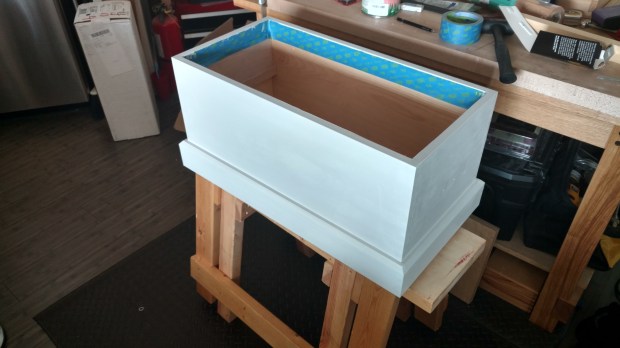
Speaking of durability, I started painting the chest with Seagull Grey milk paint.  The first coat looked a bit too blue for my taste, but has since flattened out in the second coat.  I don’t do a ton of finishing, but I’ve done two things differently this time around.

First, I did not attach the handles to the chest prior to painting, although I did punch alignment holes.  The traveling tool tote was in service before it even got painted and I did not remove the handles for that operation.  I will assume this was part laziness and part fear the screws would lose their bite when reinstalled.  Painting is so much easier without curvy obstructions, it turns out.

wp-1467978451801.jpg

See?  Baby blueish.  

Second, I am painting the carcase before the lid is attached (or even made, for that matter).  See the above comment re: obstructions.  I also took the time to properly mask the inside of the lid, which did not stop me from dripping a big glob of paint on the inside of the chest.  That little accident cleaned up okay with multi-surface furniture cleaner and will hopefully be hidden by the tools in the wall rack.

I have neither the oak for the tray bottom nor the pine for the tray sides on hand.  Those will be acquired over the weekend (from the home center and from my stash at my parents’ house, respectively).  The width of the tray is still TBD.

And there is still that pesky lid to make.

JPG

Looking the Part

The new traveling tool chest is finally starting to look like one.  The dovetailed lower skirt went on Sunday morning, and I couldn’t be more pleased with the result.

wp-1467581470950.jpg

Another size comparison with Version 1.0.

Unlike my other tool chest iterations, the chamfer on the lower skirt was cut by hand with a block plane.  The result is a steeper angle (about 55 degrees) than I would otherwise get with a trim router.  It was good practice at planing both right and left handed and the clean-up was oh-so-easy.

wp-1467554212662.jpg

A simple operation, really.

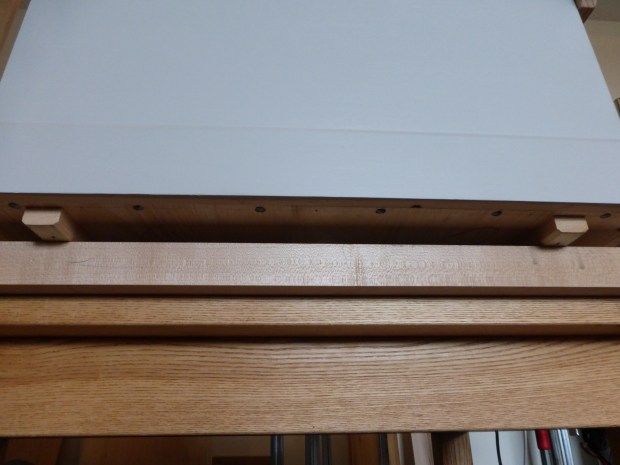
When gluing the skirt onto the carcase, there was a sizable gap along the front skirt, more than I was comfortable filling with just paint.  So in addition to a significant clamping setup, I made a goberge to help close the gap from the inside.  Marginal improvement, but not enough for my aesthetic taste.  The front of the chest is now the rear (and wee-keh wehr-sah).

wp-1467554216193.jpg

So much clamping going on here.

Problem is, the more a goberge is required, the more it tends to dent the inside of the carcase.  With some heat from an iron and a wet cloth, though, the impressions should spring out well enough for a tool chest.  On a furniture piece, I would probably add some padding to the corners (adhesive-backed cork, probably) to lessen the marring.

With the lower skirt finished, next up is the lid.  The panel glue-up didn’t turn out as expected, so I’m going in a completely different direction: 3/4″ birch plywood.  That also means I’m skipping the full dust deal. Three oak battens, one in the front and two on the sides (dovetailed together) will be glued and screwed to the underside of the lid, keeping out the dust.  I have some lovely 3/4″ flat-sawn red oak that is mineralized along the rift-sawn edges and will be perfect for this operation.

Perfect enough to keep the natural wood color, I think.

JPG

Crippling Self-doubt

Woodworking has been a struggle, lately.  I’m at a point where I need my thickness planer to progress any further into several projects, and it’s just so far away.  The dovetailed carcase for the new traveling tool chest is filled to the brim with S2S versions of its remaining pieces (among other boards).   I just need to pass them through the magic lunchbox and get on with it.  That’s on the agenda for the holiday weekend, also.

wp-1467325903474.jpg

It’s slightly morbid, when you really think about it.

But I still wonder if I’m going about this all wrong.  The size of the new tool chest seems right, but do I really need a full dust seal around the lid?  Won’t oak battens work just fine?  But that would waste a couple board feet of quarter-sawn white pine.  I guess I can use it for french fitting dividers.

It goes on and on.  These types of questions gnaw at me constantly.  I’ve only been woodworking for about 4 years, less than three with hand tools.  What the hell do I know?

Then, every now and again, I get some reaffirmation.  On my new workbench, I organically came to the same conclusion as a previous craftsman, making the front left leg larger than the other three, allowing for a larger tenon at the joint that incurs the most stress.  And speaking of tool chests, a woodworker with credentials beyond my own seems to work out of a chest that looks an awful lot like my first attempt at a traveling tool chest.

wp-1467307705588.jpg

A size comparison.  Please ignore the soft backlight from the patio door.

I don’t crave the approval of others.  But I, like everyone else, need some confirmation once in a while that I’m not totally off base.  And that confirmation keeps the crippling self-doubt at bay for another week or two.

JPG

Apropos of Nothing

My name is James.  I am a hand-tool woodworker and this is my workbench.

wp-1467117629690.jpg

In all its glory.

I only mention it because I plan to finish the Stent Panel workbench over the holiday weekend, so this may be a last-ish hurrah for my beautiful little clamp-on slab.  It has performed quite admirably over the last year or so, and it deserves a retrospective of its own.

Made of Hard Maple, its overall dimensions are 48″ long x 9″ deep x 1.75″ thick.  The bench uses two Veritas aluminum planing stops (one of which functions also as a bench hook on the right side of the bench) for general workholding.  There is also a dog hole for a Grammercy Tools holdfast on the right side of the bench.  The whole thing clamps onto my sturdy dining table using angle iron and ordinary F-style clamps.  It’s finished in two coats of natural Danish Oil (Watco, obvi).

I always meant to add a crochet and peg system for working on edge grain.  Heck, I still might (using some brass shim stock for the pegs).  Most of my edge grain planing is done with free standing boards (for more tactile feedback), but anything that wouldn’t stand on its own gets clamped onto the front face with some F-style clamps.  That works okay, but it’s no replacement for a face vise or crochet system.

The slab has served me well and stayed very true over its life.  It’s planed to be flat when clamped down to the dining table, so if the slab finds new life (as the top of a child’s workbench, perhaps), it will need to be re-trued.

And, apropos of nothing, I bought River a climbing rig that hangs on the back of a door.  It’s pretty sweet, but it makes me want to build a better one myself.

wp-1467285410765.jpg

But it should be fine in the meantime.

Happy 4th of July, everyone.  Grill some meats and make some sawdust (not at the same time).

JPG

Why I Can’t Have Anything Nice

I’m pondering a new feature on http://www.theapartmentwoodworker.com. A weekly “Things I Learned This Week” segment. Cautionary tales for the small space woodworker.

This week’s entry: when driving nails into unsupported face grain, pre-drill as deep as you can.

For the new travel tool chest, I nailed on the rot strips (instead of screwing them on like I would normally). The nails (Tremont fine finish) are about 1/4″ shorter than the combined thickness of the rot strips and the floorboards, prior to setting. Wanting the nails to bite hard, I only pre-drilled the rot strips themselves and not the floorboards. Fine finish nails taper dramatically, so it should have worked.

image

And it looks fantastic from this angle.

What actually happened was each nail pushed fibers up and through the floorboards, splintering the face grain. Not a structural issue, but an annoying cosmetic blemish.

As a result, the tool chest floor is getting an adhesive-backed cork lining.  They say the sign of a good woodworker is not the absence of mistakes, but the ability to hide the mistakes made.

As an alternative to further pre-drilling, I may next time drive the rot strips first, before attaching the floorboards to the carcase. That should eliminate any unsupported fibers and give me the fastening power I’m after.

JPG

Traveling Tool Tote Retrospective

It’s been about a month since I finished the traveling tool tote.  I am very pleased with the result.  Even if I haven’t figured out how or where to attach a transom chain.

wp-1463092251778.jpg

I’m getting better at stuffing it, too.

I may be my own biggest critic, but there also are genuinely some things I don’t like about it.  In no particular order of importance, the good and the bad are as follows:

Size and Shape

  • The Good: the basic dimensions are nearly perfect for the tools it was designed to hold.  My panel saws fit inside lengthwise (in a till) and the well area comfortably holds a bevel-up jointer, a No. 4 smoothing plane, a large router plane, a block plane, a tool roll (chisels) and sharpening gear (diamond plates, saw file roll, etc).  The 4″ deep sliding tray has plenty of capacity for two backsaws (dovetail and carcass), marking and measuring tools and assorted odds and ends.  The simple rack on the back wall rounds out the basic storage setup, giving me everything I need for working away from the shop.  It’s heavy but portable, even fully-loaded (but by “portable”, I mean “I can move it from my apartment to my trunk by myself without herniating a disk”.
  • The Bad: the sliding tray itself is too wide. At just under 7″, it covers more than half of the well, making it difficult to reach tools that sit in the center of the floor.  I find myself removing the tray more often than not as I’m unloading.  A small complaint, but still something to address in the next version.  In addition, the simple rack, with its four spacers, will eventually be replaced with a solid rack of 1/2″ holes bored every 1 1/8″ on center (which I avoided this time around due to lack of drill press).

Construction

  • The Good: rabbets and nails are definitely easier to get right than dovetails.  Angling the nails a bit adds to the holding power and properly sizing the end grain makes for a strong joint.  Although not strictly necessary, I added a dovetailed lower skirt to keep everything cinched tightly and cover the end-grain on the floorboards.  And the lid, consisting of a pine panel and two oak battens nailed on, came together quickly and easily.
  • The Bad: rabbets and nails will never be as strong as dovetails.  In fact, trauma to the case during construction fractured one of the corner joints and even when re-glued and re-nailed, I felt it necessary to add corner brackets as reinforcement.  I will likely dovetail the next incarnation.  Also, the oak battens only hold the pine lid flat across the width and do not affect the slight bow across the length of the lid.

Hardware

  • The Good: the Lee Valley iron handles are comfortable and stout, being screwed through the pine sides and into the oak tray runners.  Both the Tremont cut nails (used for assembling the case and attaching the tray bottom) and Dictum die-forged nails (used for attaching the lid battens and assembling the tray sides) look nice and hold well.  I am still searching for a reasonably-priced transom chain for the lid.
  • The Bad:  the “no mortise” hinges are a pain to get straight.  Even after attaching all three to the case and transferring marks to the lid, I still put the lid on slightly crooked.  An extreme amount of fussing barely undid the damage, and I switched in regular butterfly hinges .  I also continue to struggle with slotted screws (hand-driven or not) to the point where it was preferable to glue in the panel saw till.

Conclusion

I may have overestimated the tools required for on-site work.  I don’t really need everything this tool chest is meant to hold (e.g., I haven’t once reached for a panel saw or my saw set).  As a result, the fully-loaded tool chest is very heavy; almost too heavy for casual travel.

The next incarnation will be smaller and lighter.  I’m testing out a 24″ x 12″ version (also made from home center 1×12 pine, but thicknessed down to 1/2″) that will be dovetailed at the corners.  In addition to experimenting with french-fitting the well storage, it will also swap out a sliding tray for a full-depth version that should be placed on the benchtop (like a mobile tool well).

And this might be a good excuse to splurge on that BT&C Hardware Store Saw, which I believe will fit the 23″ inside dimensions.

JPG

I’ve Said it Before

And I’ll say it again: I never know how big something will be until it’s knocked together.

wp-1465746129644.jpg

24″ wide x 12″ deep x 11″ tall, to be exact.

They may be a P.I.T.A. to store, but I’m always glad to have the band-clamps seen above.  The half-pins on the top front corners (i.e., the most visible corners) of the carcase don’t fit tightly to the tail board, so I’m cinching it all together as the glue dries.  Fingers crossed the glue holds long enough for me to drive a headless brad into each tail board to close up the gap permanently.

If that doesn’t work, Plan B is to use wood filler and paint the top rim.  I’m putting a proper dust seal on this chest, so there will be plenty of clearance for a couple coats of milk paint.  If this were a chest with a battened lid (like the traveling tool tote), as a matter of course the top rim would be painted to protect against the constantly slamming.

wp-1465762343142.jpg

Editor’s Note:  Success!

Next up: ripping bards for the lid and the skirts. And maybe making a saw till.  This is another travel-size tool chest, FYI.  Check out tomorrow’s post for more info.

JPG