Projects

Another One Down

I am officially over making footstools.

This is the last one, I swear.

This is the last one, I swear to Glob.

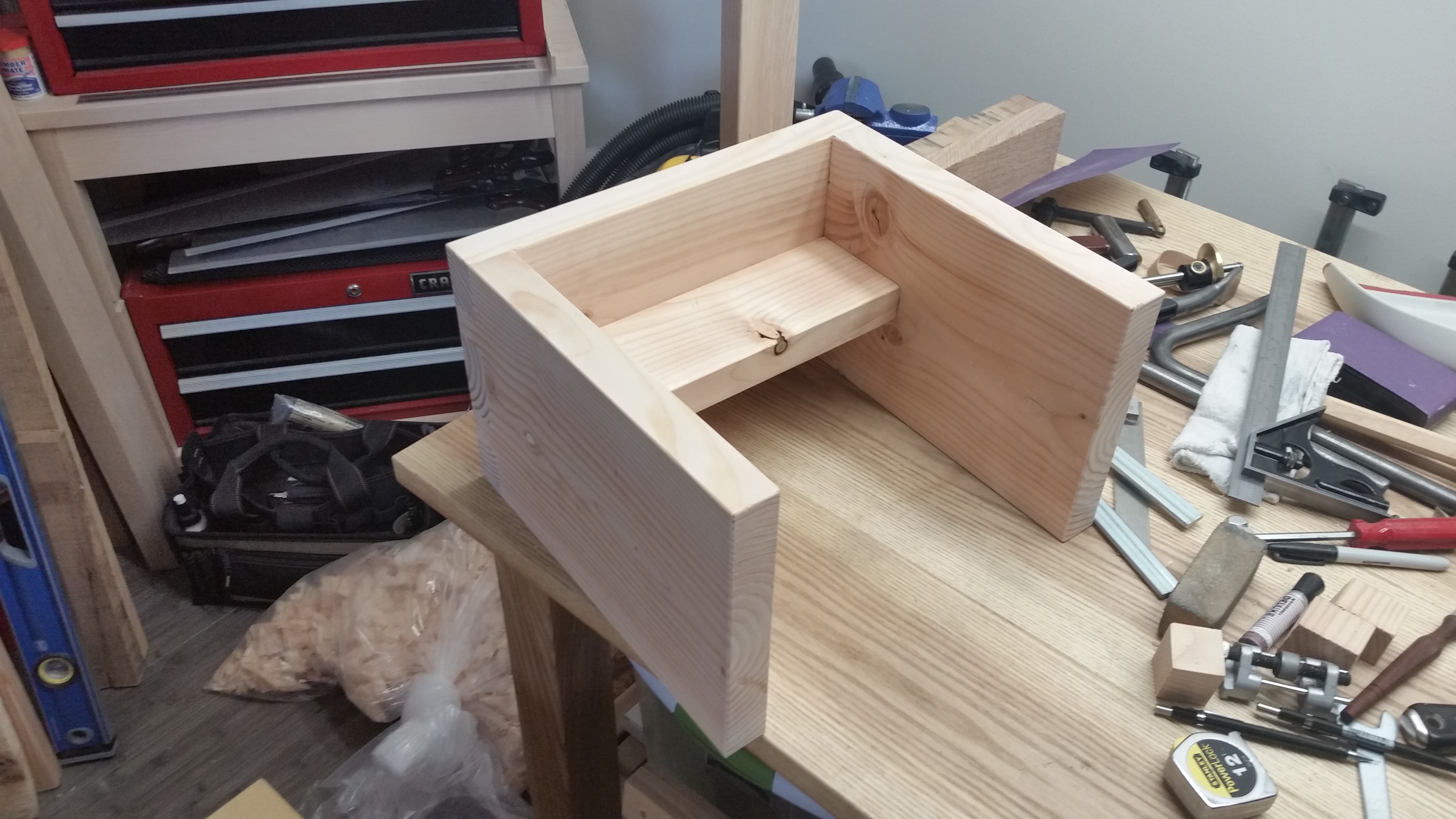
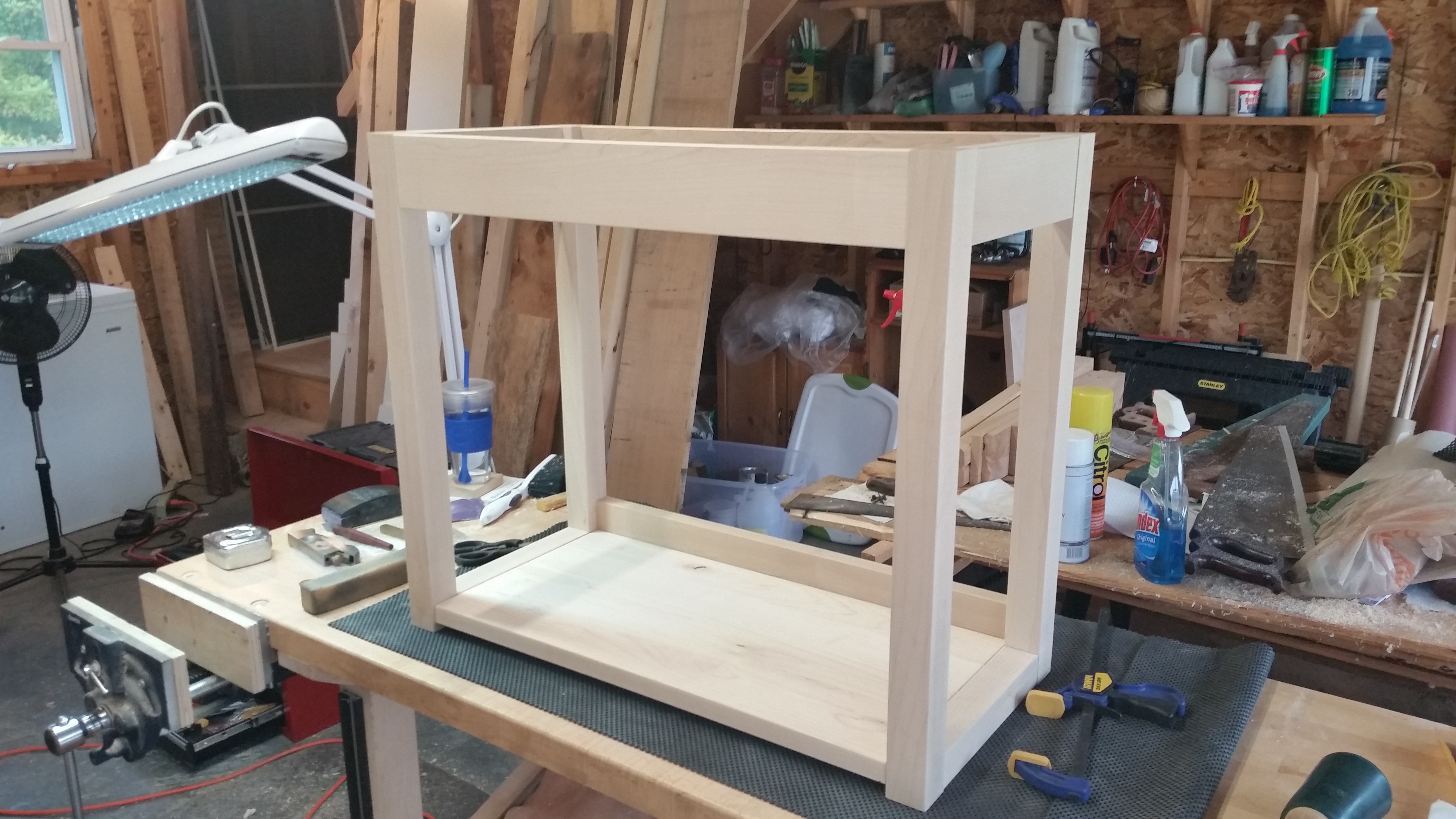
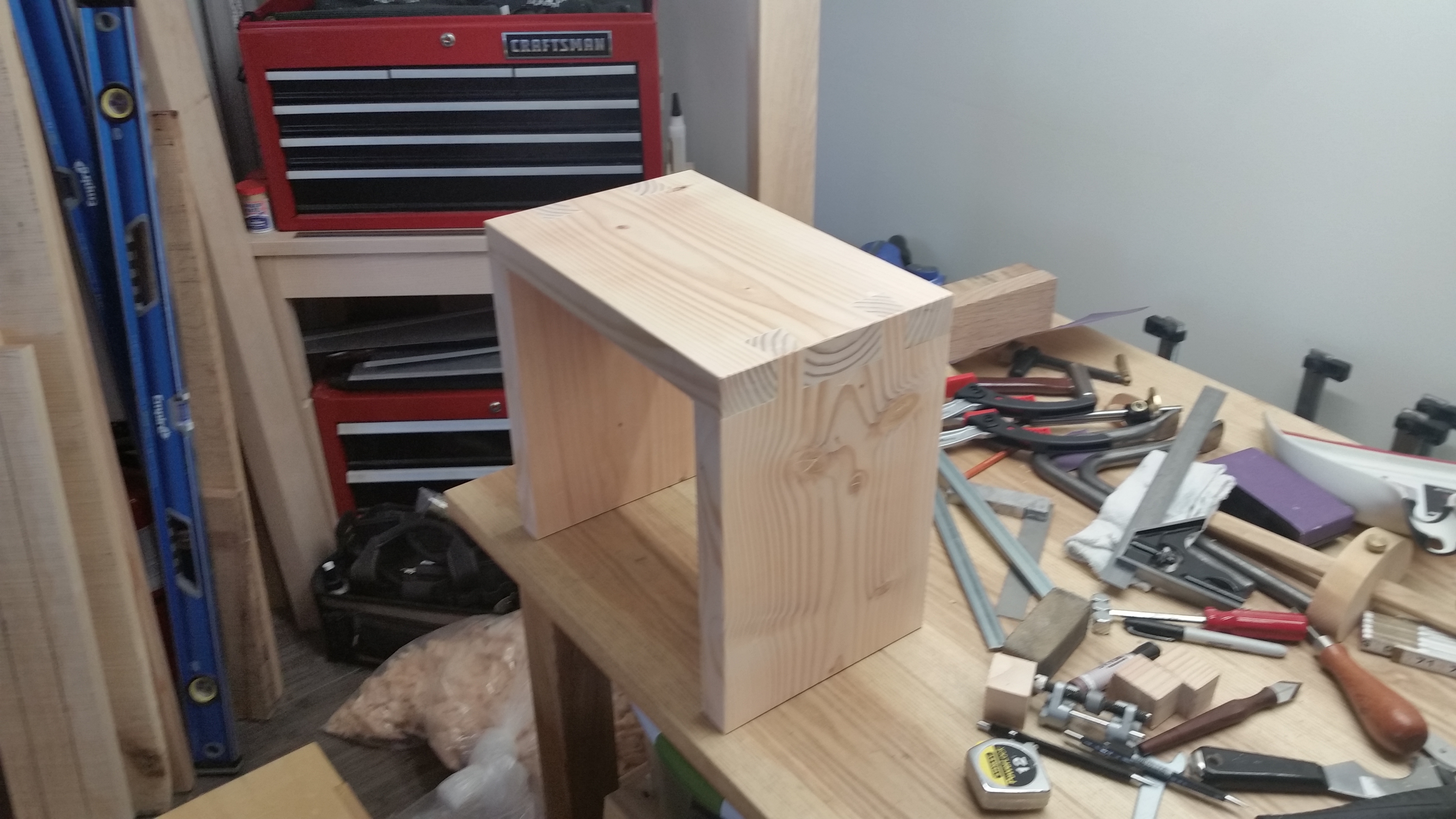
I finally got around to making the third of three footstools for my brother’s new house.  The first two footstools were for my niece and nephew.  This third one is for use in the kitchen.

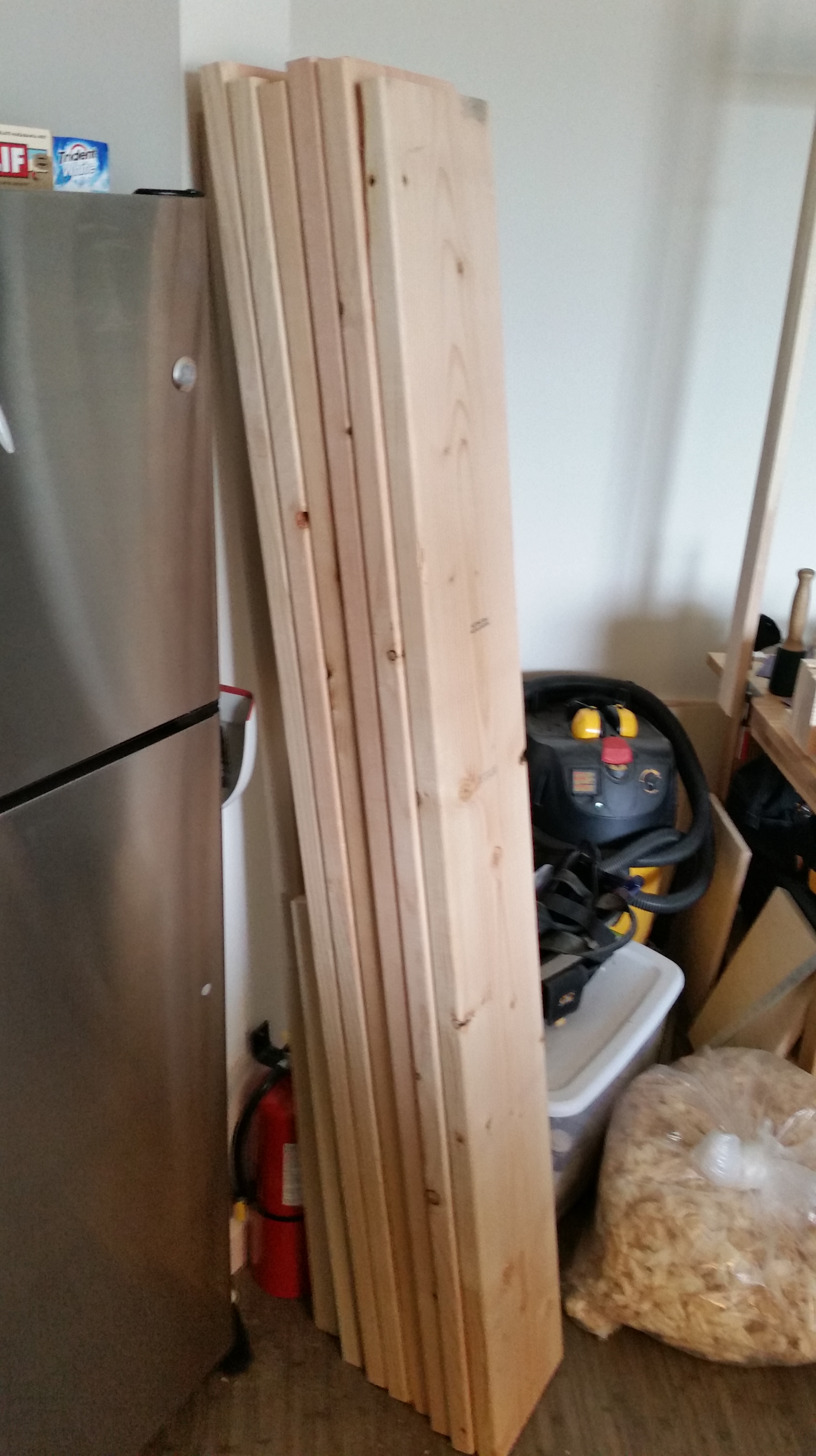
This is very clearly a utility piece.  Made from home center Douglas Fir 2×10 (leftover from the Planing Slab project), I opted to be super lazy and left the stock pretty close to original thickness and width (after some rough flattening, straightening and squaring).  I just realized that I forgot to mark the pieces to ensure continuous grain in the three main boards, but I imagine it will get a couple of coats of paint regardless.

I think that in hardwood, I would have been comfortable with just the two sides and the top.  But in something as soft as Douglas Fir, I opted for an additional cross-support, which connects to the sides via mortise and tenon.  I did not glue or otherwise attach the cross-support to the underside of the top to allow a tiny bit of flex.

Solid as a rock in softwood.

Solid as a rock in softwood.

Speaking of flex, one nice byproduct of using such a soft wood is that the entire piece has a bit of give throughout.  This means that any bit of twist or wobble the piece might have (due to an uneven floor or what have you) vanishes when the weight of a person is applied.

With this done, I am now done with footstools, forever.  Probably not forever, but certainly for a while.

JPG

Safe and Sound

I have been pouring over potential plant stand designs for several weeks and I finally settled on what I think will work. The final height of the pot should end up roughly the same as the temporary fix (see below), which has been a useful guide.  I haven’t nearly finished the build yet, but some of the stock (scrap hard maple) is at least surfaced and ready for final dimensioning and joinery.

In my continued quest to not turn The Apartment Woodworker into a “look at this awesome thing that I made with my awesome tools” kind of website, I would like merely to share the design specs and explain some of the choices.  I am certain the design will be refined further through the build process, but for now, I am satisfied with the aesthetic baseline.

Plant Stand - February 2015

Careful readers will note the ratio of each leg above and below the cross-member is almost exactly that of a lightsaber (or, if you’re boring, a katana).

First, the piece only has three legs. While there has been much going on lately in the world of three-legged furniture, I really just wanted some practice cutting angled tenons and chopping angled mortises. Much of what I design and build is square and true, which can get pretty boring. Plus, the splay and the angle of the legs will keep it stable and the tops of the legs will secure the pot laterally.

Second, the hub design was born from how to get the correct splay angle on the legs. I initially gravitated toward a lapped t-shape (seen top right), which would have reduced the number of individual pieces but required a compound angle on each tenon. Unfortunately, the piece will be weight-bearing, and that compound angle would not place the load on the legs parallel with the mortise and tenon. The hub design, though, allows for the in-line load distribution.  I can drawbore each leg assembly to the hub for an eternal joint, even with the additional complexity.

Finally, although the drawing doesn’t show it, I will probably shape the legs a bit as an excuse to put my new spokeshave (a very old Stanley with a very new blade) through it’s paces.

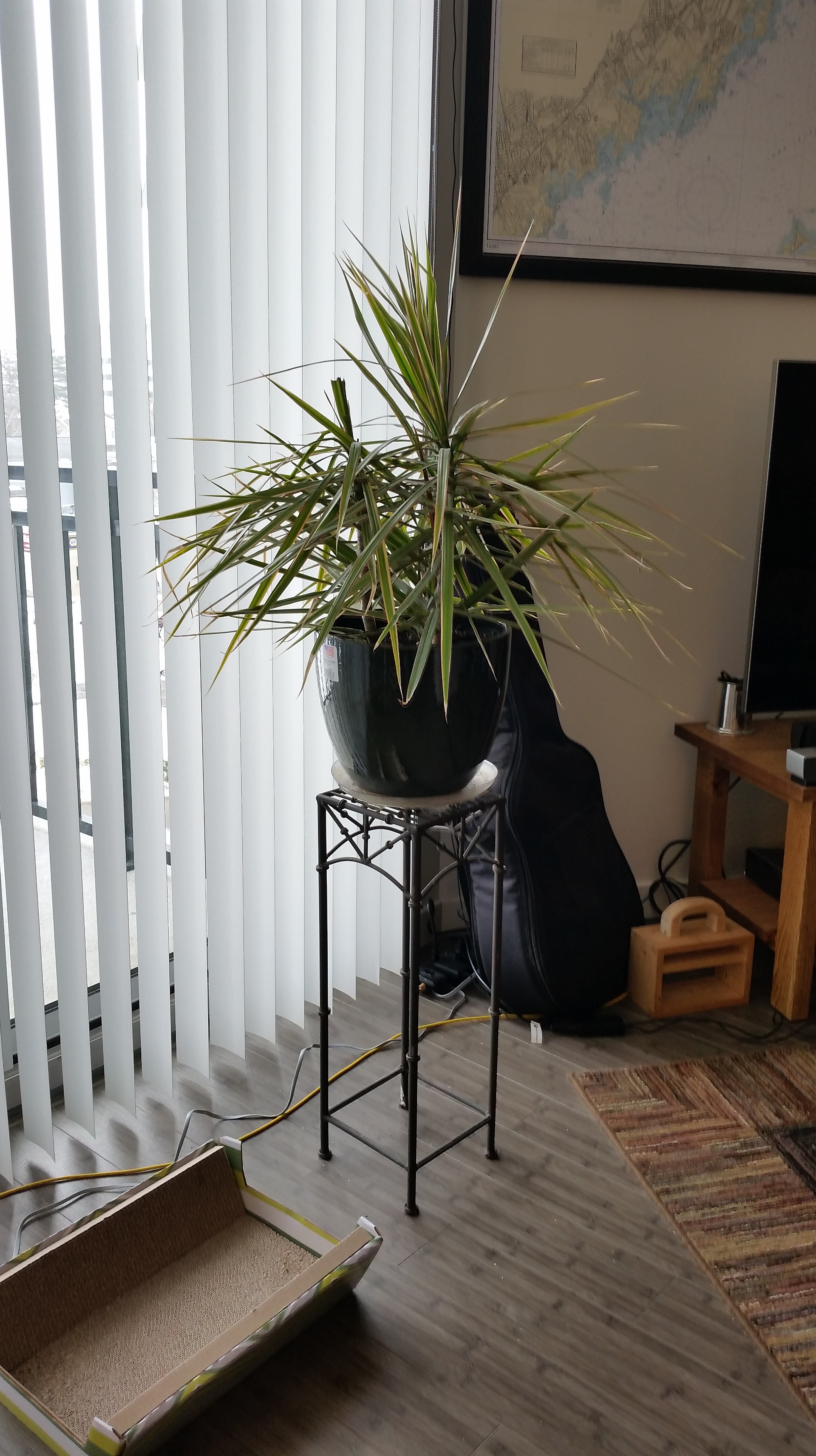
This is my current, temporary solution.

In case you are wondering, this is my current, temporary solution.  River ate the crown off the left stem, which was the impetus for this particular project.

Now I just have to build the thing. I’ll post pictures when it’s finished.

JPG

A Time to Revisit

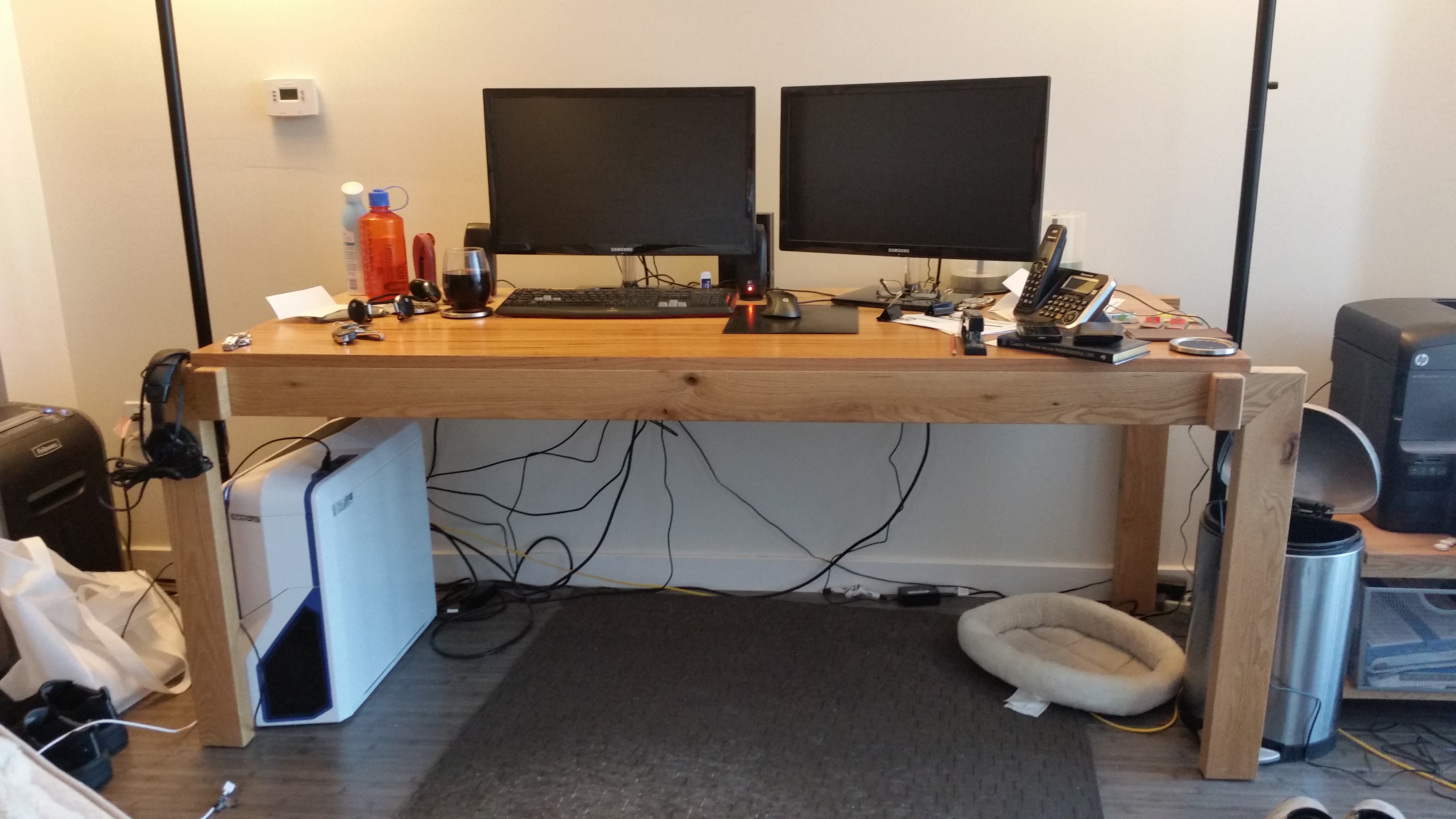
It’s been a long time coming, but I think I’m ready.  I’ve progressed sufficiently in my woodworking that it’s finally time to revisit my red oak desk.  I still love the design (mitered half lap joints continue to be a personal favorite) and I’m quite satisfied with the overall size and shape (which is why the revisit hasn’t been a high priority), even the joints were cut almost entirely with a plunge router.  I don’t even think I owned a tenon saw at that point.

wpid-20150222_155621.jpg

I’m very proud of the piece, despite being made entirely with power tools.

There is no real need to revisit the piece.  I just think I can do it so much better now, almost two years later.  And I’d love another crack at some of the design elements.

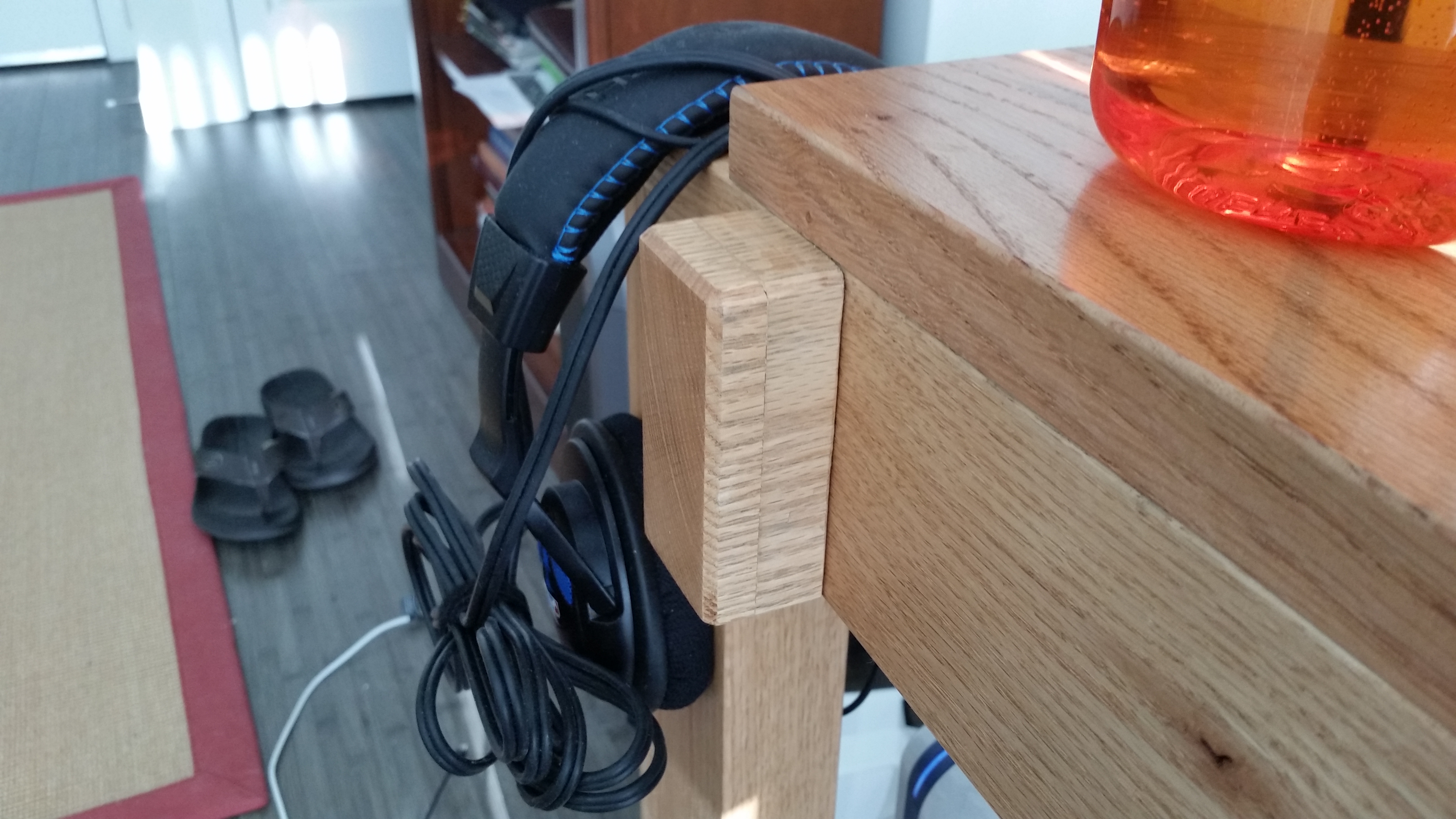
The biggest design change I think will be to thin out the frame pieces a bit, which are currently full-width red oak 2x4s.  3/4″ or so off the width will create a slightly more delicate feel (without any real compromise to strength).  I’d also like to tweak the shape and increase the size of the exposed ends of the cross-rails.  I’ve had to reinforce them once already and, although they are holding well, I worry that one day they’ll snap off again.  There are some execution-related flaws as well, but they are pretty well hidden from day to day view.

wpid-20150221_083449.jpg

I apparently used to not know a ton about grain matching.

The tabletop (which is quartersawn and well-jointed) is not permanently affixed and is in fine shape, so I’ll just reuse it as is.  Also, I have quite a bit of air-dried, rough-sawn red oak stock available, so I won’t need to salvage anything from the existing desk (meaning I can build the new frame at my leisure).  Plus, it will give me a chance to use the new planing slab.

wpid-20150222_162702.jpg

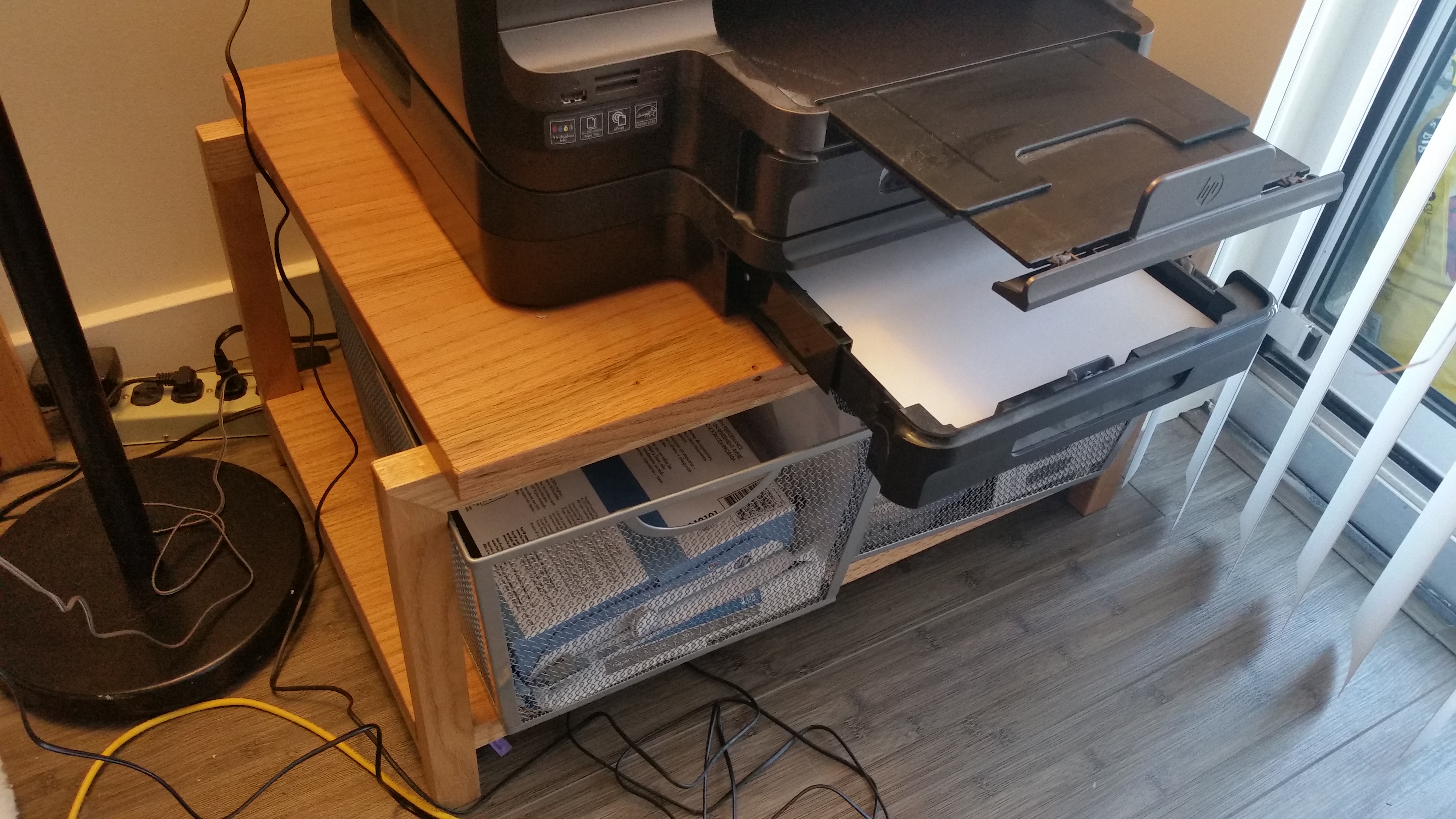
There is also a matching printer stand that fits two metal baskets on the bottom shelf (because I didn’t know how to make drawers back then).

There will be significant stock preparation involved, and I have other projects in the works already, so the desk revisit will likely take a while.  I’ve already sketched a few possible design tweaks, which I will share when I discuss the build.

JPG

What Now? (or, Planing Slab, Part 4)

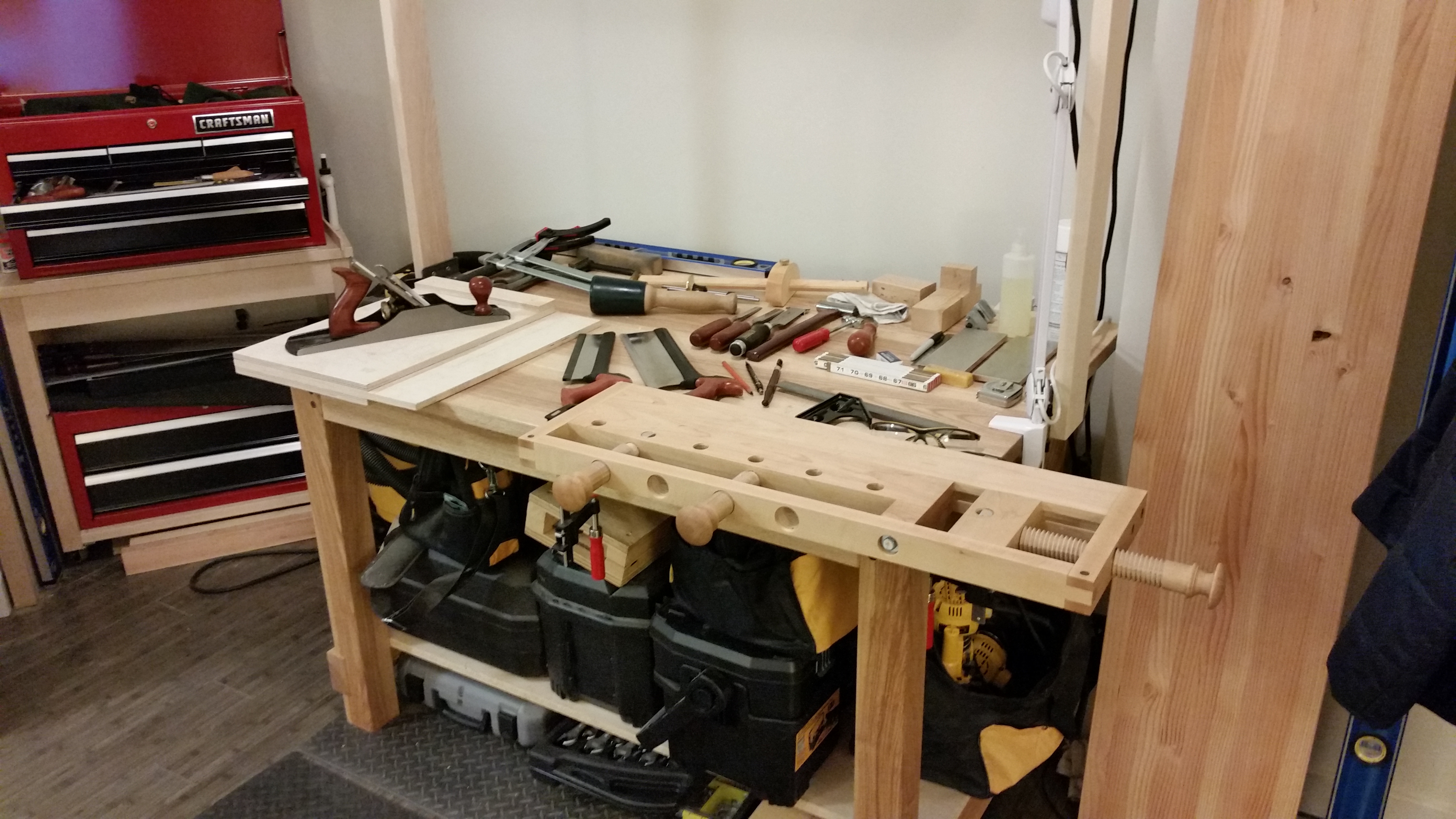
If you’ve been following the saga, you know I now had a relatively S4S planing slab.  All that remained was some final flattening/smoothing, installation of the Veritas inset vise and dog holes, and sealing with a coat or two of Danish Oil.

I never bothered flattening the slight bow on the front edge.  I just knocked down the splinters with some 220 grit sandpaper.

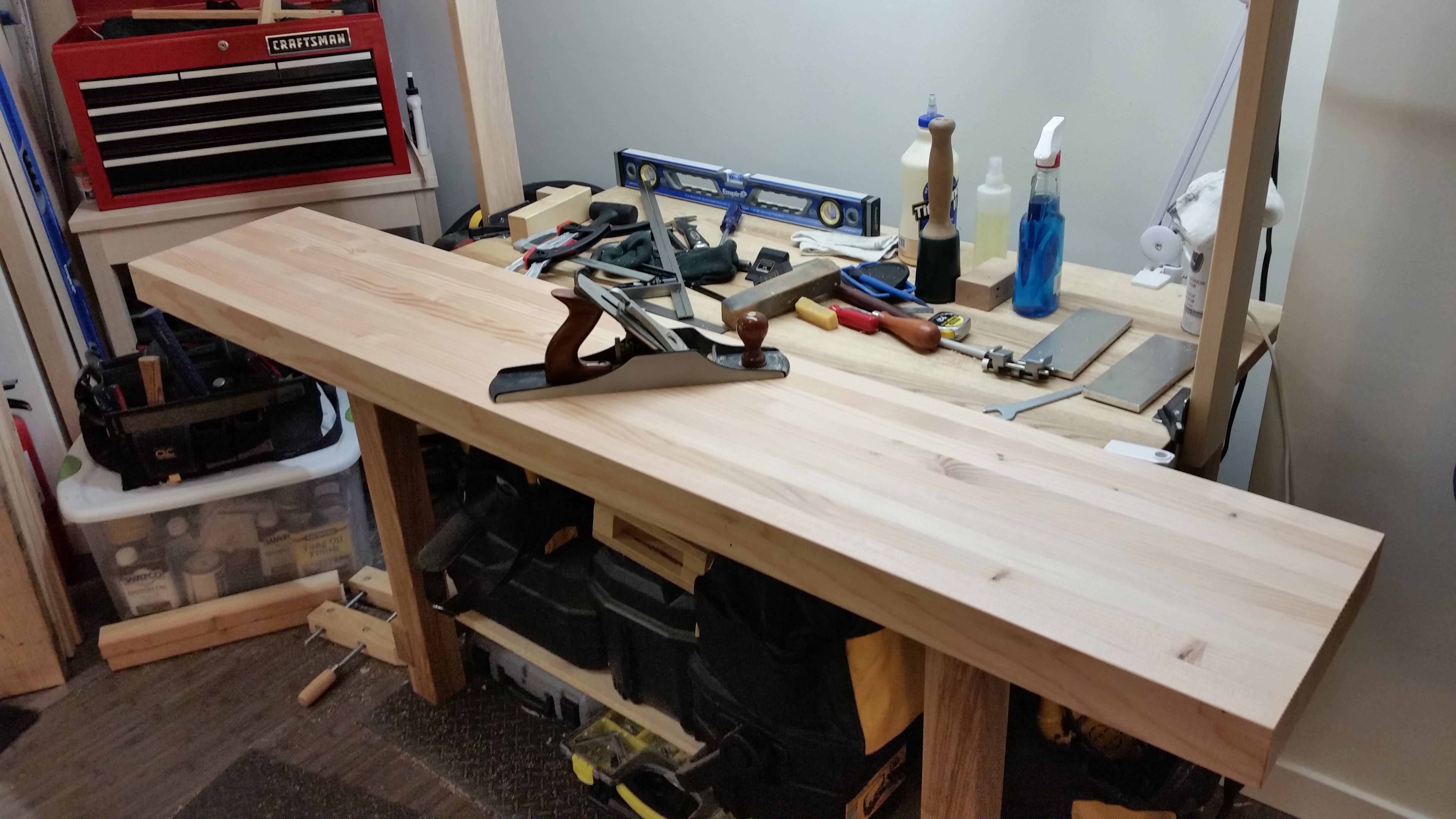
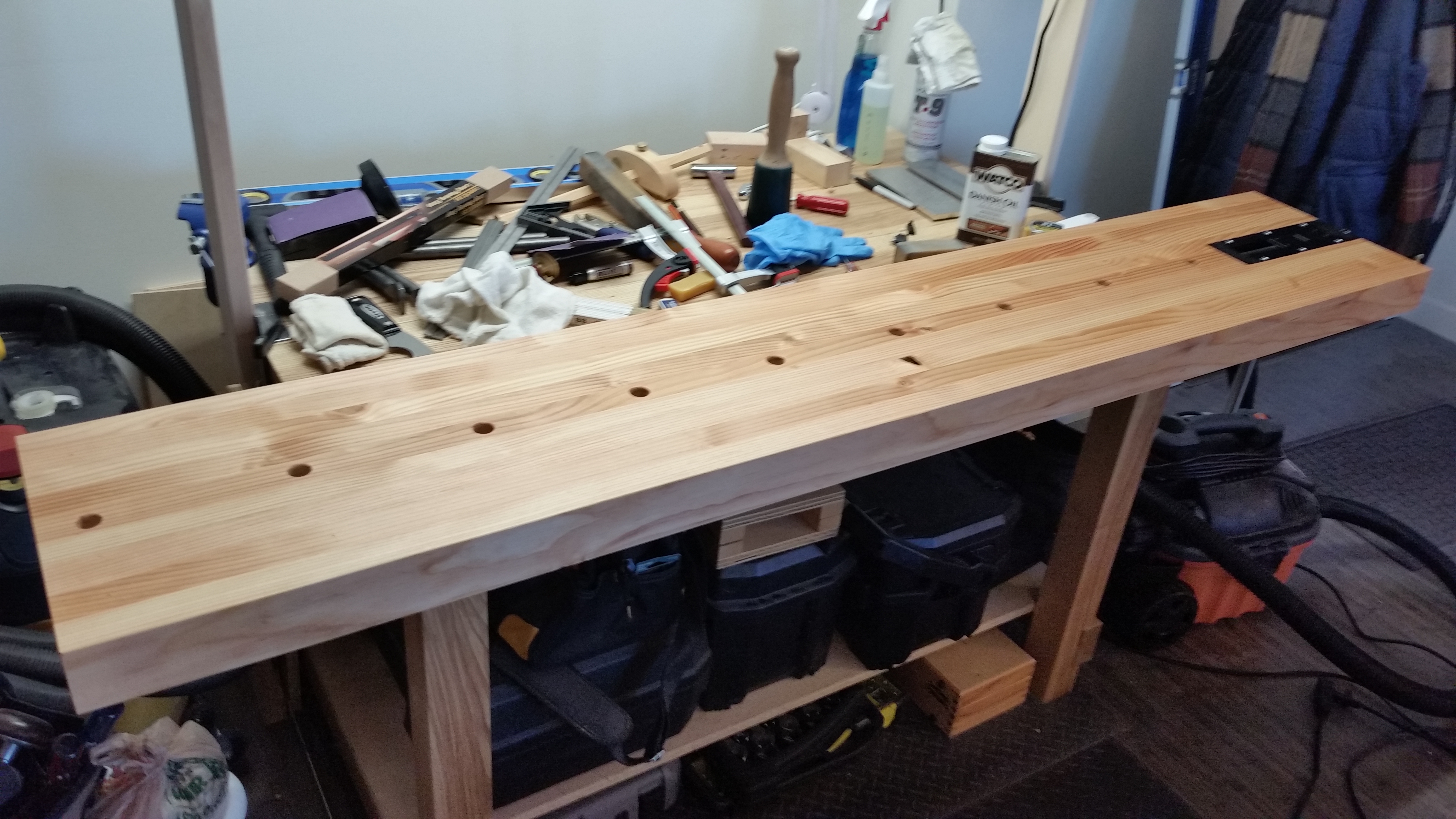
The final dimensions are a smidge under 72″ wide, 13″ deep and 2 3/4″ thick.

Truth be told, not a ton of final flattening was required after skip planing.  The back seven boards of the slab are perfectly flat along their length, and although there ended up being about 1/32″ of hollow along the entire length of the front two boards, there is no twist across the entire slab.  I made the executive decision (starring Kurt Russell) that the miniscule hollow wasn’t worth agonizing over.  Therefore, it was time to install the Veritas inset vise.  After much thought, I determined it would be best to install the vise centered over the width with a single strip of in line dog holes.  More dog holes could be bored as needed.

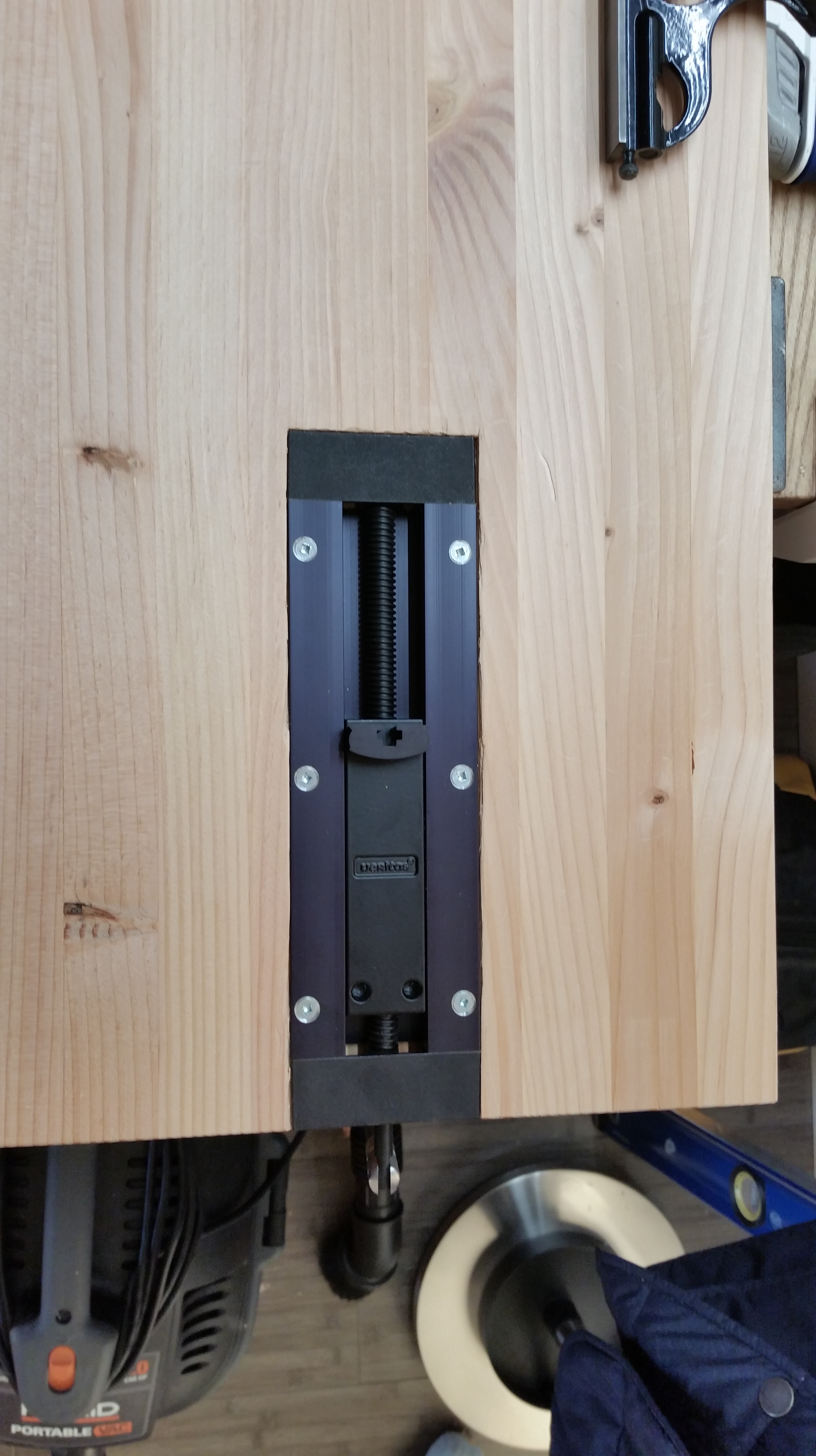
The inset vise requires a two-stepped recess, with the bulk of the vise sitting inside a 29/32″ deep recess and the wings (where the screws attach) sitting inside shallower, 1/8″ deep wing recesses.  I seriously considered using a power router at this point.  I could have (should have?) marked out the entire recess, hogged out most of the waste with a 1/2″ upcut spiral bit on a full size router and cleaned it up by hand with a chisel.  Instead, I did it all by hand.  After marking and carcass-sawing down the sides of the main recess, I hacked out the waste with my new Narex 1 1/4″ bench chisel and cleaned up the bottom with a large router plane.

This took way longer than it needed to.

This took way longer than it needed to, but it was good practice (I think?).

The good news was, once the main recess was cut, I could mark the wing recesses directly off the vise itself.  The bad news was, at 1/8″ deep and running with the grain, there was no completely clean way to remove the waste and leave crisp corners on the wing recesses (I opted for the large router plane, which did an adequate job, albeit slightly rough).  After a while, the vise was fully installed and, remarkably, the jaws are perfectly square to the back reference edge.
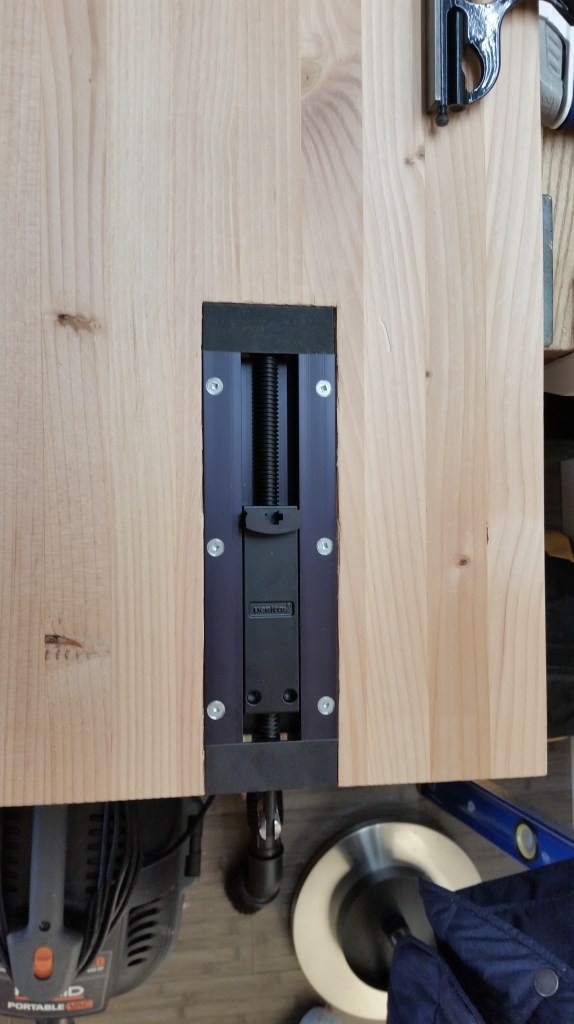
The lack of crisp corners will haunt me forever, or at least until I have to reflatten the board and recut the recess.

But the lack of perfectly crisp corners will haunt me forever (at least until I reflatten the slab and recut the recess).

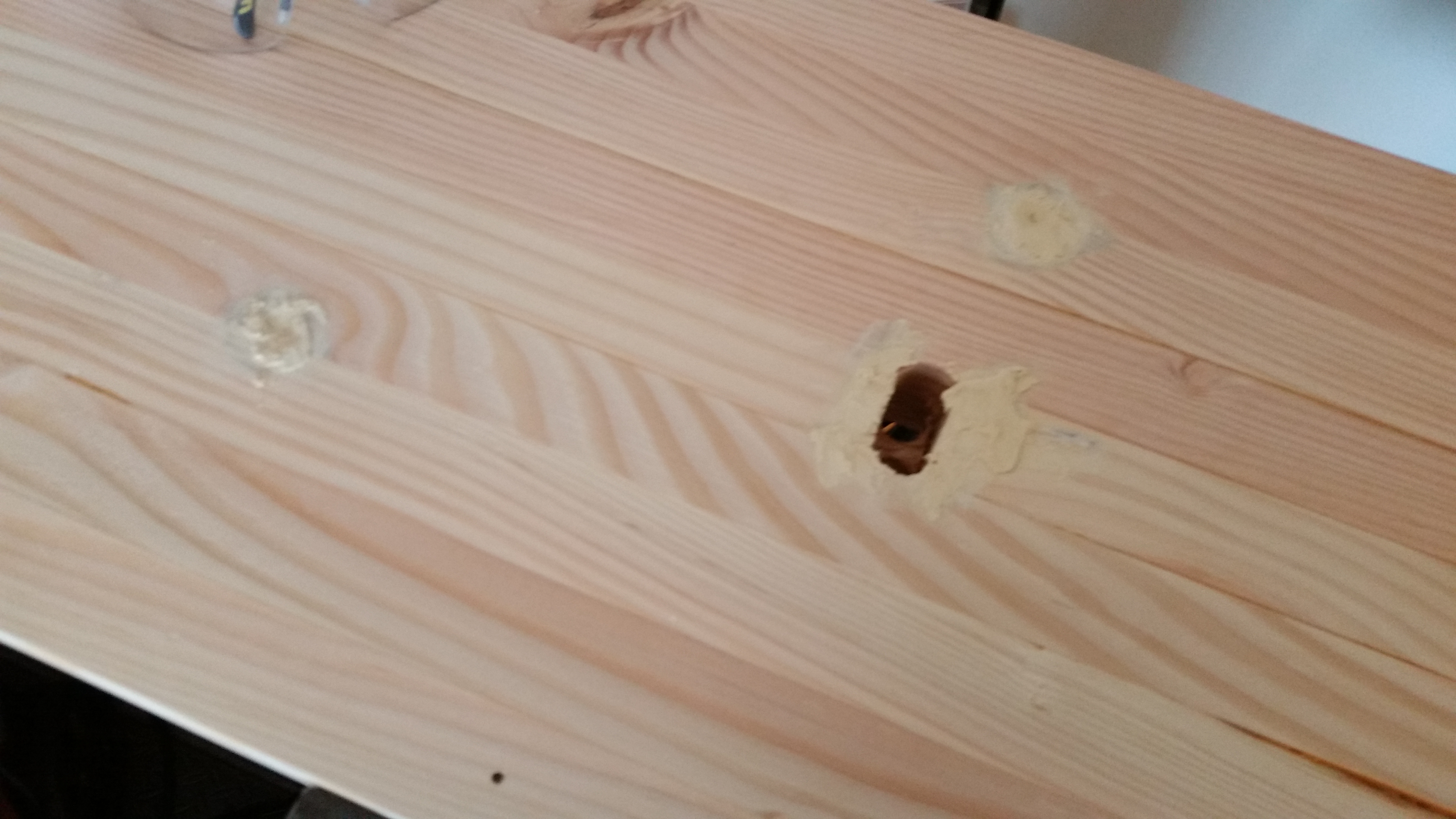
The 3/4″ dog holes were interesting to bore.  I have been using the Rockler forstner bit guide with my handheld drill for a while now, but the slab was too thick to make it all the way through.  After starting the hole straight with the guided forstner bit, I had to switch to my beefy brad point bit after the drill chuck bottomed out on the guide.  I went slow, but I still had a little bit of blowout on the underside, easily solved with water-based putty.  I filled some other holes as well and left them to dry overnight.
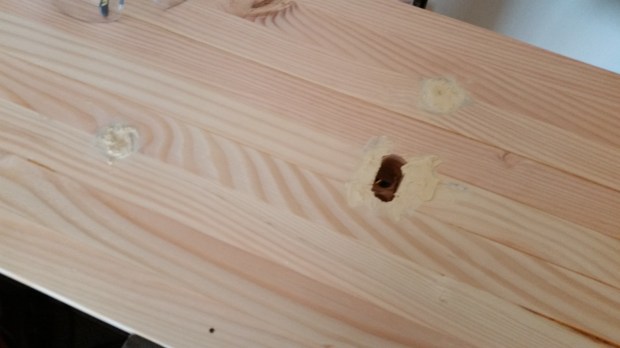
This is actually the vise exhaust port, but still.

This is actually the inset vise exhaust port, but still.

Nearing the end, I hit everything with a quick 220 grit orbital sanding, slapped on two thick coats of natural tint Danish Oil and leaned it up against the wall.
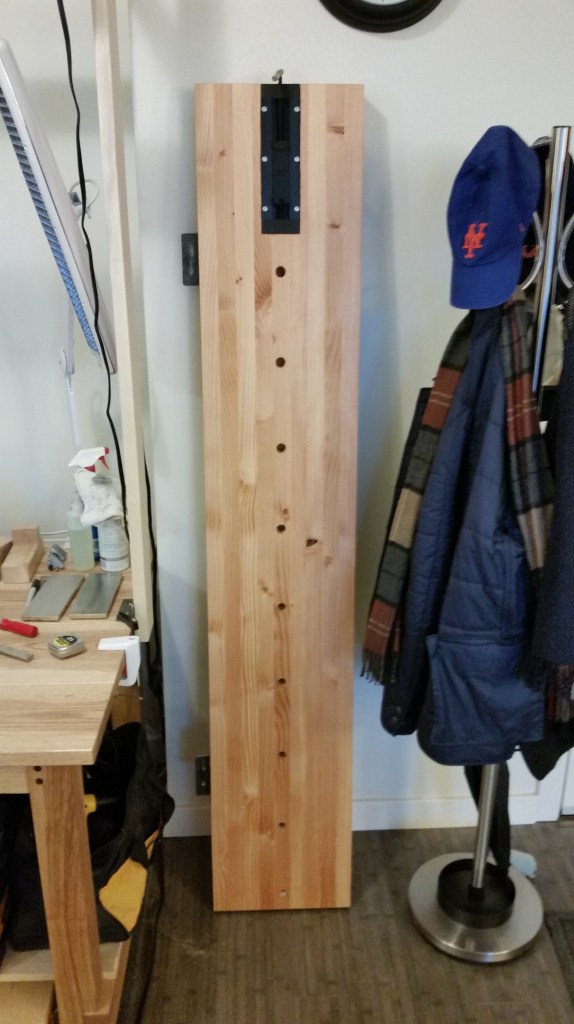
A place for everything and everything in its place.

A place for everything and everything in its place.

So there it is: the finished planing slab.  From home center douglas fir construction lumber to a sufficient worksurface for planing longer, thinner boards, all in about 30 shop hours (not including drying time).  I think it was excellent practice for eventually making a proper woodworking bench (maybe something in white ash and walnut) and I am glad now to have it.

Now all I need is to pick a furniture project that requires planing longer, thinner boards so I can actually use the thing.  I will report back.

JPG
A New Technique and a Helping Hand (or, Planing Slab, Part 3)

Welcome back to the third installment of the Planing Slab series (Parts 1 and 2 linked here and here)!

When laminating the slab, I did my best to keep what would be the bottom of the planing slab as flat as possible. I did this by only using boards ripped from the outside edges of the 2x10s and by doing some basic straightening before glue-ups. Also, by laminating one board at a time, I was better able to control float during the glue-up.

wpid-20150102_225907.jpg

Overall, not too bad for a starting point.

As is often the case, the best intentions only get you so far. I still had a decent amount of flattening to accomplish for the fully-laminated slab. I have a box store Stanley bench plane that I set up as a scrub plane, but it’s unfortunately not at my apartment, so I did the next best thing: I sharpened an exaggerated camber into my No. 5 1/2 (not overly much, so I wouldn’t need to grind to reset the iron) and went to work.  A few hours later, my floor was blanketed in shavings and I had something flat enough to skip plane through my thicknesser.

Not all the shavings, but I do like to keep the place cleaner than this.

I generally keep the workshop cleaner than this, ladies.

Skip planing is relatively new to me. I don’t often work in boards large enough (read: thick enough) to resist the flex of the roller bars on my thicknesser. It was pleasant to focus solely on getting the the outside edges parallel and on axis and scooping just enough out of the center to ensure the outside edges ran slightly proud. After all, the slab was rigid enough that it would ride only on the edges while going through the thicknesser (which is how skip planing works).  I removed the angle irons (used to clamp it to the table) and loaded the slab into the car.

It took about 10 light passes through the thicknesser to flatten the top and about 3 more to flatten the bottom (after a flip). Overall thickness ended up just over 2.75″, which is not bad, considering I ripped the component boards to slightly over 3″. All that was left was some basic squaring of the ends, accomplished via chop saw, and the rough dimensioning phase was done.  Back at the apartment workshop, I straightened and squared the back edge, rounded all the corners with a 1/8 round-over router bit and reinstalled the angle irons.

My shop-made sharpening depth stop block makes a great backerboard for installing angle irons.

My shop-made sharpening depth stop block makes a great backer-board for installing angle irons.

Special thanks to my mother for helping me out with the skip planing. It would have been a much tougher job without the extra set of hands. I would have managed it, but a little help goes a long way.

Straight-ish, square-ish and ready for an inset vise and dog holes.

Straight-ish, square-ish and ready for final flattening and installation of the inset vise and dog holes.

In the next (and final installment), I’ll cover installation of the Veritas Inset Vise and final flattening, smoothing and finishing.

JPG

Lamination, Lamination, Lamination (or, Planing Slab, Part 2)

Welcome to the next installment of the Planing Slab project!  Part one is here.

To make the planing slab, I opted to follow Christopher Schwarz’ advice and dig through the stacks at my local home center for the clearest, driest, straightest Douglas Fire 2″ x 10″s I could find in order to laminate a benchtop.  I should mention I showed up at exactly 7am and spent over an hour garnering confused and/or disapproving looks from the contractors who were probably wondering why a stocky thirty-something with a beard and a trendy haircut was checking construction grade lumber for knots and twist in fashionable jeans, a scarf and work gloves.

Once back at home, I left the approximately 36 feet of the aforementioned 2″x 10″ Douglas Fir (crosscut into six 6 foot boards) against the wall to dry out for 2-3 weeks, because “driest and straightest” equals not “dry and straight”.

Driest and straightest doesn't mean dry and straight.

Apologies for the grainy picture.  On a side note, is it just me or is my chisel mallet incredibly phallic?

I don’t own a moisture meter, but wetter pretty much means heavier, so I used a scale to compare the relative weights of each board over a couple weeks.  When there was no change in the weight of a board over a 7 day stretch, I knew it was dry enough to be ripped down. I will spare everyone the play-by-play on hand-ripping nine 3″ wide lengths of Douglas Fir, but suffice to say, I had to resharpen my 8 TPI panel saw after rip seven of nine.  It also became much easier once I built that second saw bench.

Not sure if I ever posted a picture of my Lie-Nielsen-style saw vise.

Not sure if I ever posted a picture of my Lie-Nielsen-style saw vise.

From there, it was all ripping, surface planing and glue-ups when I could find the time (usually one board every three or four days).  After a couple weeks in total, I had at long last a little more than 72″ x 13″ x 3″ of lamination.

Clearly labeled!

I had to grab all of my parallel jaw clamps from my parents’ house.

That’s all for this installment.  In part three, I’ll cover flattening and final dimensioning, while part four will take us through installation of the Veritas inset vise and dog holes and final surfacing of the completed slab.

JPG

Other People’s Handiwork

It’s a unique challenge altering someone else’s woodworking project. I have my own design style and fully prescribe to George Vondriska’s philosophy that “it doesn’t need to be perfect, it just needs to be consistent”, so when I need to alter a piece of furniture I did not create, it’s often a struggle to find a reference face.

My brother asked me to help him trim down the height of some chairs he purchased on the internet for his kitchen counter, so I spent a couple hours Saturday with my freshly-sharpened Veritas carcass saw taking 4″ off sixteen chair legs. Thankfully, the front legs were almost square and pretty much perpendicular to the floor, so I had a decent reference face.

image

That’s gross pine and spray finish for you.

What I normally would do is measure down from the seat, but even that measurement was rather inconsistent (like the floor they’d be sitting on), so I just measured from the bottom. I used a knifewall, but with the nail-in sliders, there wasn’t a ton of need for precision (nonetheless, no excuses for bad habits!)

I realized pretty quickly that I should have brought my 24″ blade for my combination square, but everything turned out alright in the end. And it was good saw practice, if on pine. There was a bit of wobble on the finished product, but between the unevenness of the floor and the flex in the chairs themselves, it was fine.

image

Illustrating the height difference.

I of course would have made the chairs myself I’d he had asked me, but he wanted them sometime this year. It was just nice to saw something after three weeks straight of 18 hour days.

JPG

The Missing Part of My Workbench (or: Planing Slab, Part 1)

It seems these days the only part of a workbench that anyone cares about is the benchtop.  Everyone is blue in the face with strong opinions on length, depth, thickness, material, vise configuration, dog hole locations, what have you.  The average workbench is lucky to get much more than four legs, four stretchers and maybe a shelf.  But I am telling you, there is much more to a workbench than a flat, heavy slab (or lamination).

20140702_191541

Until they make levitating workbenches, I guess.

If you’ve been following the blog, you know that in lieu of a traditional woodworking workbench I built a solid ash table to which I clamp various work surfaces: a Milkman’s workbench for joinery or a miterbox for repeatable cuts, to name a couple.  The tabletop is only about 5/4 thick and I’m certainly not drilling dog holes or chopping mortises on it (I really do hope to use it as a dining table someday), but as a clamping surface, it truly excels.   In theory at least, as long as it can clamp to a table, my workbench can have any work surface I want (or am able to create).  The system has served me well these last few months, but it has its obvious shortcomings.

wpid-20150103_195527.jpg

It’s worked well enough, so far, as long as the boards that fit between the dogs or the screws.

Don’t get me wrong.  I would love to have a real woodworking workbench and I’m very close to convincing myself a furniture-quality roubo (maybe something 72″ long x 20″ deep x 32″ high, with a double screw front vise and a slatted shelf underneath) would be a perfectly acceptable apartment furnishing.  Given my time and space constraints, though (for all my prop replica sonics, I’m still not The Doctor), I did the next best thing to making a real woodworking workbench.  I built the part of the workbench I was missing: the benchtop.

wpid-20150117_151815.jpg

Behold, approximately 35% of a proper woodworking benchtop!

What you see above is 72″ x 13″ x 2.75″ of pure home center Douglas Fir, with 3/4″ dog holes and a Veritas inset vise, and sealed in two coats of Danish Oil.  Nine boards, each one hand-ripped from six-foot lengths of the clearest, straightest, driest 2×10’s I could find in the pile, hand planed to decent gluing surfaces and skip-planed through a thickness planer after basic flattening (followed by final flattening and smoothing by hand). Weighing in at around 75 lbs, the planing slab clamps to the table with angle irons and f-clamps and stands against the wall when not in use.

Over the next week or so, I plan to take you through the planning and construction of what I have dubbed my “planing slab”a, more or less because the genesis was a need for extra work surface for planing longer boards.  It was a beautiful chore to construct and I am thrilled with the result.  I can’t wait to tell you all about it.

JPG

A Strong Finish

Remember those dovetailed white ash footstools I made for my niece and nephew a while back?  My brother recently painted and stenciled them and sent me a picture of the (literally) finished products.

Neither of those colors exists in nature.

Neither of those colors exists in nature.

I have to say the footstools came out quite beautifully.  Although paint is not really my thing (I prefer Danish Oil), the finish certainly fits the application and I am happy to see some of the grain and joinery still shows through. I find the colors a bit gender cliche, but it occurs to me the cliche likely evolved because color coding is the most expedient way to settle arguments among children. With the combination of substantial joinery and heavy duty finish, I am certain the footstools will endure.

I still owe my sister-in-law one more footstool (for the kitchen), but I am almost out of spare white ash. I think I have some extra quartersawn red oak offcuts I can scrounge, though, and red oak is close enough in hardness and texture to white ash to work in a mixed stock piece. Going to keep the parsons design of the two footstools pictured above, but I will change up the detail a bit.

JPG

The Strong, Silent Type

I recently received an email from a follower (who runs an excellent, albeit way over my head, chronicle of his custom Triumph TR6 called Bowtie6) that made me realize I had completely neglected the second most important piece of furniture in my apartment woodworking shop.  I spent so much time rifling through my tool chests, but I gave nary a mention to the rolling tool cart I built specifically to support those tool chests.

wpid-20140917_093911.jpg

The white part keeps the red parts off the floor.

Constructed entirely of hard maple, the rolling tool cart is custom dimensioned to fit the top chest and intermediate chest.  It’s rock solid, relatively compact and was never intended to be flashy.  There is no finish on the piece (I could never settle on a color and it’s waterproof anyway).  And, just by luck, the whole assembly fits very nicely into a corner in my apartment near the workbench.

I’d like to think much thought went into the design.  For example:

  • the top chest sits (unbolted) on the top, with the handles comfortably at 36″ high (the exact height of my elbows) for ease of lifting
  • there is enough tabletop around the top chest for storing glues and putties (and other odds and ends that have no place on a bench top during a project)
  • the gap between the intermediate chest (also unbolted) and the top rails is almost 10 inches high, giving me ample room to store my machinists granite slab and my panel saws
  • the bottom shelf is slatted and floats free in rabbets in the lower rails for maximum flexibility as the piece settles under the weight of the tool chests
No one will ever know

I think aesthetics are sometimes lost on shop furniture projects.

As always, after a few months of use, there are some things I would change, in retrospect:

  • the casters are not nearly large enough to make the cart mobile, which is fine while the cart sits stationary in my apartment
  • I should have added dowels at the tops of the posts to secure the tabletop, which is currently glued directly to the frame and further secured with glued-in wood blocks (like corner brackets)
  • I measured the intermediate chest wrong and had to cut shallow dadoes in the posts to accommodate the lip of the intermediate chest (which extends out slightly to permit stacking of intermediate and top chests)
  • I haven’t yet been able to bring myself to drive nails into the side for hanging my winding sticks and dovetail markers
wpid-20140916_160713.jpg

You can clearly see the dadoes and the tiny casters in this shot.

I built the rolling tool cart to be furniture quality (like everything I do) and I know I succeeded because my mother has already called dibs on the piece to use as a kitchen island.  If and when she finally confiscates it, I will swap in a set of larger, decorative casters and fit a middle shelf into the dadoes (there is a bright side, I guess).

In the end, like any good piece of shop furniture, the rolling tool cart does its job and fades silently into the background.

JPG