woodworking tools

New Sharpening Jig

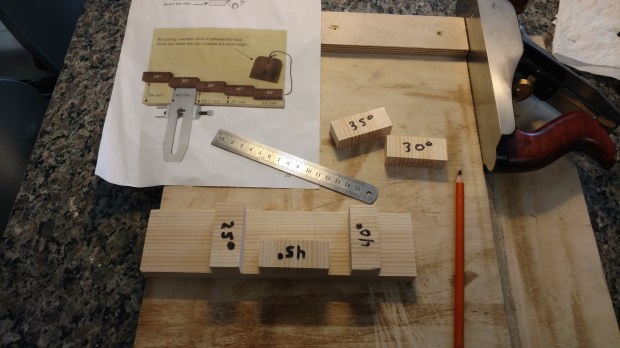
It was time to make another depth stop jig for use with an off the shelf Eclipse/Record-style sharpening guide.  My current version of the jig, made of 2×3 offcuts, is way too bulky for carrying around in my traveling tool tote.  I don’t freehand sharpen my plane irons, so this is an essential piece of shop equipment for getting consistent edges across multiple sharpening sessions. I did not make one for chisels, though, because I freehand (or machine, if available) sharpen my chisels.

wp-1463935046348.jpg

The sharpening guide in question shown in the middle.

I had considered making this a “Basic Project”, but it’s been done so many times I don’t want to take credit for the plans.  This new version is just a variation of Christopher Schwarz’ design.  Please note that if you don’t use the Eclipse/Record-style of sharpening guide, the depths listed below won’t work for you (but the numbers can be adjusted to fit whatever sharpening guide you use).
wp-1463935036436.jpg

Instructions for the full-size, benchtop style seen top left.

There is no real joinery in this project, which I love. Each stop block is CA glued in place and tacked with brads once the glue is set.  What makes this project a little tricky, however, is the need for perfectly square edges. Once you have a straight reference edge (planed or factory, if using sheet goods), the shooting board really gets a workout squaring the ends of the stop blocks and the base board.

I could not find a link to the instructions pictured above, but the depths are as follows:

  • 25° = 54mm
  • 30° = 40mm
  • 35° = 29.5mm
  • 40° = 21mm
  • 45° = 15mm

One thing I didn’t realize before this build was how quickly CA glue sets on white pine (spoiler alert: VERY quickly).  Even so, CA glue does not have great shear strength, so pre-drilling the brads was important.  Two brads per block seems to be more than enough.

wp-1463935043153.jpg

I put the depths I use the least on the underside of the jig.

I eschewed the 1mm shim on a string for creating 1° microbevels (seen in the full-size instructions pictured above).  Mainly because using the same metal ruler I use for the David Charlesworth Ruler Trick works just fine.

It may only be quartersawn white pine, but this thing should last forever.  And if the CA glue gives way, I’ll just scrape it off and use hide glue (the nails will guide the block into place again).  Or I could preemptively drive a third, larger nail into each block and be done with it.

JPG
Forging New Paths

New to me, at least.  I’m cleaning up a vintage saw.

wp-1463397729478.jpg

And ruining my nice ash table in the process.

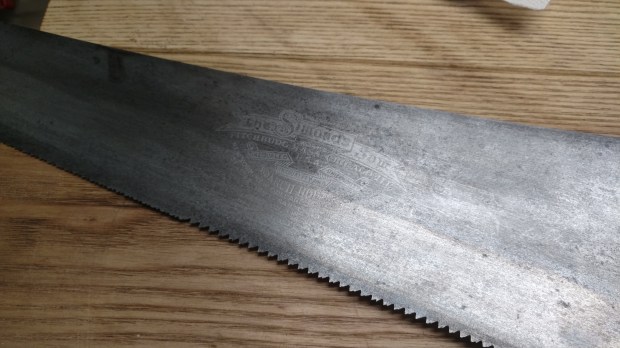
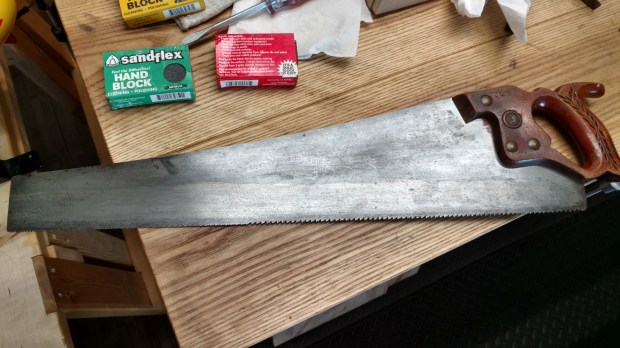
This Simonds saw, a 12ppi crosscut panel saw, came to me through a family friend (a godparent, in fact).  The plate was lightly rusted, with little pitting (and none near the teeth).  Sandflex hand blocks and some elbow grease quickly led to a passable shine.  And the Etch even survived the rust removal process.  The plate was slightly breasted along the toothline: unclear to me if the breasting was OEM or a product of uneven filing over time.

wp-1463397737989.jpg

Made from 1901 to 1926, according to teh interwebs.

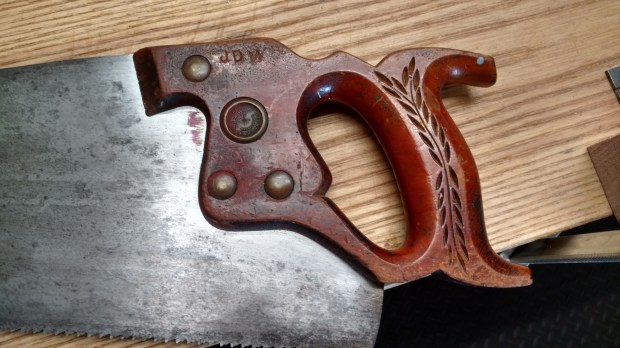
The handle is also in excellent shape, if slightly paint-caked around the plate.  There is some chipping around one of the saw nuts (probably my doing), but otherwise, the finish is consistent and no work was needed.  I may ease the top tongue on the handle to fit my hand better, but I’d like to see how it works before I do.

wp-1463397733639.jpg

No lamb’s tongue, but whatever.

The only real problem with the saw was the teeth.  One side of the plate, the were filed much smaller than other.  My best guess is the crosscut filing was consistently done out of horizontal and without flipping the saw around between sides.  So my choices were: (i) file the teeth completely away and start all over or (ii) reshape the saw into a 6+ tpi rip saw.  There is a great Paul Sellers tutorial on recutting saw teeth, but a 6+ tpi rip saw will fill a gap in my tool chest.

wp-1463397744561.jpg

Notice the sharp teeth on the left even after heavy jointing with a flat file

I’m not finished with it yet, but I think reshaping was the right choice.  I already own a 10 tpi rip pattern panel raw (which is great for all-around work, including cross-cutting to rough length), but my only other rip pattern panel saw is 4.5 tpi (too coarse in my experience for hardwoods).  This saw will almost split the difference and give me a more aggressive option for hardwoods and softwoods alike.

And worse comes to worst, I’ll file them flat and start all over again.  There is plenty of plate left.  Either way, I’m going to need a new 7″ slim file after this.

JPG


Fleam On

From time to time, I make woodworking resolutions.  Maybe “resolution” isn’t the correct work; perhaps “aspiration” is more appropriate.  A less pedantic version of me would just say “goal”.

My most recent woodworking resolution is using my crosscut tenon saw more often.  Which is secret code for “learn to sharpen my crosscut tenon saw better”.

wp-1462967979904.jpg

I put these lines on the new saw vise for a reason…

For some time now, I’ve relied almost exclusively on rip-pattern saws for both ripping and crosscutting.  It’s true that crosscutting with a rip-pattern saw leaves a ragged edge, but most cross-grain cuts also get a knife-line (or gauge-line) to establish a clean shoulder.  Any raggedness from the saw sits below the visible shoulder line (or is cleaned up when paring to said line).  And I’ve gotten quite good at rip-pattern sharpening, making it even more efficient.

But crosscut saws exist for a reason.  The different tooth geometry really does matter in some applications (e.g., through dadoes).  So I am retraining myself to sharpen a crosscut-pattern.  I have a feeling there will be some tooth jointing in my future.

JPG

Some [Non-]Mechanical Assistance

I’m not always kind to my Work Sharp 3000 sharpening system.  It’s a temperamental machine, in my experience. But seeing as I somehow let some of my chisels get a bit out of shape, the Work Sharp has spent a fair time on my bench lately.

P1000307

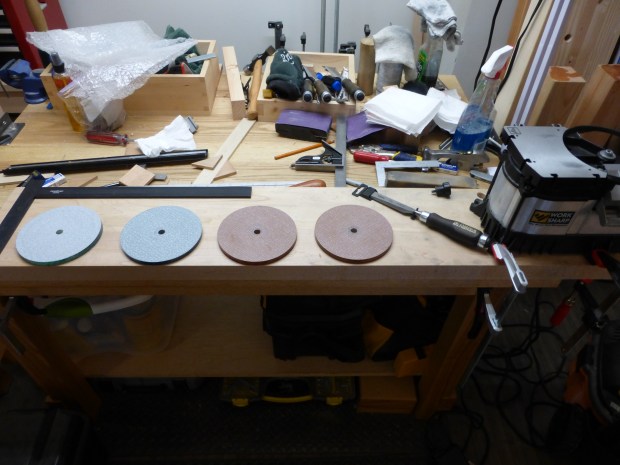
In all its glory.

For those unfamiliar with the product, the Work Sharp spins a tempered glass disc covered with adhesive-backed abrasive paper on each face (see above).  With the disc spinning, the top face is typically used for flattening, while an adjustable tool rest permits bevel-grinding and sharpening on the underside (up to 2″ wide).  Though great for bevels, I’ve found it nearly impossible to evenly flatten on the top face while the disc is spinning.  But the discs are very flat, which is what I’d like to talk about today.

For flattening, I typically use a machinist’s granite slab with adhesive-backed sandpaper.  The setup is admittedly much better for planes than for chisels and the granite slab can be cumbersome in use.  For example, I can only adhere a few different grits at a time (which range only from 80 to 320).  Also, changing sandpaper often leaves adhesive residue that needs to be scraped away (or worse, removed with mineral spirits).  So instead, I’ve been using the Work Sharp discs for re-flattening my chisels, but off the machine.

To begin with, there are more grits available than with adhesive-backed sandpaper (WS goes from 80 grit to 3000 and above) and each of grit is available at all times because I own 5 glass discs.  Plus each disc is naturally non-skid on the benchtop, having abrasive paper on both sides.  In addition, because each disc is barely over a chisel-length in diameter, I can work the chisel from all angles use every square inch of abrasive on the discs (unlike my granite slab, where large swathes of fresh grit are wasted).  Finally, the abrasive on the WS discs lasts much longer than ordinary sandpaper and can be easily cleaned with a crepe block while spinning on the machine.

And the results have been more than satisfactory, especially for my purposes.

P1000308

Polished to 1000 grit only.  I already own enough mirrors and my chisels are for chopping.

I’m not recommending anyone go out and buy a Work Sharp 3000 (and certainly don’t blow $100 on extra glass discs just because they are nice surfaces for flattening).  But small-space woodworking is about finding the right tool for the job from what’s available.  And in this case, something I had on hand works better than anything else.

JPG

Finding the Hole(s)

It’s pretty snowy out, all of a sudden.  And I’m using the quiet time to get some things done in the shop.  Sharpening and plane making in the early am, then onto other tasks.

On my list for a while was drilling a few more dog holes in the maple planing bench.  Not actually for bench dogs, but for aluminum planing stops.  Extremely low-profile, they come in several lengths (and can be hacksawed to exact measurements).  I’m sure I’ve talked about them before, but I could not live without them in my apartment woodworking shop.

wp-1453569811248.jpg

Not sure if others sell them, but all mine are from Lee Valley/Veritas.

The pegs (which come in 3/4″ or 20mm) slide in a track on the underside of the stop, so they fit in a variety of dog hole configurations.  And the pegs are shallow (less than 1 1/2″): perfect for a clamp-on workbench made of 8/4 maple.

In addition to their utility for surface planing (seen above), I have found these planing stops to be quite useful as bench hooks. Two more holes to the right side of the bench now make a crosscutting bench hook (see below).  And because my plywood shooting board/bench hook is too deep for this particular bench, I no longer have to unclamp the whole bench every time I want to cut a tenon shoulder.

wp-1453569834524.jpg

And it saves me from always digging out the saw benches.

There are actually three more holes to drill.  One centered in the far right for a holdfast.  And two more along the back edge on the left side of the bench to form a perpendicular for traversing and general bracing.  Everything is measured and marked; I’m just taking it slowly today.

Hope all my east coast readers are staying off the roads.  It’s not too bad out here, but pretty blustery.  I can only imagine what it’s like further north.

JPG

More on Shop-made Rebate Planes

Attaching the fence to the right-hand rebate plane wasn’t nearly as difficult as expected.  I approached it like I would a drawbore, by first drilling the pilot holes in the fence, then using the same brad-point bit to transfer those holes to the body of the plane.  After that, everything came together nicely.

P1000239

I did drill all the way through the backer board into the dining table, but that kind of thing happens once in a while.

The above photo shows the fixed fence at max extension (5/8 inch).  I am yet to elongate those holes to permit the fence to adjust to take a narrower cut, but that is just a question of marking and chopping out two slots in the fence.  After the fence is fitted, I’ll recess the scoring spur and the whole thing will be ready for a coat or two of Tung Oil.

I did take some quick test cuts with the fixed fence and was quite pleased.  I’m assuming the slight slope at the edge of the rabbet is due to my unfamiliarity with proper fillister plane technique.

P1000241

Product placement!

I hope to start work on the left-hand plane this weekend.

JPG

Warrington Pattern Hammer Recommendation

I don’t usually do tool recommendations, but I have been very pleased with my new Warrington Pattern Hammer.  It’s nothing special, just a $25 dollar amazon find, but it’s worked well so far.

I may have lucked out, but the hammer is well handled and straight, and the balance of the 12oz head feels good in my hand.  If you’re looking for a relatively cheap woodworking hammer, you could do worse.

JPG

Making Replacement Wedges

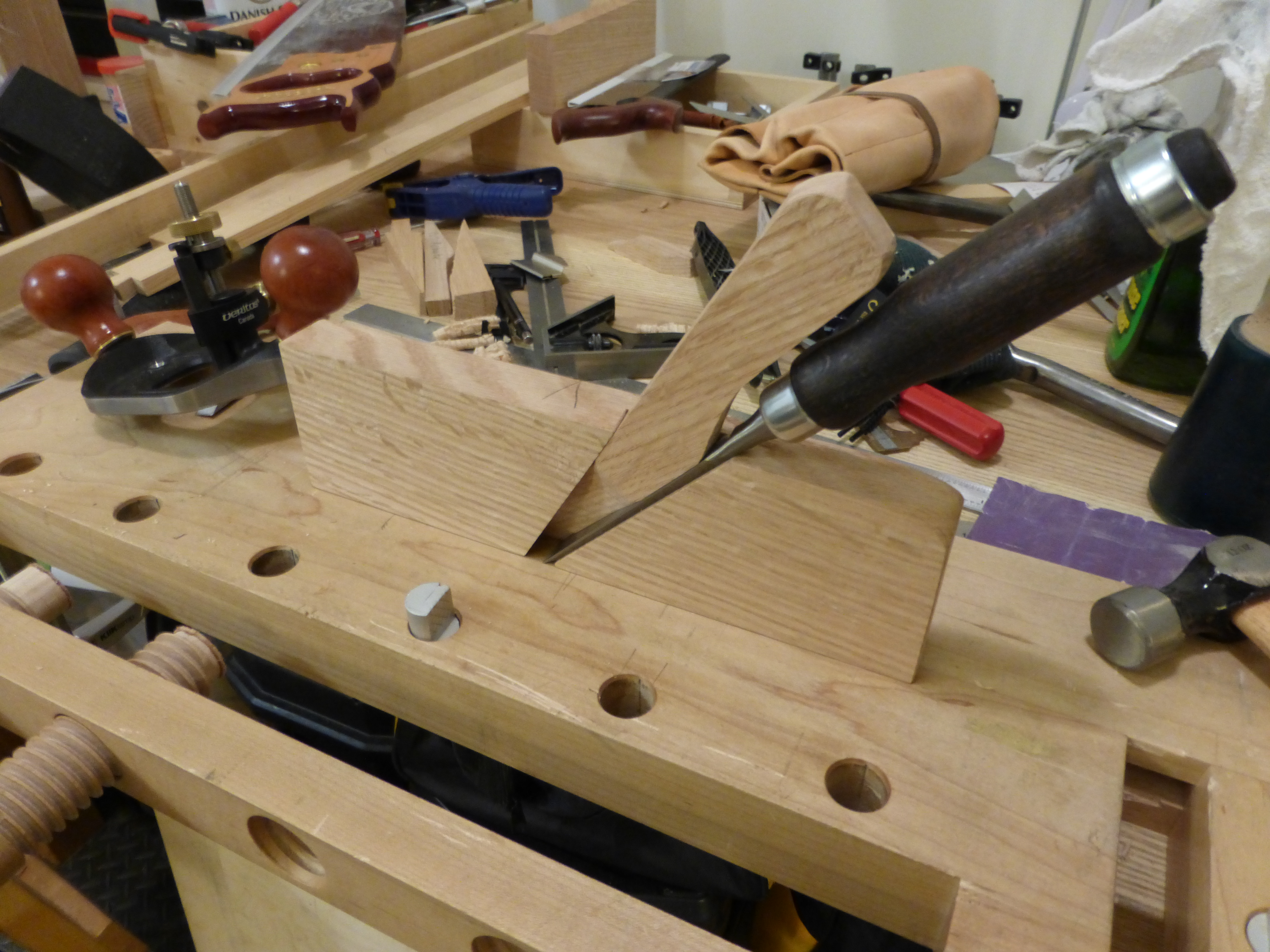
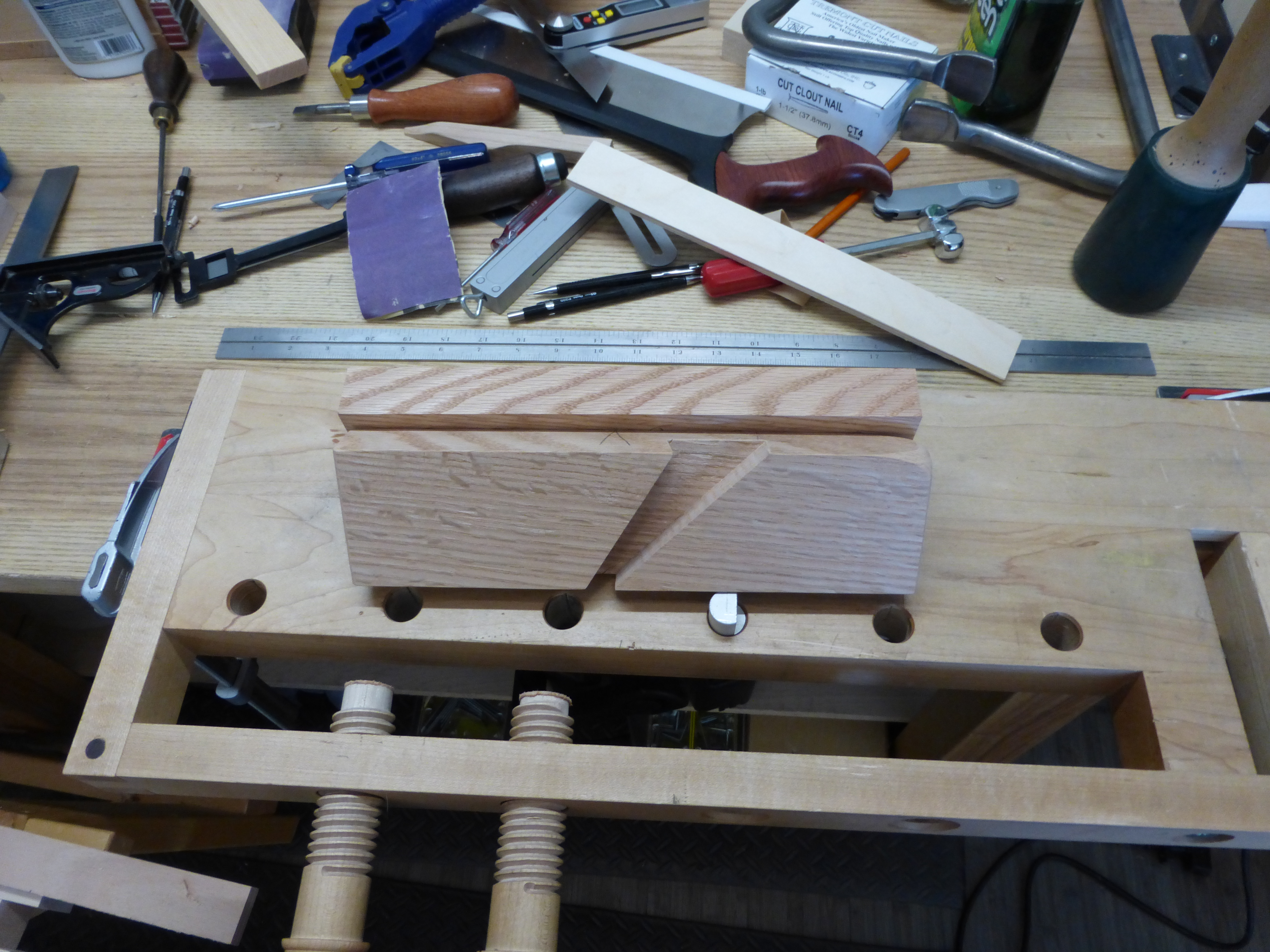
When I deepened the recess on the set of poor man’s rebate planes to accept a 5/8 inch bench chisel, the initial 1/2 inch wedge for the right-hand version became useless.  This presented two issues: (a) the bed angle itself was sized against the old wedge, so the new wedge must be custom fit; and (b) there had to be an easier way to get the correct bevel than just starting from a four square blank and planing down.

In addition, there was the problem of not having any 5/8 stock, but I fortunately had enough remaining quarter-sawn red oak to resaw some wedge blanks.  Plus, the waste from the resaw, at just over 1/2 thick, is probably usable for something else.

Taking my time, as there is little margin for error.

Taking my time, as there is little margin for error.

The initial recess was marked against a 1:4.5 angled wedge (as recommended in the Paul Seller’s video), but after all the trimming and refinement of the bed, I think it’s now closer to 1:4.  Also, I tried marking the actual bevel angle directly on the blank and rip down along that bevel.  This gave me matching right and left wedges (for the matching right-hand and left-hand planes) that need less work overall in refining the fit.

Perfect fit!

Perfect fit!  Now to make the fence.

I’m excited to finish up the fence and put the right-hand plane to work (after I figure out the best way to attach the scoring spur).  I might even buy a second 5/8 inch Narex chisel so I don’t need to swap back and forth once the left-hand plane is done, but we’ll see.  Here’s hoping using quarter-sawn hardwood will increase the longevity of the planes.

All in all, it’s been a good exercise, and very enjoyable learning basic plane-making.  I’m certain the left-hand version will come out even better than the right.

JPG

Home-made Rebate Plane

I, like most woodworkers, have a Lee Valley/Veritas wish list.  For some time now, just sitting in the “Purchase Later” section of my shopping cart, has been a skew rabbet plane.  In fact, it is next on my list of impulse purchases.  Or at least it was, until today.  Because I’ve decided to make my own rebate plane instead.

Well, two, technically.

Well, two, actually.

If you haven’t already, I highly recommend creating a free account at Paul Sellers’ Woodworking Masterclasses.  There are paid project videos, but there are also free-to-watch how-to videos on a wide range of topics.  One installment in the “Poor Man’s” woodworking tools series is a rebate plane that uses a chisel for a plane iron.

I had some lovely quarter-sawn red oak scraps laying around the shop, so I decided to try my hand at planemaking.

Actually quarter-sawn

Actually quarter-sawn.

The first rebate plane came out so well that I decided to make both right and left versions.  The right version originally used a 1/2 inch Narex bevel-edged chisel, but I decided to increase to 5/8 (for both aesthetic and practical reasons), so I need to make a new wedge.

Both versions will have an adjustable fence.  The right version will also have a nicker (or “scoring spur”) made from a re-purposed (read: chipped) wheel marking gauge cutter, for cross-grain rabbeting.

Suffice to say, I now have a Lie-Nielsen wishlist that includes a set of planemaker’s floats.

JPG

The Essential Tool Kit, Redux!

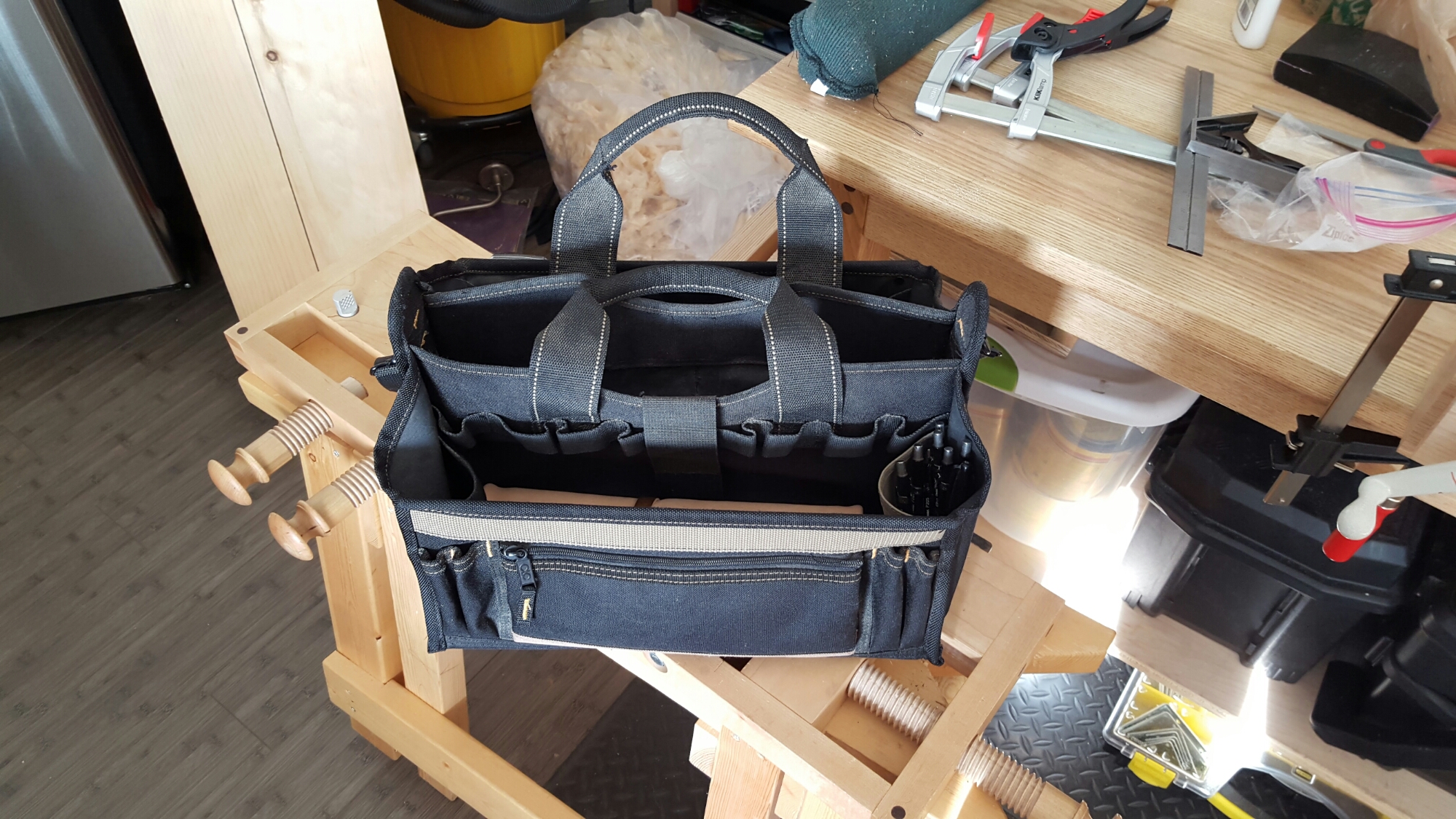
Over the weekend, I was asked by my mother to clean up some poorly-mitered baseboard moulding. Not knowing what the moulding was made of (MDF, by the way), I packed up a small toolbox with enough woodworking handtools to tackle any task. I’ve been down this road before, but I took the chance to think through the essential handtool woodworking kit once again.

More than anything, I was confined by what I could fit in or on the toolbox, which is about 16″ long and has been with me since the beginning.

Seen here

Seen here, mostly empty.

Here is what I came up with:

  • Tool roll, with chisels from 1/4″ to 1″, plus 1/2″ mortise chisel, birdcage awl and 18 oz mallet
  • Tape measure, 12″ combination square, sliding bevel and marking knife
  • 14″ rip cut tenon saw and 22″ rip cut panel saw
  • No. 5 1/2 jack plane and small chisel plane
  • 600 and 1200 grit diamond plates, saw file roll and plane adjustment hammer
  • Some screwdrivers and mechanical pencils

And that’s it.

Looking back, I had room for a small router plane and a couple clamps. Maybe a dovetail saw, spokeshave and Shinto rasp if feeling fancy. A hammer and cut nails too. Plus a 200 grit diamond plate and honing guide for grinding.

And that, along with a small cordless power drill, would be enough to get started making anything, I think.  Just don’t forget the glue and blue tape.

JPG