Techniques

The Clamp I Use Most

Apartment woodworking is mostly about making due.  But that can be said about much of woodworking.  And finding the right tool for the job is important regardless of square footage.

wp-1452356025178.jpg

The clamp I use the most is not a clamp at all.

I’ve talked about alternative clamping styles before.  I’ve even showcased the machinists granite slab as a clamping apparatus before.  The reality is, sometimes a heavy, flat rock is much easier than an actual clamp.

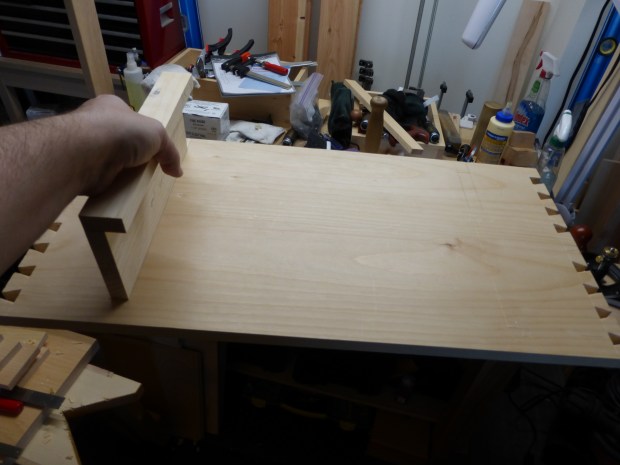
When (for example) I need to glue back down some face grain that split while cutting a dado, I could use a parallel jaw clamp.  Or I could just put a big rock on top of it.  More times than not, I opt for the latter.  Because if I’ve done my job and my joints are square, weight is as good as mechanical clamping pressure.

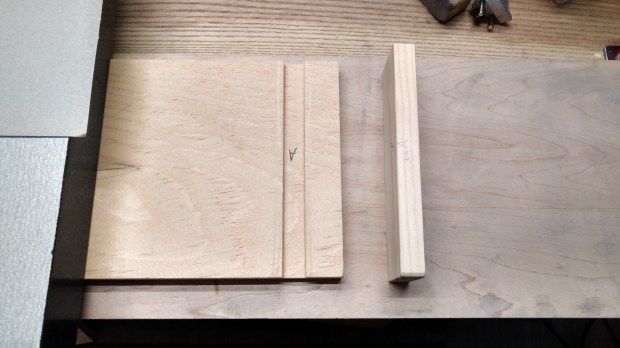
Speaking of dadoes, these are for a three-board sushi tray from leftover pine.  If the sizing is okay (about 7″ x 15″), I will likely make a couple more from a tougher wood.

wp-1452356031714.jpg

No stopped dadoes, this time.  My masochism knows some bounds.

Have a great weekend, everyone.

JPG

A Short Time Ago, in an Apartment Pretty Close By

Last weekend weekend, I cut dadoes. Two, to be precise.  Of the stopped variety.  To install the drawer runners in the dovetailed plant stand.

P1000276

All dado bottoms flattened with a Veritas router plane.

There was a time when I would not have hesitated to strap a parallel guide clamp on the work and plunge-router the whole thing. A time not too long ago. A time I do not miss one bit.

The dado on the above right was cut with a 1 1/4 inch chisel.  After marking and chopping to depth one side, I then scribed the other side of the dado against the mating piece.  Knowing the vertical chisel chops would compress the fibers and move the knifewall, I intentionally marked the other side of the dado a bit narrow (1/64 or so).  The end result was a wonderfully fitting joint.

P1000274

No reinforcement yet.  Only friction.

The dado on the right, however, was cut differently.  At the time of day (about 6am Eastern), I couldn’t be chopping with a chisel.  I live in an apartment, after all.  So instead, I scribed deeper and deeper knifewalls with the marking knife to get to depth.  This meant that, without the compression from the vertical chisel chops, the narrower scribe line on the other side of the dado was never compensated for.  I ended up planing the mating piece to fit the dado.  It’s still a very snug joint, just with a different approach.

I have since glued in the runners into place, with a bead of hide glue along the long grain bottom of the dado.  While I suspect this will be enough, I will also reinforce with some nails or buttons.  The drawer is almost done too; I’m merely figuring out the best way to fit the drawer bottom (without a plow plane).

Then it’s time for assembly.

JPG


More Routine Maintenance

Last night, I had a nightmare that all my chisels had rusted over and bellied.  So this morning, during my breakfast of mini-bagel and green tea, I made sure they had not.  I actually only got through 1/4-5/8, and will do the rest tonight.

wp-1449248491594.jpg

Screw you, subconscious.

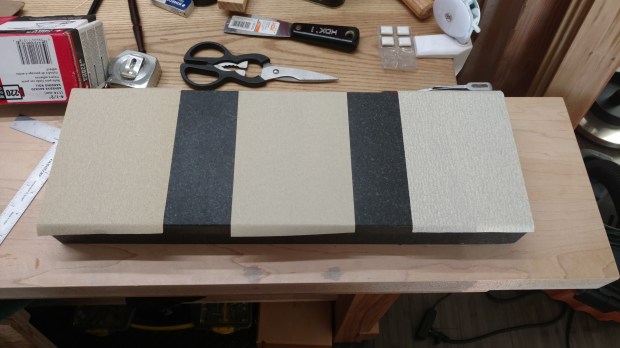
I love my 3×8 diamond plates for grinding and sharpening, but they are not ideal for lapping and flattening.  When I need something perfectly flat, I turn instead to the machinist’s granite slab pictured above and adhesive-backed sandpaper of various coarseness.

For flattening chisels or plane irons, I typically use 80 grit, 120 grit and 220 grit sandpaper.  I care more about flatness than mirror polish, so any additional polishing done on the diamond plates in the course of sharpening.  For plane soles, I might go up to 320 grit (which is overkill for everything but a smoothing plane, I know).

I’ve experimented with sanding belts and spray adhesive in the past, but I’m never happy with the adhesion, and certainly loathe the mineral-spirits cleanup of the spray adhesive.  With adhesive-backed sandpaper, I just need a scraper and a spritz of Simple Green cleaner.  The grit on the sanding belts definitely lasts longer, but it’s a small price to pay.

JPG

A Very, Very Serviceable Prototype

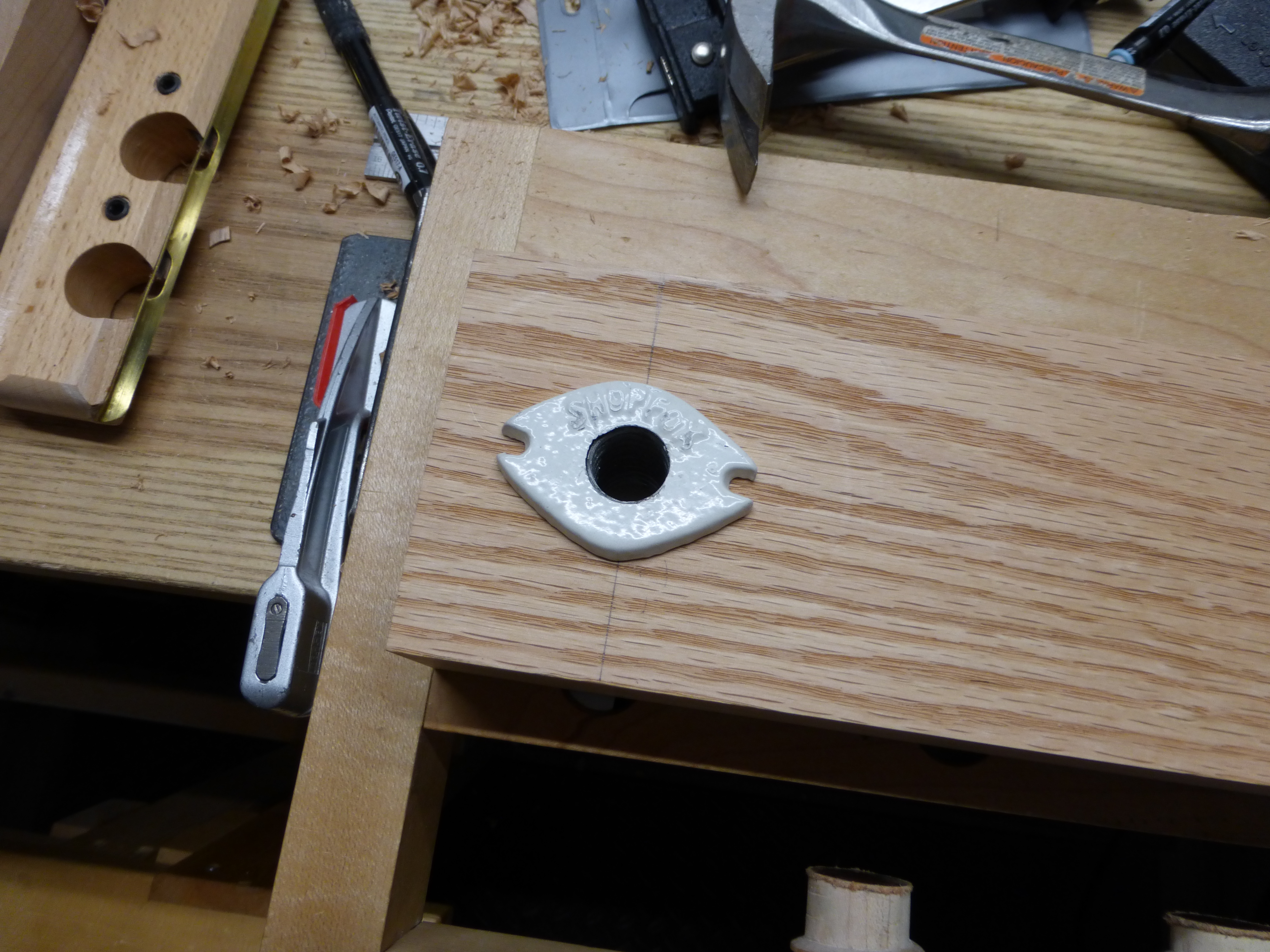
For more almost a week now, I’ve been mulling over the plan for using veneer press screws and some reclaimed red oak to create a moxon-style vise.  I was rather resigned to chopping out recesses for the collets by hand, until I had an idea.  The collets themselves are a little over 1 inch in diameter, with some ridges that increase the overall width to just over 1 1/8 inches.  So using a 1 1/8 inch forstner bit (the same one used for the 1 1/4 inch wooden screw threading kit from J&J Beall), I drilled a “mortise” all the way through the back vice chop and drove the collets into place with a mallet.

P1000209

Nice and flush(ish)!

There are some gaps on the inside of the mortise, which I will likely fill with epoxy to seat the collets permanently into the back chop.  For now, though, some No. 8 screws do the trick to lock the collets in place while I finish the vise.

P1000211

The roundover is more out of habit than necessity.

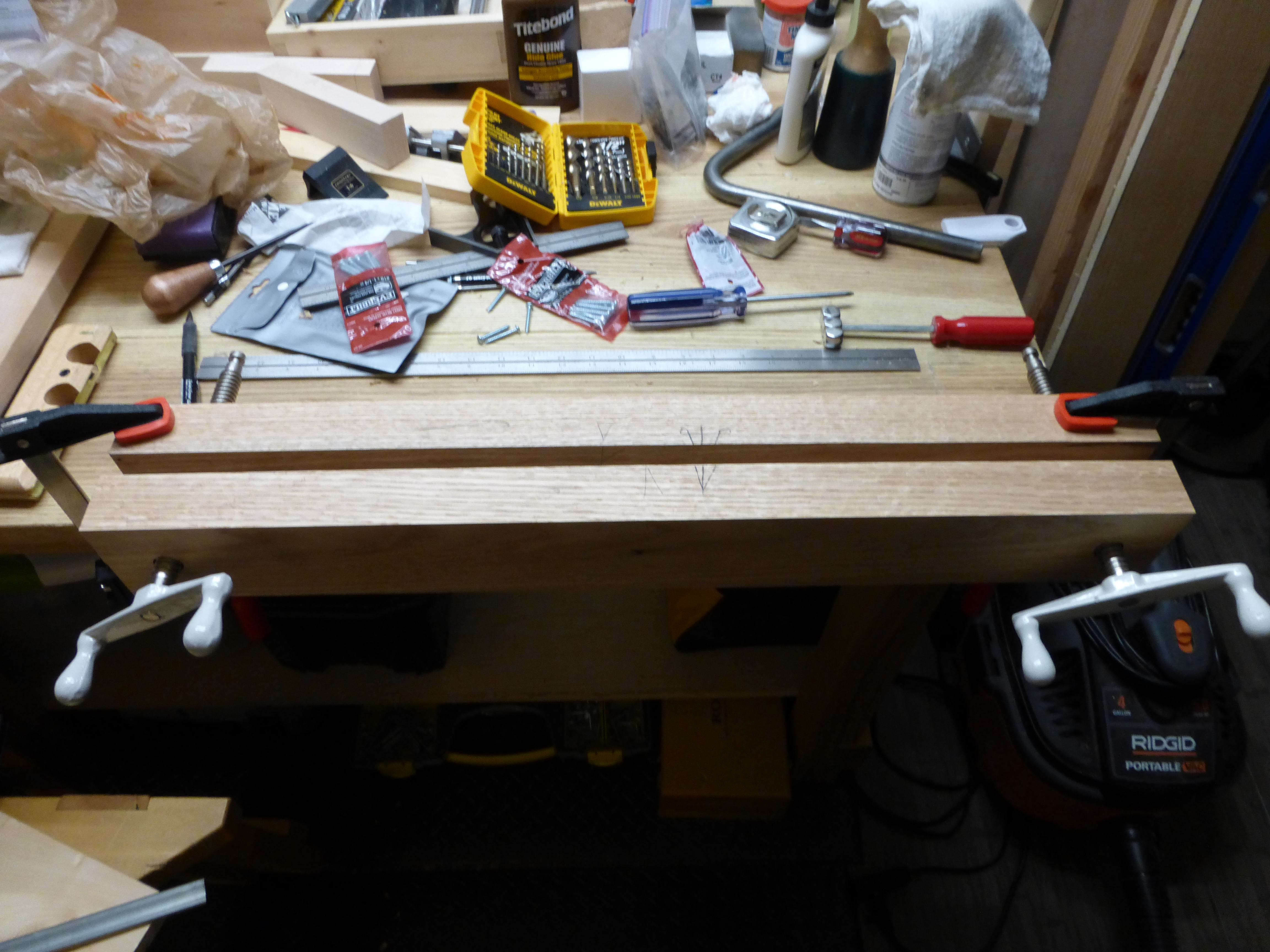
I then threaded the press screws through the collets and used the sharp tips on the ends to transfer the hole locations to the front chop.  The holes in the front chop are 3/4 inch, while the screws themselves are just over 11/16, so I will wrap the screws with some electrical tape to tighten up the fit on the front chop.  Then it was time to test fit.

P1000214

Surprisingly quick to come together.

The last component to the moxon vise is a set of spacers which glue to the outside of the front chop.  They prevent the spinning handles from rubbing against the front chop.  I had some scrap 1/2 inch oak left over from the medium tool chest drawer runners which came in handy.

Glued down, though I may add screws as belt-and-suspenders.

Glued down, though I may add screws as belt-and-suspenders.

And that’s it.  After the glue dries, I will round over the exit holes on the spacers, break the corners all over and chamfer the top of the front chop.  I hear the chamfer creates clearance for handsaw cuts. Then I will test out the vise doing vise things.

The amazing part is that the entire vise build (other than driving to/from my thickness planer and glue drying time) only took about 3 hours of shop time.  That includes stock preparation.  Very doable overall, and not bad for a first attempt.

The finished build (pre-chamfer).

The finished vise (pre-chamfer).

JPG

Free-Hand Sharpening Follow-up

While free-hand sharpening the iron on my No. 5 1/2 jack plane, something occurred to me. The depth adjust on that particular plane has always been tight. No matter how well-oiled the screw or how deep or shallow the frog set, advancing the iron for a deep cut becomes finger-crushing work.

Then, when I was looking for a link to the ruler trick for my previous post, it dawned on me. The bevel on the iron was entirely hand sharpened to about 35 degrees. Meaning the heel of the bevel stuck out further than the factory grinding. Meaning it was butting up against the throat.

So I slapped the iron into a honing guide at 25° and ground the heel of the bevel back down. Now the plane advances smoothly and I didn’t even have to resharpen the edge, as it was well clear of the grinding.

image

Like so

So I guess now I have a hybrid approach for plane iron sharpening. First grind to 25° by guide, then free-hand hone the cutting edge at 35° or so (30° for bevel up tools).

JPG

On Freehand Sharpening

Edge sharpening has always been a weak spot for me.  While I took to saw sharpening very quickly, my chisels and plane blades were never been perfect.  I used micro bevels and wide-wheeled guides and even tried the ruler trick, to no avail.  My edges were sub-par and short-lived and almost always out of square.  So I gave up on all of that and went in a different direction.

It’s no secret that Paul Sellers has been a great influence on me over these past few years.  I consider his YouTube channel to be the best free resource for a woodworker just starting out in the craft.  Paul advocates freehand sharpening and none of that micro bevel nonsense.

I already had the diamond plates, so I figured I’d give it a try.  And it’s worked for me thus far.

P1000197

Scary sharp, indeed.

I started with my chisels (easier to correct if I made the edge worse) and instantly noticed that the “macro camber” approach of freehand sharpening lends itself to a stronger, longer-lasting edge.  Since then, I’ve freehand sharpened both my No. 4 1/2 smoothing plane (pictured above) and my general purpose No. 4 and gotten instant results.

No more fussing with stop blocks or fumbling with guides means I just spritz some window cleaner on a diamond stone and work until I feel the burr.  Freehand sharpening has actually decreased my sharpening time.

Maybe I’m just bad with guides and sharpening jigs.  Or maybe this is just the next step in hand-tool only woodworking.

More on Cauls

Jigs are not as important in the hand tool woodworking shop as they are for avid power tool users, but I took some time yesterday to make some extra cauls for the tool chest glue up.

On the advice of someone who would know about such things, I cut some pretty tight dovetails for the tool chest carcass.  In order to ensure the tails seated properly into the pin recesses, I attached (with double-sided tape) individual cauls onto each tail prior to clamping.

P1000156

Pre-clamping.

That way, the parallel jaw clamps applied consistent pressure directly onto each tail, seating them nicely.  I forgot to take a picture of the full glue-up, though.  And the clamping pressure crushed the cauls to the point where they cannot be reused.

On a side note, the tails were so tight that there was a bit of splitting on the tail boards. Fortunately, I keep a supply of cyanoacrylate glues of various viscosity.  A generous bead of medium cyanoacrylate will seep into the cracks and should stabilize them for the life of the tool chest.  I haven’t yet flushed the joinery on the carcass, so I can still plane off the excess glue with an extra pass or two.

The same trick works to stabilize a knot.

The same trick works to stabilize a knot.

The floorboards for the tool chest are dimensioned (S3S), but still need a pass them through the thickness planer before I cut the ship-laps.  I might wait to flush the tails and pins after I’ve attached the floorboards, because I do not have a full workbench around which to wrap the carcass.  We’ll see.

JPG

The Importance of Hypocrisy

Handtool woodworking is awesome.  It’s relatively quiet and significantly dust free.  In fact, most of the time, “by hand and eye” is far faster and more accurate than “by power and jig”.

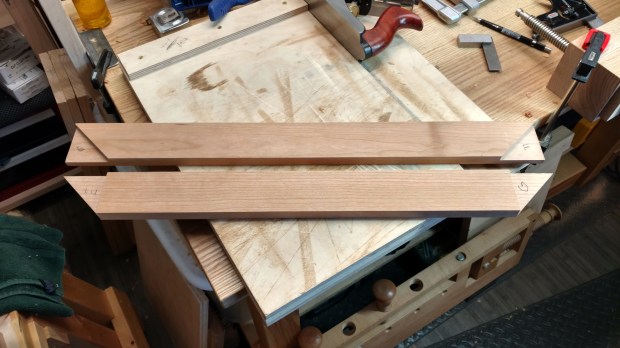
Except when it’s not.  Like when trying to square a glued-up panel that is too large for your shooting board.

For my time and effort, this is still the fastest and most accurate way to square a panel.

For my time and effort, this is still the fastest and most accurate way to square a panel.

No purest am I.  I’ll use whatever tool makes the most sense under the circumstances.  In my opinion, nothing beats a carpenter’s square, straight-edge clamp, trim router and flush trim router bit for squaring end-grain on a large panel.

Give it a try.  There is a reason my trim router (and dust extraction unit) has survived every power-tool purge in my shop thus far.

JPG

Angled-leg Side Table

Cards on the table, I’ve been almost done with this table for about two weeks, just needing to prepare the tabletop and do a quick smoothing before glue-up. The tabletop should only require two boards, so it will go quickly once I get some time to go back to the project.

It's been blocking traffic for a while.

It’s been blocking traffic for a while.

In the meantime, though, I learned an important lesson during this project. I had shaped the angled legs over a year ago, removing rough stock by hand and then cleaning up the profile by trim router with a plywood pattern and a pattern bit.

Although they are pretty close, none of the legs is identical to any other (except for height, which is remarkably close for being cut on a chop saw). Each leg varies slightly in rake and, after some straightening, thickness. Sending them back through the thickness planer would mean also redoing the stopped chamfers, so I figured there must be a way to keep the table square and straight without making the legs identical. Turns out, the basic principals of marking were the solution.

I had always planned for the top to overhang the frame a bit, so as long as the frame was square, I could hide any variations due to the legs. In theory, as long as I marked from the same edges on each leg, and the parallel rails were identical in length to the shoulders, any variation on width or depth would be purely cosmetic. So I took great care to size the rails perfectly. Then I assembled the frame and, while the frame overall was square, one of the rails didn’t seat squarely.

This confused me, because I had marked everything from the same reference edges on each leg. However, the front and back rails were marked from the outside, not the inside like the side rails. Because of the varying thickness of the legs, this added extra length between the mortises for the front and back rails on one side. I ended up having to take down the inside thickness of one leg by hand to fix it.

The moral of the story is: there is more to consistent marking than using the same reference face. When parts are not identical, there is also a correct reference face. To be safe, while marking mortise layout, if you can, reference your marking gauge only on the faces where the mortises will be.

JPG

The Sound (of Mallet Blows) and the Fury (of the Neighbors)

A close second on the overall list of questions people ask me about small-space, apartment-based woodworking is, “Don’t the neighbors complain about the noise?”. I get the question frequently enough to warrant a full post response.

Woodworking, even the hand-tool-only variety, is noisy. The thud of the chisel mallet echoes down a long hallway just as the whirr of the plunge router does. The wheeze of hand-sawing is unmistakeable to even the most casual aural observer.  And other more muted work, such as hand-planing, can nonetheless audibly rattle bench-top accoutrements.

So what can you do, if you want to make furniture in an apartment or a side room and not also accumulate noise violations or the scorn of your family members?  Each situation is unique, but there are some tricks that I employ. And since chopping mortises is the loudest thing I do other than a quick orbital sanding (rarely, if necessary), I will use that as my basic example:

  1. Don’t chop mortises during quiet hours. Apartment buildings usually have a range of hours during the business day where loud noise is tolerated.  So keep your loud tasks to the daytime hours and generally be cognizant of what you’re doing.
  2. Space out louder tasks. You’ve got 8 or more mortises to chop, I get it. Chop two at 10am and then two more at each of noon, 2pm and 4pm. Short bursts of loud banging are less likely to attract attention than sustained pounding.  Use the time in between for quieter tasks, like sawing, planing or sharpening.
  3. Sharpen early and often. Sharp tools mean better results for less effort, so trim down your total mallet blows by keeping your chisels sharp.
  4. Fully support the work.  Wood vibrates and resonates when struck.  Trying to chop a mortise in a piece of wood that’s partially overhanging the bench top is not very different from banging on an impromptu xylophone.  Fully supporting the piece over it’s entire length will reduce vibration and help deaden any resonance.
  5. Dampen outbound noise.  My walls are solid concrete, but my front door certainly isn’t.  It’s a hollow metal box that works pretty much like an amplifier into the hallway.  In a pinch, I will drape a heavy cloth blanket over my front door (not unlike the soundproofing they put in music studios).  There are commercial sound-dampening tapestries that work even better, if you care to spend the money.

Some combination of these tricks will go a long way toward keeping your neighbors and loved ones tolerant of your furniture-making.  And time spent disputing noise complaints or apologizing to your family is time not spent in the workshop.

JPG