apartment woodworking

Unfinished Business (Heyo!)

Having cleared some general carpentry projects from my plate, I got back to doing what I do best: picking up projects I hadn’t thought about in weeks (months?).  In this particular case, it was the travel tool chest.  It’s been lidless for a long time.  So I made a lid.

img_20161014_200856604.jpg

Seems to be a theme here.

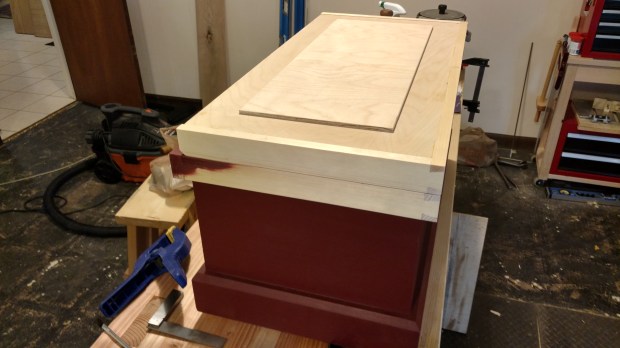
It’s probably clear from the picture above, but that’s just a 1/4 piece of home center birch plywood face glued to a 3/4 piece of home center birch plywood.  It’s a trick from Christopher Schwarz’ A Traditional Tool Chest in Two Days and it is fantastic.  I can use plywood here because the chest has a proper dust seal (that works like edge banding and hides the ugly plywood edges).

img_20161014_202853097_hdr.jpg

Seen here (2/3 scale).

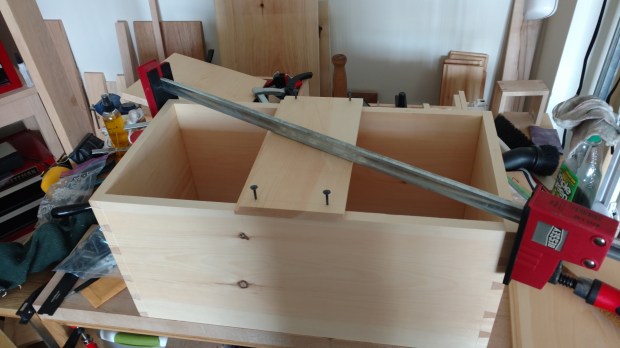
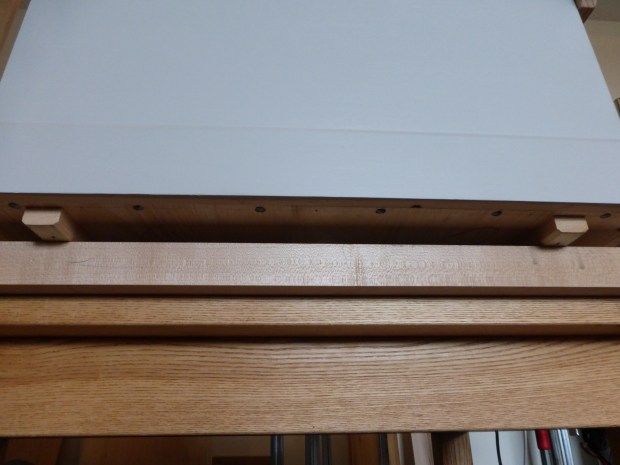
The benefit of plywood (in addition to the ease of “raising” a panel) is the full length glue-up on all three sides of the dust seal.  There was a bit of twist in the dust seal, but the weight of the clamps was enough to press it flat while the glue dried.

img_20161016_130124330.jpg

Gravity is a wonderful thing, when applied correctly.

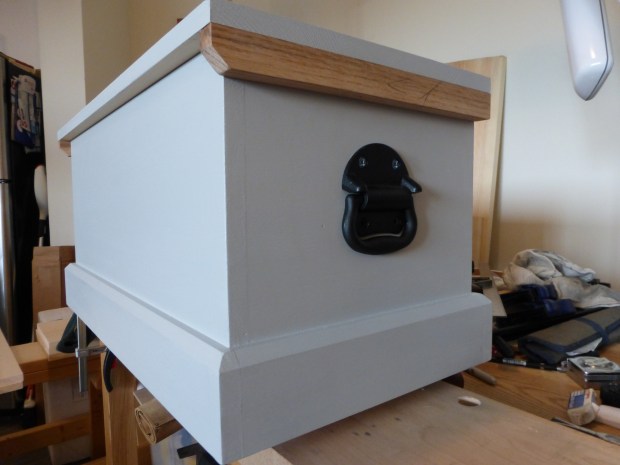
Even with the strength of a full length glue up, I plan to nail the dust seal into place.  I am also yet to level the top seams and fill the back edge of the plywood (with water-based wood putty).  Then it’s painting time.

img_20161016_171516014_hdr.jpg

My buddy thinks it looks like a coffin.

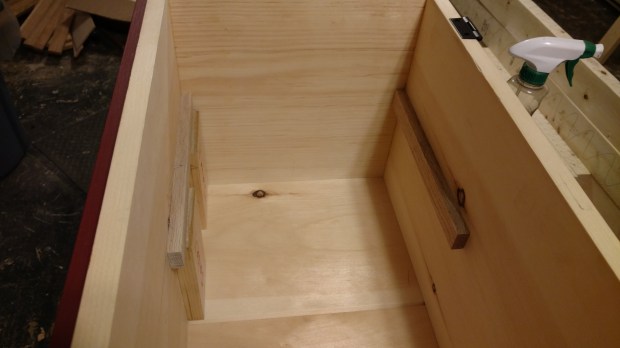
What I haven’t figured out is what to do with the inside of the chest.  On the last incarnation, the full length sliding tray didn’t really have room to slide and totally blocked access to the tools below when in place.  On this version, I might hang a stationary (but removable) till on the inside left.  Something large enough to hold all the odds and ends for on-site woodworking, but not so big that it blocks the well entirely.  That plus a wall rack with 1/2″ holes on 1 1/8″ center should be plenty of storage.

And there is the small matter of how to attach the handles.  Oak runners for sliding tills usually reinforce the side walls enough to use iron chest lifts.  I either need to attach more wood to the inside of the chest, or make rope beckets to screw in from both outside and inside.

Neither option is ideal, but one is clearly easier.

JPG

A Proper Foundation for Dining

Many moons ago, when I first moved into my old apartment, the first order of business was getting my sturdy dining table ready for clamp on workbenches.  Two years later, I’ve moved, and now that I have the space for an actual workbench, it was time to get my sturdy dining table ready for use as an actual dining table.  That meant stripping the finish and reflattening the tabletop.

wp-1476097103453.jpg

And also replacing the plywood shelf with ash.

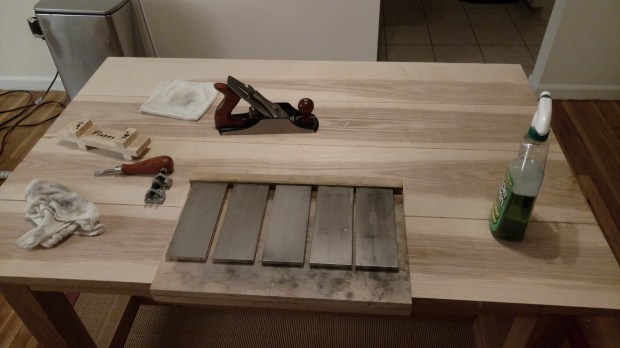
Ash is quite porous, and the tabletop had soaked in quite a bit of steel slurry and rust particles over its life as a quasi-workbench.  Plus, the Danish Oil finish had fully cured.  As a result, there was nothing to do but have diamond plates on hand for frequent sharpening.  Two hours, half a garbage can of shavings and about ten resharpenings later, the tabletop was tried and true.

wp-1476097110835.jpg

Fun fact: this rug was supposed to be under the table in my old apartment.

It had been a long time since my No. 4 1/2 got a decent workout.  I ordinarily use it only for panel smoothing.  All that resharpening allowed me to work on the blade geometry a bit, getting it mostly straight with a slight camber at the edges (as opposed to a full camber across the entire edge).  When it was time for final smoothing, though, I re-instituted a continuous camber.

wp-1476097119672.jpg

This was sharpening #11.

Ash being a fickle mistress, there is significant tearout at one corner (far right, above), but I’m not so concerned. It’s meant to be a rustic piece. Before I refinish the tabletop, however, I will give it a once over with a tool I haven’t used in ages: the random-orbit sander.  Half an hour at 150 grit should clean up any remaining traversing marks that didn’t come out from smoothing.  I also dressed the long grain edges of the tabletop, just because.

wp-1476097123380.jpg

The top is actually glued down, long grain to long grain.  No splits yet.

I can’t wait to show everyone the new workshop (spoiler alert: it’s larger than a dining nook).  I’ve been making new kitchen cabinet shelves for the new place (the old ones were warped and gross), so it’s high time for a real furniture project.  But everything in due time.

wp-1475783288745.jpg

RIP old shop.

JPG

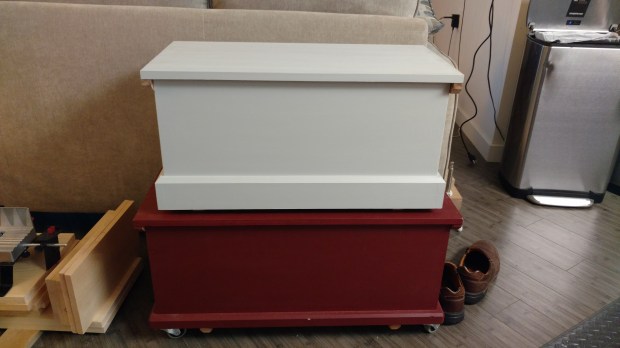
One of these…

…is not like the other.

wp-1472588368496.jpg

At least it will be, soon enough.

I’ve spoken before about how pleased I am with the overall size of this 24″ x 12″tool chest.  It fits everything I need for off-site projects (except for a panel saw, but whatever) and remains portable.  On this, my fourth overall traditional floor chest, I am going back to the full dust seal.  Which means, first of all, a dovetailed upper skirt.

wp-1472588373573.jpg

Fewer dovetails means less work (in theory).

I’ve also decided to paint the full carcase before I attach the handles or make the lid.  And speaking of lids, I am so enamored with the plywood “raised panel” lid from Christopher Schwarz’ Build a Traditional Tool Chest in Two Days, that’s the approach I’m taking here.  Albeit with a 1/4″ raised panel.

wp-1473111898736.jpg

I’m also using Tuscan Red again.

There’s been a lot going on, but posts should become more frequent.  More on this tool chest next week.

JPG

Version 2.1 – Phase II

One consistent feature in all of my various English tool chests is the lower skirt.  The end grain on ship-lapped floorboards is so ugly to my eye that I add a dovetailed skirt to hide the crime even on rabbeted and nailed chests.

wp-1471835101717.jpg

Nearly identical to the last one.

I’m particularly proud of the dovetails on this chest, both on the carcase and the loqwe skirt.  For the first time, though, there is a pretty noticeable gap at the corners on the short sides.  My base lines just weren’t tight enough, which makes me think my marriage marks got mixed up while fitting the skirt.

wp-1471814639338.jpg

At least the front and back skirt are gapless.

I am hopeful that a generous slathering of milk paint (black or red, this time) will fill those gaps enough for piece of mind.  This chest is for my personal use (the last one is finally going to a friend), so I’ll pretend not to care as much as I otherwise would.  It’s pretty much my only option at this point, other than prying it apart.  Clamping the crap out of the skirts during glue up certainly didn’t do the job.

wp-1471814635841.jpg

Nor is this the best picture I’ve ever snapped.

Hopefully I’ll do better on the upper skirt.  Oh yes: this chest will have a full dust seal.  Mostly to hide the end grain on the “raised panel” plywood lid.

JPG

A Familiar Scene

Here I find myself again: tons of nails to drive and too many neighbors to drive them all at once.

wp-1471204709447.jpg

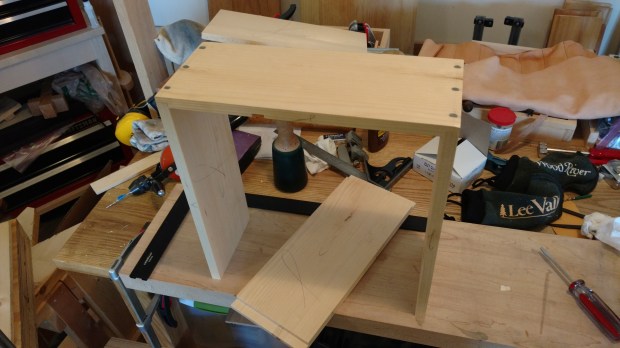
I needed some nails on 2″ center to flatten out the tongues at the joints.

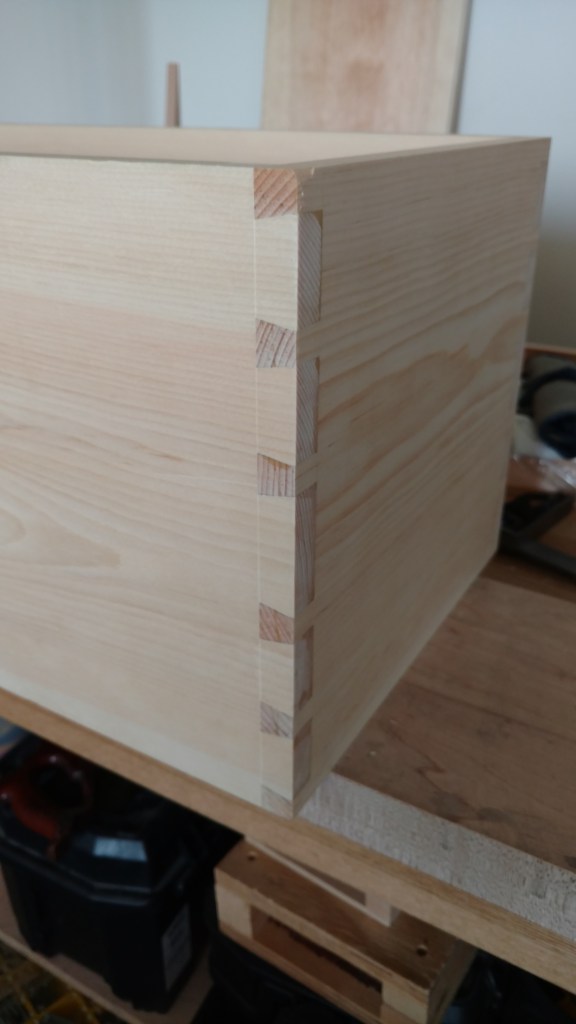
I’ve been making a second traveling tool chest.  The dovetails on the carcase came out quite nicely, although the large tail in the middle did not close up completely to the baseline in two corners.  Some water-based putty will fix that, no problem.

wp-1471204729507.jpg

Dovetail pr0n.

I’ve pretty much locked down my process for cutting ship-lap joints for floorboards.  After scribing the base line with a marking gauge, my DIY rebate plane does most of the work, then I finish up with a router plane.  I guess I could build a depth stop for the rebate plane, but that would make too much sense.

wp-1471204733551.jpg

Why use one tool when you can use three?

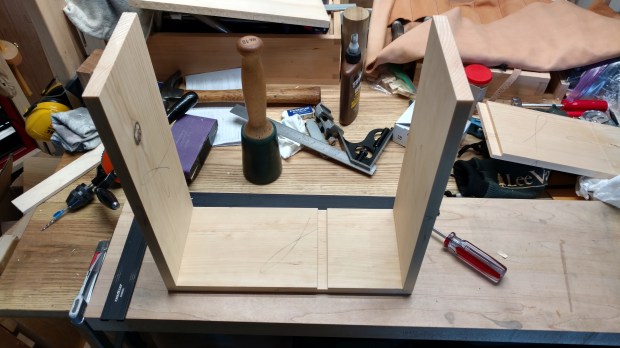
For the first time in a while, the carcase was not square, so I had to clamp it into square.  It’s still probably 1/64″ out, but I can live with that if you can.

wp-1471204713911.jpg

Seriously, I can.

Next up is the dovetailed skirt.  This tool chest will have a 3/4″ plywood lid, so I should probably buy some black milk paint soon.

JPG

Head Over Heels

Every time I get to a certain point on a project, I ask myself the same question: should I stick with the plan or go in a completely different direction?

I had built this whole project with the idea of putting the video game cases on the bottom and the drawer for controllers on the top.  But that would be stupid, because the drawer would be above eye level.  My solution: flip it 180 degrees.  So it goes in a literal different direction.

wp-1470526126452.jpg

Because why not?

The cleats are more for hanging than anything, and it’s not like they are asymmetrical anyway (having foregone a french cleat in my design).  With the drawer on the bottom, the bottom shelf can immediately be used for holding controllers (because the cleat acts as a stop).  Plus, the game cases fit so tightly on that shelf it doesn’t matter whether the clean (which is also a stop) is on the top or the bottom.

Problem solved.  Not it just needs some paint, before I whip up two more as presents.

JPG

Small Victories

Sometimes I get a little impatient in my woodworking.  Case in point, a random dovetailed pine box I had always meant to section off for nail and screw storage.  Instead, it’s become a rabbeted and nailed box.

wp-1470433702381.jpg

Most of one, anyway.

But I started nailing it together before I cut the rabbets for the dividers.  Lucky for me, I had a stroke of genius: make a single shelf (for a drawer) and hang it on the wall.  And what do you know, it not only fits console game cases on the bottom shelf, but the drawer will be large enough to hold console game controllers.

wp-1470433706050.jpg

Amazing how that works out.

Since I had already nailed on two sides before I started cutting the rabbets, I couldn’t use a chisel other than in the vertical position.  My solution: use a block plane blade.  Surprisingly, the joint fits tight enough for the application.

I will post some pictures of the finished project when I’m done.

JPG

Travel Tool Chest Retrospective

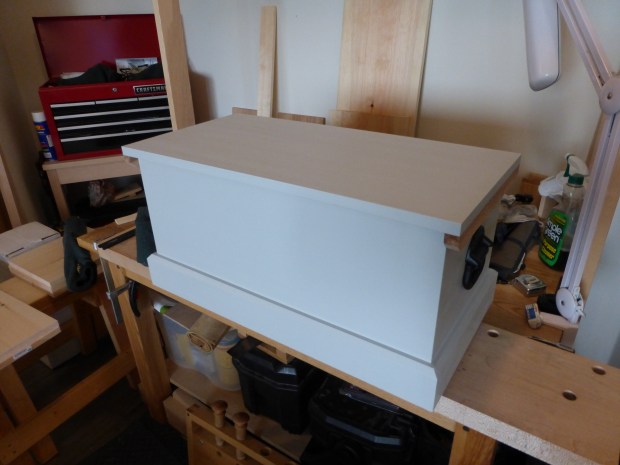
The final coat of paint went onto the travel tool chests over the weekend.  Net net: I am very pleased.

P1000320

The color is still a little blue for my taste.

For the first time in a long time, I have nothing bad to say about a completed project.  At least nothing bad to say about the design or the concept.  There is always something bad to say about my execution of the aforesaid (the lid is not on straight, yet again).  So rather than do my usual pros and cons, I will talk about what I’ve learned on this project.

  • Geometry is a thing.  The dimensional difference between this tool chest and the original traveling tool tote is ostensibly minimal.  Compared to its predecessor, it’s 4″ shorter in length, barely 2″ less in width and essentially the same height.  But when we’re talking inches cubed, that adds up to a lot.  This thing is truly portable.  Filled to the gills, it’s not even a chore to carry around.  I’ve finally made a replacement for my nylon tool box.
wp-1469578005282.jpg

Doesn’t look like much, but do the math and you’ll see.

  • A wide skirt is a better skirt.  On my original traveling tool tote, the skirt was only 1.5″ wide.  With the 45″ chamfer, it’s basically all corners and has gotten beat to hell. In version 2.0, the skirt is over 3″ wide: quite a bit of surface area for deflecting blows.  Unlike its forebear, the skirt is a bit out of proportion to the lid.  But this is because I had meant to do a full dust deal (of approximately equal width to the skirt) and just got lazy in the end.
P1000321

Durability > all.

  • No casters for small tool chests.  The casters have worked out really well on version 1.0 and I meant to add casters to this project.  But I didn’t.  For two reasons, really.  The first is the spacing on the die-forged, headed nails holding on the floor boards precludes the caster feet from seating properly at the corners.  The second reason doesn’t really matter, does it?  At least it won’t roll around the trunk of car in use.
P1000322

These will have to do.

  • Grey is not for tool chests.  Or is it gray?  I don’t know anymore.  At least it’s easily distinguishable from my other tool chests.
P1000329

That’s the “sliding” tray to the bottom right.  It has about 1″ of travel.

I plan to immediately make another one of these (and this time, paint it black).  More on that later, though.

JPG

Basic Project: Rabbeted/Nailed Box

Today’s basic project, a rabbeted and nailed box, is a sub-project of my new traveling tool chest.  Although I alternate between through dovetails and rabbets/nails for carcases, when it comes to sliding trays for tool chests, I always go for rabbets/nails.  It’s faster, holds almost as well, and is a great way to practice hand-cut rabbets.  The project can be scaled to any length, width or depth you desire .  The tray pictured below is 8″ wide and 22 1/2″ long by 4 1/4″ high (4″ not including the tray bottom).

wp-1468700479189.jpg

Easy as can be.

moving fillister plane (with scoring spur) is great for cutting cross-grain rabbets, but I still enjoy the hell out of hand-splitting rabbets.  Hand-splitting is definitely not faster than using a dedicated plane, although in my experience it can be more accurate both in terms of depth and shoulder squareness.

Materials and tools for this project were as follows:

Materials:

Carcase ends:  4″ x 8″ x 5/8″ eastern white pine
Carcase sides: 4″ x 22 1/8″ x 5/8 eastern white pine
Tray Bottom: 8″ x 22 1/4″ x 14″ red oak
Carcase Nails: Dictum 40mm door nails
Bottom Nails: Tremont “Fine Finish” cut nails
Hide Glue

Tools:

Wide chisel (I used 1″)
Chisel Mallet
Marking Gauge
Router Plane (if you don’t have one, you can just use a chisel)
Dividers (a ruler and awl will work just as well)
Hammer

After you’ve prepared the pine stock for the carcase, first set your marking gauge to the thickness of the carcase sides.  Mark the inside face and the sides of each end board.  Then reset your marking gauge to exactly half the thickness of the end boards and finish laying out the rabbets on the end boards.  Chop the rabbets with the wide chisel, same as when making a dado.

wp-1468700445889.jpg

Until your relief cut gets down to the line.

Next, split the rabbets, just like you would with a tenon.  Keep an eye out for grain direction and don’t be afraid to leave a little bit of waste to paring away later.

wp-1468701582418.jpg

It’s nice to use a metal vise once in a while.

When you are reasonably close to your gauge lines, break out the router plane.  I recently upgraded my small router plane, which I unboxed just for this operation.  Set the depth to your gauge line and pare the rabbets to depth.  A chisel works just as well if you don’t have a router plane: just go slowly and pay attention to your depth lines.

wp-1468700465785.jpg

An huge upgrade from my previous small router plane.

At this point, you should have all four rabbets cut and parallel, resulting in two identical end boards.  If for any reason the shoulder lines on the two boards aren’t identical, pare down the shoulders until they are.  Cut the carcass sides to length, square up the ends and get ready to glue and nail the boards together.  Pre-drill your nail holes and assemble the carcass with glue and the 40mm door nails.  Three at each corner should do the trick.

wp-1468700473804.jpg

Level the seams if you have to (I did).

Once the glue is set, it’s time to attach the tray bottom.  A bit of glue on one carcase side will control the direction of expansion and contraction.  Assuming the tray carcase is leveled, clamp the tray bottom and tray together (against the bench) and pre-drill your nail holes every 3-4 inches or so.  I like headless cut nails for tray bottoms, so be sure the nail is oriented with the grain to prevent splitting.

wp-1468702301504.jpg

Add nails along all four sides.

The ends of a tray bottom in a tool chest extend slightly beyond the ends of the carcase (for clearance when sliding), but you should at least level the bottom to the sides of the carcase.  If you are making a stand-alone tray, skip the overhang and flush the bottom perfectly to the carcase on all four sides.

And there you go.  As Christopher Schwarz would say, when done right nails are not “second class joinery”.  They can be beautiful and functional.  And very quick to throw together (the above box took less than 3 hours, including stock preparation by hand).

JPG


You Get What You Pay For

The roll of cheap adhesive-backed cork purchased online for the floor of the new traveling tool tote was exactly that: cheap.  The adhesive was not uniformly sticky and kept curling up in places.  My slightly less permanent solution: foam drawer liner and spray adhesive.  This should provide comparable, if less durable, cushioning.

wp-1467978455547.jpg

And it fits much better than the cork did.

Speaking of durability, I started painting the chest with Seagull Grey milk paint.  The first coat looked a bit too blue for my taste, but has since flattened out in the second coat.  I don’t do a ton of finishing, but I’ve done two things differently this time around.

First, I did not attach the handles to the chest prior to painting, although I did punch alignment holes.  The traveling tool tote was in service before it even got painted and I did not remove the handles for that operation.  I will assume this was part laziness and part fear the screws would lose their bite when reinstalled.  Painting is so much easier without curvy obstructions, it turns out.

wp-1467978451801.jpg

See?  Baby blueish.  

Second, I am painting the carcase before the lid is attached (or even made, for that matter).  See the above comment re: obstructions.  I also took the time to properly mask the inside of the lid, which did not stop me from dripping a big glob of paint on the inside of the chest.  That little accident cleaned up okay with multi-surface furniture cleaner and will hopefully be hidden by the tools in the wall rack.

I have neither the oak for the tray bottom nor the pine for the tray sides on hand.  Those will be acquired over the weekend (from the home center and from my stash at my parents’ house, respectively).  The width of the tray is still TBD.

And there is still that pesky lid to make.

JPG