small projects

Deviating from the Norm

There has been much going in lately: both in the world and in my own life. Though it all, I’ve been wrapping up some projects and figuring out where to go next.

I have serious need of some indoor plant stands and keep vacillating over the design. So much, in fact, that I’ve decided to go in a different direction.

Osborne Wood Products has begun selling hairpin legs, in 18″ and 29″ heights at very workable prices. I expect some roughly 19″ square maple slabs will be more than sufficient and aesthetically pleasant, but I’ll wait until the legs actually arrive before preparing any stock. I do have just the material, though: some 6/4 rough-sawn hard maple.

JPG

More on Shop-made Rebate Planes

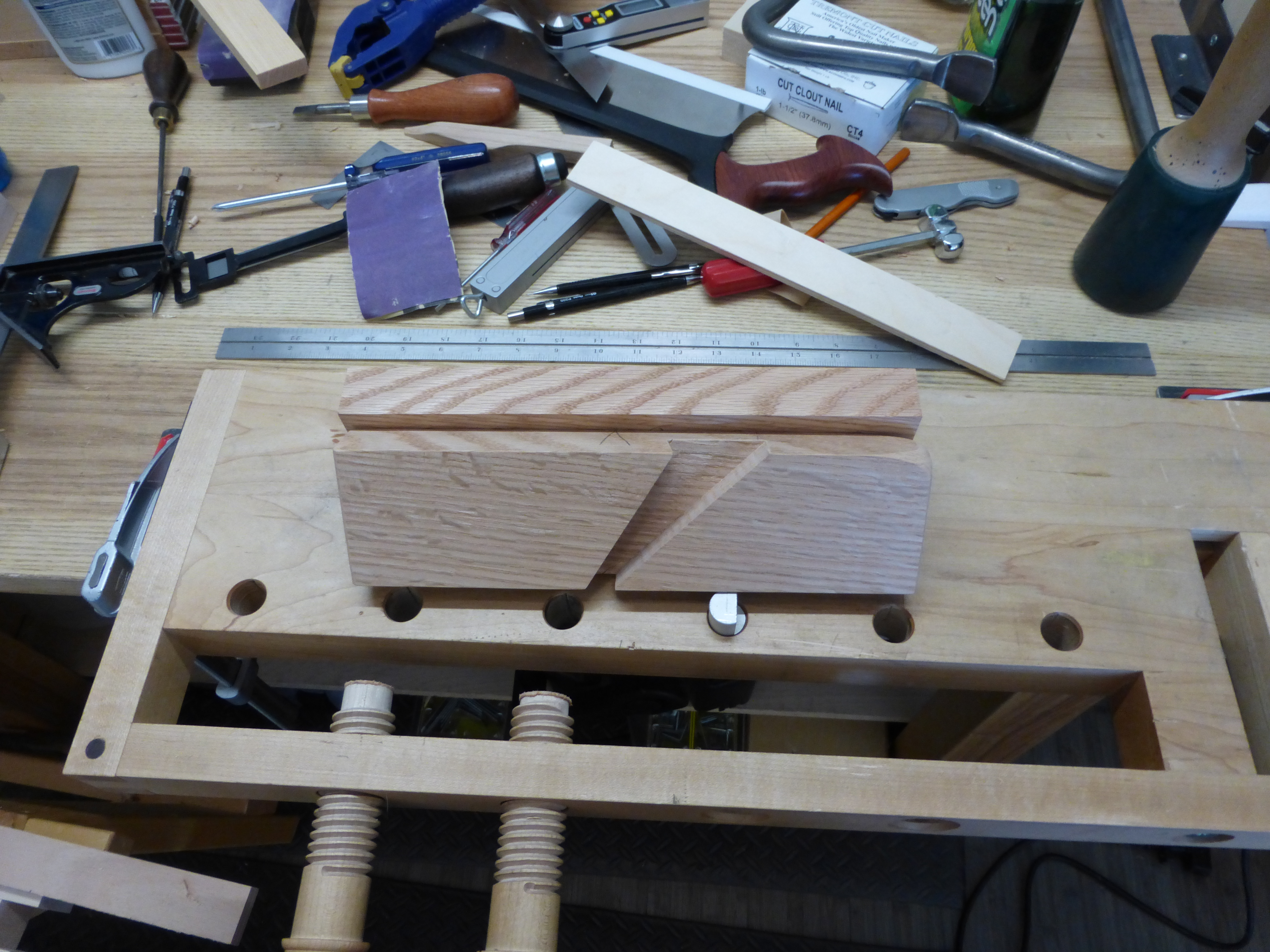
Attaching the fence to the right-hand rebate plane wasn’t nearly as difficult as expected.  I approached it like I would a drawbore, by first drilling the pilot holes in the fence, then using the same brad-point bit to transfer those holes to the body of the plane.  After that, everything came together nicely.

P1000239

I did drill all the way through the backer board into the dining table, but that kind of thing happens once in a while.

The above photo shows the fixed fence at max extension (5/8 inch).  I am yet to elongate those holes to permit the fence to adjust to take a narrower cut, but that is just a question of marking and chopping out two slots in the fence.  After the fence is fitted, I’ll recess the scoring spur and the whole thing will be ready for a coat or two of Tung Oil.

I did take some quick test cuts with the fixed fence and was quite pleased.  I’m assuming the slight slope at the edge of the rabbet is due to my unfamiliarity with proper fillister plane technique.

P1000241

Product placement!

I hope to start work on the left-hand plane this weekend.

JPG

Making Replacement Wedges

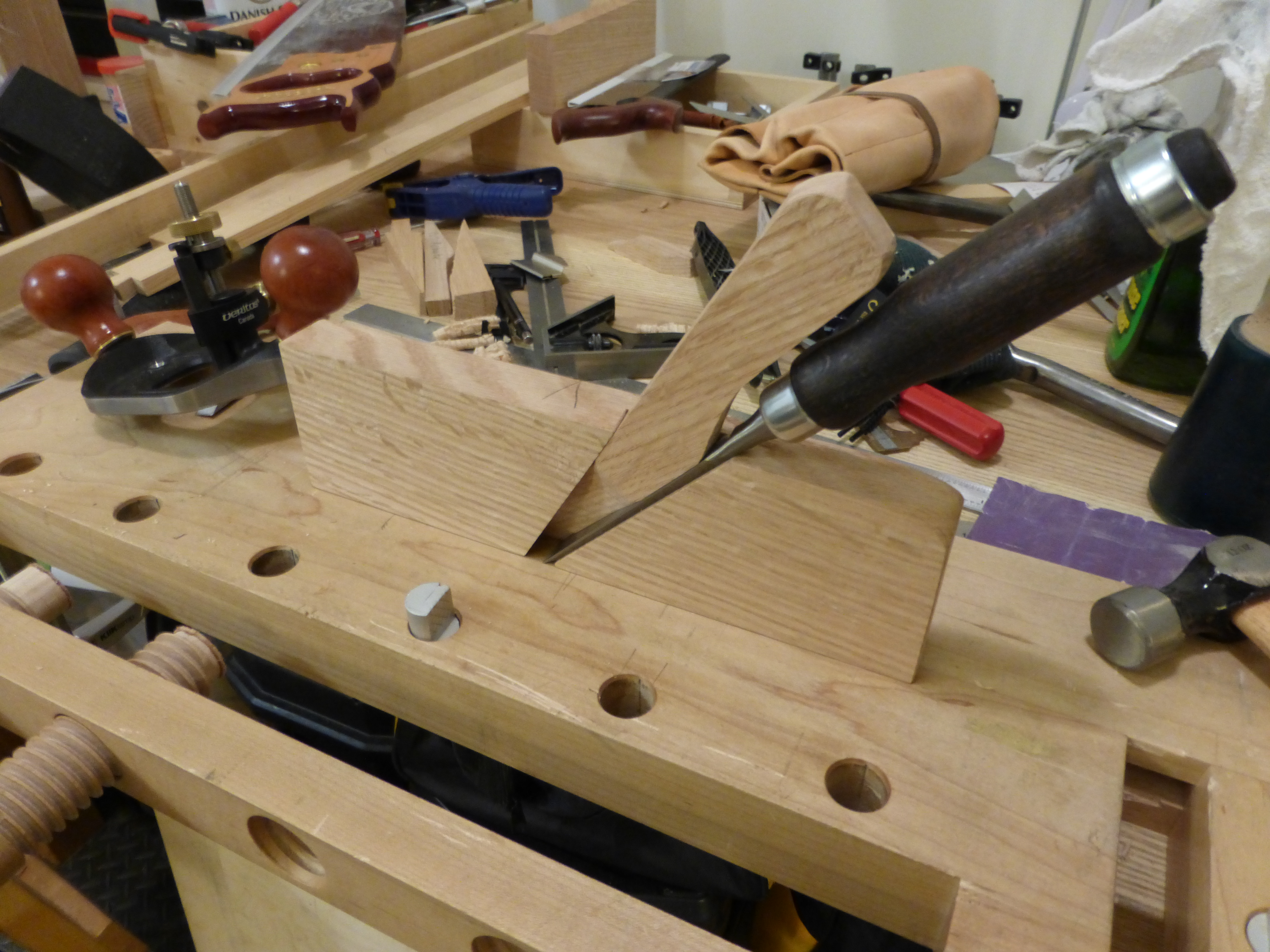
When I deepened the recess on the set of poor man’s rebate planes to accept a 5/8 inch bench chisel, the initial 1/2 inch wedge for the right-hand version became useless.  This presented two issues: (a) the bed angle itself was sized against the old wedge, so the new wedge must be custom fit; and (b) there had to be an easier way to get the correct bevel than just starting from a four square blank and planing down.

In addition, there was the problem of not having any 5/8 stock, but I fortunately had enough remaining quarter-sawn red oak to resaw some wedge blanks.  Plus, the waste from the resaw, at just over 1/2 thick, is probably usable for something else.

Taking my time, as there is little margin for error.

Taking my time, as there is little margin for error.

The initial recess was marked against a 1:4.5 angled wedge (as recommended in the Paul Seller’s video), but after all the trimming and refinement of the bed, I think it’s now closer to 1:4.  Also, I tried marking the actual bevel angle directly on the blank and rip down along that bevel.  This gave me matching right and left wedges (for the matching right-hand and left-hand planes) that need less work overall in refining the fit.

Perfect fit!

Perfect fit!  Now to make the fence.

I’m excited to finish up the fence and put the right-hand plane to work (after I figure out the best way to attach the scoring spur).  I might even buy a second 5/8 inch Narex chisel so I don’t need to swap back and forth once the left-hand plane is done, but we’ll see.  Here’s hoping using quarter-sawn hardwood will increase the longevity of the planes.

All in all, it’s been a good exercise, and very enjoyable learning basic plane-making.  I’m certain the left-hand version will come out even better than the right.

JPG

Home-made Rebate Plane

I, like most woodworkers, have a Lee Valley/Veritas wish list.  For some time now, just sitting in the “Purchase Later” section of my shopping cart, has been a skew rabbet plane.  In fact, it is next on my list of impulse purchases.  Or at least it was, until today.  Because I’ve decided to make my own rebate plane instead.

Well, two, technically.

Well, two, actually.

If you haven’t already, I highly recommend creating a free account at Paul Sellers’ Woodworking Masterclasses.  There are paid project videos, but there are also free-to-watch how-to videos on a wide range of topics.  One installment in the “Poor Man’s” woodworking tools series is a rebate plane that uses a chisel for a plane iron.

I had some lovely quarter-sawn red oak scraps laying around the shop, so I decided to try my hand at planemaking.

Actually quarter-sawn

Actually quarter-sawn.

The first rebate plane came out so well that I decided to make both right and left versions.  The right version originally used a 1/2 inch Narex bevel-edged chisel, but I decided to increase to 5/8 (for both aesthetic and practical reasons), so I need to make a new wedge.

Both versions will have an adjustable fence.  The right version will also have a nicker (or “scoring spur”) made from a re-purposed (read: chipped) wheel marking gauge cutter, for cross-grain rabbeting.

Suffice to say, I now have a Lie-Nielsen wishlist that includes a set of planemaker’s floats.

JPG

A Very, Very Serviceable Prototype

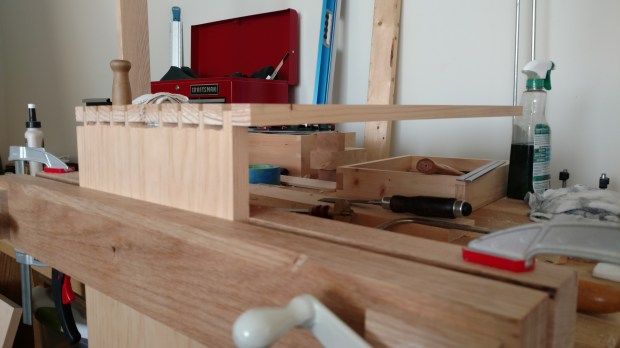
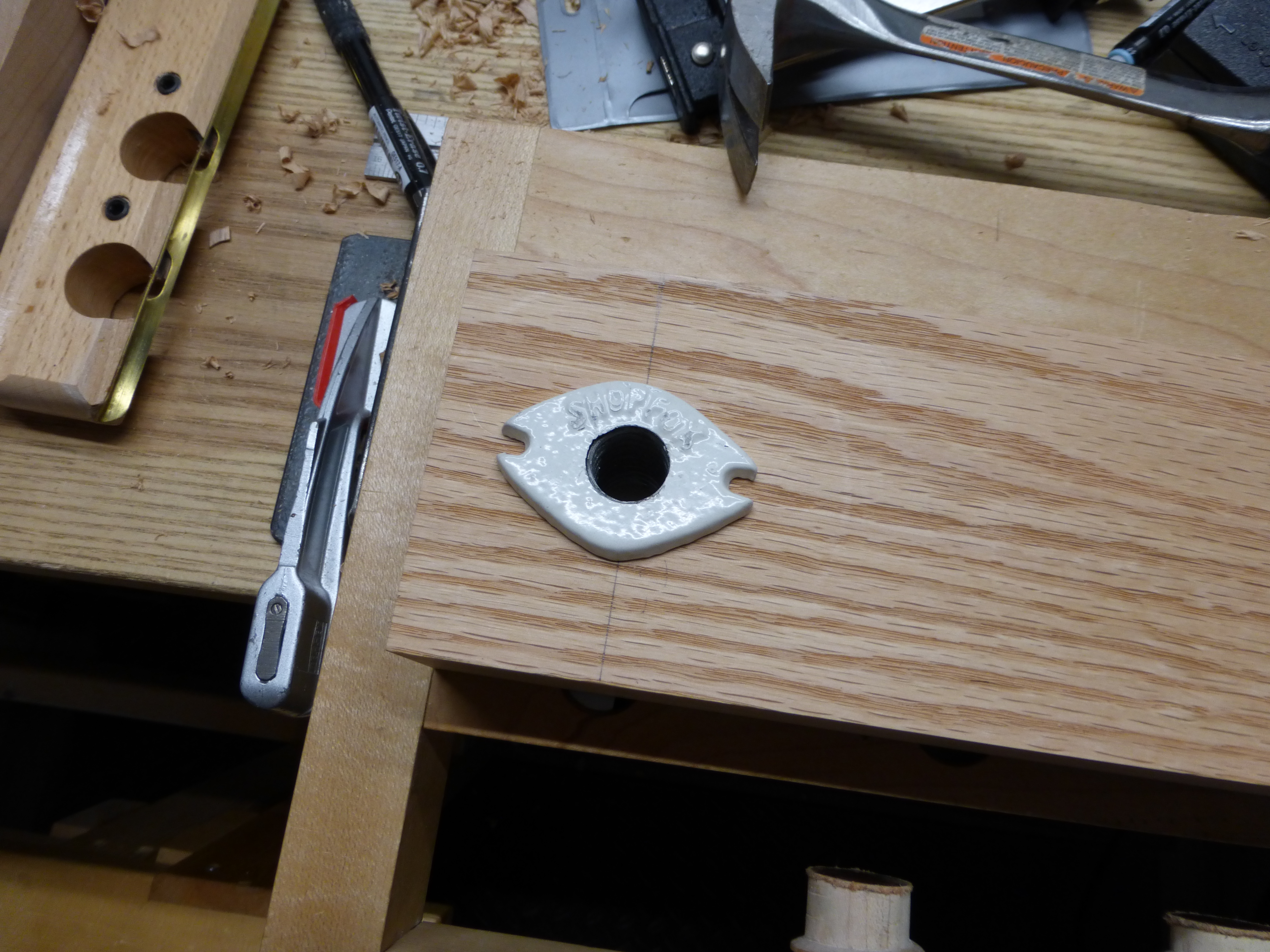
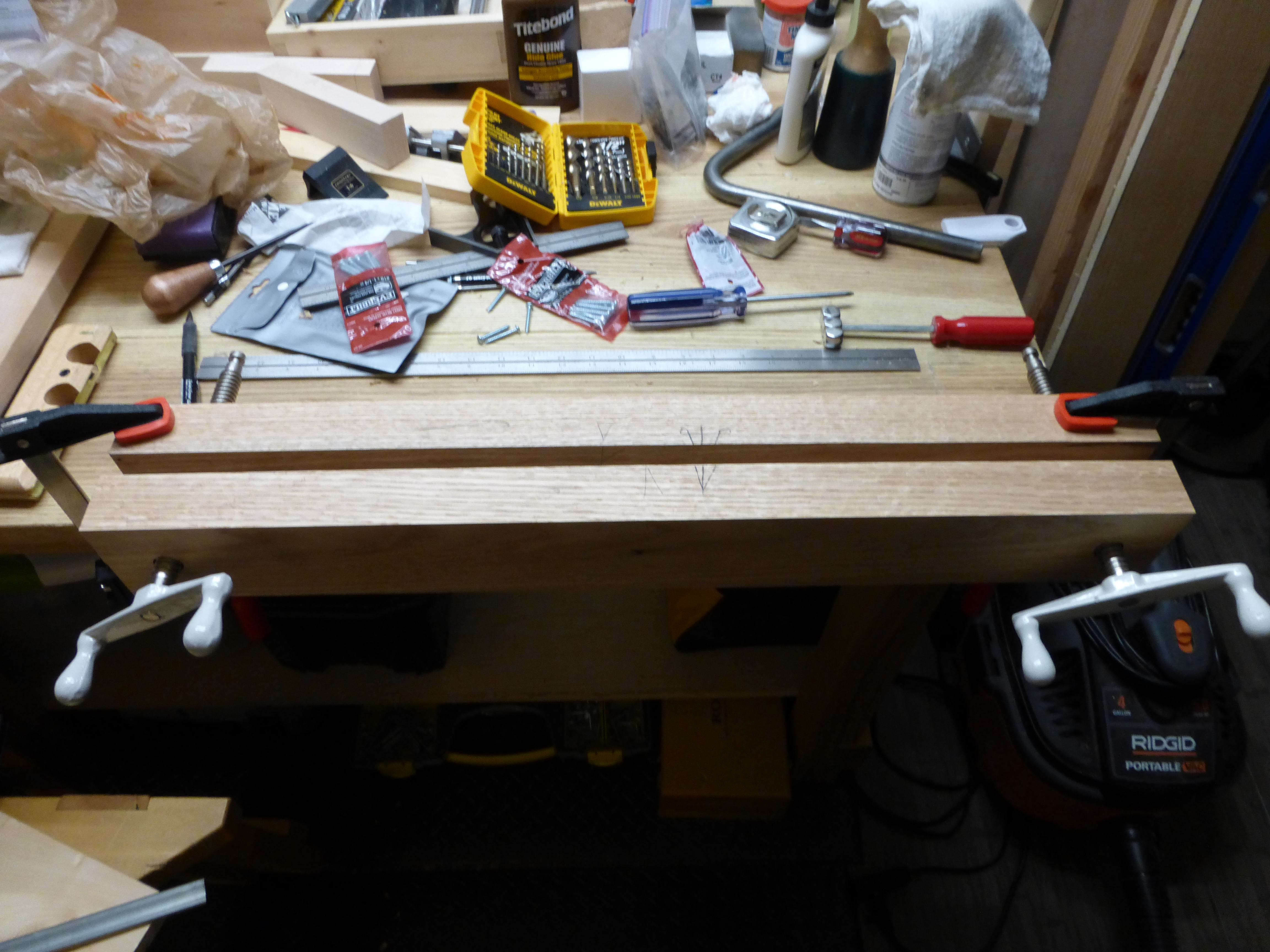
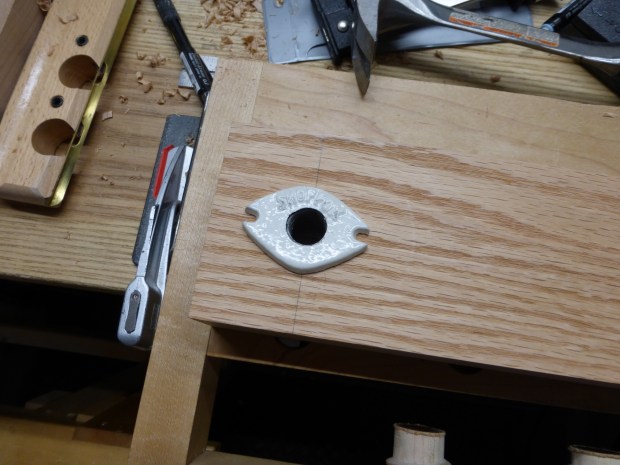
For more almost a week now, I’ve been mulling over the plan for using veneer press screws and some reclaimed red oak to create a moxon-style vise.  I was rather resigned to chopping out recesses for the collets by hand, until I had an idea.  The collets themselves are a little over 1 inch in diameter, with some ridges that increase the overall width to just over 1 1/8 inches.  So using a 1 1/8 inch forstner bit (the same one used for the 1 1/4 inch wooden screw threading kit from J&J Beall), I drilled a “mortise” all the way through the back vice chop and drove the collets into place with a mallet.
P1000209

Nice and flush(ish)!

There are some gaps on the inside of the mortise, which I will likely fill with epoxy to seat the collets permanently into the back chop.  For now, though, some No. 8 screws do the trick to lock the collets in place while I finish the vise.

P1000211

The roundover is more out of habit than necessity.

I then threaded the press screws through the collets and used the sharp tips on the ends to transfer the hole locations to the front chop.  The holes in the front chop are 3/4 inch, while the screws themselves are just over 11/16, so I will wrap the screws with some electrical tape to tighten up the fit on the front chop.  Then it was time to test fit.

P1000214

Surprisingly quick to come together.

The last component to the moxon vise is a set of spacers which glue to the outside of the front chop.  They prevent the spinning handles from rubbing against the front chop.  I had some scrap 1/2 inch oak left over from the medium tool chest drawer runners which came in handy.

Glued down, though I may add screws as belt-and-suspenders.

Glued down, though I may add screws as belt-and-suspenders.

And that’s it.  After the glue dries, I will round over the exit holes on the spacers, break the corners all over and chamfer the top of the front chop.  I hear the chamfer creates clearance for handsaw cuts. Then I will test out the vise doing vise things.

The amazing part is that the entire vise build (other than driving to/from my thickness planer and glue drying time) only took about 3 hours of shop time.  That includes stock preparation.  Very doable overall, and not bad for a first attempt.

The finished build (pre-chamfer).

The finished vise (pre-chamfer).

JPG
Tiny Mortises (Part 2)

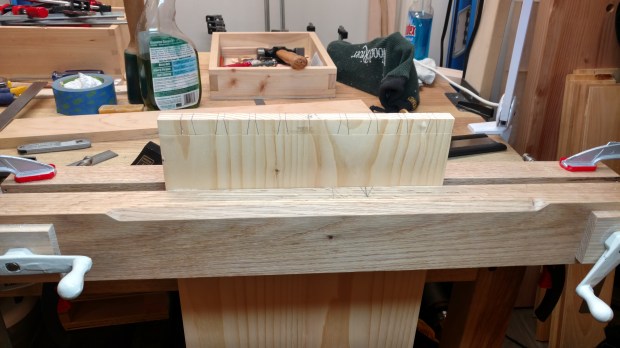
Does anyone own a 1/4″ mortising chisel?  I sure don’t.  Chopping tiny mortises for the breadboard ends of a marine cutting board for my father’s boat was a bit of a chore with only a 1/4″ bevel-edged chisel.

P1000148

They are done, at least.

The worst part was the inability to lever out the waste between chops.  A 1/4″ bevel-edge chisel is just too flimsy for aggressive levering, so I ended up using a square awl to clean out the waste between chops.  Definitely slowed down the process.

I also had to lengthen the mortises after they were initially cut, but that wasn’t too bad.  I just sawed down the walls (as if I were cutting a haunch) and then banged out the waste with heavy chisel chops.

Now it’s time to cut the tiny tenons.  I wonder, though, will drawboring work with an elongated hole the same way simple doweling does?

JPG

Solving Problems

Making a marine cutting board with breadboard ends and don’t own a plow plane?

Solution: tiny mortises (with drawbores).

Yes.  It's a mortise and it is tiny.

It’s a mortise and it’s tiny.

Two down.  Two to go.

JPG

Christmas in June?

The Woodworking Masterclasses video course on the housing joint carrying tote is one of my favorites.  Not sure if it’s Paul Sellers in a santa cap or the beautiful simplicity of the project, but I’m a big fan of this particular set of videos.  I watched it the other day, so one of the techniques Paul Sellers teaches in those videos was fresh in my mind and of use today.

The tabletop for the angled leg side table will consist of two 24″ x 12″ boards cut from the same piece of 1″ pine.  As a result, I can use the double knifewall method shown in the housing joint carrying tote video.  By sawing between the scribed lines, each end has its own knifewall to plane down to, guaranteeing square ends and eliminating chipping from the saw cut.

I haven't used this knife in a while.

I haven’t used this marking knife in a while, either.

I don’t crosscut boards this wide very often, so it was nice to use my 22″ crosscut panel saw and some saw benches for a change (instead of my usual carcass saw and bench hook for smaller crosscuts).  Using my least twisted, flattest piece of premium pine for will hopefully mean there won’t be a ton of mill work to be done once the boards are cut to length.

Mid-cut, for illustrative purposes.

Mid-cut, for illustrative purposes.

On a side note, the table will end up overall 1/4″ shorter than it is wide/deep, which will allow me to use those felt furniture pads to get it back to cubed overall.

JPG

Another Benchtop Appliance

The wood is acclimated and the veneer press screws were delivered a while ago, so I think it may be time to finally make that bench top joinery bench. I’ve always liked the plans and I think there is some room left in a corner of the shop where it can live when not on the bench.

Maybe

Maybe

I wonder, though: is it worth including any storage underneath?  I think I’d add a drawer (or maybe just a sliding tray) to hold my dovetail saws and coping saw (and spare blades).  Not sure it’s practical to store anything else in a mobile joinery bench.

Either way, my “clamp-on worksurface” collection might be getting out of hand.

JPG

In the Here and Now

Having finally cleared a couple projects from the queue, I can now get around to that plant stand I designed a few months back. Its lower priority was due to the presence of a suitable placeholder, certainly, but also because of a personal flaw I often struggle with. I find it difficult to focus on a single project from start to finish. I get distracted regularly, sometimes to the detriment of timeliness.

The rough stock for the plant stand was ripped quite a while ago. The design, with some minor tweaks from the original, has been locked off for almost as much time. But things kept coming up (work, life, other projects) and the build was always delayed. But now I’m back on task – for now, anyway. A couple more hours of planing and I’ll be ready to hit the thicknesser and move onto joinery.  As a bonus, I used the planing slab for the first time in a while.  The planing slab is still flat, which is nice. And that Veritas Inset Vise is such a joy to use.

P1000075

I think I need to tweak the orientation of the planing slab to the work table.

Also, I’ve said it before, but hard maple is hard.  Especially the stuff for this project: air-dried, riftsawn, tight-ringed Vermont sugar maple. After only S2S’ing these boards, I sure am grateful for my thickness planer.

wpid-20150519_074128.jpg

A jar of Vermont Maple Syrup died so that this plant stand may live.

JPG