tips and tricks

Words to Cut Joints By

Admittedly, my previous post was a bit harsh.  Without any remorse and sans even one iota of apology to the douchenozzles in question, I concede that things got a little out of hand on Friday.

I like to keep it pretty highbrow around here, so let’s talk about one of my favorite joints: the cross-lap joint.


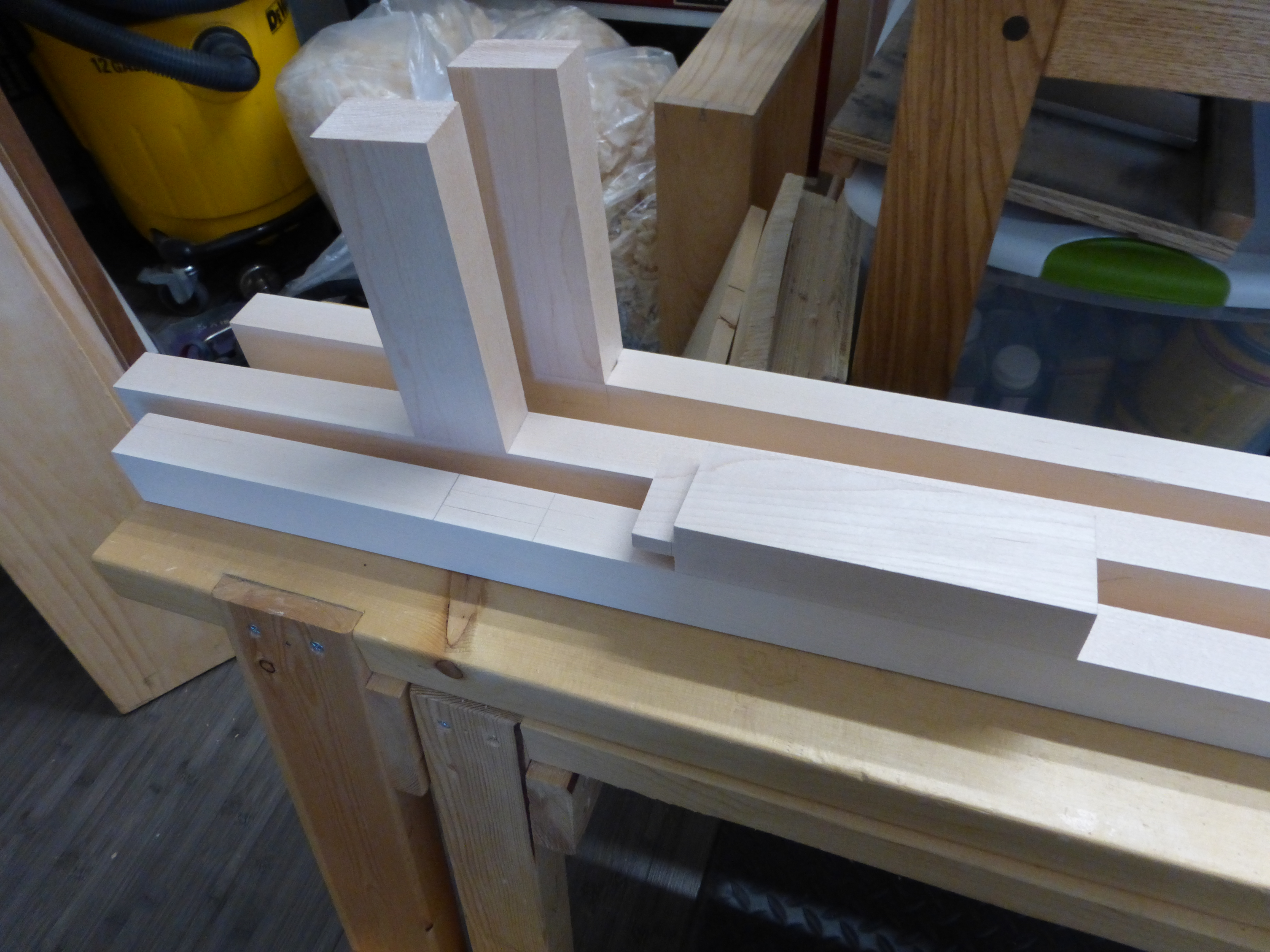
The cross-lap joint is all about precision.  In its simplest form, two pieces are joined to form an overlapping “T” through two dadoes.  Each dado must be precisely sized to snugly fit the mating piece and (usually) the combined depth of both dadoes is equal to the thickness of one of the pieces.  This precision is achieved, first and foremost, through careful layout.

For me, the most accurate way to mark each dado is to scribe an initial line with a marking knife and, leaving the square in place, use the mating piece to transfer the dado width.  I tend to mark my dadoes about 1/64″ narrower than the mating piece when working in softer woods.  In harder woods, it might be only a few thousands of an inch.  I then transfer the width lines to the sides and scribe my depth line normally.

Unless the boards are wide (6″ or more), I will use a tenon saw to establish the outside walls and then chisel out the waste to just above my depth line with stabbing motions.  On twider boards (or in the case of stopped dadoes), I may only establish the show faces of the walls with a saw and the do the rest by chisel.

P1000258

I always wear safety glasses when paring in this orientation.  

After test fitting for snugness (and paring down the walls to the scribe lines, as necessary), I then fine-tune the dado depth with a router plane, taking very shallow passes until I hit my scribed depth line.  Rinse and repeat for the other dado, fine tuning dado depth to ensure the pieces are joined flush.

When done right, and used in the correct orientation, a cross-lap joint can have mechanical strength and may require little reinforcement.

P1000266

The first dado in process.

The cross-lapped pieces above are the base of a small plant stand.  Assuming I accurately locate the through-mortises on each of the legs to evenly distribute the vertical load, the cross-lap joint won’t require any reinforcement.  Assuming.

JPG
The Plank in My Own Eye

I don’t much go in for 2,000 year old metaphors, but there is one passage in the Christian Scriptures that always made sense to me.  Matthew 7:5 makes a pretty poignant point about judging others.  We’re all flawed, some of us more than others, so fix yourself before you criticize your fellow man.  Nowhere do I wish people lived by this concept more than in woodworking forums.

A gentleman I follow on twitter named Christopher Bowen (@abysmaljoiner) is making a beautiful side table, with a striped inlay and a curly something or other drawer front.  He recently posted a picture of his burnisher laying on top of the table, with ostensibly burnished corners (something I had never thought of, as I tend to just break them with a smoothing plane).  Hoping to learn more about the practice, I went to teh interwebs. The very first search result was to the forums of a major woodworking magazine.  And the very first response to a question about burnishing miters was by some intractable dickbag who, instead of answering the quite-reasonable question, admonished the person to just cut better fitting joints.

Sadly, this dickholery is the norm through most of the woodworking forums out there.  For every one stronghold of enlightenment, knowledge and community out there, you’ll find ten wastelands where you’re pretty much guaranteed nothing but rants from sad old men comparing dick sizes fresh off their chop saws.

The internet can be such a force for good, where knowledge, experience and advice is freely exchanged by people who care about the topic, and we’re all made better for it.  But I’m sick of having to slog through pages and pages of ePeen just get a comprehensible answer.

Besides, if they were really that good, they ought to care more about helping the rest of us get to that point than about bragging and putting other people down on the internet.  No one’s impressed, you incorrigible fucktards.

Happy Black Friday.

JPG

More Progress

Sometimes, my design ideas are too ambitious for my contemporaneous skill set.  If so, I leave the design on the shelf for and come back to it.  Such is the case with the angled-leg plant stand I designed a while ago.

So the other day, thoroughly sick of flattening a recently glued-up panel, I decided to cut the angled tenons for the plant stand rails.  After some trial and error at full size, I decided a leg rake of 2.5° was aesthetically better to me than the as-designed 5° angle.  Though marked at the correct angle from a sliding bevel, the crosscut tenon shoulders were not perfect.  I had to use a shoulder plane to tweak the angles, but after a while, each rail seated nicely into a test mortise on one of the legs.

P1000224

I cannot stress enough how hard this maple is. I had to resharpen my shoulder plane while tweaking the angles.

There is still one more mortise to chop, and then I have to figure out how best to shape the center hub of the plant stand.  But all in all, as I’m fond of saying, “progress is important”.

JPG

The Essential Tool Kit, Redux!

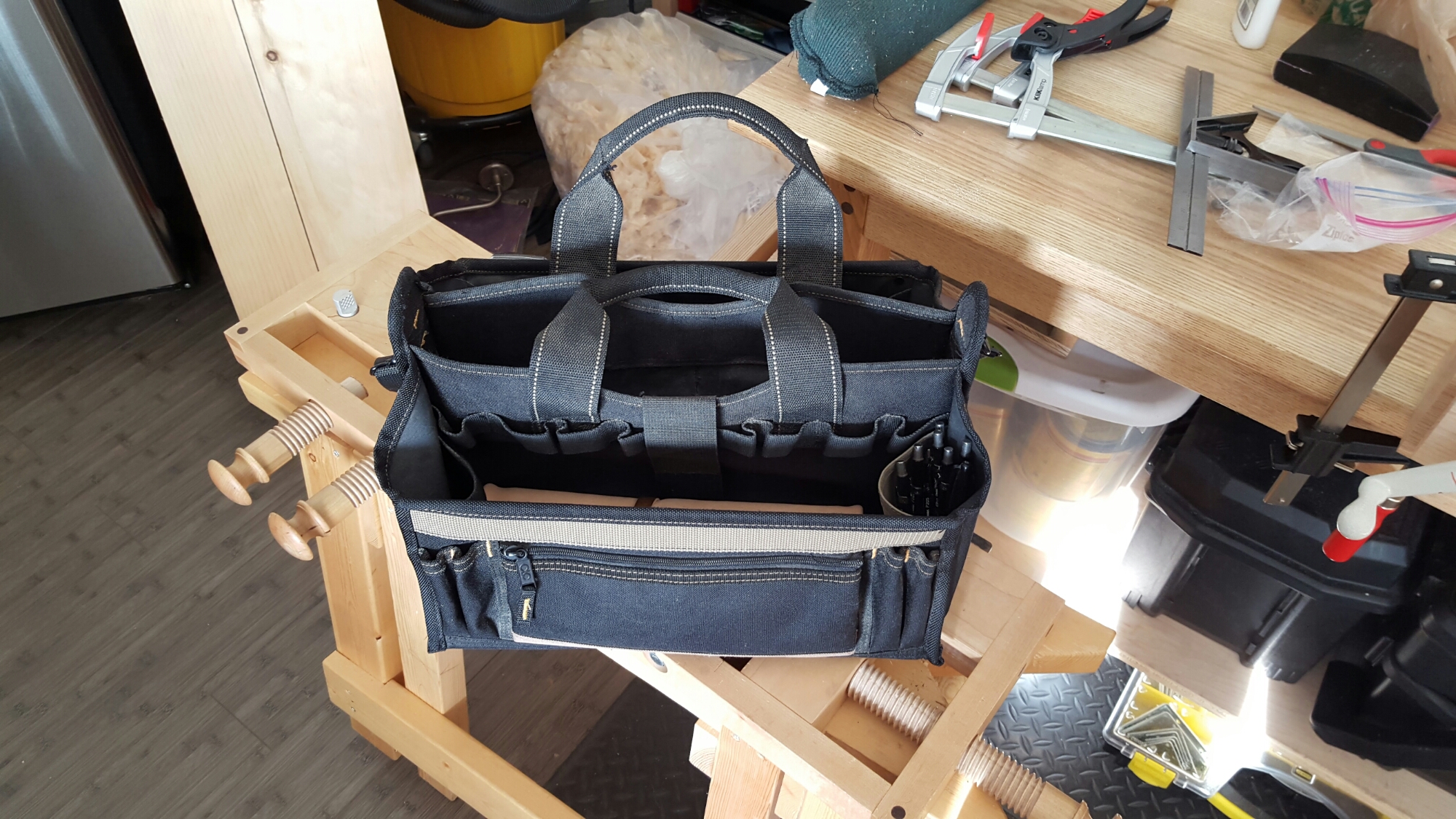
Over the weekend, I was asked by my mother to clean up some poorly-mitered baseboard moulding. Not knowing what the moulding was made of (MDF, by the way), I packed up a small toolbox with enough woodworking handtools to tackle any task. I’ve been down this road before, but I took the chance to think through the essential handtool woodworking kit once again.

More than anything, I was confined by what I could fit in or on the toolbox, which is about 16″ long and has been with me since the beginning.

Seen here

Seen here, mostly empty.

Here is what I came up with:

  • Tool roll, with chisels from 1/4″ to 1″, plus 1/2″ mortise chisel, birdcage awl and 18 oz mallet
  • Tape measure, 12″ combination square, sliding bevel and marking knife
  • 14″ rip cut tenon saw and 22″ rip cut panel saw
  • No. 5 1/2 jack plane and small chisel plane
  • 600 and 1200 grit diamond plates, saw file roll and plane adjustment hammer
  • Some screwdrivers and mechanical pencils

And that’s it.

Looking back, I had room for a small router plane and a couple clamps. Maybe a dovetail saw, spokeshave and Shinto rasp if feeling fancy. A hammer and cut nails too. Plus a 200 grit diamond plate and honing guide for grinding.

And that, along with a small cordless power drill, would be enough to get started making anything, I think.  Just don’t forget the glue and blue tape.

JPG

Free-Hand Sharpening Follow-up

While free-hand sharpening the iron on my No. 5 1/2 jack plane, something occurred to me. The depth adjust on that particular plane has always been tight. No matter how well-oiled the screw or how deep or shallow the frog set, advancing the iron for a deep cut becomes finger-crushing work.

Then, when I was looking for a link to the ruler trick for my previous post, it dawned on me. The bevel on the iron was entirely hand sharpened to about 35 degrees. Meaning the heel of the bevel stuck out further than the factory grinding. Meaning it was butting up against the throat.

So I slapped the iron into a honing guide at 25° and ground the heel of the bevel back down. Now the plane advances smoothly and I didn’t even have to resharpen the edge, as it was well clear of the grinding.

image

Like so

So I guess now I have a hybrid approach for plane iron sharpening. First grind to 25° by guide, then free-hand hone the cutting edge at 35° or so (30° for bevel up tools).

JPG

More on Cauls

Jigs are not as important in the hand tool woodworking shop as they are for avid power tool users, but I took some time yesterday to make some extra cauls for the tool chest glue up.

On the advice of someone who would know about such things, I cut some pretty tight dovetails for the tool chest carcass.  In order to ensure the tails seated properly into the pin recesses, I attached (with double-sided tape) individual cauls onto each tail prior to clamping.

P1000156

Pre-clamping.

That way, the parallel jaw clamps applied consistent pressure directly onto each tail, seating them nicely.  I forgot to take a picture of the full glue-up, though.  And the clamping pressure crushed the cauls to the point where they cannot be reused.

On a side note, the tails were so tight that there was a bit of splitting on the tail boards. Fortunately, I keep a supply of cyanoacrylate glues of various viscosity.  A generous bead of medium cyanoacrylate will seep into the cracks and should stabilize them for the life of the tool chest.  I haven’t yet flushed the joinery on the carcass, so I can still plane off the excess glue with an extra pass or two.

The same trick works to stabilize a knot.

The same trick works to stabilize a knot.

The floorboards for the tool chest are dimensioned (S3S), but still need a pass them through the thickness planer before I cut the ship-laps.  I might wait to flush the tails and pins after I’ve attached the floorboards, because I do not have a full workbench around which to wrap the carcass.  We’ll see.

JPG

Some Rando Dovetailing

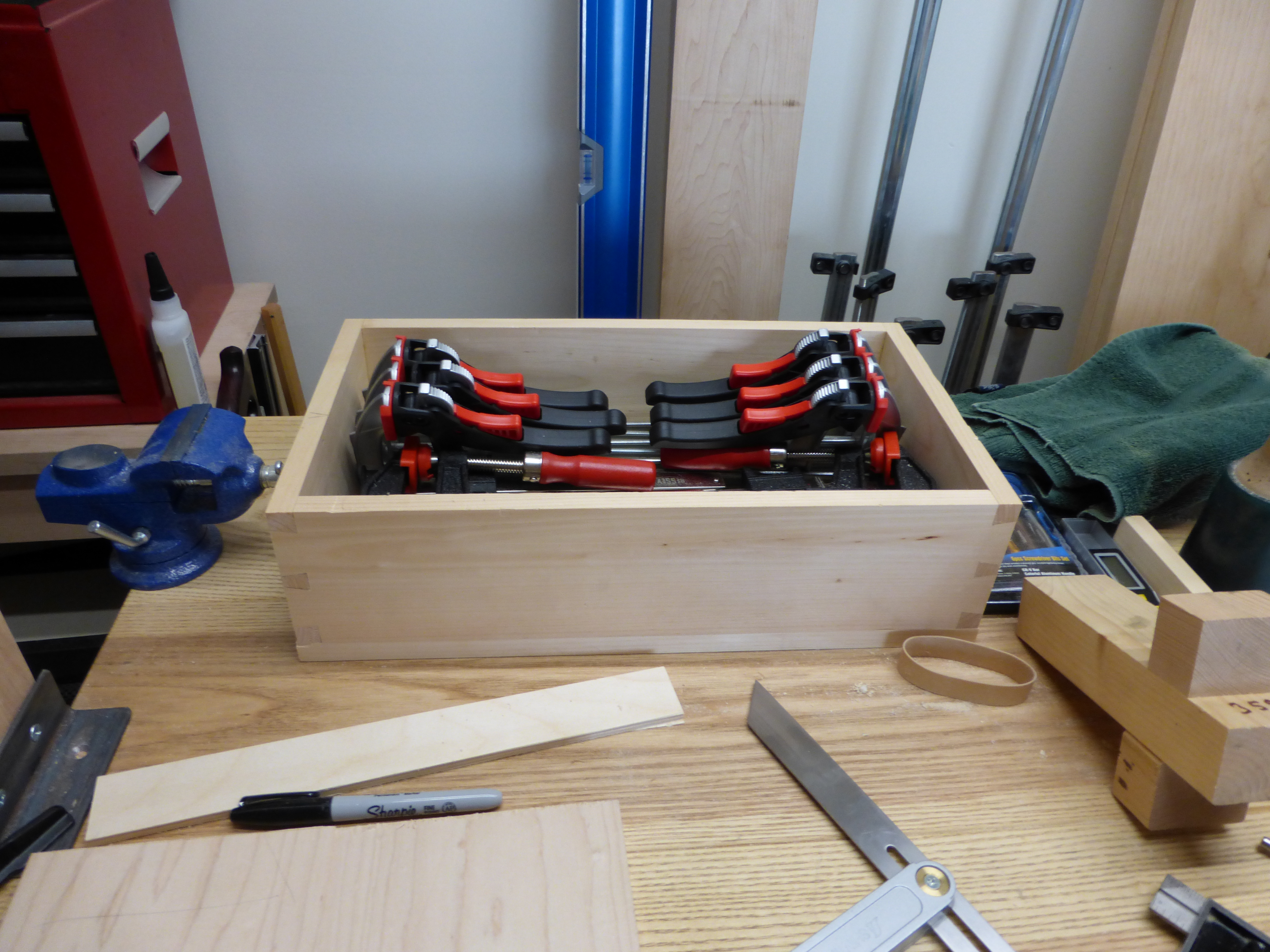
In prep for the medium-size wooden tool chest project, which I plan to knock out starting next week, I’ve been practicing my dovetails.  Some benchtop tool storage was far overdue, so I took the liberty of knocking together a few dovetailed boxes.

P1000140

Some “every day clamp” storage.  Don’t laugh at the bulk on my sharpening angle guide.  It’s super wieldy.  

And a "benchtop miscellany" tray (which will eventually be a benchtop chisel tray.

And a “benchtop miscellany” tray (which was specifically built to be a benchtop chisel tray for my eventual full-size workbench).

I don’t own a plow plane, so in each case, the bottom is simply glued and nailed to the tray frame (wire brads, until my cut nails arrive in the mail).  Don’t give into the hype: a heavy stone and a flat surface is sometimes all the clamp you need.

A heavy stone and a flat surface: sometimes all the clamp you need.

The lip is so the tray can be spring-clamped to my worktable top.  I’ll rip it off at some point and re-purpose the tray.

I’ve found the pre-sized, 1/4″ birch plywood you can buy at big box craft stores (e.g., Michael’s) is perfect for drawer bottoms.  Off the shelf, it has much less warp than a full 5′ x 5′ sheet from the lumber yard.  Plus, the inevitable offcuts make great battens and holdfast cushions.

There is also a 12.5″ x 18″ x 4″ box (corner detail seen below) that might actually end up being a drawer for something.  I’ve been experimenting with different pin sizes and techniques for hogging out waste (I’m back to the coping saw method) and they are the tightest I’ve ever cut dovetails thus far.

P1000137

Practice makes better.

Even if I opt for the rabbeted and nailed version of the tool chest, I’m glad to have gotten the dovetailing practice.  In addition, each of the boards used in these boxes was 100% hand-prepared.  No thickness planer for once.

Happy Bastille Day everyone!

JPG

The Importance of Hypocrisy

Handtool woodworking is awesome.  It’s relatively quiet and significantly dust free.  In fact, most of the time, “by hand and eye” is far faster and more accurate than “by power and jig”.

Except when it’s not.  Like when trying to square a glued-up panel that is too large for your shooting board.

For my time and effort, this is still the fastest and most accurate way to square a panel.

For my time and effort, this is still the fastest and most accurate way to square a panel.

No purest am I.  I’ll use whatever tool makes the most sense under the circumstances.  In my opinion, nothing beats a carpenter’s square, straight-edge clamp, trim router and flush trim router bit for squaring end-grain on a large panel.

Give it a try.  There is a reason my trim router (and dust extraction unit) has survived every power-tool purge in my shop thus far.

JPG

Alignment Cauls for Perfect Glue Up

One of the woodworking tasks with which I struggle mightily is hand-planing the twist entirely out of thinner stock.  I have found, though, that careful alignment during the glue-up is one way to manage (and maybe even eliminate) any remaining twist in a thinner board that is part of a larger panel (like a table top).  This won’t work for boards that are majorly out of wind, but there is a very simple jig you can make from scrap to perfectly align two boards in a glued butt joint.

P1000129

I think they are technically a type of caul.  I don’t know if they have a proper name.

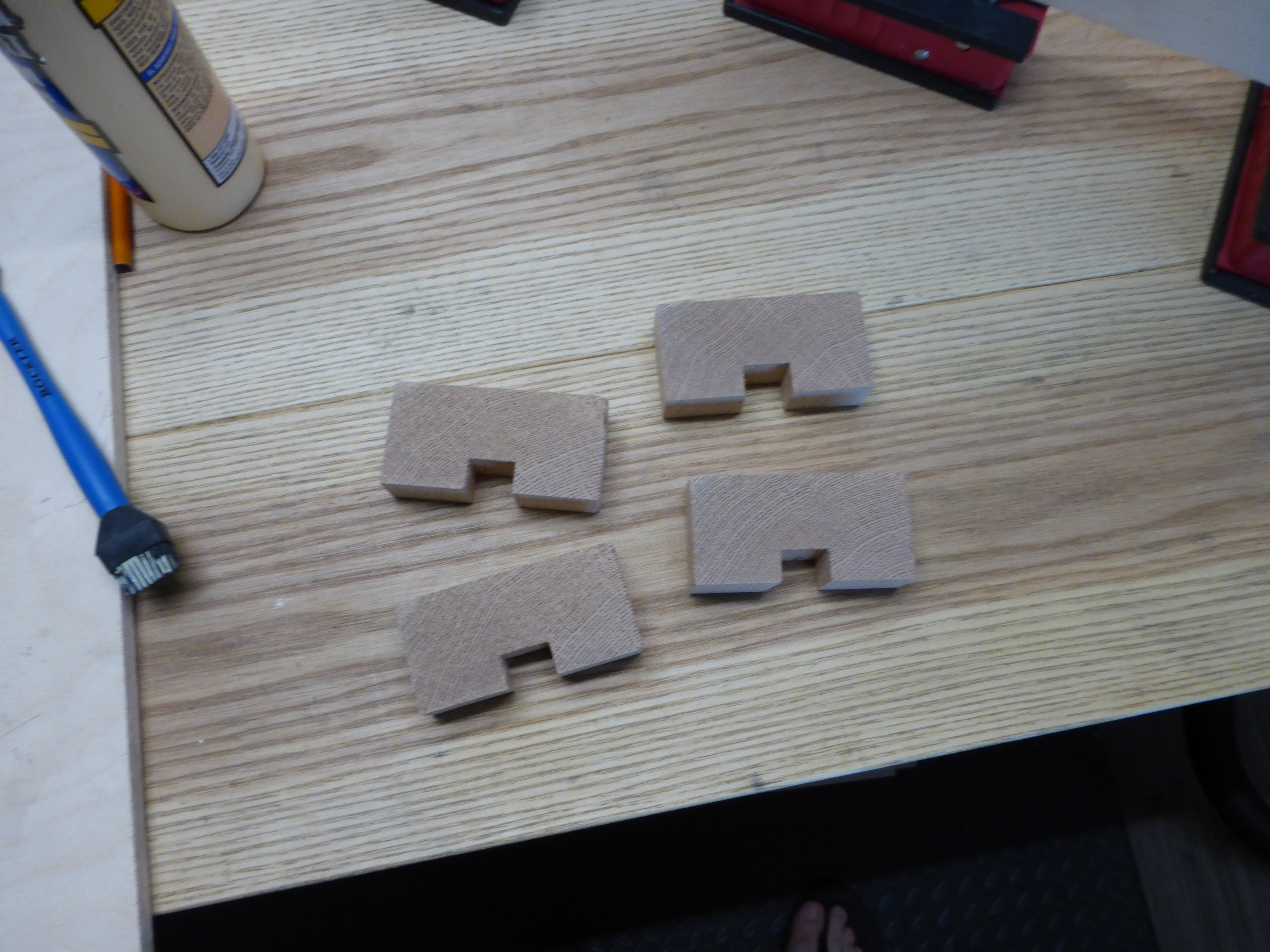
The alignment cauls pictured above are 1″ thick slices of red oak 2×4, with a 1/2″ x 1″ groove routed in them.  The exact size isn’t critical, but you want them to be wide enough for a decent sized groove and thick enough to easily take a clamp.  I recommend routing the groove first, then cutting the slices and truing the faces with the groove over some sandpaper on a flat surface.

The most important part, before any gluing up, is to make sure the two boards are planed as flat as you can get them and thicknessed to the exact same thickness (the thickness is the critical part).  Once that is done, you clamp two cauls, opposite each other, to straddle the glue joint and perfectly align the outside edges of the boards.  You use four cauls per glue joint (two on each end, pictured below).  Once the glue dries, just dress the seams.

Like so.

To avoid marring the work, go easy on the clamping pressure.

When doing the dry run for the angled-leg side table glue up, I noticed there was about 1/32″ twist in each of the boards.  It would have been no problem to skip the cauls and just level the seams after glueup, but I had them handy and the boards are already thin enough (5/8″ after thicknessing) without any more dressing.

P1000128

I will give the panel a couple hours to set and then I’ll attach it to the frame and be done.

You should always try and get as much twist out of the boards as you can, but in a pinch (nailed it!), these alignment cauls will get the job done.

I will post pictures on twitter of the finished table, once I figure out how to attach the top.

JPG

Angled-leg Side Table

Cards on the table, I’ve been almost done with this table for about two weeks, just needing to prepare the tabletop and do a quick smoothing before glue-up. The tabletop should only require two boards, so it will go quickly once I get some time to go back to the project.

It's been blocking traffic for a while.

It’s been blocking traffic for a while.

In the meantime, though, I learned an important lesson during this project. I had shaped the angled legs over a year ago, removing rough stock by hand and then cleaning up the profile by trim router with a plywood pattern and a pattern bit.

Although they are pretty close, none of the legs is identical to any other (except for height, which is remarkably close for being cut on a chop saw). Each leg varies slightly in rake and, after some straightening, thickness. Sending them back through the thickness planer would mean also redoing the stopped chamfers, so I figured there must be a way to keep the table square and straight without making the legs identical. Turns out, the basic principals of marking were the solution.

I had always planned for the top to overhang the frame a bit, so as long as the frame was square, I could hide any variations due to the legs. In theory, as long as I marked from the same edges on each leg, and the parallel rails were identical in length to the shoulders, any variation on width or depth would be purely cosmetic. So I took great care to size the rails perfectly. Then I assembled the frame and, while the frame overall was square, one of the rails didn’t seat squarely.

This confused me, because I had marked everything from the same reference edges on each leg. However, the front and back rails were marked from the outside, not the inside like the side rails. Because of the varying thickness of the legs, this added extra length between the mortises for the front and back rails on one side. I ended up having to take down the inside thickness of one leg by hand to fix it.

The moral of the story is: there is more to consistent marking than using the same reference face. When parts are not identical, there is also a correct reference face. To be safe, while marking mortise layout, if you can, reference your marking gauge only on the faces where the mortises will be.

JPG