Author: The Apartment Woodworker

The Apartment Woodworker is a weekly blog with insights, projects and tips for making the most of woodworking with hand tools in confined spaces.

Everyone Leaves in the End

I think about death pretty often.  My own, mostly.  It intrigues me, in a way.  I certainly do not fear death.  Why waste the energy worrying about something that will absolutely, with one hundred percent certainty, happen to each and every one of us?  Those who are scared of dying have something to hide.

And when I die, what will I leave behind?  My clothes, my shoes, the stuff in that one drawer I keep locked: I doubt those things will last much beyond my natural life.  But the work of my hands: who knows?  Through the motise, tenon, dovetail and dado, I may live forever.

wp-1479590861587.jpg

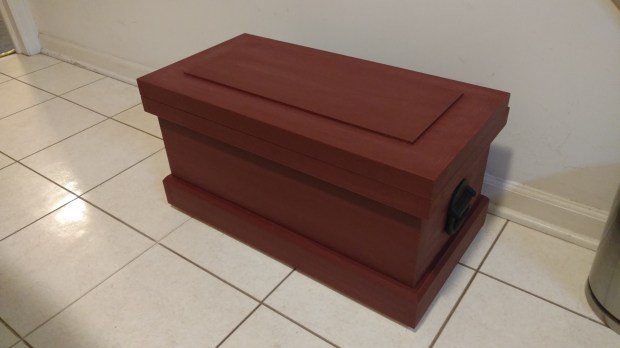
And, if I can, I shall haunt you from my Tuscan Red coffin.

At least until the collapse of civilization, in which case all would be turned to firewood anyway.

JPG

If it’s Wobbly…

then you should have put a stretcher on it.


IMG_20170818_182542

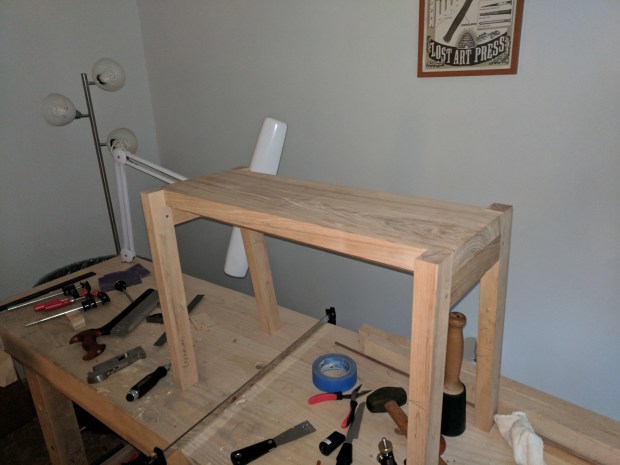
A bit more spindly than I expected.

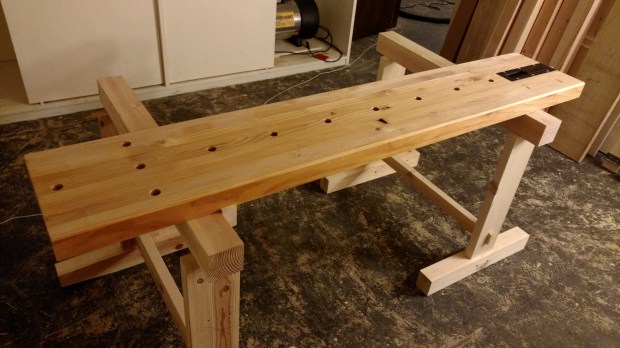
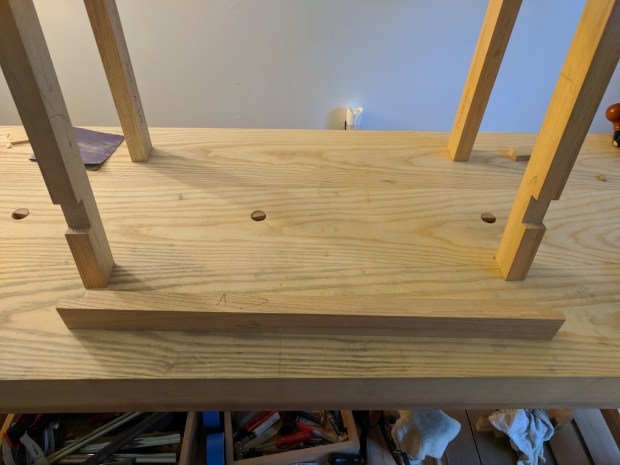
I thought the drawbored mortise and tenon joints would be enough, but the ash sitting bench has turned out to be a bit wobbly.  So paraphrasing Queen Bey, I’ve decided to retrofit a stretcher to back legs.  In my world, “retrofit” is a synonym for “lap joint”.

IMG_20170819_084743

It’s times like these when I’m glad my workbench is apron-less.

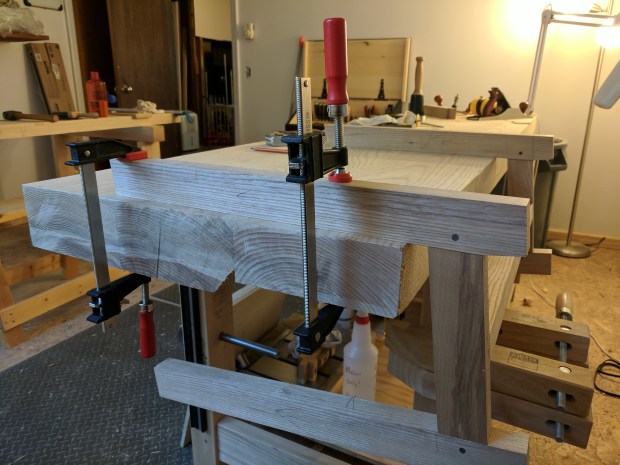
A friction-fit lap joint can be very strong.  Between the long grain-to-long grain glue surface and the mechanical strength of the intersecting joint, it can be nearly as strong as a proper mortise and tenon joint, even without a metal fastener.

IMG_20170819_090714

It’s so pretty.

Because the joint will never be seen, though, I may add a slotted screw to each joint for a little bit more lateral support.  Or perhaps a walnut peg, to mimic the other drawbored joints in the piece.

There was some subtle twist in the entire assembly, so I’ve left the joint clamped for the full 24 hours.  That will give me time to think about whether to screw or peg.

IMG_20170819_093540

It’s almost like I meant to do it.  And now it matches the table a bit more.

The only other remaining question is whether this one stretcher will be enough.  I’d prefer not to add a second stretcher to the front legs.  I tend to cross my legs at the ankles when I sit, and that stretcher would get in the way.

JPG

We Who Are About to Bore

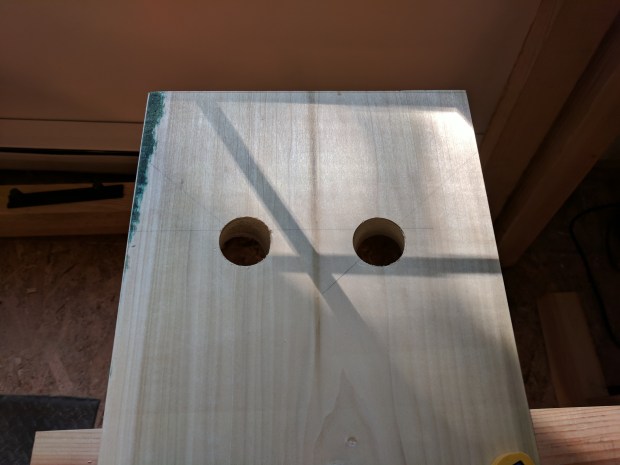
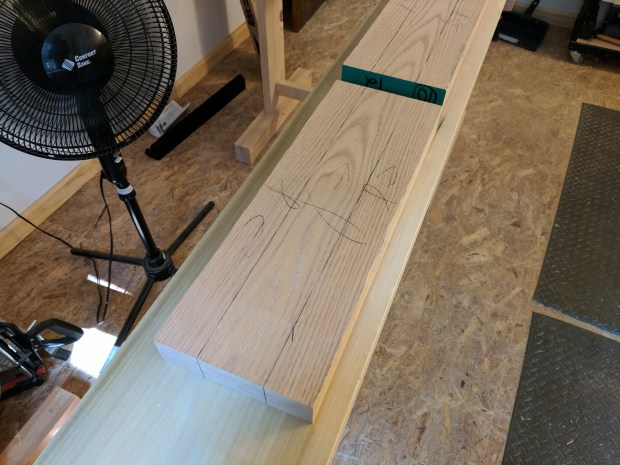
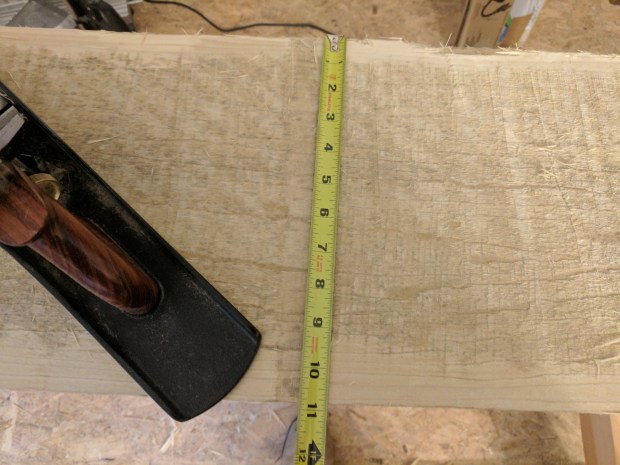
A straight and square board, surfaced on all four sides is a thing to behold. When it’s 7 feet long, 11 inches wide and 2 inches thick, it’s down right beautiful. And that’s what I did over the weekend. It may be poplar, but soon it will be a Roman Workbench.

Little thin for a proper Japenese bench,

Like any pretty board in my workshop, though, it started out ugly and rough. But ugly and rough is how we like ’em ’round here (at least at the start). Then comes the Jack Plane.

My only complaint about the new floor is that it’s slick sometimes.

In my experience, the trick to flattening a wide, thick board is to start on the cupped aide and not get too overzealous. It’s very easy to plane a hump if you’re not paying attention. And that’s no recipe for keeping as much thickness as possible.

This is not a how-to on traversing . So my only other advice is to figure out where the twist is early in the process. It’s no good first taking out the cup then having to take out the twist. That’s likewise a recipe for losing more thickness than necessary. Once I have one side flat, I like to send it through the thickness planer. Others square an edge right away. Either works.

Then I tackle the edges. The goal is to remove only as much width as necessary. I try to square each foot or so to the face, then worry about overall straightness. On this board, I ended up only losing about 1/8″. A testament to the sawyer more than my planing skills.

So glad to have my 5 1/2 back in the shop.

The end result (seen in the first picture above) is a board that’s ready for joinery. And joinery, in this case, means big, round, wedged tenons.

JPG

For All to See

After clearing a few little projects around the home, I turned back to the ash sitting bench I’ve been [slowly] making.  The design includes a 10° rake on the back legs and that means one thing: angled mortise and tenon joints.  One of my favorites.  But that’s not what I’m here to talk about.  I’d like to talk about mistakes.


IMG_20170817_092823

I’ll wedge that gap at the top, no problem.

The cross rails pictured above are a different thickness than the legs.  This means that while the mortises are centered in the legs, the tenons are not centered on the rails.  So keeping track of the reference face for the mortise gauge on the rails is SUPER important.  And, of course, I messed it up on the very last tenon.  Nothing would be square without a fix, and I’d prefer not to make another rail unless I really have to.

IMG_20170816_200834

The saddest “spot the diffrences” puzzle ever.

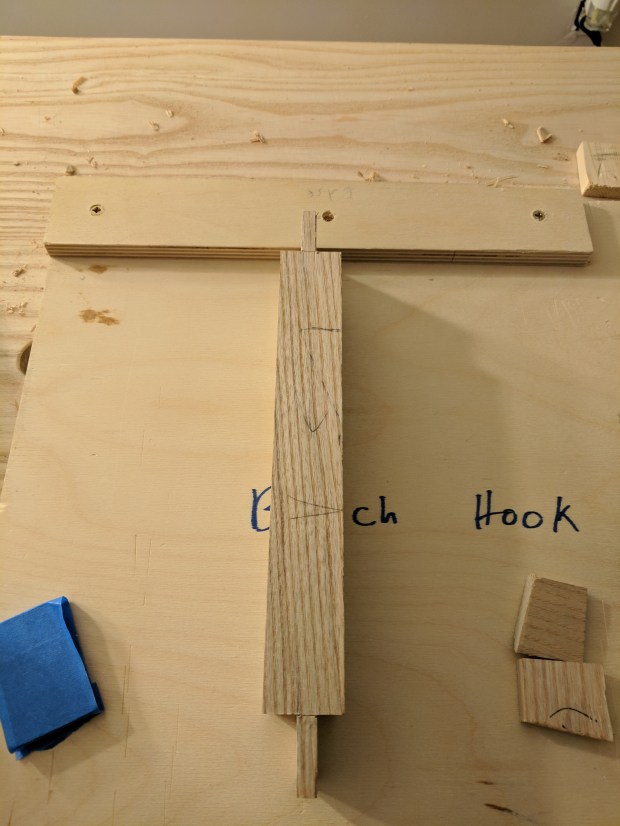
In the past, when I’ve pared tenons too thin, I glue on veneer of a similar hardness wood to build it back up.  Like the leg tenons on the Stent Panel workbench.  So why not use the same trick to build back up one of the tenon cheeks, then widen the mortise on the rail to accept the fatter tenon?  I grabbed an offcut from one of the tenon cheeks and glued it back onto the tenon.

IMG_20170816_201937

Say what you will, but these squeeze-style clamps work well for light clamping tasks.

After the glue set, I pared the patch down to the correct depth.  Then I reset my mortise gauge and widened the mortise to match the fatter tenon.  Net net, the joint is tight and the reveal is even (as shown in the first picture above).  And because I didn’t lose any of the original tenon’s thickness, the joint is still as strong as it would be had I not messed it up in the first place.  Once glued and drawbored, the joint will last forever.

Of course, none of this was necessary to share.  But I don’t keep anything from you guys.

JPG

Silly Little Details

I’m at a wedding this weekend and have workbench separation anxiety. So for the next few days, I’ll continue building an ash sitting bench in my mind. As of right now, I’ve got everything planed to proper dimensions and the top mortises cut in the front legs. It’s slow going, given everything else I’ve got going on.

I don’t cut many mortise and tenon joints. Not as many as I do dovetails, anyway. So it may be lack of skill on my part, but my mortises never seem to be completely parallel. To compensate, though, I cut my tenons fat: to tighter than piston-fit. This allows me to ease the mortise walls to bring the joint into parallel while still keeping an overall tight fit on the joint.

After all, what’s the point of making the stock straight and square (tried and true?) if the joint is crooked?

JPG

For the Love of My Tools

For almost a year now, my workshop floor has been bare concrete (other than a few anti-fatigue mats).  It’s not ideal for either knees or tools, and I hold my breath every time something drops to the floor.  But no longer.  My workshop has a wood floor now!

IMG_20170722_123011

Oriented Strandboard, as it were, but still.

After about 5 hours of work, and for the low, low price of about $350 (plus the lunch I bought my buddy from work), I no longer have to pray in slow motion every time a marking gauge or chisel rolls off the workbench.

IMG_20170722_161229

But I still put the anti-fatigue mats down.

The DriCore tongue and groove panels were super easy to install.  It’s night and day from the old concrete surface.  I even did the pine trim boards.  The room even feels brighter, now that the black concrete floor is hidden.  In case you forgot what the old floor looked like, see the contrast.

IMG_20170722_123001

$1.54 per square foot never felt so good.

For now, I will leave it bare.  I’d like to see how well it wears before I go overboard.  BTW, I know it’s been a full month since my last post.  I’ve been preoccupied with non-woodworking tasks, but am hoping to get back on the horse soon.

JPG

First Church of Christ, Cabinetmaker

For some time now, I’ve had a silly little fantasy. I’d start my own church: the First Church of Christ, Cabinetmaker. We’d meet on Saturday afternoons and glory in the making of things. From the crotchety handtoolers to the hipster CNC’rs, and everyone in between, all would be welcome. 

The Jesus part would be optional, of course. I am Catholic, after all. The only mandatory worship would be at the sharpening stone.  We’d observe only the greatest commandment: do your best not to be a dickbag, at least not all the time.  And don’t borrow tools without asking. 

Any early converts?

JPG

A Loving Home

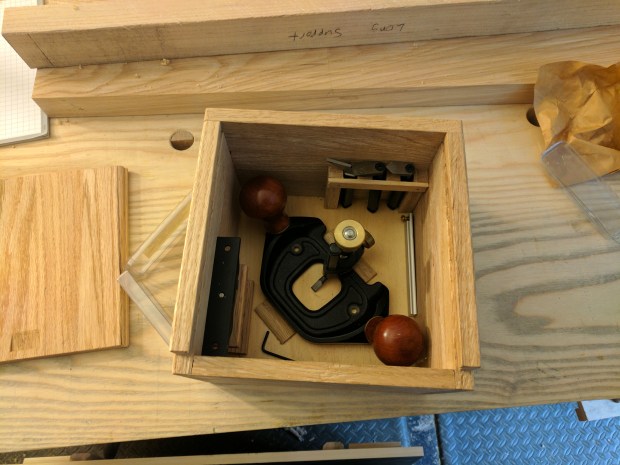
A package came in the mail on Saturday.  James over at The Daily Skep was gracious enough to gift to me the box he made for his custom box for a Veritas Large Router Plane.  I am happy to say the box now has a new home in my tool chest.

IMG_20170618_095956-1

Fits very nicely.

For those who haven’t seen it before, it holds the plane itself, the fence and some additional blades, with a sliding lid.  I am particularly fond of the bits of veneer that hold the plane in place in the well.  It feels very Dutch tool chest-like in its own way.

IMG_20170618_095611

I seem to have one more extra blade than James.

Thanks very much, James.  By the way, if you’re not a reader of The Daily Skep, you should be.

JPG


Like that Scene in ‘Office Space’

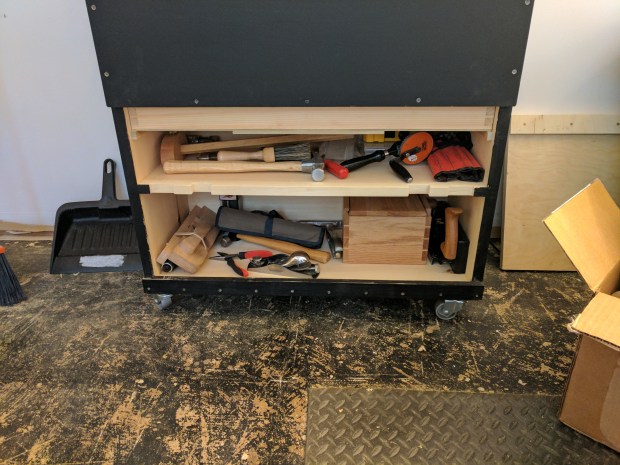
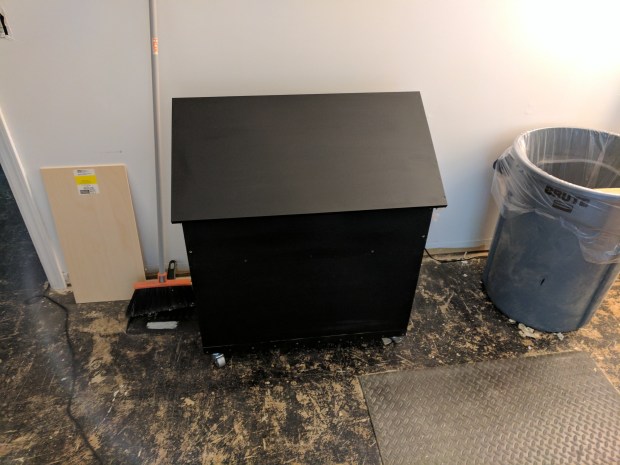
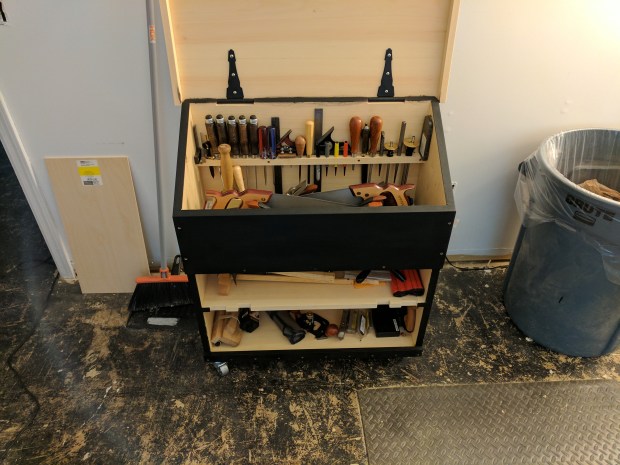
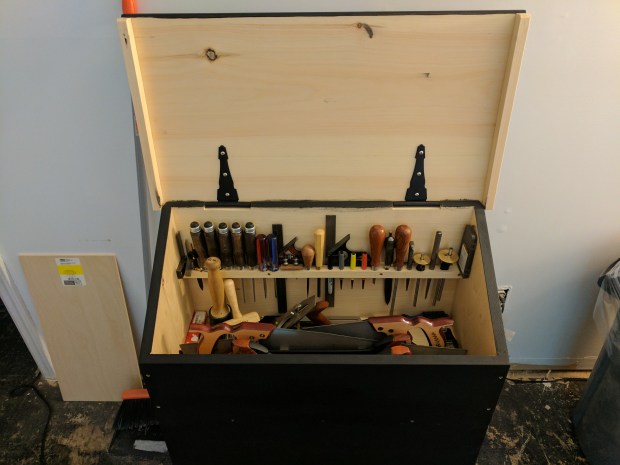
Life has been fairly hectic lately, but I found some time over the weekend to paint the finished Dutch tool chest.  Seeing has how I’ve been working out of a black tool chest (albeit a Craftsman 40″ mechanics chest) for a while, I kept the theme by painting the Dutch tool chest black.  What I didn’t keep, however, was the expansive footprint.  The shop feels so much more open now.   The smaller footprint will allow me to move my workbench further away from the back wall.

IMG_20170604_132704

The area from the trash can to the door used to be completely filled with tool chest.

I am very pleased with the overall result, although I have two minor complaints about my execution of the design of the Dutch tool chest:

  • The fall front really needs to be made from something quarter- or rift-sawn.  I made the mistake of using two flat-sawn boards that have cupped wildly (despite the battens) and expanded as the humidity changed over the last month.  It’s less visible now that it’s painted, but I will eventually throw a temper tantrum and remake the fall front .  The locks will be reusable, and I’ll try and salvage the nails from the battens.
  • I don’t think having two fully open compartments below is correct for my tool set.  I’m not sure I’d have evenly divided it into three, but I need to test a shallow drawer first and see how things work out (more on that later).
IMG_20170604_130308

If I could turn back time, I’d paint the case before attaching the lid.

Figuring out how to efficiently store everything is still a work in progress.  I have plenty of room for hanging things on the walls (e.g., a block plane holster like Mr. Schwarz) and still need to make the under-lid till for my crosscut panel saw.  There seem to be nooks and crannies everywhere to stash tools.  And I should probably remake the inner saw till from a harder wood as well.

IMG_20170604_132716

Quite a bit of real estate on the inside walls.

All of that said, I’m really pleased with how this has worked out.  Even if it ends up being a non-permanent solution, I’m glad for the experience.  This is something I definitely could have (should have?) made for my apartment.  I’d love to make the smaller version as an intellectual exercise, but I have many traveling tool chests kicking around and there is so much still to make for my living quarters.

JPG

Saw Till, Part Deux

I should have mentioned it in my previous post, but it is no accident the new saw till is made from 3/4″ pine.  I didn’t want to waste time and materials on a hardwood version until I confirm it worked within the space.  And working within the space seems to be the most important part of the Dutch tool chest.

IMG_20170521_212313

Next up: red oak.

The saw till debacle brings up a larger point about the importance of spacing.  I did not measure my own chisel handles (Narex, which are about 1 3/8″ wide) before spacing the 1/2″ holes in the tool rack.  I took Chris Schwarz at face value on the 1 1/8″ spacing, and I have since suffered for it.  My chisels only fit the rack when turned 90°.  Live and learn.

IMG_20170523_193754

What proper spacing looks like.  

The lesson is this: trust, but verify.

JPG