woodworking tools

Sharp Enough, From Now On

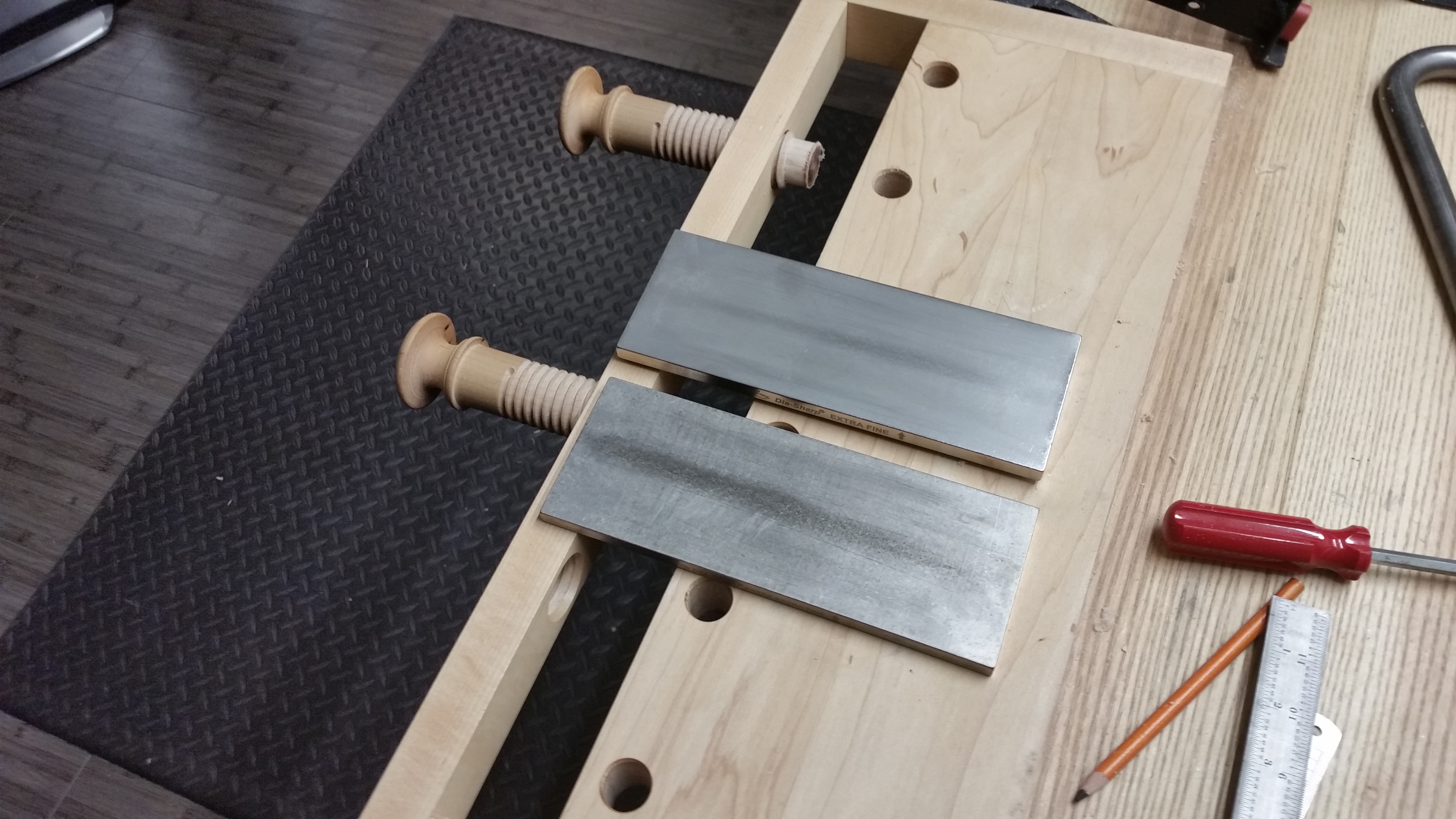
I use diamond plates for hand-sharpening (with window cleaner as lubricant).  Specifically, I use DMT Dia-Sharp continuous diamond plates and I currently own four: coarse (320 grit), fine (600 grit), extra fine (1200 grit) and extra extra fine (8000 grit).  I am truly happy with only the coarse and fine.

I don’t know if it’s the wheel on my sharpening guide or bad manufacturing luck, but both the extra fine and extra extra fine plates have developed a stripe down the center where the grit has worn almost completely off.  This happened almost immediately with the extra extra fine and took about a month of heavy use with the extra fine.  I try to change up which parts of the plate I use, but for thick plane irons, I have no choice but to run right down the center and the difference in grit leaves a dull hump in the center of the irons.

DMT, if you are listening, I am not particularly happy with these two diamond plates.

DMT: if you are listening, I am not particularly happy with these two diamond plates.

So I am trying something new.  Rather than purchase replacements (new territory for me, I know), I have decided that from now on, my plane irons are only getting sharpened to 600 grit (i.e., on the fine plate).  After re-watching Paul Sellers’ Sharpening to 250 Grit video a couple times over the last few days, I think it will be okay (I sharpen pretty often as is).  I’ll still do my chisels and router plane irons to 1200 grit on the extra fine plate (since I can run them up and down the remaining grit on the sides).

I don’t really even use the 8000 grit plate anymore.  Given how proactive I am with re-sharpening, I haven’t found the extra effort makes much of a difference on edge retention.  And I think I remember hearing somewhere that the edge dulls to a lower grit pretty quickly anyway, so what’s the point?

We’ll see how it goes.  If nothing else, it will cut the weight of my tool chest by a diamond plate’s worth of ounces.

JPG

Holiday Cheer at The Apartment Woodworker

As the year wraps up, I find myself (as always) being very grateful for my loving and (mostly) supportive family and friends (especially Matty).  They indulge me in my eccentricities and manic woodworking fervor and I am very lucky to have such excellent and admirable people in my life.

Now, I would like to brag about the awesome woodworking gifts I received this Christmas.

From my parents, a 24″ imperial ruler blade for my Starrett combination square.  When not in use with the combination square, I expect it will live on the workbench as my go-to straightedge.  Its first combination square task, though, will probably be in connection with squaring the ends of the planing slab (as soon as I finish a couple more laminations).

A gorgeous piece of steel.

A gorgeous piece of steel.

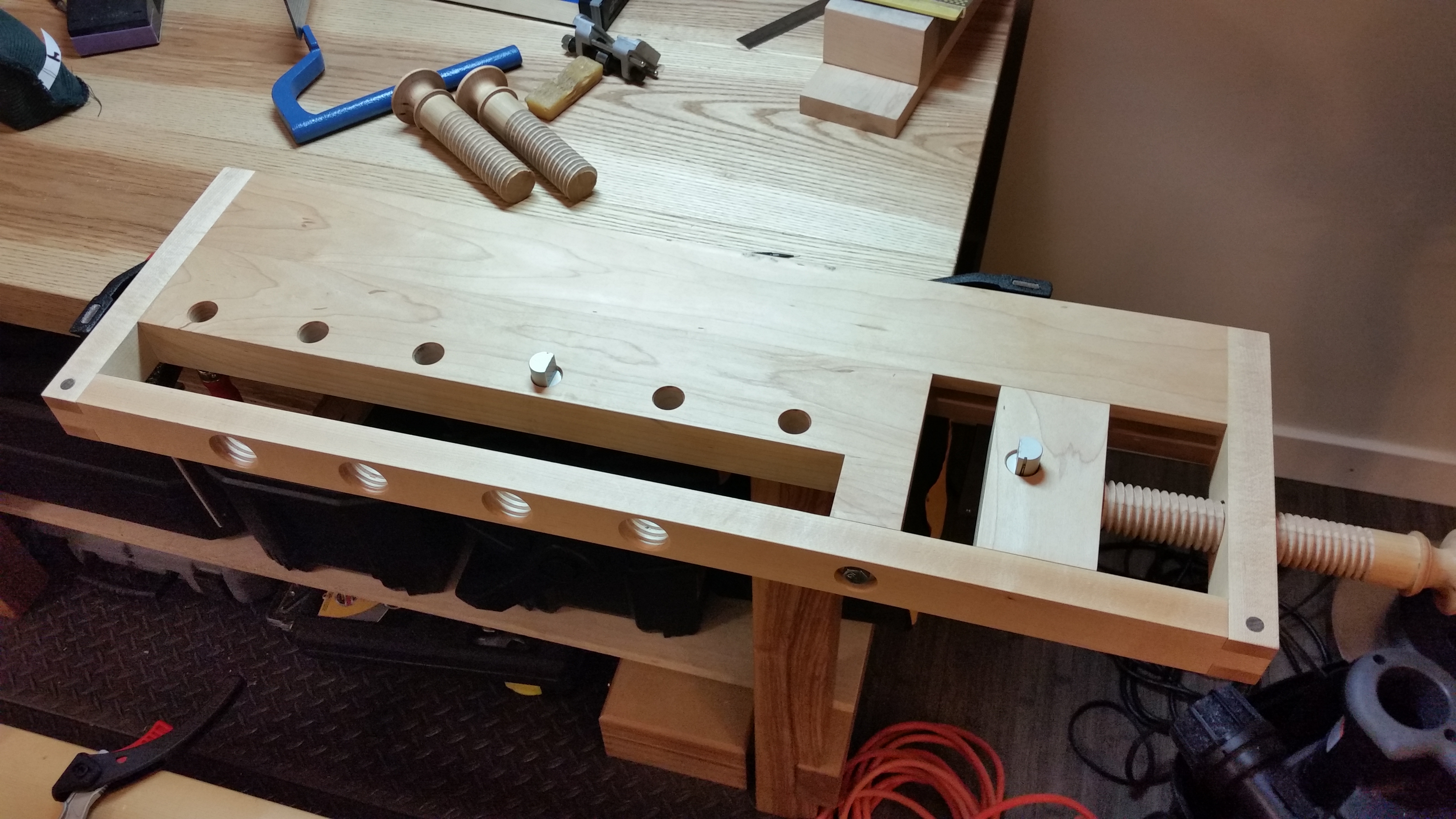
Speaking of the planing slab, my brother and sister-in-law gave me not only a Veritas inset vise (for which I had asked), but also surprised me with the pivoting jaw and the low profile jaw as well (both of which were actually sitting in my Lee Valley online shopping cart ready for purchase).  Now i just need a Veritas planing stop and to settle on inset vise positioning.

I have a feeling this will quickly become my favorite vise.

I have a feeling this will quickly become my favorite vise.

All in all, a pretty awesome Christmas.  Thanks very much, family.

Happy Holidays to all!  I should probably get back to making the second footstool for my niece and nephew.

JPG

Because sometimes what we really mean is “unplugged”

Hand tool woodworking is great.  It’s relatively quiet, can be done with minimal shop space, and the results are often better than anything produced solely or mostly by machine.  I consider myself a hand tool woodworker, although I admit sometimes I reach for a plunge router, cordless drill or an orbital sander.  I also own, and frequently use, a thickness planer to surface the remaining two faces of a board that I’ve hand straightened and squared.

Net net, if I’m deviating from my basic set of saws, chisels and planes, there are meaningful efficiencies at work.

That having been said, I have a new addition to the shop. The Nobex Champion 180 miter box, with Ikeda blade.

Perpetually on backorder at  www.leevalley.com for a reason.

Perpetually on back-order at http://www.leevalley.com for a reason.

I know it’s technically not a power tool, but it is also not an essential tool for hand tool woodworking.  I can mark a knifewall and saw/shoot down to the line. I get it.

I wanted the convenience and the speed of a precision miter box.  Accurate saw cuts mean less time at the shooting board, so I can get back to the fun part, cutting joints.  Plus, I miss my 14″ double bevel compound miter saw and this should be a pretty solid replacement.

I have only cut a few pieces of wood so far, but I have some initial reactions.  First, the unit was much easier to assemble than expected (although there were a few extra pieces [two random hex nuts], which is distressing).  Second, the unit feels sturdy and the Ikeda blade is super sharp (already cut myself).  Third, the blade should definitely be lubricated prior to use.

My brother and sister-in-law requested that I make some footstools for their new house (they left the last footstool, which matched a vanity sink I also made, at their old house), so I will have an opportunity to further the miter box.  I have also been thinking about making some picture frames; not out of necessity, but as practice for cutting mitered halflap joints by hand (which is a favorite design element in exposed joinery).

Edit: After a couple days of use, I am very happy with the saw. I still have to shoot the ends of each board (the blade is ever so slightly canted to the left, which is probably user error), but it is always a slight cleanup, not a major straightening.

JPG

What hand tools should a beginner woodworker buy first?

For the last few weeks, in what little spare time I’ve had, I have agonized over one question: “What hand tools should a beginner woodworker buy first?”  I tried (and hopefully succeeded) in answering that question over the last few “Bare Essentials” posts.  In response to a question from a colleague, though, and for the TL;DR crowd out there, I thought I would take one more stab at it.

It’s a tough question and there is no easy answer, of course.  Partly, because the answer depends on what kind of woodworking the beginner wants to do; partly, because each person’s budget and/or available space vary.

So, instead, I will answer an easier question: “If I had a time machine, what basic set of hand tools would I have bought my past self as a birthday present when I was a beginner hand tool woodworker?”  I know it’s cheating, but, after all, the paradoxes largely resolve themselves and this is my website.

Basic Tools

Happy 30th Birthday, Past-James!

The picture above is for (literally) illustrative purposes only.  I thought it would be fun to fit everything in a single camera frame, but I don’t actually own one of the tools I recommend (a No. 5 jack plane) and I apparently forgot to include three others in the picture (low angle block plane, 600 grit diamond stone, saw files).

I am sure my views will evolve over time, but for now, here is what I believe should have been the first tools I owned as a beginner hand tool woodworker (with the goal of making tables and chairs):

Safety: Eye protection (ALWAYS!)
Bench Chisels: 1/4″, 1/2″, 3/4″, 18 oz. mallet
Hand Planes: #5 jack, low angle block
Hand Saws: rip cut panel (8-10 TPI), rip cut tenon (8-12 TPI)
Marking and Measuring: 12 inch combination square (the best you can afford), 12 foot tape measure, double bevel marking knife, mechanical pencils
Sharpening: 600 grit diamond plate, 1200 grit diamond plate, eclipse-style honing guide, saw files
Other: spray lubricant, screwdrivers, deadblow mallet, 2x 12″ bar clamps, 2x 8″ bar clamps, 24″ straightedge, 50″ straightedge clamp, blue tape

These tools (plus a regular claw hammer, a power drill, wood glue and some sand paper) should give a new hand tool woodworker everything absolutely required to get started cutting joints and making things out of wood.   Remember to stick to your budget and always do your safety, technique and sharpening research ahead of time.

I started out working on a WorkMate Portable Workbench, but any stout surface you can clamp material to (such as a sturdy dining table) is just fine.  I recommend laying down some hardboard or plywood to protect any finished surfaces from tool marks and marring, though.

Note: if you are interested in brand recommendations for the above, please leave a comment or email me.

JPG

The Bare Essentials (Part 2, Handplane Edition)

Welcome back to The Apartment Woodworker!

This week, I will be rounding out the workshop tour with an in-depth look at the set of hand planes that I’ve come to know and love.  Just like always, I won’t be using brand names in any description.  After all, only one of my planes is a premium brand (the large router plane; thanks, Mom!) and everything else is at best a mid-budget brand.  If you are here looking for hand tool porn, you are still in the wrong place.

wpid-20141029_185518.jpg

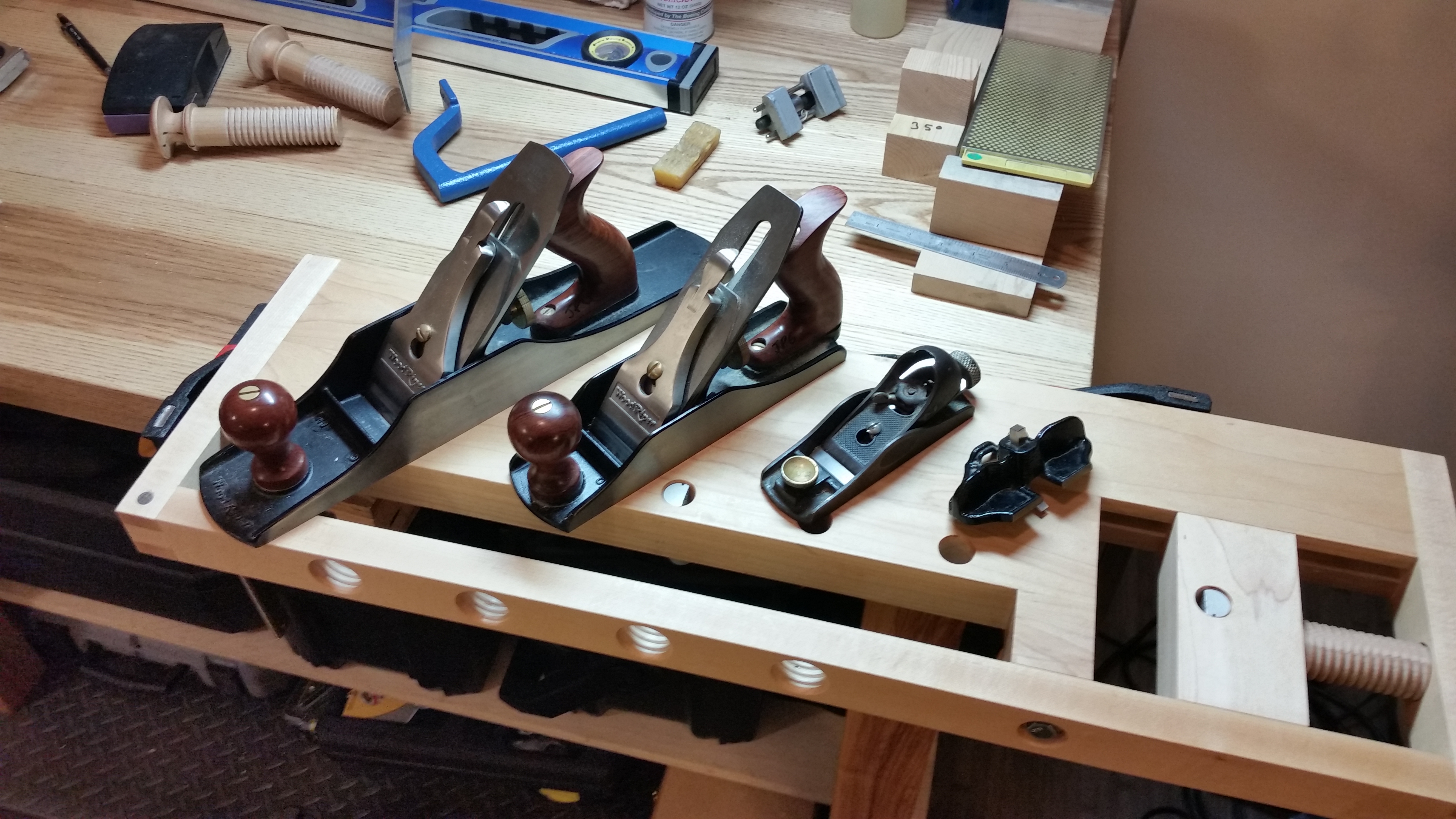
From left to right: No. 5 1/2, No. 4 1/2, No. 4, low angle block, large router, small router, small chisel, small shoulder, trimming.

Every woodworker loves planes, even woodworkers who don’t use hand tools, and for good reason: planes are the most beautiful and complicated (and expensive) hand tools in the woodworker’s arsenal.  From straightening and squaring rough stock to refining the fit of a joint to preparing the final piece for finishing, hand planes are essential at every step of furniture building.  Even the most die-hard power tool enthusiast still needs at least a block plane.

Ownership of a hand plane is sort of endothermic.  Only through consistent use and maintenance will a plane (and the woodworker using the tool) reach full potential.  Be it a premium modern plane or a rehabilitated antique-store find, “up and running” is just the first step in the lifelong maturity and growth of tool and user alike.  Once the sole is flat and the iron is sharp, the real fun begins.  Plus, S4S’ing a piece of 12/4 ash is excellent exercise.

20140704_105330

This is reclaimed pine, but it’s still super way better than going to the gym.

In my hand-tool woodworking, I quickly developed a preference for two particular planes: the #5 1/2 jack plane and the #4 bench plane.  The #5 1/2 is plenty long enough for jointing, the #4 is plenty short enough for smoothing, and those two planes will touch every single piece of wood in every single project.  I definitely use my other planes (for instance, I’m very fond of my large router plane, and the # 4 1/2 is “super tuned” for smoothing), but the #5 1/2 and the #4 form the foundation of my tool chest. It’s true that sometimes I struggle when edge jointing thin stock, because the #5 1/2 is rather too heavy and tippy and the #4, though thinner and lighter, is probably too short.  Other times, flattening very long boards is a chore because even the #5 1/2 is too short.   Generally, though, these two planes (and a block plane) give me everything I need to prepare all six faces of a board (faces, sides and ends) for joinery and finishing.

wpid-wp-1414623745997.jpg

I rarely reach for anything else.

As an aside, I know quality hand planes are expensive and I’m not advocating that any beginner woodworker go out and spend a fortune on premium versions of the planes shown above.  Truth be told, each plane has its limitations and I have made compromises for lack of space.  As always, stick to your budget and figure out what works for you.  If you are dying for a recommendation, though, first go out and buy a regular home center block plane.  Learn how to sharpen it and adjust it.  Then, make your second hand plane a decent quality #5, which I guarantee will get the job done. After that, get a small router plane and hand cut a housing joint. It will change your life.

So, that’s it for the “this is my apartment workshop and these are my tools” portion of The Apartment Woodworker.  I purposely didn’t bore you with my straightedges and other miscellany and I hope you have enjoyed the tour.  Next time, I hope to share with you a silly little personal project that was a little bit about necessity and a lot about testing the capabilities of the Milkman’s Workbench.

The Milkman's Workbench

This thing

By the way, Happy Halloween to everyone!  Do yourself a favor and treat your Saturday hangover to a Netflix binge on Supernatural.  It’s still an amazingly entertaining show, even though it jumped the shark like a billion years ago.

JPG

The Bare Essentials (Full Version, Part 1)

When I first decided to take up woodworking in May 2012, I lived in a two bedroom apartment in Lower Fairfield County, Connecticut and had exactly zero clue on how to proceed.  So I did what I think anyone would do in that situation: go to the home center, grab a WorkMate portable workbench, some hand saws, chisels, marking tools, clamps and a block plane off the rack and get to work.

Tools in hand (and having not yet discovered Paul Sellers and his Woodworking Masters Classes or Chris Schwarz and his Lost Art Press), I then did what anyone in this internet age would do: browse some basic instructions on the interwebs and do my best.  I took on projects well beyond my skill level (including a seven foot parsons dining table for my parents and a vanity sink for my brother’s remodeled bathroom) which, surprisingly, came out okay.  Today, I cringe at the tool marks and gaps in those early pieces (and I have since reclaimed the wood from most of my other early projects), but I was making things and I was hooked.

[Picture Not Found (Thankfully)]

Fast forward two and a half years and I am back pretty much where I started: in apartment in Lower Fairfield County, Connecticut, working wood in the evenings and weekends with a limited set of hand tools.  What lives on my workbench now (a Milkman’s Workbench clamped to a sturdy dining table I built for such a purpose) is very surprisingly not much different than what lived on and around my workbench then (a WorkMate 425): some hand saws, chisels, marking tools, clamps and hand planes.  My current tools are nicer, sharper, better tuned and of slightly larger quantity, it’s true, but in retrospect I wasn’t THAT far off when I stumbled into the home center a fresh faced newbie.

I have found a setup that works for me and I hope to be a resource for other new woodworkers wandering in the “what tools to buy” wilderness. I made some very bad tool purchases when I didn’t know any better and if I can steer just one person away from the same mistakes, I will be proud. I am intentionally avoiding brand-name-dropping, so if you are looking for hand tool porn, you are probably in the wrong place.  And remember: all of this is just my opinion based on my personal preference, experience and budget.  Figure out what works for you based on your goals and your resources.

So, here we go.  Please, feel free to judge.

Chisels:
20141023_063208

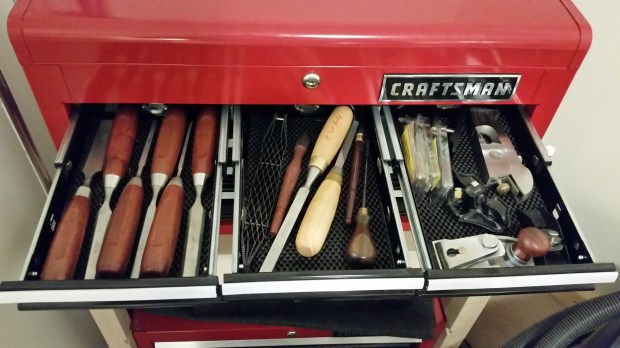
Marking knives and small planes, as well.

Nothing special here. A set of six bench chisels from 1/4 inch to 1 inch in 1/8 increments (which took forever to flatten but hold an edge quite nicely), plus two other chisels: a 1/2 inch sash mortiser (which I also use for paring) and a 3/8 inch corner chisel.  I use an 18 oz poly-wrapped chisel mallet that I bought off Amazon. That’s it, and it gets the job done. I would love to add a real paring chisel and maybe a wider bench chisel, but I am not quite sure where to fit them in the chest.

Chris Schwarz recommends that beginning woodworkers start with 1/2 inch and 3/4 inch chisels, and I would add to that a 1/4 inch (for cleaning out waste). At that point, though, a low cost but quality set of bench chisels starts to make sense (it seems they are always on sale, anyway).  Be sure to read up on flattening and honing, though, so you don’t completely ruin your first set like I did.

Hand Saws:

20141023_063240

Not pictured: three panel saws.

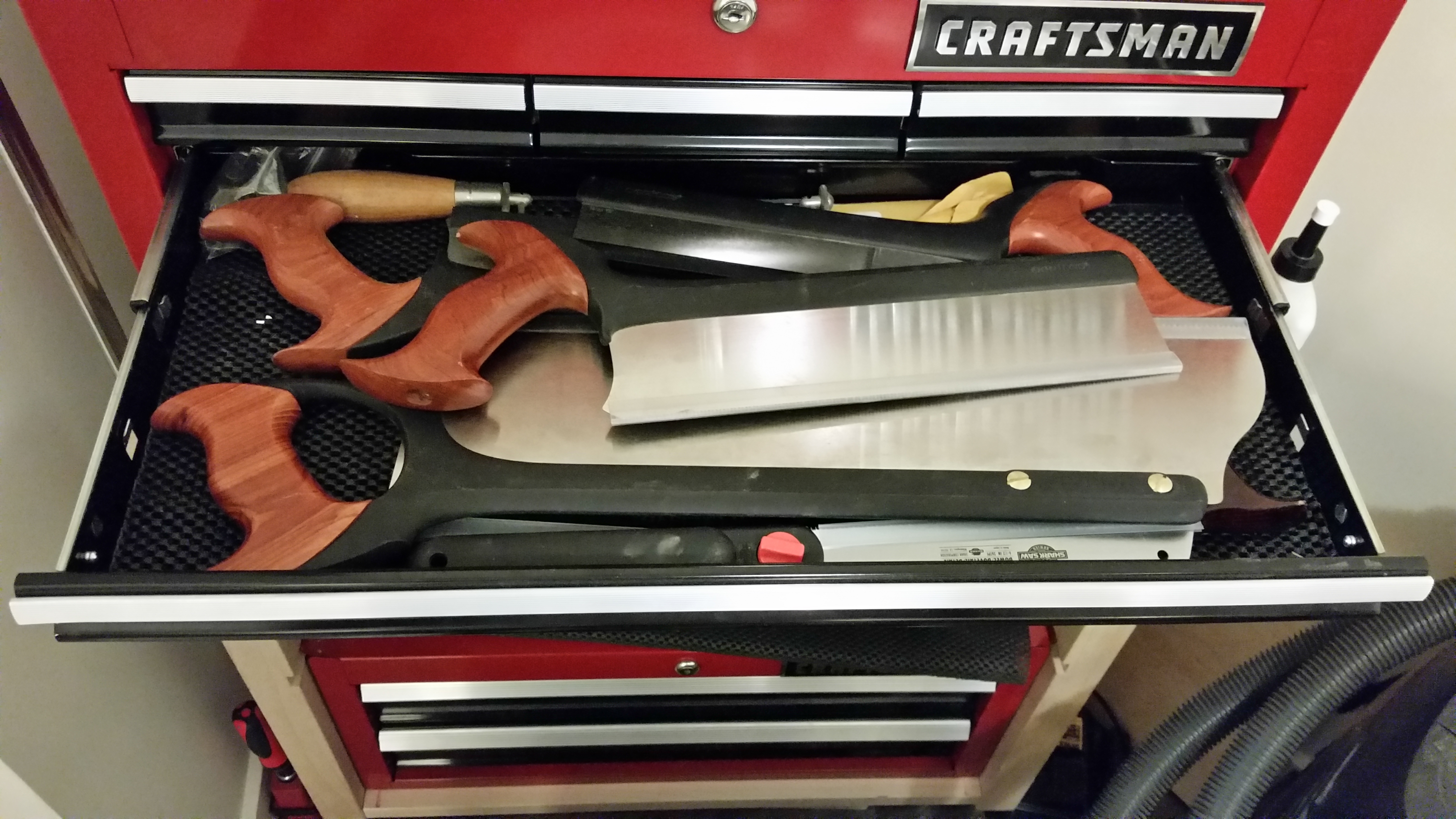
Pictured are seven joinery saws: an 11 inch crosscut carcass saw, two ripcut tenon saws (12 inches and 16 inches, respectively), two dovetail saws (14TPI and 20TPI), an old Disston coping saw that was my grandfather’s and a box store flush cut dowel pullsaw.  I know that is too many for a beginning woodworker; you really only need three, I think.

In my mind, the essential joinery saw set consists of crosscut carcass, ripcut tenon and dovetail. I know could do without the super fine dovetail saw (at 20tpi, I never use it because I don’t think I can even sharpen it) and the smaller tenon saw (if I had to, though it’s my favorite saw).  Also, there is nothing a flush trim saw can do that a dovetail saw and a chisel can’t in slightly more time.  Furthermore, not everyone hogs out dovetail waste with a coping saw (and mine requires vintage blades). If you use the knifewall marking method (which you absolutely should), you could even skip the crosscut carcass saw, but I have found the decreased resistance when crosscutting shoulders and housing joints helps in developing good sawing technique and habits.

My panel saws include two 26 inch ripcut (4.5 and 8 TPI) and a 22 inch, 10 TPI crosscut, although I got along just fine with only the 8 TPI ripcut panel saw for an extended period.  8 TPI in a ripcut pattern is easy to sharpen and works in a both directions for a variety of woods and thicknesses.

Measuring and Marking:
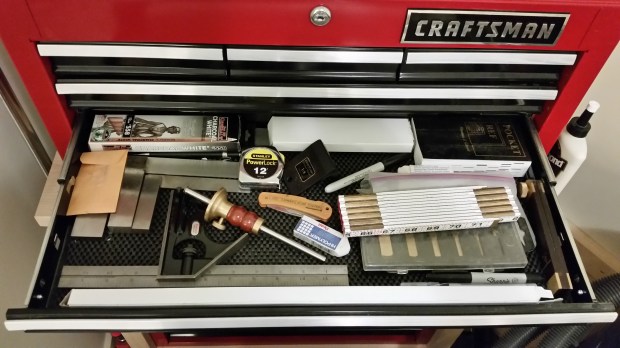
20141023_063533

Yes, that is a folding rule, and I use it all the time.

Now we are starting to cross into the more “miscellaneous” part of woodworking.  Other than a 12 inch combination square (the best you can afford), a decent tape measure, a marking gauge of some sort, a marking knife and some pencils (mechanical, black charcoal and white charcoal), the rest is personal preference.  I use a folding rule every time I woodwork and I couldn’t live without my brass setup gauges (which I use for testing tenon shoulders depth just as often as setting router depth).  The long white box in the front is a set of aluminum winding sticks, which are absolutely essential for hand-preparing rough stock and work well as straight edges.  The other try squares and the aluminum dovetail marker are luxuries I could live without (but would prefer not to).  And, of course, that Pocket Ref (4th Ed.) is just for show.

Two double bevel marking knives (both gifts), a scratch awl and a Shinto rasp live in the middle top drawer with the sash mortiser and corner chisel (see above).

Miscellaneous:
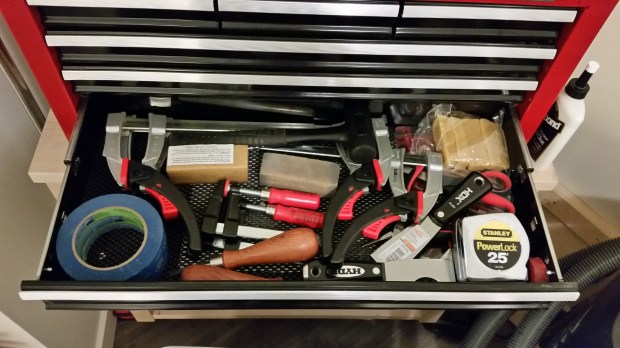
20141023_063549

There is never enough space for never enough clamps.

We are officially at essential odds and ends.  Some clamps; Blue Tape (you gotta have Blue Tape); screwdrivers; pliers; crepe blocks (if you don’t have one, get one); painters tools; a deadblow mallet; sharp scissors (essential for sand paper); and who knows what else.  I think those are needle files under the beeswax and a magnet at the front right.

And there you have it.  A place for (almost) everything, and everything in its place.  I am satisfied with the current state of my tool collection, although there are still a few, non-critical gaps I will address in due course.

You may be wondering, “where are the big hand planes?!?”  Well, I will treat them in a bit more depth in a second full post that should go live next week (the alluded-to “Full Version, Part 2”).  For now, here they are in their resting state, mere soldiers in this endless, bitter war against corrosion.

wpid-20141023_075128.jpg

In my defense, my chisel plane, small router plane and shoulder plane were in the “Chisels” picture.

That’s all for this week.  I have to prepare for an early Friday conference call.

JPG
The Bare Essentials (Short, Text-Only Version)

Welcome back to The Apartment Woodworker! In this week’s installment, I will share (in two parts) the contents of my recently-condensed workshop and why certain tools made the cut and others did not.

Monday is my first day back at the office, so in the spirit of brevity, this is the relatively TL;DR version. Later this week, the full version (with all the pretty pictures) should go live.

Although markedly less organized in practice, the process of downsizing my workshop was in three steps.

Step One was easiest. I asked myself, “What large items will I simply not have space for in the new apartment?” Seven foot workbench? Out. Miter saw? Out. Thickness planer? Out. All three were no-brainers. Also falling into this category was my rolling tool cabinet, although I briefly entertained the idea of keeping it, as the compact cabinet I made isn’t MUCH smaller. It’s not like I own a table saw or a jointer in the first place.

Step Two was also relatively straightforward. I thought, “What tools are essential for me to prepare and join two pieces of wood together?” In other words, “What are the basics of my more traditional style of woodworking?” Hand planes, hand saws, chisels, marking tools, sharpening implements, a few essential clamps, glues and finishes. Add in a solid work surface (Milkman’s Workbench clamped to a rock solid table) and a shop vacuum for cleanup and I have the essentials to keep making furniture. Period. Full Stop. From here on, nothing was included without justification.

Step Three was the most difficult and (potentially) dangerous. “What else, other than the above, do I need in practicality and can I find space for?” I definitely need my power drill for the household, although I do have a brace. And some screw drivers/socket wrenches also for the household. Sandpaper too. Okay, but what else? I do all my roundovers and chamfers by compact router, so I guess that’s in. So is my random orbit sander, which serves so many purposes. Now I need my dust extractor because I’m inside. Why not jig saw and circular saw, too? After all, they take the same batteries as the power drill and I have a few inches of shelf space left over. Then, just as I was running out of room, I struggled to justify any other big items. I just filled up the corners with some odds and ends (READ: other mallets and adhesive tape), some straight edges and essential safety equipment.

I don’t think I went overboard and it all fits.

Making due with less. Or, rather, making due with just enough. What a brave new world.