Ruminations

Fleam On

From time to time, I make woodworking resolutions.  Maybe “resolution” isn’t the correct work; perhaps “aspiration” is more appropriate.  A less pedantic version of me would just say “goal”.

My most recent woodworking resolution is using my crosscut tenon saw more often.  Which is secret code for “learn to sharpen my crosscut tenon saw better”.

wp-1462967979904.jpg

I put these lines on the new saw vise for a reason…

For some time now, I’ve relied almost exclusively on rip-pattern saws for both ripping and crosscutting.  It’s true that crosscutting with a rip-pattern saw leaves a ragged edge, but most cross-grain cuts also get a knife-line (or gauge-line) to establish a clean shoulder.  Any raggedness from the saw sits below the visible shoulder line (or is cleaned up when paring to said line).  And I’ve gotten quite good at rip-pattern sharpening, making it even more efficient.

But crosscut saws exist for a reason.  The different tooth geometry really does matter in some applications (e.g., through dadoes).  So I am retraining myself to sharpen a crosscut-pattern.  I have a feeling there will be some tooth jointing in my future.

JPG
Acute Sense of Longing

I left my No. 4 and my No. 7 hand planes at my parents’ house last week so they’ll be there when I pick up the workbench build again on Saturday.  That means the only bench planes remaining in my apartment workshop (other than a block plane) are a No. 4 1/2 smoother and a No 5 1/2 jack plane.  The shop feels positively undermanned.

Once my go-to bench plane, it’s been a long time since I’ve even touched the No. 5 1/2 (having been pretty much entirely replaced by my No. 7).  And the No. 4 1/2 has always been exclusively for final smoothing (an excellent luxury if you can swing it).

All of this is a roundabout admission. I had hoped to put together another “Basic Projects” installment this week, but I feel absolutely lost without at least my No. 4.  I just couldn’t psych myself up to make anything.

Everyone’s got a favorite, after all.

JPG

Some Scattered Thoughts

Sometimes, I regret spending the first year or so of my woodworking life using primarily power tools. I ponder how much further along I’d be in my hand work and sigh.  Sunk costs, I guess.  But more than that, I wonder how awesome it would have been to learn on a proper workbench.  I started on a Black & Decker Workmate 425, so it could have been worse.

But then what is the right type of workbench for a new apartment woodworker?  While I love my Milkman’s Workbench, and am glad to have made it, it’s not my go-to workbench anymore.  And I certainly did not have the skill to make one just starting out (not to mention the PWW article had not even been written yet).  So what would I do?  I’d buy another Black & Decker Workmate 425, of course, and start on my basic set of tools.

But then, I would buy four, eight foot long Douglas Fir 2x4s and laminate a 48″ x 12″ slab.  Which I could then dress by hand, drill some dog holes for a planing stop and clamp to a sturdy table with angle iron.  Then I’d use that surface to make a DIY moxon vise from veneer press screws and some red oak or maple 2×4’s and have all the workholding I could need for a while.  Then I would use the moxon vise to make a shooting board.

I’m not just spitballing here.  I woodwork almost exclusively on a 48″ x 9″ x 1.5″ maple slab, a shop-made moxon vise with 24″ between the screws, and a plywood shooting board.  And it works for me.

JPG

An Oft-forgotten Step

There is much in the process from a pile of lumber to a piece of furniture.  More than just stock preparation and joinery, anyway.

wp-1453300762584.jpg

Although each are integral unto themselves.

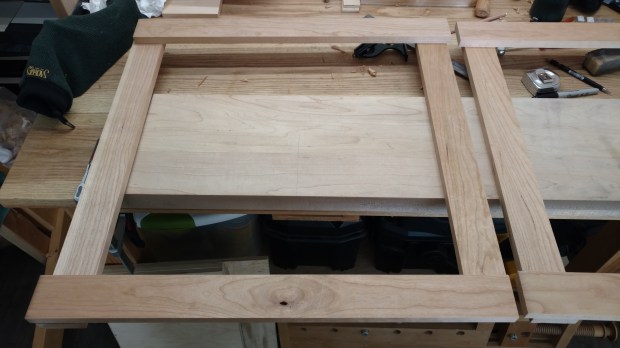
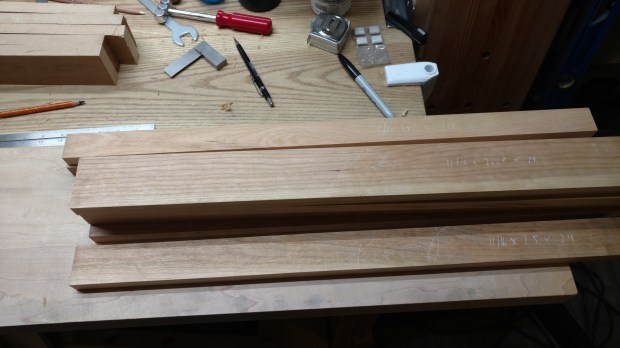
One of the most important steps to my creative process is initial parts layout.  In any piece where the grain will be visible, before any lines are scribed or joints cut, I always lay the pieces out on the bench and read the grain.  Then I arrange the parts in a way that is (i) most aesthetically pleasing and (ii) works for any unique considerations in the piece.

wp-1453299325394.jpg

Like this.

From past experience, I know the vertical pieces in an assembly like this should be the most stable pieces.  This means the four straightest, tightest grain boards become the stiles of the side frames.  Once assembled, these two frames will then be joined with several cross rails, which (together with the tops of the frames) should also be as stable as possible.  Whatever is left can be the lower rails and the drawer runners.

Assuming everything is joined squarely (a big assumption, sometimes), the piece then has the best chance of resisting twisting after final assembly.  And it doesn’t hurt that the cherry in question is as dry as anything I’ve ever worked with.

JPG

Stuff. And, also, Things.

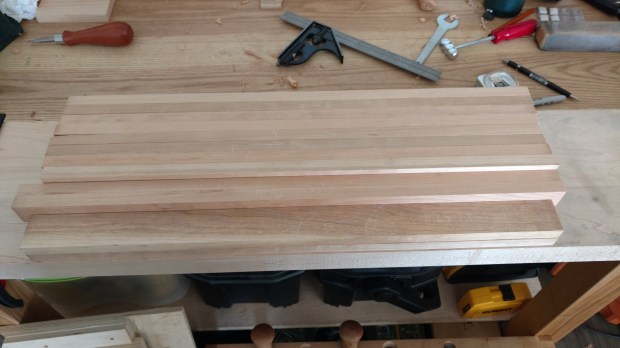
Much of my free time lately is spent straightening and squaring dimensional cherry. Some of it is making silly food service. And a good chunk of it is sharpening.

Although I may claim a solitary New Year’s resolution, I in fact have many goals for 2016.  Many are centered around using up the rando wood I have accumulated these past few years. Among other things, I hope to:

  • make the lower shelf for the dining table (and also clean it up a bit from two years’ use as a workbench).  Soon enough I will have a real workbench and the table can finally assume its true destiny.
  • build a new frame for my computer desk.  I plan to keep the same overall design, just make it better.
  • build a new moxon vise, with threaded wooden screws.

And I think that’s ambitious enough for now.  Back to that cherry!

wp-1452635800698.jpg

Whoa!  We’re halfway there!

JPG


Something Different

On Sunday, I went to lunch with a friend in Fairfield, CT.  On my way back to the car, in front of a shop along the strip, there was what I’m calling an antique wine press.

wp-1450109696149.jpg

If not antique, then rather well distressed.

wp-1450109703762.jpg

Looks pretty old to me.

I found the joinery to be quite interesting.  It looks like all the dadoes are hand cut to fit the metal parts and the long rails, and everything is reinforced or secured with through bolts.

wp-1450109706929.jpg

Accented stopped chamfers for a bit of flair on an industrial setup.

Also, each of the cross-supports on the top of the frame appear to be mortise-and-tenon joined into the long rails, and then also cinched with long through bolts.  I didn’t get a good shot from underneath, so I’m not quite sure how the lower shelf is secured.

wp-1450109700449.jpg

You can really see the hand-cut joints from this angle

Does anyone know anything about these?  I should have checked for a patent number on the metal part, but I was too focused on the wood joinery.

JPG

The Plank in My Own Eye

I don’t much go in for 2,000 year old metaphors, but there is one passage in the Christian Scriptures that always made sense to me.  Matthew 7:5 makes a pretty poignant point about judging others.  We’re all flawed, some of us more than others, so fix yourself before you criticize your fellow man.  Nowhere do I wish people lived by this concept more than in woodworking forums.

A gentleman I follow on twitter named Christopher Bowen (@abysmaljoiner) is making a beautiful side table, with a striped inlay and a curly something or other drawer front.  He recently posted a picture of his burnisher laying on top of the table, with ostensibly burnished corners (something I had never thought of, as I tend to just break them with a smoothing plane).  Hoping to learn more about the practice, I went to teh interwebs. The very first search result was to the forums of a major woodworking magazine.  And the very first response to a question about burnishing miters was by some intractable dickbag who, instead of answering the quite-reasonable question, admonished the person to just cut better fitting joints.

Sadly, this dickholery is the norm through most of the woodworking forums out there.  For every one stronghold of enlightenment, knowledge and community out there, you’ll find ten wastelands where you’re pretty much guaranteed nothing but rants from sad old men comparing dick sizes fresh off their chop saws.

The internet can be such a force for good, where knowledge, experience and advice is freely exchanged by people who care about the topic, and we’re all made better for it.  But I’m sick of having to slog through pages and pages of ePeen just get a comprehensible answer.

Besides, if they were really that good, they ought to care more about helping the rest of us get to that point than about bragging and putting other people down on the internet.  No one’s impressed, you incorrigible fucktards.

Happy Black Friday.

JPG

Medium Tool Chest Retrospective

I didn’t keep track of how many build hours the Medium Tool Chest took, but I can’t imagine it was more than 75 (not including travel time to and from my thickness planer).  I enjoyed the making, but as you all probably know, I won’t be using the chest for my woodworking shop.  It’s just not the right size for my set of tools.

I ordered one more hinge for the top.

I ordered one more hinge for the top.

I think, though, I’ve caught the tool chest bug (slightly more manageable than the workbench bug?).  So my next tool chest will be a custom size more like to the Anarchist’s Tool Chest than the current one.

I learned quite a bit from the project, though.  Some of it is apropos of an apartment woodworking shop, and the rest is just a workbench confessional.  Here goes:

1.)  Cut Nails are awesome.  They hold well and look great.  I think my previous aversion to metal fasteners was mostly because I’d never used real nails before.  I still dislike screws, though.  Even flathead.

2.)  Hand-cut Rabbets are fun.  The tool trays are both rabbeted/glued together (because I’d had enough of dovetailing by the end).  I didn’t own a fillister plane at that point, so I ended up splitting the rabbets (just like you’d split a tenon) and then fine tuning to depth with a router plane.  End result: parallel, uniform rabbets all around.

3.)  Never skimp on flattening.  I thought the oak bottom for the lower tool tray would pull the tray carcass into wind, but I was wrong.  7/16″ oak just isn’t rigid enough to straighten out 11/16″ pine.  I should have flattened and/or thinned the tray carcass boards before joining.  As a result, the lower tray rocked, even when full of heavy tools, which took some flattening.

4.)  Measure twice – cut once.  The upper runners for the tool trays are 1/4″ shorter than they should be.  Because and only because I set my combination square wrong and didn’t check it again before ripping them down.  Sometimes we all need a reminder of the oldest woodworking adage.

5.)  I really do need a larger workbench.  The Milkman’s Workbench is great, but I made the transitional slab (with Veritas planing stop) to handle the longer stock in a (sort of) vice-less approach.  It’s worked well so far, in conjunction with a DIY moxon vise.

Like I always say: now what?

More Progress

Sometimes, my design ideas are too ambitious for my contemporaneous skill set.  If so, I leave the design on the shelf for and come back to it.  Such is the case with the angled-leg plant stand I designed a while ago.

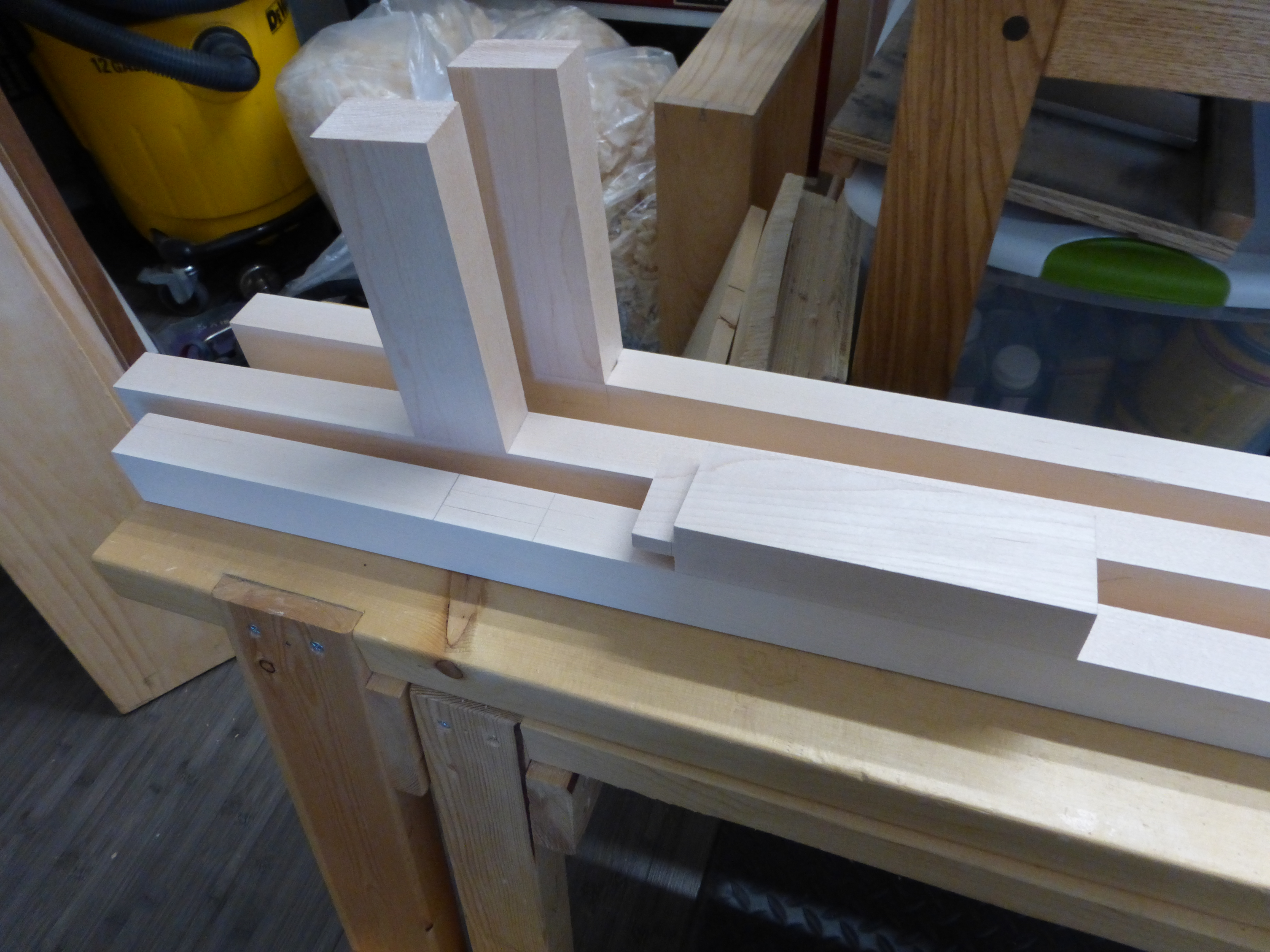
So the other day, thoroughly sick of flattening a recently glued-up panel, I decided to cut the angled tenons for the plant stand rails.  After some trial and error at full size, I decided a leg rake of 2.5° was aesthetically better to me than the as-designed 5° angle.  Though marked at the correct angle from a sliding bevel, the crosscut tenon shoulders were not perfect.  I had to use a shoulder plane to tweak the angles, but after a while, each rail seated nicely into a test mortise on one of the legs.

P1000224

I cannot stress enough how hard this maple is. I had to resharpen my shoulder plane while tweaking the angles.

There is still one more mortise to chop, and then I have to figure out how best to shape the center hub of the plant stand.  But all in all, as I’m fond of saying, “progress is important”.

JPG

On Freehand Sharpening

Edge sharpening has always been a weak spot for me.  While I took to saw sharpening very quickly, my chisels and plane blades were never been perfect.  I used micro bevels and wide-wheeled guides and even tried the ruler trick, to no avail.  My edges were sub-par and short-lived and almost always out of square.  So I gave up on all of that and went in a different direction.

It’s no secret that Paul Sellers has been a great influence on me over these past few years.  I consider his YouTube channel to be the best free resource for a woodworker just starting out in the craft.  Paul advocates freehand sharpening and none of that micro bevel nonsense.

I already had the diamond plates, so I figured I’d give it a try.  And it’s worked for me thus far.

P1000197

Scary sharp, indeed.

I started with my chisels (easier to correct if I made the edge worse) and instantly noticed that the “macro camber” approach of freehand sharpening lends itself to a stronger, longer-lasting edge.  Since then, I’ve freehand sharpened both my No. 4 1/2 smoothing plane (pictured above) and my general purpose No. 4 and gotten instant results.

No more fussing with stop blocks or fumbling with guides means I just spritz some window cleaner on a diamond stone and work until I feel the burr.  Freehand sharpening has actually decreased my sharpening time.

Maybe I’m just bad with guides and sharpening jigs.  Or maybe this is just the next step in hand-tool only woodworking.