small space woodworking

A Familiar Sight

With the floorboards now flushed to the case on the traveling tool tote, I’m at a critical juncture.  Should I finish the dovetailed skirt, or do I fit the tray runners?  Obviously, the runners, but not for the reason you’d think.

The walls of the carcass are only 11/16″ thick.  But the cast iron chest handles I’ve selected take 1″, No. 12 screws.  The case is becoming unwieldy, so in order to attach the handles I need the extra thickness from the runners.  After the handles are attached, I can apply the skirt, add the rot strips and paint the carcass (Tuscan Red this time).    Then I’ll turn to the sliding tray, wall rack and battened lid.

But in the meantime, I only have two wooden clamps and the hide glue needs to dry.

JPG

Nailed It!

A quick update on the traveling tool tote: it has a bottom now.

First, each floorboard is tacked in position with a headless brad.  I’m still a relative novice at driving nails and I want the alignment to be correct when I drive the heavy nails.

wp-1459775389546.jpg

With a business card’s worth of space in between.

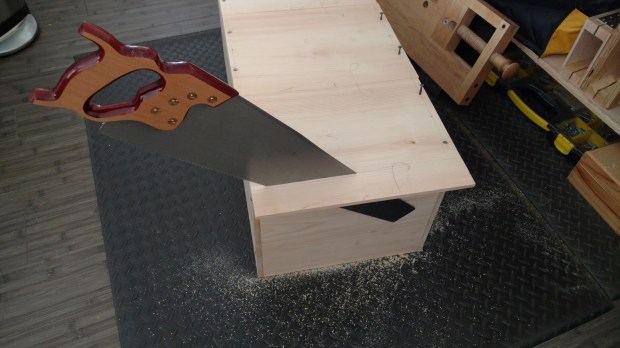
Next, I pre-drill and drive the aforementioned heavy nails (CT6, to be exact) at 5″ intervals, which I marked using my new 8″ dividers.  I also trim the overhang with a panel saw.

wp-1459775395289.jpg

The half-driven nails are a story unto themselves, for another time.

Then, I plane down the remaining overhang to be flush with the case and admire just how well cut nails cinch the work together.

wp-1459775418419.jpg

Quite remarkable, really.

Finally, I spend a few days agonizing over whether I drilled the pilot holes too deep and resolve to drive a few brads through the lower skirt into the floorboards, just in case.

Because nothing can ever just be nice.

JPG

The Best Laid Plans

I fully intended to add the skirt to the tool tote before nailing on the ship-lapped floorboards.  I really did.  The case went together square, so the floorboards weren’t needed to pull everything into alignment.

But because the case is rabbeted and nailed together, I wanted a low profile skirt to sit below the cut nails.  Unfortunately, with the floorboards being over 5/8″ thick, there is just barely half of the 1×2 skirt in contact with the case itself.  Not nearly stable enough to glue on first.  Oh well.

wp-1459386746465.jpg

Pretty board

It’s not all bad news, though.  Because the thickness of the floorboards is approximately half the height of the skirt, it should be really easy to clamp down the skirt and eliminate any gaps when it does go on.  Even if I have to make a go-bar.

JPG

So Far, So Good?

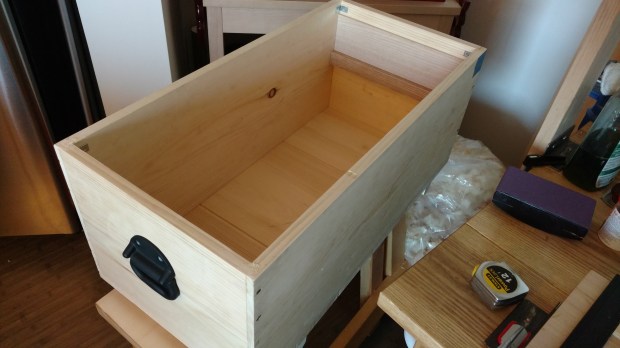
One consistent challenge in my apartment woodworking life is understanding the actual size of things before they’re put together.  Case (ahem!) in point: the carcase for the new traveling tool tote.  I didn’t really understand what 28″ x 14″ x 11 1/4″ looks like until it was assembled.

wp-1459034858953.jpg

It looks something like this.

The carcass of this toolbox is actually the same interior length as the medium tool chest I built last year (26 1/2″ or so).  I was well aware of that during the planning stages (it’s based on my panel saws, after all).  However, scaling down the other interior dimensions from 14 7/8″ high to 11 1/4″” high, and from 16 1/2″ deep to 12 1/2″ deep, is proving to be less significant than initially expected.  In terms of interior space, I’ve basically given up one shallow tray of height and one saw till of depth (on both the floor and the deep tray, though).

wp-1459037125541.jpg

It’s so hard to tell at this phase.  Also, spooooky!

Will that be small enough to make this thing truly portable once loaded up?  I have no idea.

JPG

Squaring Up

Using a router and a straightedge clamp to square the ends of the core slab went better than anticipated.  With some fussing, the straight bit worked like a charm, giving me a crisp step down to run the bearing on the pattern bit against.  There wasn’t even any chipping on either first pass with the straight bit.

wp-1458436431391.jpg

Quite a bit of fussing, actually.

Unfortunately, the pattern bit didn’t work as well and I did get some blowout on the second passes.  Nothing terrible, but I was kicking myself for not first scribing the ends (to sever the fibers and prevent chipping).  No harm, no foul, though, because I still had to plane the front face square to the underside.  All in all, I’m very pleased with the final length of 71 7/8″, which will be further augmented by the inner and outer jaws of a quick release tail vise.

wp-1458436437134.jpg

Not bad, starting from twelve foot 2×10’s.

The core slab, now S3S with only the top to go, is approximately 4 1/16″ thick.  Assuming the slab doesn’t move any further (it cupped very slightly in the week after initial thicknessing), I doubt it will take more than 1/16″ to flatten the top.  At any rate, anything over 3 1/4″ validates my choice to use 2×10’s instead of straight 2×4’s.

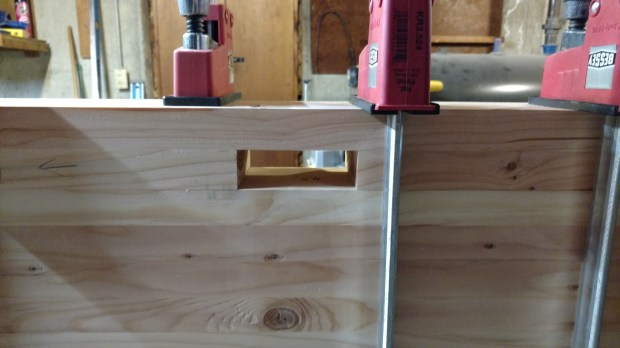
I’ve already created the mortises on the back edge, and I’ll be creating the front mortises over the Eastern weekend.

JPG

A Different Direction

The first set of mortise strips went onto the core slab without a hitch (almost).  I’m very pleased with the result, but I’m glad I did the back mortises first.  When I get to the front mortises, I’ll have perfected my technique.

wp-1458436358874.jpg

I don’t think this was faster than boring and paring, but it is certainly crisper.

After all the flattening, squaring and gluing (which I promise to write more about later), I’m sick of the workbench build.  Instead, I’ll distract myself for a couple weeks with a traveling tool tote, based heavily on Christopher Schwarz’ boarded tool chest from 2015, but scaled down.  I outgrew my soft tool tote long ago.  It’s time I upgraded my traveling setup.

I like this boarded tool chest design because it’s rabbeted and nailed, rather than dovetailed.  Dovetails are great, but this is a working piece that I want to complete on a decent timeline.  And call me crazy, but I really enjoy splitting rabbets (my shop-made fillister plane is only 5/8″, after all).  I will likely follow the oak-battened lid design of the source material, also for no other reason than it’s easier than a full dust seal of a traditional floor chest (but also because this tool tote won’t be populated full-time).  The entire carcass, including the ship-lapped floor, is only seven boards.

wp-1458496591661.jpg

Two sides, two ends, three floor boards, all cut to rough length.

Made almost exclusively from 1×12 common pine from the home center, the inside dimensions of the tool tote will be slightly over 26″ long x 12″ wide x 11″ high. There will be plenty of room in the floor plan for a panel saw, two back saws, a jointer plane, a smoothing plane and a router plane, plus a chisel rack on the inside wall.  A single sliding tray on oak runners will hold everything else I need for on-site work.

One final note: it’s amazing what you can find when you dig through the stacks of common pine.  In addition to a nearly knot-free carcass, there is enough clear, quarter-sawn wood to laminate a stable lid.  Plus, the quarter-sawn off-cuts from the floor boards will become the walls of the sliding tray.  All of this from only twenty-four feet of home center common pine.

I feel energized.

JPG

Improvisation

I had hoped to quickly and easily square the ends of the new workbench’s core slab with my compound miter saw.  Unfortunately, the slab is too heavy for the extending arm on the base and no amount of clamping pressure could keep it steady and square.  As a fallback option, I will use a straightedge clamp and a full size router.  A 3″ straight bit should hog off most of the waste, with a pattern bit to finish the job on the flip side.  My little trim router may have the torque, but it definitely doesn’t have the collet, so my full size router and D-handle base are coming out of retirement for one last job.

Once the core slab is squared off, I can begin applying the boards that will form the mortises.  Each mortise strip is comprised of three boards: two ends at 12″ long each, and one center board, sized to fit.

wp-1458089211001.jpg

Seen here, surfaced but not yet cut to final length.

Each mortise strip board will be pre-sized and glued directly to the core slab, using the underside of the core slab as the reference surface and the tenon boards for each of the four laminations as spacers.  As a result, the front and back faces of the core slab must be absolutely square to the underside of the core slab.  The slab has probably moved since initial flattening last weekend, so the last thing before glue-up will be re-dressing the underside and faces.  And I still have to surface those tenon boards

The mortises are completed by adding another, full-length, board to each face of the bench top.  Then, on the front face only, a second full-length board, picked for its beauty, will complete the bench top and be the show face of the bench top.  This added depth also keeps the dog holes out of the mortise strip.

Finally, each front leg will be brought co-planar with the show face of the bench top by similarly adding show boards.  Having not thought it completely through yet, I would nonetheless imagine the show-faces of the legs will be sized and added after assembly and settling.

If I do it all correctly, only the topside of the bench top will require any further dressing.  IF.

JPG


Reflections on a Theme

The internet contains a wealth of information on how to properly laminate a workbench.  Some are better than others, but something useful can be gleaned from all.  Let me add to that wealth with a few reflections on a topic: grain direction in the laminated bench top.  I know workbenches are supposed to be tools, not furniture, but this isn’t just about optics.   Minimizing tear-out serves both structuring and aesthetic purposes.

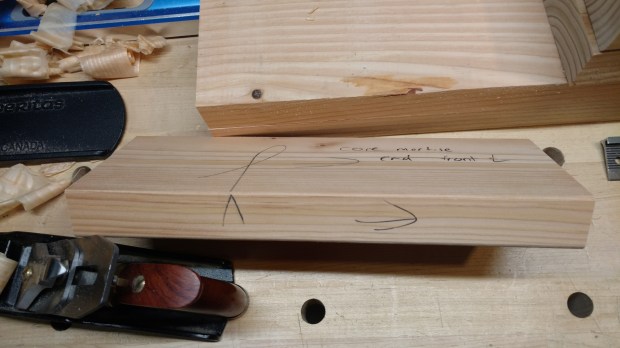
Perhaps because I rely heavily on a thickness planer after S2S’ing boards by hand, I am conscious of grain direction at all times.  I keep a charcoal pencil handy and every board, in addition to face and edge marks, gets two arrows, each indicating grain direction on the reference face and reference edge.  This allows me to quickly orient the boards, flip them end-over-end, and pass them through the machine for tear-out-free thicknessing.

wp-1457910947687.jpg

Every board.  Every time.

Minimizing tear-out on face grain will increase the overall glue surface and, therefore, increase the overall strength of the laminated bench top.  But, ultimately, those faces are hidden in the glue up and will never be dressed again.  What is most critical when laminating a benchtop is aligning the edge grain direction of the entire slab.

wp-1457830094027.jpg

All of this grain runs in the direction of the giant black arrow.

I have a specific reason for this assertion: the edge grain surfaces will be dressed many times through out the life of the workbench.  Taking a few minutes to orient the edge grain direction during the glue up means less work both (i) when initially flattening the bench top during construction and (ii) when re-flattening the bench top from time to time.  And over the life of a workbench, that will add up to quite a bit of time and energy saved.  And you might possibly save yourself some awful splinters down the road.

Plus, it will look nice.  After all, your workbench may one day be someone’s antique dining room table, right?

JPG

Basic Project: LN-style Saw Vise

This new “Basic Projects” segment is a Lie-Nielsen-style saw vise.  A good saw vise is essential, hand-tool woodworking shop equipment. This saw vise is simple to make from a few scraps and basic hardware and can be held in a bench vise during use.
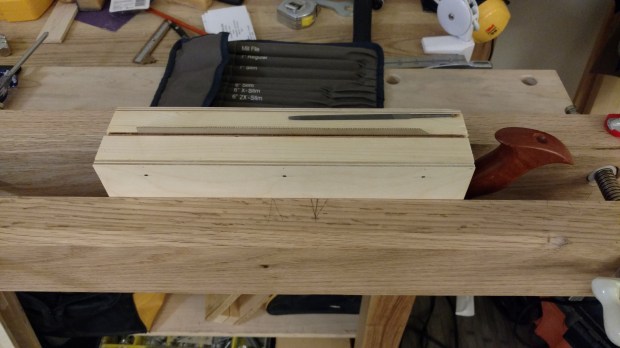
wp-1457658364376.jpg

The materials list below is for a 12″ saw vise, which I’ve sized to fit my dovetail saws (and therefore pretty much everyone one of my other saws).  A larger 16″ version is fantastic for my panel saws and larger tenon saws, but not so great for saws with smaller plates.  Please note that all materials were what I had on hand, so feel free to mix and match what’s available to you.

Materials list:

  • 2x birch plywood (1/4″), approximately 12″ x 6″ (for the sides)
  • 4x white pine blanks, approximately 12″ long and sized to fit your saws (for the upper and lower jaws)
  • Metal hinges
  • Wood screws/Cut Nails
  • Wood glue
  • Suede leather strips (to line the jaws)

Tools list:

  • 22″ panel saw
  • Low angle block plane
  • Hand drill and screwdriver/hammer
  • Scissors, chisel or razor blade (for trimming the leather jaw lining)

First, make the plywood sides.  Mine came from some craft store birch ply I picked up at the same time as the suede to line the jaws.  Saw them to length and width and plane to equal size with a block plane.  You can shoot them if you’d like, but exact squareness is not critical.  All that matters is they are identical and the long sides are roughly parallel.

Then, to size the upper jaws, take your smallest saw and subtract 3/8″ from the height of the saw plate at its narrowest point (probably by the handle): that’s the height of each upper jaw.  Then make each upper jaw about the thickness of the saw tote (or 2x overall) to accommodate different size saws in the finished vise (but there is no magic to this measurement).  Using my Vertitas dovetail saw as a reference, each upper jaw is 7/8″ high and 1″ thick.

When you glue the leather lining onto the upper jaws, you can use pretty much any type of glue when bonding leather to wood.  I use hide glue for the longer open time.  Either glue the leather down proud of the wood on all sides and trim flush with a chisel and mallet (like I did), or cut the strips to size before gluing.  Either will work.
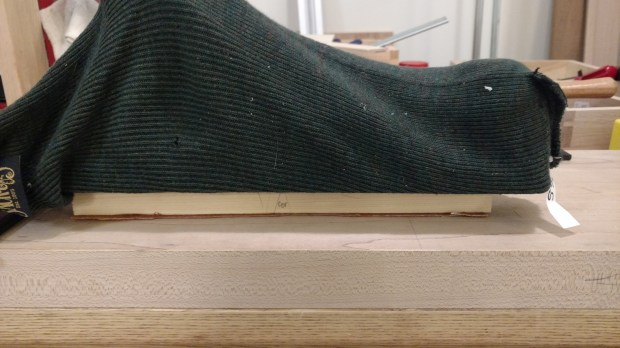
wp-1457528797584.jpg

In scales this small, a hand plane is a good as a granite slab.

Height on the lower jaws is not critical, but they should be substantial enough to take wood screws or nails.  Depth on the lower jaws is more important: they must be overall pretty close the upper jaws (including the leather lining) so the upper jaws will close tightly when clamped around the saw plate.  If you can, leave the lower jaws larger to accommodate the leather jaw lining on the upper laws (which can add up to 1/8″).  I always forget that part and make all four jaws identical.  So instead, I added leather to each of the lower jaws also.

Now glue and screw one upper jaw and one lower jaw to each plywood sides, driving from the outside.  Three screws for each jaw should be more than enough.  Cut nails will work also.  I actually used 1″ headless cut brads (from Tremont Nail) because I don’t have a No. 8 countersink bit handy.  If you use nails, remember to orient the head of the nail with the grain of the top piece.
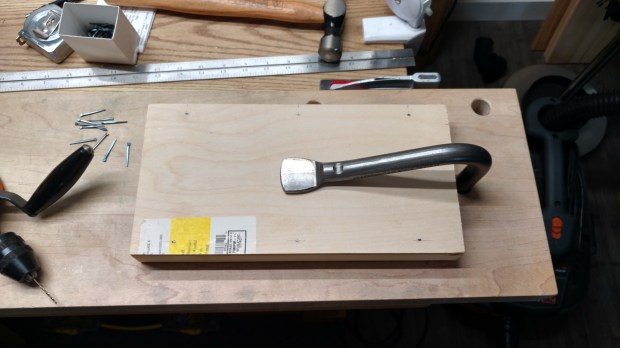
wp-1457615220386.jpg

Light pressure from the holdfast keeps everything cinched while driving the nails.

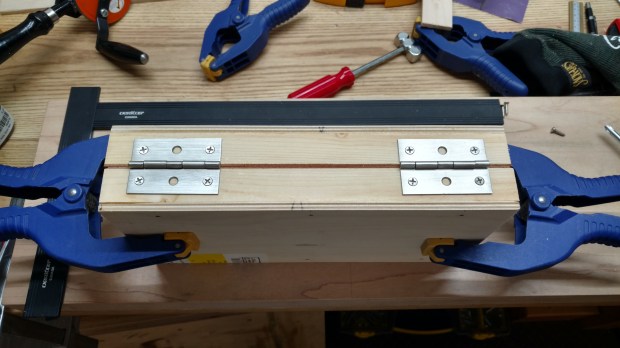
Then clamp the assembled halves together in a bench vise or with some F- or spring-clamps.  Mount the hinges on the outside of the lower jaws, about 1″ from each end (and in any event, clear of the screws or nails holding the jaws onto the sides).  The hinges I had on hand were overkill for this application, but I wasn’t about to buy more.  Finish is optional
wp-1457658360257.jpg

Good thing I added leather to both sets of jaws; I installed the hinges on the wrong side!

And that’s it.  You’re ready to sharpen your own saws.  If you’d like, go ahead and chamfer the top front edge.  Although not strictly required, this detail will save your knuckles in the long run.

I will be hand-flattening the core slab of the new workbench this weekend, so wish me luck.

JPG

Taking Stock (Literally)

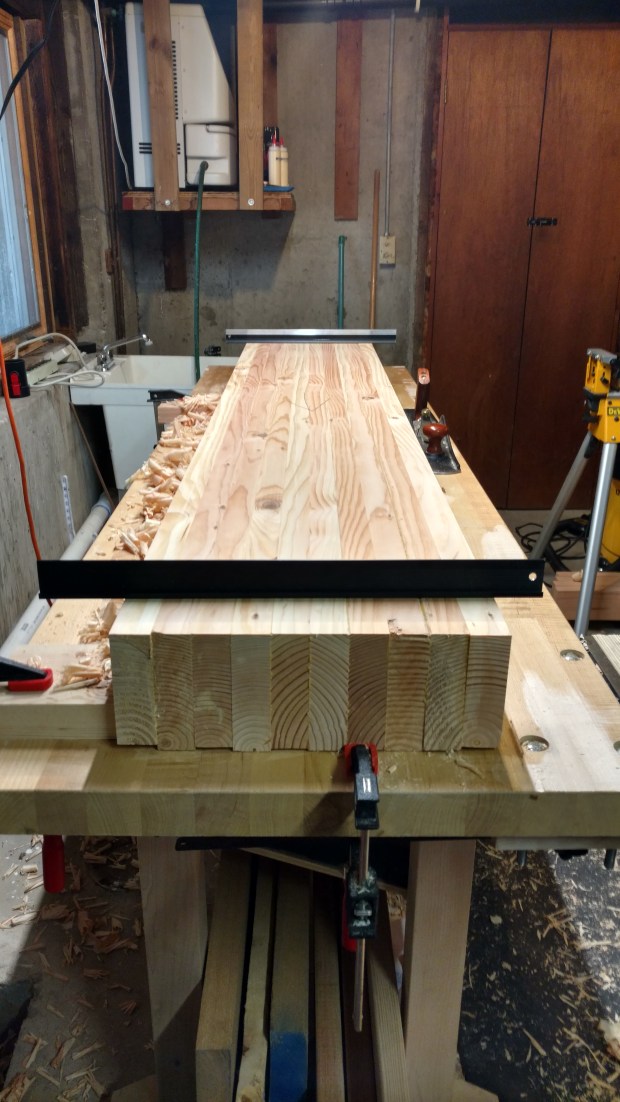
Saturday was another productive day on the Douglas Fir workbench build.  I surfaced and glued two additional boards to the core slab, bringing it to just over 13″ deep.

wp-1457213524532.jpg

The same length and depth as the planing slab, but nearly twice as thick!

Dodging a bullet on the previous eight boards, the expired/near-expired PVA glue has in fact held.  Being paranoid, I plan to add a couple full-length mending plates to the underside of the bench top once fully assembled.  Not because I think it will do anything, but because it will make me feel better.

I also rough cut to length the remaining stock so that I could take, umm, stock of how much more lumber I needed.  What’s shown below is almost everything required to make the full bench.

wp-1457213250309.jpg

wp-1457213253579.jpg

DeWalt, I am open to sponsorship…

Here is what’s still on the buy list:

  • Eight feet of 2×6, which will become (i) the tenon board and the inside board of the left front leg and (ii) [probably] the outside vise chop on the tail vise.  Not sure if I’ve mentioned it, but unlike the other three legs (which are comprised of ripped down 2×10’s), the left front leg is laminated from 2×6’s for extra stoutness when chopping.
  • Twelve feet of 2×10, which will be ripped in half and cut down to (i) four 48″ lengths for two long stretchers and (ii) four 24″ lengths to make two short stretchers.  I also have two other 24″ lengths which are flagged as short stretchers.  The prettiest of the six 24″ boards will become the end cap/inner chop on the tail vise.  I will decide on the fly if I want to add a second end cap to the benchtop (unlikely).

All in all, should be another $30 or so from the home center.  I’m definitely under budget on this build, having carefully planned out my cuts from what was available.  I will eventually need some pine for the slatted shelf, but I’m not worried about that right now.

I’m torn about something, though.  My thickness planer is only 13″, so to use it I’d have to remove about 1/4″ of depth from the core slab as it currently exists.  However, my local woodworking club has a 15″ thickness planer.  If I use theirs, I can add one more board to the core slab.  But then I’d be using tools other than my own (and it would cost me for shop time).  A good problem to have, I guess.

JPG