apartment woodworking

Needing Something More

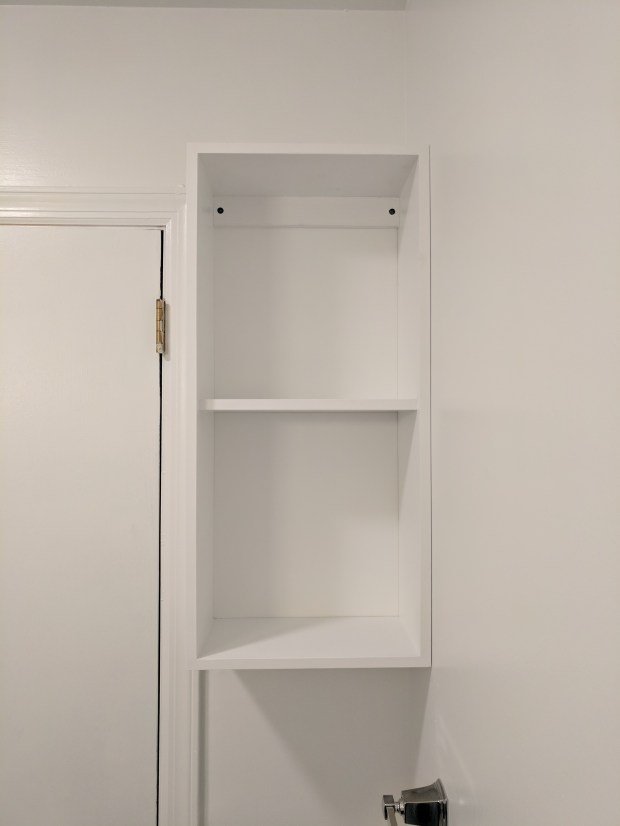
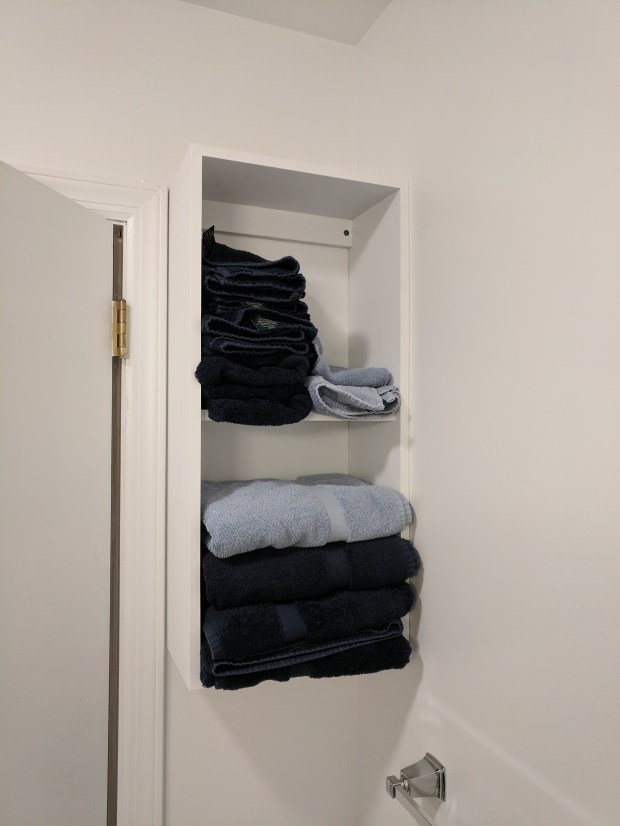
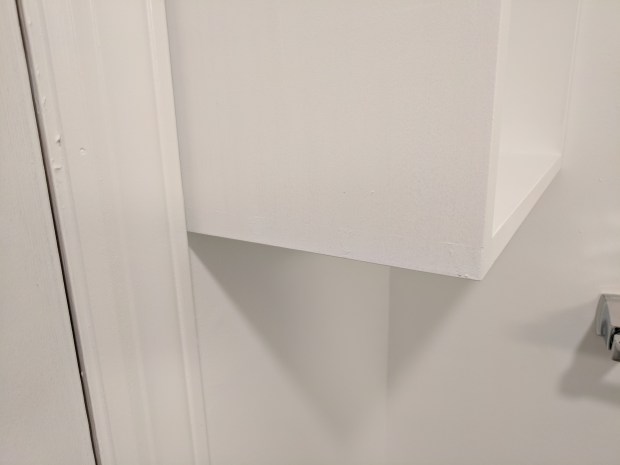
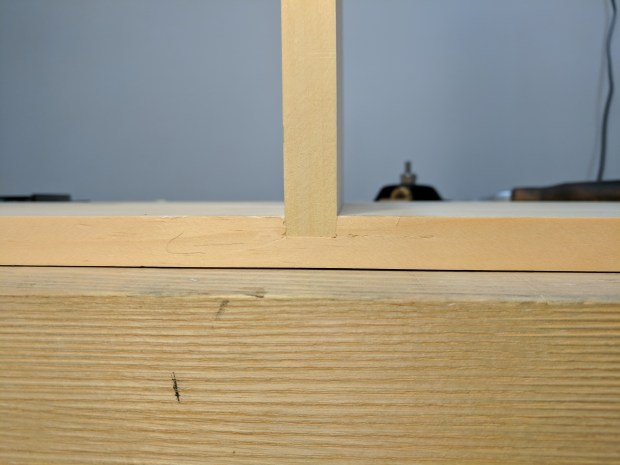
It’s a magic thing.  Starting from 7 linear feet of home center 1×12 eastern white pine. Adding the plane, the saw and the chisel.  Then ending up at the finished piece.  In this case, a 14″ x 30″ x 7.25″ wall cabinet, with through-dovetails at the corners and stopped dadoes for the shelf.  It is as perfect as I am capable of making.

IMG_20170913_212240

And perfect for hiding in a bathroom corner behind a door!

But it looks a bit plain to me.  I can only imagine how drab it will be when painted grey to match the vanity in the bathroom.  Rather than shape the sides, though, I may spruce it up with small molded face frame.  Or perhaps just an applied moulding on the shelf.  In any event, something I can do with moulding planes.

It feels like everything I make is square and flat.  Maybe it’s time I learn to cut compound dovetails.

JPG

A Small Oversight

I’ve been on a shop appliance kick lately, including some necessary upgrades for the workshop itself. In addition to finally hanging some proper lighting, I also added a parallel clamp rack to the side wall. I have two more such racks; I just need some more washers to hang them correctly.

IMG_20170902_091015

Much harder to knock down, now.

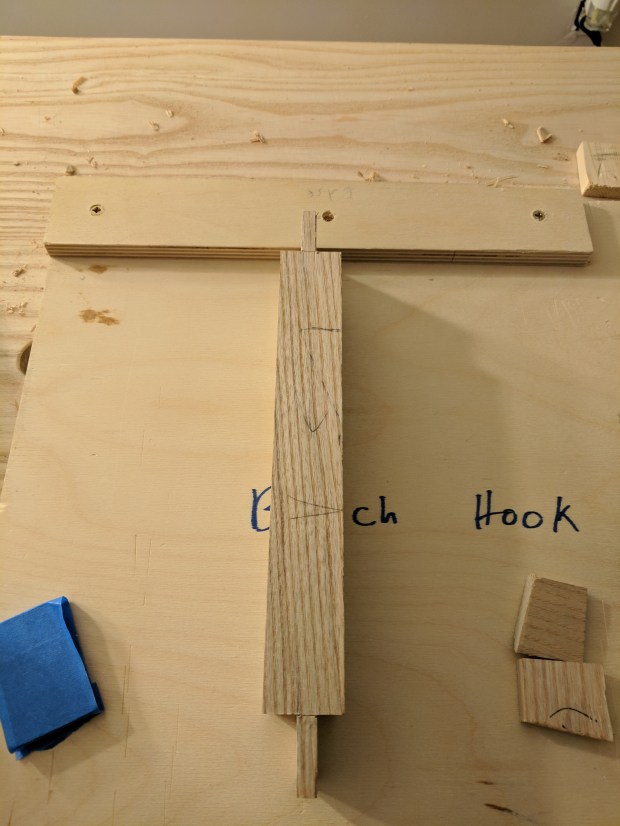
I also felt it was time for a tool rack on the back side of the workbench, a la Monsieur Roubo. With a scrap of 1/2″ baltic birch and some pine offcuts, I knocked together a rack that gets the spacing right for my chisels and other everyday tools.

IMG_20170904_104420

Holes on 1 5/8″ center are just right for Narex chisels (rather than the 1 1/8″ in my tool chest).

I am 100% certain this would have been a 20-minute job if I owned a table saw. Instead, it was about 2 hours of planing, spacing and gluing (not including drying time), but the result was worth it.

IMG_20170903_213245

That block plane is a clamp.

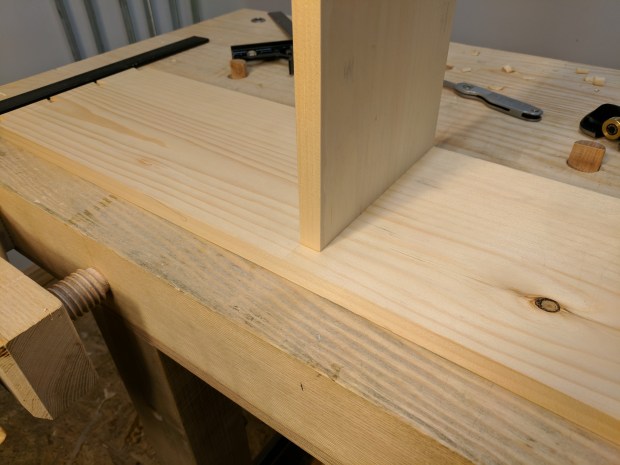
There is only one problem: I never squared the back edge of my workbench. Time to debate whether to remove the top from the frame so I can square the back edge, or just attach a wedge to level out the surface.

In the meantime, I think I’ll make a “Basic Project” out of it.

JPG

Walking on Sunshine

I had intended to call this post “Let there be Light: the Revenge”, but thought better of it in the end. But the point is the same: proper illumination is an integral part of doing quality work (woodworking or otherwise).

It’s not pretty, but I don’t want to hardwire any fixtures yet.

By now, that I swear by these LED light bars is not news. But as always happens, there is some finesse in the hanging. To hang properly, the hooks in the ceiling should be about 45 inches apart. But in the orientation I desire, that meant hanging on studs 48 inches apart. Too far for just the S hooks to reach.

My solution? Twist some leftover coat hangers from the Roman Workbench mockup.

And I got to use my electrical pliers!

Each is about 5 inches long and much sturdier than the thin wire that originally came in the box. Nothing fancy, totally free, and quick.

The simplest solutions are always the best.

And now I can see what I’m doing. And isn’t that really the point?

JPG

A Brief Flashback

My post the other day reminded me that I never actually posted this.

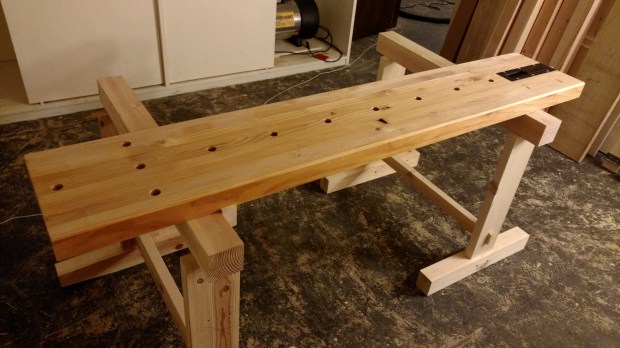
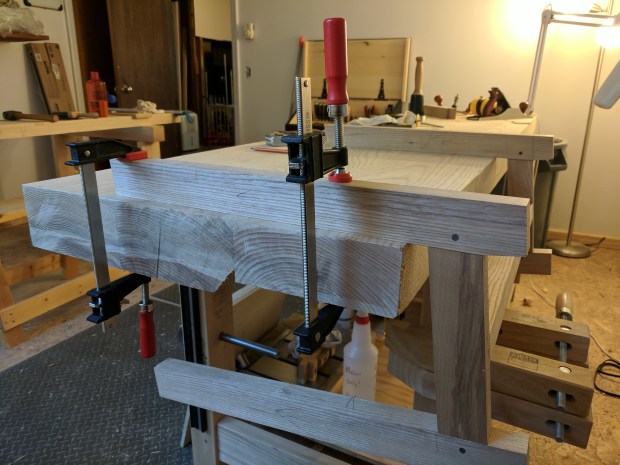
Once upon a time, as a supplement to my Milkman’s Workbench, I made what I called a “planing slab”.  It was 6 feet long, 13 inches wide and about 2 inches thick (after several flattenings), with a Veritas Inset Vise on one end.  It clamped to my dining table with angle iron, just like the Milkman’s Workbench.  And now, it has reached its full potential.

wp-1480513262955.jpg

Yes, that’s a second Japanese-style saw horse as well.

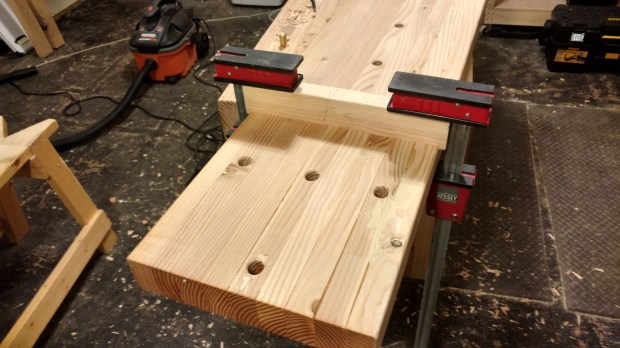
I had always meant to add a cleat to the underside so it could function like a Japanese-style workbench.  Nothing fancy, like the sliding dovetail shown in the source material.  Just dado and glue.  I used PVA, so I’m pretty sure it’s permanent.

wp-1480514705774.jpg

So tight, it needed clamp persuasion to seat.

The most important thing I’ve learned in this process is that the coefficient of friction on douglas fir is not significant.  A layer of adhesive-backed sandpaper on the underside of the slab in front of the cleat or (better yet) on the tops of both sawhorses does wonders to keep the slab in place.  A couple of F-style clamps holding the cleat tight against the front saw horse also work.

JPG

There is Always One

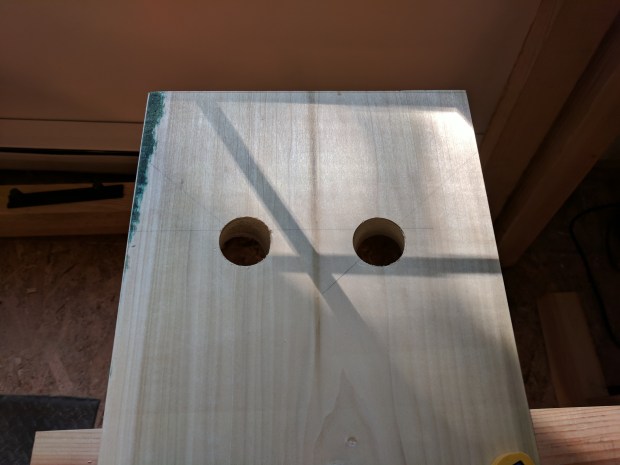
I’m no stranger to angled mortises.  But I’ve never done staked furniture before, so when it came time to bore the through mortises into the Roman Workbench slab, I didn’t know what I was getting into.  I read and reread the entries in both The Anarchist’s Design Book and Roman Workbenches, and I think I nailed the sight line and resultant angles, but it was still a bit touch and go.

IMG_20170826_104812

The front two mortises look pretty good.

I should have done a test mortise because, as often happens, the first one is a bit wonky.  It’s not quite lined up laterally, and I can tell the rake is off by a few degrees.  Not just by eye, but also because it’s the only mortise that had any blowout on the top face. While I can fill in the chipping (and might even paint the top), there is not much I can do about the angle.  Luckily, it’s the back right leg, so I won’t see it day to day.

IMG_20170826_104835

There is always one.

So that means it’s just about time to make the legs.  Shaping the tenons without a lathe will be one challenge, but before that, I’ve got to rip down the legs.  By hand.  Out of 8/4 air dried red oak.  At least it will be a workout.

IMG_20170826_104822

I wish I had a table saw right about now.

Speaking of wishful thinking, it would have been great to know about the Roman Workbench form when I first started woodworking five years ago.  This seems like the perfect workbench for getting started in an apartment with a limited set of hand tools.  It’s easy to make and straightforward.  Hell, you could probably even make the top from a single sheet of 3/4″ plywood ripped four times down the length.

Plus, with an extra cleat on the underside, a Roman Workbench could also go up on saw horses and act like a Japanese-style workbench for added flexibility.  And flexibility is the key to apartment woodworking, in my experience.

wp-1480513262955.jpg

Like this, basically.

Oh well, coulda, woulda, shoulda, right?

JPG

If it’s Wobbly…

then you should have put a stretcher on it.


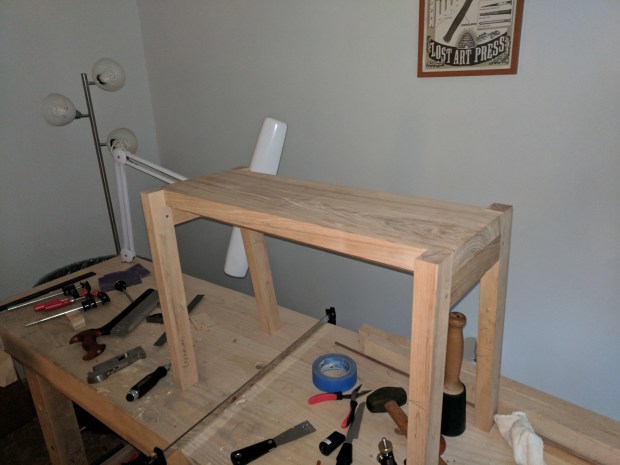
IMG_20170818_182542

A bit more spindly than I expected.

I thought the drawbored mortise and tenon joints would be enough, but the ash sitting bench has turned out to be a bit wobbly.  So paraphrasing Queen Bey, I’ve decided to retrofit a stretcher to back legs.  In my world, “retrofit” is a synonym for “lap joint”.

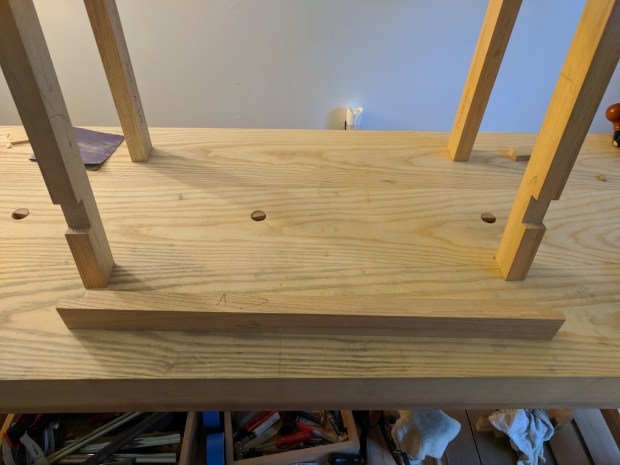
IMG_20170819_084743

It’s times like these when I’m glad my workbench is apron-less.

A friction-fit lap joint can be very strong.  Between the long grain-to-long grain glue surface and the mechanical strength of the intersecting joint, it can be nearly as strong as a proper mortise and tenon joint, even without a metal fastener.

IMG_20170819_090714

It’s so pretty.

Because the joint will never be seen, though, I may add a slotted screw to each joint for a little bit more lateral support.  Or perhaps a walnut peg, to mimic the other drawbored joints in the piece.

There was some subtle twist in the entire assembly, so I’ve left the joint clamped for the full 24 hours.  That will give me time to think about whether to screw or peg.

IMG_20170819_093540

It’s almost like I meant to do it.  And now it matches the table a bit more.

The only other remaining question is whether this one stretcher will be enough.  I’d prefer not to add a second stretcher to the front legs.  I tend to cross my legs at the ankles when I sit, and that stretcher would get in the way.

JPG

We Who Are About to Bore

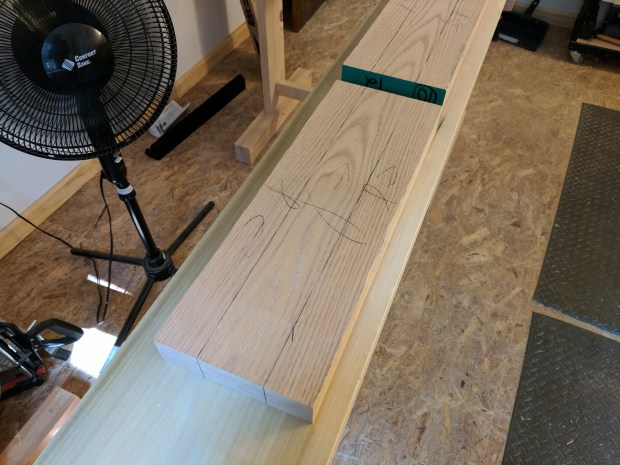
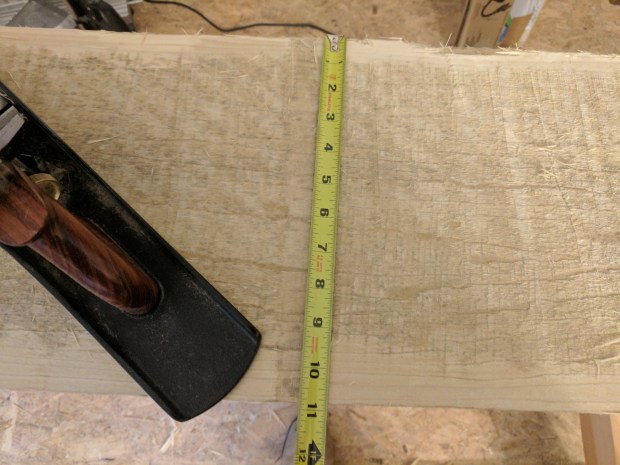
A straight and square board, surfaced on all four sides is a thing to behold. When it’s 7 feet long, 11 inches wide and 2 inches thick, it’s down right beautiful. And that’s what I did over the weekend. It may be poplar, but soon it will be a Roman Workbench.

Little thin for a proper Japenese bench,

Like any pretty board in my workshop, though, it started out ugly and rough. But ugly and rough is how we like ’em ’round here (at least at the start). Then comes the Jack Plane.

My only complaint about the new floor is that it’s slick sometimes.

In my experience, the trick to flattening a wide, thick board is to start on the cupped aide and not get too overzealous. It’s very easy to plane a hump if you’re not paying attention. And that’s no recipe for keeping as much thickness as possible.

This is not a how-to on traversing . So my only other advice is to figure out where the twist is early in the process. It’s no good first taking out the cup then having to take out the twist. That’s likewise a recipe for losing more thickness than necessary. Once I have one side flat, I like to send it through the thickness planer. Others square an edge right away. Either works.

Then I tackle the edges. The goal is to remove only as much width as necessary. I try to square each foot or so to the face, then worry about overall straightness. On this board, I ended up only losing about 1/8″. A testament to the sawyer more than my planing skills.

So glad to have my 5 1/2 back in the shop.

The end result (seen in the first picture above) is a board that’s ready for joinery. And joinery, in this case, means big, round, wedged tenons.

JPG

For All to See

After clearing a few little projects around the home, I turned back to the ash sitting bench I’ve been [slowly] making.  The design includes a 10° rake on the back legs and that means one thing: angled mortise and tenon joints.  One of my favorites.  But that’s not what I’m here to talk about.  I’d like to talk about mistakes.


IMG_20170817_092823

I’ll wedge that gap at the top, no problem.

The cross rails pictured above are a different thickness than the legs.  This means that while the mortises are centered in the legs, the tenons are not centered on the rails.  So keeping track of the reference face for the mortise gauge on the rails is SUPER important.  And, of course, I messed it up on the very last tenon.  Nothing would be square without a fix, and I’d prefer not to make another rail unless I really have to.

IMG_20170816_200834

The saddest “spot the diffrences” puzzle ever.

In the past, when I’ve pared tenons too thin, I glue on veneer of a similar hardness wood to build it back up.  Like the leg tenons on the Stent Panel workbench.  So why not use the same trick to build back up one of the tenon cheeks, then widen the mortise on the rail to accept the fatter tenon?  I grabbed an offcut from one of the tenon cheeks and glued it back onto the tenon.

IMG_20170816_201937

Say what you will, but these squeeze-style clamps work well for light clamping tasks.

After the glue set, I pared the patch down to the correct depth.  Then I reset my mortise gauge and widened the mortise to match the fatter tenon.  Net net, the joint is tight and the reveal is even (as shown in the first picture above).  And because I didn’t lose any of the original tenon’s thickness, the joint is still as strong as it would be had I not messed it up in the first place.  Once glued and drawbored, the joint will last forever.

Of course, none of this was necessary to share.  But I don’t keep anything from you guys.

JPG

Silly Little Details

I’m at a wedding this weekend and have workbench separation anxiety. So for the next few days, I’ll continue building an ash sitting bench in my mind. As of right now, I’ve got everything planed to proper dimensions and the top mortises cut in the front legs. It’s slow going, given everything else I’ve got going on.

I don’t cut many mortise and tenon joints. Not as many as I do dovetails, anyway. So it may be lack of skill on my part, but my mortises never seem to be completely parallel. To compensate, though, I cut my tenons fat: to tighter than piston-fit. This allows me to ease the mortise walls to bring the joint into parallel while still keeping an overall tight fit on the joint.

After all, what’s the point of making the stock straight and square (tried and true?) if the joint is crooked?

JPG

Back on Track

For various reasons, I have resumed work on the large Dutch tool chest.  It was pretty far along when first abandoned, needing only the fall front and the lid (and racks/tills).  I couldn’t justify scrapping it after so much work.  So I spent the day making the fall front.

IMG_20170514_201242

Some flushing still to do.

I was unsure how the wooden latch system would work.  It didn’t help using a material I’d never used before: home center poplar for the battens, latches and locks.  It wasn’t so bad (I chose only quarter- or rift-sawn hobby boards) and overall the alignment is pretty good.  I especially enjoyed cutting the shallow dadoes on each of the four latches by hand.

IMG_20170514_201200

Screws on the latches, nails on the battens.

Not so much for the shelf, however.  In the PWW article, there is no mention of the notches for the battens.  I should have realized I needed them, but didn’t.  I therefore  glued and screwed the lower lip and face board before I cut the notches for the battens.  There was barely clearance for a dovetail saw, and none for a coping saw.  I made due with chisel and router plane, though, and they came out okay.

IMG_20170514_201308

Live and learn, I guess.

Next up (before tills and racks) is making the lid.  But first, I must flush everything to the carcase.  A trim router should make quick work of any overhang on the face board and back boards, and I’ll bring the front and back edges into 30 degree plane with the sides via jointer plane.

But I’m out of daylight and motivation for now.

JPG