small space woodworking

Apropos of Nothing

My name is James.  I am a hand-tool woodworker and this is my workbench.

wp-1467117629690.jpg

In all its glory.

I only mention it because I plan to finish the Stent Panel workbench over the holiday weekend, so this may be a last-ish hurrah for my beautiful little clamp-on slab.  It has performed quite admirably over the last year or so, and it deserves a retrospective of its own.

Made of Hard Maple, its overall dimensions are 48″ long x 9″ deep x 1.75″ thick.  The bench uses two Veritas aluminum planing stops (one of which functions also as a bench hook on the right side of the bench) for general workholding.  There is also a dog hole for a Grammercy Tools holdfast on the right side of the bench.  The whole thing clamps onto my sturdy dining table using angle iron and ordinary F-style clamps.  It’s finished in two coats of natural Danish Oil (Watco, obvi).

I always meant to add a crochet and peg system for working on edge grain.  Heck, I still might (using some brass shim stock for the pegs).  Most of my edge grain planing is done with free standing boards (for more tactile feedback), but anything that wouldn’t stand on its own gets clamped onto the front face with some F-style clamps.  That works okay, but it’s no replacement for a face vise or crochet system.

The slab has served me well and stayed very true over its life.  It’s planed to be flat when clamped down to the dining table, so if the slab finds new life (as the top of a child’s workbench, perhaps), it will need to be re-trued.

And, apropos of nothing, I bought River a climbing rig that hangs on the back of a door.  It’s pretty sweet, but it makes me want to build a better one myself.

wp-1467285410765.jpg

But it should be fine in the meantime.

Happy 4th of July, everyone.  Grill some meats and make some sawdust (not at the same time).

JPG

Why I Can’t Have Anything Nice

I’m pondering a new feature on http://www.theapartmentwoodworker.com. A weekly “Things I Learned This Week” segment. Cautionary tales for the small space woodworker.

This week’s entry: when driving nails into unsupported face grain, pre-drill as deep as you can.

For the new travel tool chest, I nailed on the rot strips (instead of screwing them on like I would normally). The nails (Tremont fine finish) are about 1/4″ shorter than the combined thickness of the rot strips and the floorboards, prior to setting. Wanting the nails to bite hard, I only pre-drilled the rot strips themselves and not the floorboards. Fine finish nails taper dramatically, so it should have worked.

image

And it looks fantastic from this angle.

What actually happened was each nail pushed fibers up and through the floorboards, splintering the face grain. Not a structural issue, but an annoying cosmetic blemish.

As a result, the tool chest floor is getting an adhesive-backed cork lining.  They say the sign of a good woodworker is not the absence of mistakes, but the ability to hide the mistakes made.

As an alternative to further pre-drilling, I may next time drive the rot strips first, before attaching the floorboards to the carcase. That should eliminate any unsupported fibers and give me the fastening power I’m after.

JPG

Traveling Tool Tote Retrospective

It’s been about a month since I finished the traveling tool tote.  I am very pleased with the result.  Even if I haven’t figured out how or where to attach a transom chain.

wp-1463092251778.jpg

I’m getting better at stuffing it, too.

I may be my own biggest critic, but there also are genuinely some things I don’t like about it.  In no particular order of importance, the good and the bad are as follows:

Size and Shape

  • The Good: the basic dimensions are nearly perfect for the tools it was designed to hold.  My panel saws fit inside lengthwise (in a till) and the well area comfortably holds a bevel-up jointer, a No. 4 smoothing plane, a large router plane, a block plane, a tool roll (chisels) and sharpening gear (diamond plates, saw file roll, etc).  The 4″ deep sliding tray has plenty of capacity for two backsaws (dovetail and carcass), marking and measuring tools and assorted odds and ends.  The simple rack on the back wall rounds out the basic storage setup, giving me everything I need for working away from the shop.  It’s heavy but portable, even fully-loaded (but by “portable”, I mean “I can move it from my apartment to my trunk by myself without herniating a disk”.
  • The Bad: the sliding tray itself is too wide. At just under 7″, it covers more than half of the well, making it difficult to reach tools that sit in the center of the floor.  I find myself removing the tray more often than not as I’m unloading.  A small complaint, but still something to address in the next version.  In addition, the simple rack, with its four spacers, will eventually be replaced with a solid rack of 1/2″ holes bored every 1 1/8″ on center (which I avoided this time around due to lack of drill press).

Construction

  • The Good: rabbets and nails are definitely easier to get right than dovetails.  Angling the nails a bit adds to the holding power and properly sizing the end grain makes for a strong joint.  Although not strictly necessary, I added a dovetailed lower skirt to keep everything cinched tightly and cover the end-grain on the floorboards.  And the lid, consisting of a pine panel and two oak battens nailed on, came together quickly and easily.
  • The Bad: rabbets and nails will never be as strong as dovetails.  In fact, trauma to the case during construction fractured one of the corner joints and even when re-glued and re-nailed, I felt it necessary to add corner brackets as reinforcement.  I will likely dovetail the next incarnation.  Also, the oak battens only hold the pine lid flat across the width and do not affect the slight bow across the length of the lid.

Hardware

  • The Good: the Lee Valley iron handles are comfortable and stout, being screwed through the pine sides and into the oak tray runners.  Both the Tremont cut nails (used for assembling the case and attaching the tray bottom) and Dictum die-forged nails (used for attaching the lid battens and assembling the tray sides) look nice and hold well.  I am still searching for a reasonably-priced transom chain for the lid.
  • The Bad:  the “no mortise” hinges are a pain to get straight.  Even after attaching all three to the case and transferring marks to the lid, I still put the lid on slightly crooked.  An extreme amount of fussing barely undid the damage, and I switched in regular butterfly hinges .  I also continue to struggle with slotted screws (hand-driven or not) to the point where it was preferable to glue in the panel saw till.

Conclusion

I may have overestimated the tools required for on-site work.  I don’t really need everything this tool chest is meant to hold (e.g., I haven’t once reached for a panel saw or my saw set).  As a result, the fully-loaded tool chest is very heavy; almost too heavy for casual travel.

The next incarnation will be smaller and lighter.  I’m testing out a 24″ x 12″ version (also made from home center 1×12 pine, but thicknessed down to 1/2″) that will be dovetailed at the corners.  In addition to experimenting with french-fitting the well storage, it will also swap out a sliding tray for a full-depth version that should be placed on the benchtop (like a mobile tool well).

And this might be a good excuse to splurge on that BT&C Hardware Store Saw, which I believe will fit the 23″ inside dimensions.

JPG

I’ve Said it Before

And I’ll say it again: I never know how big something will be until it’s knocked together.

wp-1465746129644.jpg

24″ wide x 12″ deep x 11″ tall, to be exact.

They may be a P.I.T.A. to store, but I’m always glad to have the band-clamps seen above.  The half-pins on the top front corners (i.e., the most visible corners) of the carcase don’t fit tightly to the tail board, so I’m cinching it all together as the glue dries.  Fingers crossed the glue holds long enough for me to drive a headless brad into each tail board to close up the gap permanently.

If that doesn’t work, Plan B is to use wood filler and paint the top rim.  I’m putting a proper dust seal on this chest, so there will be plenty of clearance for a couple coats of milk paint.  If this were a chest with a battened lid (like the traveling tool tote), as a matter of course the top rim would be painted to protect against the constantly slamming.

wp-1465762343142.jpg

Editor’s Note:  Success!

Next up: ripping bards for the lid and the skirts. And maybe making a saw till.  This is another travel-size tool chest, FYI.  Check out tomorrow’s post for more info.

JPG

Short Cuts Make Long Delays

For an upcoming project, I need perfectly flat, perfectly straight stock.  But I only need 1/2″ thickness out of 3/4″ boards.  So I’m taking the laziest possible approach: skip planing.  But because the boards start off too thin for true skip-planing, I am pulling a page from the planing sled handbook and using blue tape to fill the hollows.

wp-1465429089545.jpg

If I had a super power, it would be “cutting corners”.

Each outside edge is planed perfectly straight and without twist, and the blue tape will ensure the board rides to the planer table evenly and without pressing flat.  Thereby, one side of the board will be made perfectly flat.  With the tape then be removed, the board can be flipped end over end and sent back through the planer for perfectly parallel faces.

Speaking of parallel faces, I apparently left my winding sticks at my parents house, hanging off my old workbench.  I needed some for the above skip-planing.  So I made some out of scrap 3/4″.

wp-1465429084046.jpg

About as basic as they can get.

At 1.5″ x 15″, I’m sure they will get re-purposed for actual furniture.

JPG

Easy Desk Conversion Kit

About four years ago, armed with nothing but a double bevel sliding compound miter saw and a medium router kit, I set out to make a desk.  It was my first foray into what I could (at the time) consider non-traditional table joinery (mitered half-laps and bridle joints).  I’ve wanted to revisit the design for a while now; not because I don’t like it, but because I could do it so much better by hand.

Except that sensibilities change and the design now seems heavy to me.  I want something lighter, but that won’t leave me without a desk for an extended period of build time.  The tabletop is still in excellent shape.  Laminated from five boards of ~1″, quarter-sawn, mineral-streaked red oak, it’s straight and rigid over the years.  My solution for a quick retrofit: metal legs.

wp-1465296948802.jpg

Made by Osborne Wood.

Each leg is 29″ high and has a 4×4 base.  No. 10 pan-head screws should be fine for attaching them to oak battens, which will in-turn be (hide)glued and nailed to the underside of the tabletop.

wp-1465299099984.jpg

This is 3/4″ oak.  I think I might need 5/4″ (at least) for the battens.

There is not much weight on the tabletop (two monitors and basic computer input devices), so I don’t see the need for lengthwise support battens.  I may, however, add a third batten, cross-grain at the center point.  The switch from wooden frame to metal legs will raise the work surface the thickness of the battens (~1″), add over 4″ of underside clearance, and reduce the overall length by about 7″.

Assuming I prepare the leg assemblies in advance, the retrofit should be doable in an afternoon (including a quick flattening of the underside where it will mate with the battens).  The salvaged wood from the frame (also red oak) will find some use (after being stripped of wipe-on poly).

JPG

Everything Coming Together

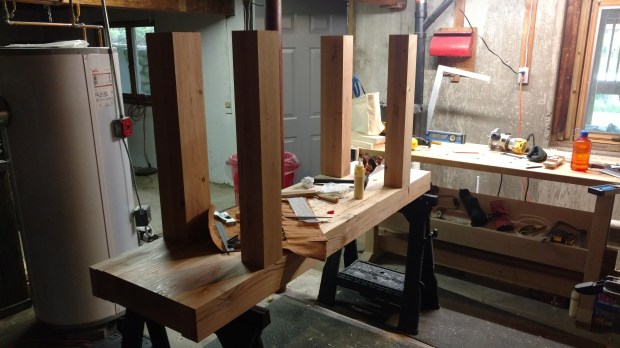
I’m so close.  I can feel it.  The legs went into the Stent Panel Workbench last weekend.

wp-1464479585598.jpg

If you squint really hard, it looks like a single board slab.

Fitting the legs was a somewhat arduous process.  Both mortise float and coarse rasp were required to bring the mortises into square and plumb.  Then each tenon was fine-tuned with a shoulder plane for friction fit.

I finally got a sense of how solid this thing will be when flipping it over for the first time.  Admittedly, I will remove a few lbs of wood when leveling the seams on the mortise strips.  But that weight should be added back in the short stretchers.  It’s already heavy and it does not seem to move under planing force, even without the extra weight of a quick release tail vise. Which will probably see more use as a front vise, anyway.

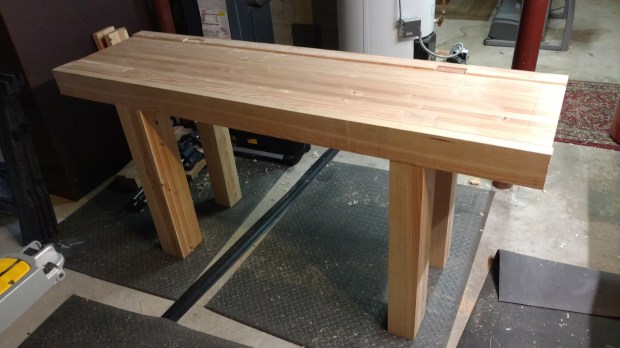
wp-1464479589646.jpg

Prettier than I would have expected.

Once the top is generally flattened, I still have to straighten the front edge and square it to the right end (where the tail vise will sit).  Only then can I bring the legs into plane with the front edge and finally flatten the work surface. After that, I will install the mortised bench stop.

Seeing how the legs fit together, I am now leaning toward gluing the legs in place (hide glue, albeit). This may or may not be the right choice, but this is likely not my last workbench. And I own a heat gun.

JPG

New Sharpening Jig

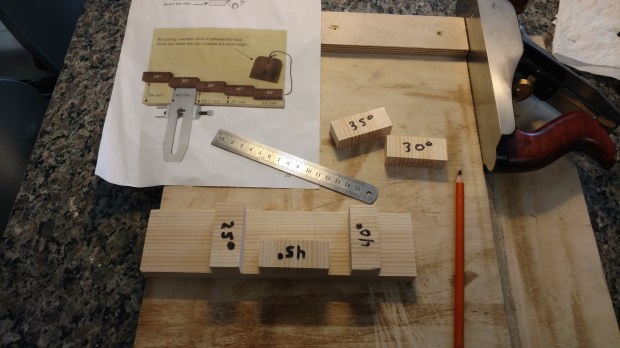
It was time to make another depth stop jig for use with an off the shelf Eclipse/Record-style sharpening guide.  My current version of the jig, made of 2×3 offcuts, is way too bulky for carrying around in my traveling tool tote.  I don’t freehand sharpen my plane irons, so this is an essential piece of shop equipment for getting consistent edges across multiple sharpening sessions. I did not make one for chisels, though, because I freehand (or machine, if available) sharpen my chisels.

wp-1463935046348.jpg

The sharpening guide in question shown in the middle.

I had considered making this a “Basic Project”, but it’s been done so many times I don’t want to take credit for the plans.  This new version is just a variation of Christopher Schwarz’ design.  Please note that if you don’t use the Eclipse/Record-style of sharpening guide, the depths listed below won’t work for you (but the numbers can be adjusted to fit whatever sharpening guide you use).

wp-1463935036436.jpg

Instructions for the full-size, benchtop style seen top left.

There is no real joinery in this project, which I love. Each stop block is CA glued in place and tacked with brads once the glue is set.  What makes this project a little tricky, however, is the need for perfectly square edges. Once you have a straight reference edge (planed or factory, if using sheet goods), the shooting board really gets a workout squaring the ends of the stop blocks and the base board.

I could not find a link to the instructions pictured above, but the depths are as follows:

  • 25° = 54mm
  • 30° = 40mm
  • 35° = 29.5mm
  • 40° = 21mm
  • 45° = 15mm

One thing I didn’t realize before this build was how quickly CA glue sets on white pine (spoiler alert: VERY quickly).  Even so, CA glue does not have great shear strength, so pre-drilling the brads was important.  Two brads per block seems to be more than enough.

wp-1463935043153.jpg

I put the depths I use the least on the underside of the jig.

I eschewed the 1mm shim on a string for creating 1° microbevels (seen in the full-size instructions pictured above).  Mainly because using the same metal ruler I use for the David Charlesworth Ruler Trick works just fine.

It may only be quartersawn white pine, but this thing should last forever.  And if the CA glue gives way, I’ll just scrape it off and use hide glue (the nails will guide the block into place again).  Or I could preemptively drive a third, larger nail into each block and be done with it.

JPG

Let There Be Light! (Part Deux)

When the electrical failed in the external workroom at my parents’ house where I keep my thickness planer, my choices were clear: learn electrician stuff or build an improvised lighting rig.  No stranger to DIY illumination solutions, I chose the latter.

wp-1464133866470.jpg

Not bad, for using only what was on hand.

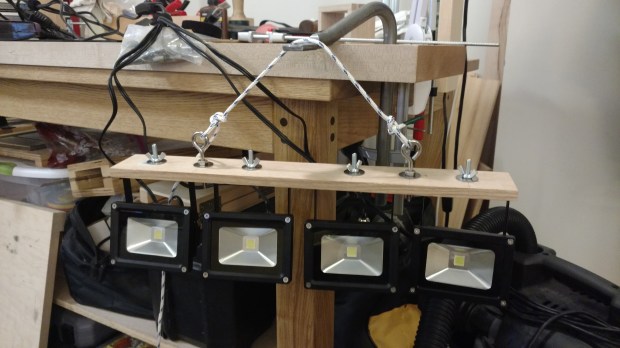
I had nearly forgotten about these LED floodlights. Each is 15W and approximately 1.5lbs. They aren’t great for directional lighting (they’re meant for use with a diffuser), but the four together provide enough illumination to thickness plane and rummage around without tripping over myself.

The board holding them together is a scrap of 1/2″ x 3″ red oak, with six 1/4″ holes drilled through it to accept the four lights and two threaded eyes (leftovers from the original arbor rig in my apartment).  I thought about using a scrap 2×4, but that seemed overkill and I didn’t have one available in my apartment, anyway.  If the board does sag over time, I can always replace it with something more rigid.

wp-1464133862307.jpg

The essence of apartment woodworking, all in one camera frame.

The line is 3/8″ marine rope from the boating center.  Whatever line I don’t use for hanging this rig will go back to its original purpose: a stay for the lid on the traveling tool tote.  Lastly, the power cords are bound together with some hook and loop zip ties and run to a one-to-four power cord splitter.

I love these little DIY rigs because they solve real problems with the minimum of materials.  Plus I get to play gaffer and pretend like I know movie stuff.  Best of all, I should be able to see again while I’m thickness planing.

I’ll take a picture on site over the weekend and post it to twitter.

JPG

Holy crap, you guys!

I got so much done over the weekend.  I’m very close to being done with the Stent Panel workbench.

First, I added pine veneer to the cheek of each of the tenons, which is part 1 of the joinery strategy for a stretcher-less workbench. Part 2 is using my new mortise float to square and plumb each mortise (although a rasp would work equally well).  Part 3 is shoulder planing the opposite side of the tenon to perfect, piston-fit.

wp-1463873618825.jpg

It’s face-grain to face-grain, so these are permanent additions.

Speaking of tenons, three out of four legs are completely done, with the fourth in process.  They are stouter than I anticipated and I’m confident in the plan for the workbench.  Overall weight should be close to 200 lbs. once assembled.

wp-1463873624555.jpg

Always label your parts.

The fourth leg is only in process because I finally added the show face to the slab, which took all but one of my parallel jaw clamps.  It was an excellent glue-up, though, and I can’t wait until the show face is glistening from final planing.

wp-1463873629327.jpg

Total depth is expected to be exactly 19.75″ after final squaring.

There is technically only one more board to glue up (the inside board on the front right leg), although I expect the crochet will be laminated.  In addition, I need two new short stretchers.  The old ones no longer fit with the fatter tenons sitting differently in the mortises.

wp-1463874003243.jpg

Also, F-clamps are no substitute for parallel jaw clamps.

That’s it for now.  Looks like I need one more weekend to finish everything.  The very last step will be to rough flush the mortise strips with the rest of the benchtop using a hand-held power planer.  Final flattening will occur once it’s back home and in place.

JPG