Month: May 2020

Thought Experiment

Where we last left off, I had just about made a functional workbench for the cost of seven Douglas Fir 2×4’s and some construction screws.  Before I knew it, I had a sturdy surface that (although a bit narrow, in retrospect) was ready for some serious woodworking.  There was just one problem: I had cheated and not even realized it.
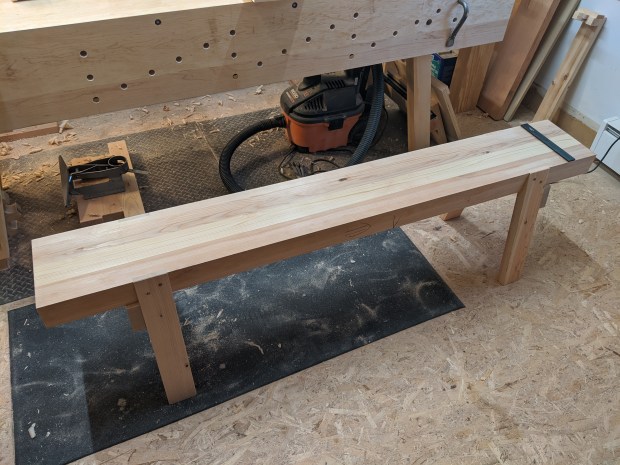
IMG_20200512_160454.jpg

Nice looking bench, if I say so myself.

You may have noticed the Veritas low profile planing stop shown above.  They are easy to install (you just drill a couple of 3/4″ holes) and super functional and I swear by them.  But there is no 3/4″ bit in my basic tool kit yet.  Since I’m not yet ready to compromise this intellectual exercise, the planing stop has to go.  Some West Systems epoxy does the trick filling the holes.

IMG_20200513_093018.jpg

Faces in things.

3/4″ drill bit aside, I definitely have a regular set of drill bits and a hammer.  So instead of a commercially-available planing stop, let’s instead make a palm, which is a different type of planing stop that’s useful for restraining boards both on the their faces and on their edges.

For those unfamiliar, it’s literally just two 1/2″ boards, nailed on at 45 degrees to the length of the bench and 90 degrees to each other. I used 6d die-forged nails with the heads counter-bored a bit so I don’t accidentally ding a plane sole on thinner stock.  Narrow boards (and boards on edge) wedge themselves into the palm (a bit like a crochet), and wider boards but up against the points (like a straight planing stop).
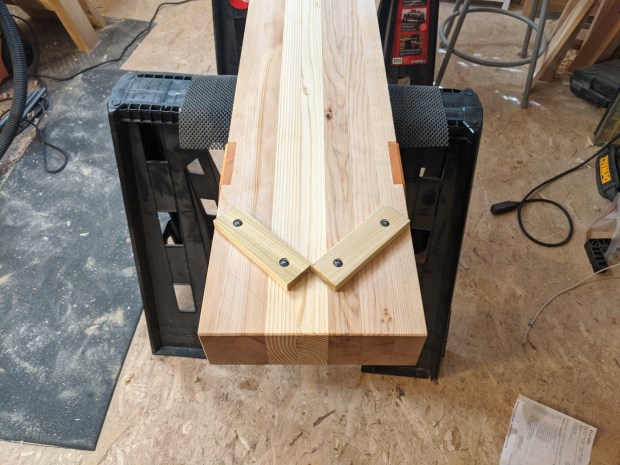
IMG_20200514_101714.jpg

Not sure what additional wisdom you’re looking for here.

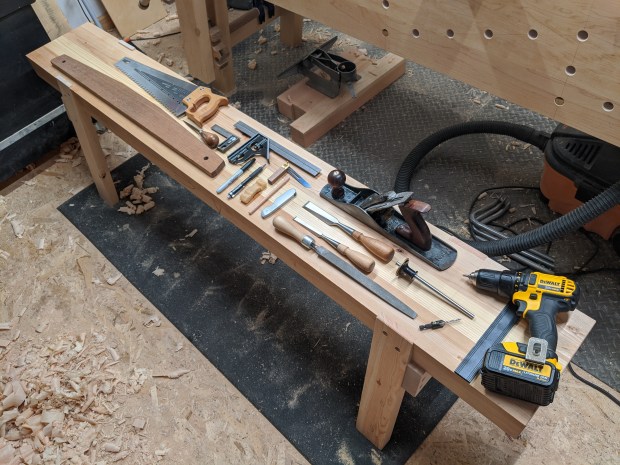
I think that’s all the workholding I’ll need for now.  That said, the list of tools has expanded a bit.  The current list of all tools I used for building the bench is as follows:

  • No. 5 Jack Plane
  • Chisels: 1/2″ and 1″
  • Panel saw
  • Double-faced mallet (not pictured)
  • Claw hammer (not pictured)
  • 12″ combination square
  • 4″ try square
  • 36″ straightedge
  • 12′ tape measure (not pictured)
  • Folding marking knife
  • Wheel marking gauge
  • Small folding bevel gauge
  • Birdcage (square) awl
  • Mechanical pencil, etc.
  • Medium cut straight file
  • Cordless drill driver with standard drill bits and driver bits (bits not pictured)

But I think it’s fair to say that if the entire tool kit for making a workbench fit on the top of that workbench, then it qualifies as an apartment woodworking bench.
IMG_20200511_194329.jpg

I plan to immediately add a large router plane, also.  I can live without it; I just choose not to.

Up to this point, I’ve just been keeping track of the tools used and putting them back in my floor chest as I go.  But a full size floor chest is not exactly within reach for most small space woodworkers.  To be honest, my full size floor chest (40x24x24, not including the casters) is probably too large for my 12×13 bedroom workshop shop.  So it’s time to make some tool storage that’s more appropriate for a small shop.

I think a tool chest in the Dutch style popularized by Christopher Schwarz and Megan Fitzpatrick is the best option here.  I’ve built two of them before (one large that was gifted to a friend, one extra small with just the angled compartment that is just a residential toolbox) and in my experience they can be built with minimal tools.  I’m not bold enough to cut dovetails pins first on a low workbench, so I’ll stick to rabbets and nails/screws for this one.  Should be plenty strong for something that will live on a saw bench up against the wall.

But here are the rules going forward for this experiment:

Rule #1A: before I can pull a tool from my floor chest, I have to first do the operation (if possible) using one of the simple tools listed above.  For example, when making the workbench, after I cleaned up one of the leg mortises entirely with chisel, I could have swapped in a large router plane to do the same job (I actually did this for one where the grain was particularly unruly).  Another example: once I hand crosscut and square a board the first time, I can thereafter use my chop saw to move things along on the rest of the cuts.

Rule #1B: if the operation cannot be comfortably (or safely) done on the low workbench with a simpler tool, I can pull the correct tool as long as it can will in the Dutch tool chest.  If the correct tool will not fit in the Dutch tool chest and the operation is not comfortable (or safe) to do on the low workbench, I cannot perform that operation and must use a different joint/feature.

Rule #2: No vises, but clamping boards to the workbench is fair game.  I have access to my full set of clamps, in fact.  I’m not that much of a masochist.

Rule #3: I have access to my existing shooting board and can do the operation on my high workbench.  I can certainly make another shooting board that will fit better on the low workbench (I’ve done it before).  However, this same shooting board used to live on my kitchen island and I see no reason to change things up now.  And shooting while standing is far easier on the back and shoulders.

Rule #4: I’m also allowed to use my benchtop drill press for the chisel rack that goes in the chest.  Yes, I could do it by hand.  But I’m not getting into this argument with you.

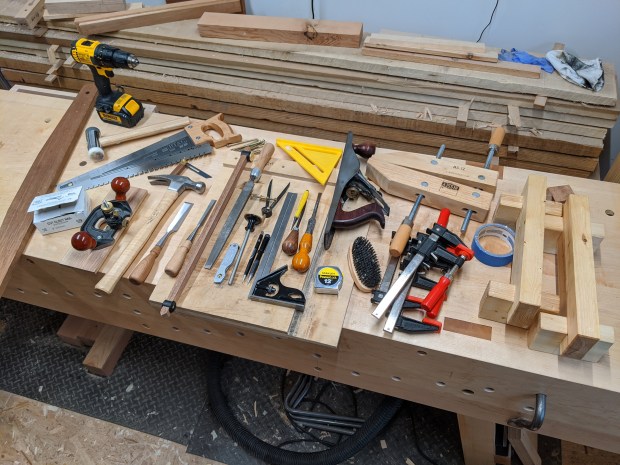
As of the writing of this post, I’m almost finished with the main part of the Dutch tool chest.  Here is the full tool kit to date (not counting parallel jaw clamps and the aforementioned benchtop drill press):
IMG_20200517_080658.jpg

Still no 3/4″ auger and bit, though.

This has been a long one, so I’m leaving it at that for now.

JPG

Starting Out Fresh

Having laminated seven Douglas Fir 2×4’s into a roughly 72″ x 10″ x 3.5″ slab off screen, it was time to set some ground rules.  Going forward, I would only use basic hand tools to make a workbench worthy for an apartment woodworker.  Or, at least that was the goal.  Let’s see how it went.

Using just my No. 5 jack plane, I proceeded to flatten the underside and square both edges to the underside.  I tried supporting it with the buckets I was using as saw benches, but that didn’t work too well.   The buckets were just too slick and the slab rocked too much.  So I reverted to just working on the floor on a non-skid mat.  It was slower going than I wanted, and my back and knees are killing me (heyo!), but it got done.

IMG_20200509_202028.jpg

The sawbucks are just for staging the picture.

It took less time to dress the top, but in doing so, I realized my basic tool kit was missing something: a marking gauge.  So I’ve added a wheel marking gauge to the basic tool kit.  Eventually, the slab was S4S enough for joinery.  But before cutting any joints, a coat of “Tung Oil” to protect against any glue squeeze out when the legs eventually get glued on.

IMG_20200510_103810.jpg

And also some home center saw horses to raise the work.

Nine inches from the end seemed about right for the legs.  When making a saw bench in the Schwarz pattern, the legs are recessed into the sides of the benchtop via square dadoes.  Then, angled lap joints on the legs cause them to poke out at the right angle.

All dadoes start the same way: mark it, saw it, chop out the waste with a chisel.  Typically, I finish off each dado with a light pass from the router plane to ensure uniform depth and a shoulder plane to square the walls of the extants.  But router planes and shoulder planes are luxuries outside the scope of the basic tool kit.  It has been a while since I did this by chisel alone, but I got it done, even if the dado bottom isn’t pretty.  But that might be because Douglas Fir is real splintery.  The extants are square at least.

IMG_20200511_093355.jpg

One of four.

The only hard part about this joint is laying out the leg.  However, if you cut the top of each leg to a consistent angle (10 degrees works great), you’re almost all the way there. But that requires a bevel gauge.  Which has also been added to the core tool kit.  I won’t go through the whole process, nor could I better than Mr. Schwarz does himself here.  But suffice to say, if your shoulders line up, then you can pre-cut each leg to the exact same length and you won’t need to worry too much about leveling the feet.

IMG_20200511_091305.jpg

More paring just via chisel.  I would typically use a carriage maker’s plane for this job.

Part of what makes this joint strong is the large glue surface between the slab and the legs.  Use the offcuts from the angled lap joints to assist in clamping, then drive in a couple screws through each leg (parallel to the bench top, not the legs).  Be sure to countersink them a bit so the screw heads are well below the face of the legs.  Don’t worry; we’ll flush the tops of the legs later.

IMG_20200511_120629.jpg

I was uncomfortable with No. 10 screws and later upped to No. 12.

But the joint doesn’t just rely on glue and screws.  A couple of gussets, glued and screwed onto the legs.  When making gussets, perfectly quartersawn softwood stock will allow you to glue and screw along the entire width with minimal risk of splitting over time.  I also squared up the ends of the slab off camera, but in fairness, that’s not necessary.

IMG_20200511_181533.jpg

I’ve already done an ode to gussets.

And that’s it for the main bench.  Next time, we’ll reassess the full basic tool kit and begin adding work-holding.

JPG


An Apartment Workbench

So I’ve hit the reset button.  Armed with only the tools listed below, I’m going to start again in my woodworking life.  First step is to knock together a decent workbench, then follow it up with a tool storage unit.

IMG_20200508_141809.jpg

Deja Vu all over again!

Let’s talk about the tools, first:

  • Handsaw.  For this, I’m using the excellent Brooklyn Tool & Craft Hardware Store saw.  I love this thing, but any impulse hardened contractor saw from the home center will do.  I especially like the Craftsman 20″ saw from the home center, if you’re going that route.
  • No. 5 Jack Plane.  The body is a Type 11 or 12 Stanley; the rest of it is very much a harlequin baby of scavenged parts from a number of different planes, plus a new Honduran Rosewood knob and tote.  I could easily have gone with a No. 4 smoothing plane, such as the very decent Taytools version.  I just like the slightly longer sole for quasi-jointing.  I’m using two different irons: one for scrubbing and one for smoothing.
  • Speed Square.  Nothing fancy here; just a plastic Stanley speed square from the home center.  I agonized about whether to use my Starrett Combination Square.  But, amazingly, this speed square (which I’ve had for a billion years) is pretty square.  This will, in fairness, be the first thing I swap out for a high end tool.
  • 1/2″ Chisel.  If I had to choose just one size chisel to use forever, it would be a 1/2″.  And the Lie-Nielsen socket chisels are second to none.  Period, full stop.  Narex are pretty good too.  Buy buy the ones from Lee Valley; the Amazon ones seem to be poorer quality, for whatever reason.  That’s a Thorex hammer, which I bought on recommendation from Paul Sellers (and I can’t live without it now).
  • Folding Utility Knife.  As noted above, I fully consider myself a disciple of Paul Sellers, and this knife is absolutely all the marking knife you need.  Cheap and effective: the apartment woodworker’s dream.
  • Tape measure, mechanical pencil, wood glue.  Stanley, PenTech, Titebond 1.  ‘Nuff said.
  • Cordless drill driver.  Whatever you’ve got.  Mine is a DeWalt 20V.  A two or three jaw brace would work just as well.
  • Sharpening Stones (not pictured).  I use Atoma diamond plates.  You could honestly get away with just the 1200 grit version, which after a little use breaks in nicely.  But having the 400 grit version makes flattening and regrinding easier.  I’m not bold enough to freehand sharpen, so I’m keeping my Lie-Nielsen sharpening jig (but a cheapo Eclipse knockoff will work fine too).

The plan is to make a low workbench.  Not a staked version.  That would require auger bits for a brace and a spokeshave to make round tenons, not to mention a bevel gauge or comparable jig.  This low bench will be patterned roughly off a Schwarz-pattern saw bench.  I prepared the slab off camera.

IMG_20200509_145217.jpg

Yes, I have lots of parallel jaw clamps.  That doesn’t count.

Douglas Fir 2×4’s at my local home center are about 102″ long.  That’s eight and a half feet, in the vernacular.  Which means the off-cuts from a 72″ workbench are long enough for legs and gussets on a low workbench.  That said, there are not four clear off-cuts from the seven boards I had.  And I would never lie to my readers.  I’ll use some 2×8 offcuts I have left over from a Naked Woodworker workbench I made for my brother for the legs.  Or just buy a couple more 2×4’s from the home center.

Speaking of not lying to you guys, I’d like to be clear about something.  I surfaced two of the seven boards for the glue up using buckets as saw benches, to prove I still can.  But for the sake of my lower back and sanity I did the rest on my 60″ roman workbench.  I’m not a masochist, after all.  At least not in my woodworking.

I’m going to leave it there for now.  Next post, I’ll work on the legs and change up the rules a little bit.

JPG

Back to My Roots

So it’s still a global pandemic, and I’m running out of lumber for projects.  I used up the last of my 1×12 eastern white pine for a sweet wall-leaning bookcase, which is really just for displaying my vintage Lego sets.  This was only supposed to be the prototype, but it came out so nice, I’m leaving it at that.  More on that soon.

IMG_20200426_152014.jpg

Space 1989-1995 FTW!

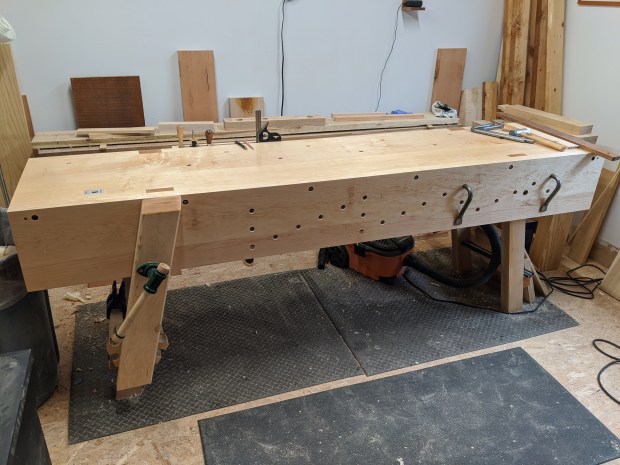
I also finished my new workbench, which is roughly in the Nicholson style.  Made of hard maple (other than  little bit of soft maple blocking under the holdfast holes), it’s 98″ long, 22″ deep and 34.75″ high.  It’s the longest workbench I’ve ever worked on, and, to be fair, it’s probably bigger than I need it to be.  Honestly, it’s probably too big for the 12.5′ x 13.5″ bedroom that I use as my shop.  I’m not banging the walls with a jointer plane or anything, but it’s definitely tight clearance on the ends.

IMG_20200501_094235.jpg

It has no rear apron, like a true Nicholson.

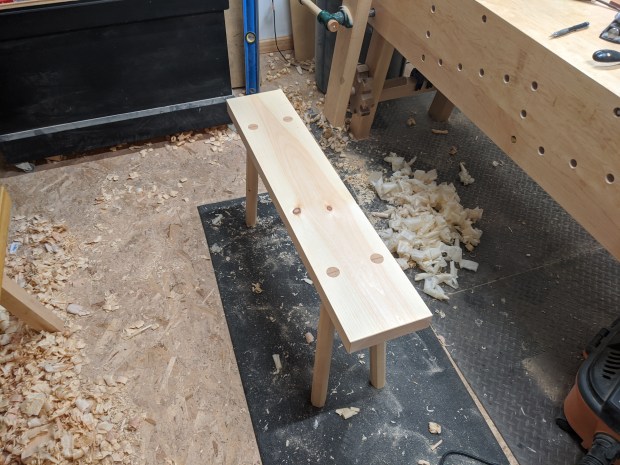
I’ve also been practicing staked furniture (mostly low benches).  I think I’ve found a layout that I like, both structurally and aesthetically.  65 degree sight line and 10 degree resultant angle.  It keeps the round mortises near the outside of the top but is still fairly stable.  There is always one wonky leg, but what can you do?

IMG_20200505_200806.jpg

At least, this time, it’s too little splay and not too much.

So all this is a way of saying I’ve been keeping busy as best I can.  But I need a challenge.  And I need to get back to my apartment woodworker roots.  I’ve gotten too cozy with my proper workbench and full tool chest.

So I’m hitting the reset button.  I’ve got seven Douglas Fir 2×4’s and only these tools:

IMG_20200508_141809.jpg

Although, in fairness, I might use my No. 4 smoothing plane.

Let’s see what we can make!

JPG