General

Another One Down

I am officially over making footstools.

This is the last one, I swear.

This is the last one, I swear to Glob.

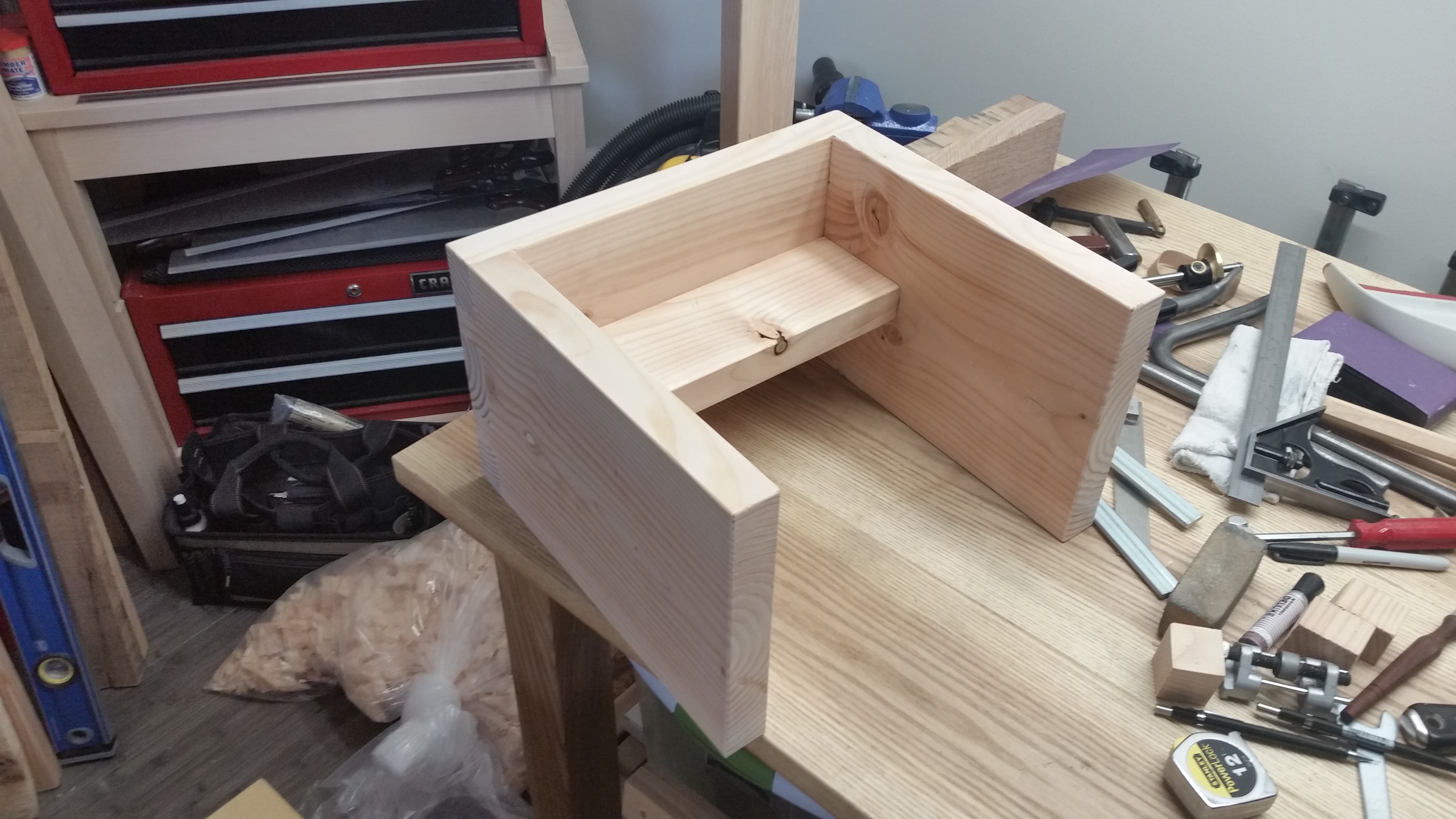
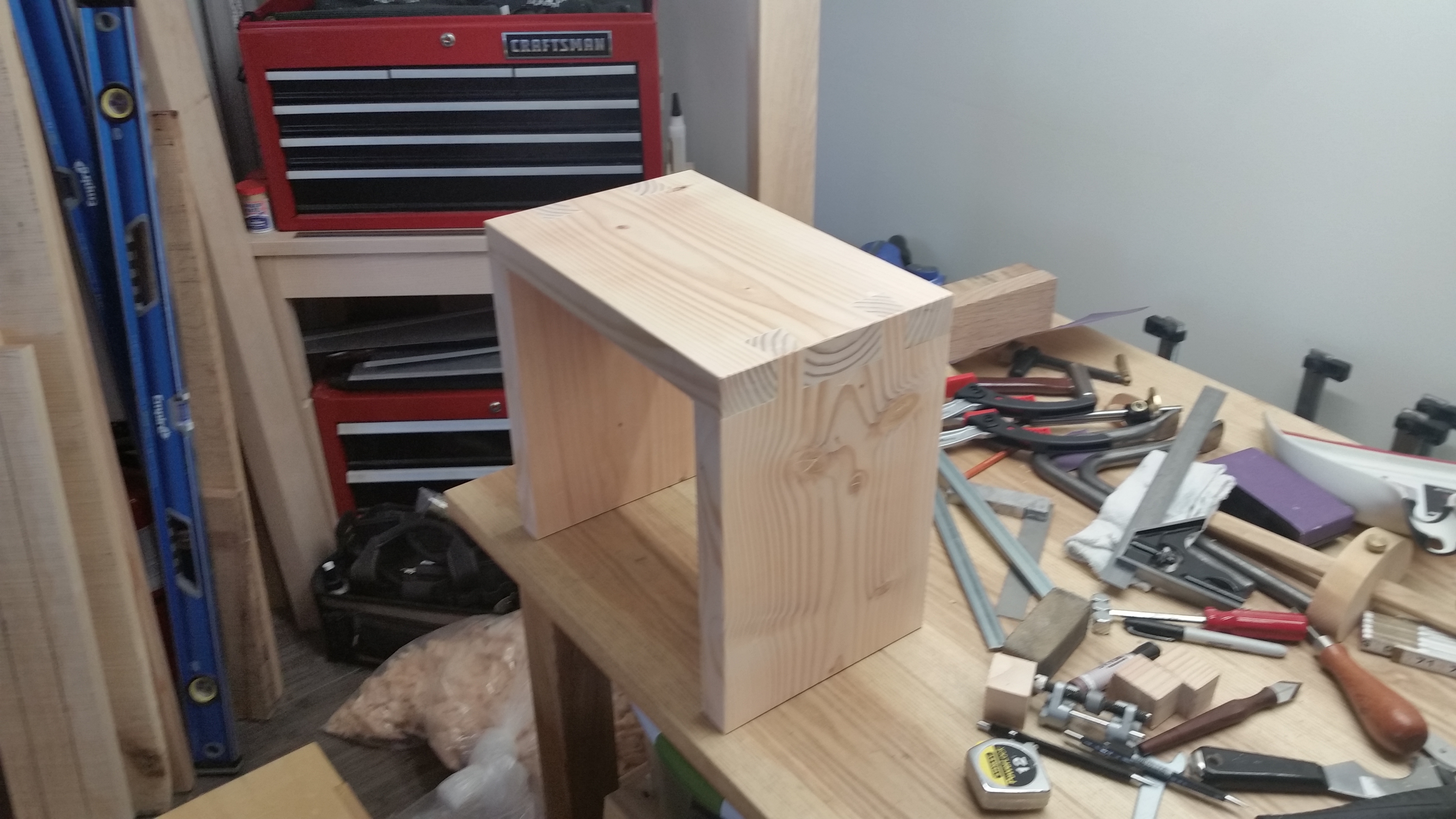
I finally got around to making the third of three footstools for my brother’s new house.  The first two footstools were for my niece and nephew.  This third one is for use in the kitchen.

This is very clearly a utility piece.  Made from home center Douglas Fir 2×10 (leftover from the Planing Slab project), I opted to be super lazy and left the stock pretty close to original thickness and width (after some rough flattening, straightening and squaring).  I just realized that I forgot to mark the pieces to ensure continuous grain in the three main boards, but I imagine it will get a couple of coats of paint regardless.

I think that in hardwood, I would have been comfortable with just the two sides and the top.  But in something as soft as Douglas Fir, I opted for an additional cross-support, which connects to the sides via mortise and tenon.  I did not glue or otherwise attach the cross-support to the underside of the top to allow a tiny bit of flex.

Solid as a rock in softwood.

Solid as a rock in softwood.

Speaking of flex, one nice byproduct of using such a soft wood is that the entire piece has a bit of give throughout.  This means that any bit of twist or wobble the piece might have (due to an uneven floor or what have you) vanishes when the weight of a person is applied.

With this done, I am now done with footstools, forever.  Probably not forever, but certainly for a while.

JPG

Safe and Sound

I have been pouring over potential plant stand designs for several weeks and I finally settled on what I think will work. The final height of the pot should end up roughly the same as the temporary fix (see below), which has been a useful guide.  I haven’t nearly finished the build yet, but some of the stock (scrap hard maple) is at least surfaced and ready for final dimensioning and joinery.

In my continued quest to not turn The Apartment Woodworker into a “look at this awesome thing that I made with my awesome tools” kind of website, I would like merely to share the design specs and explain some of the choices.  I am certain the design will be refined further through the build process, but for now, I am satisfied with the aesthetic baseline.

Plant Stand - February 2015

Careful readers will note the ratio of each leg above and below the cross-member is almost exactly that of a lightsaber (or, if you’re boring, a katana).

First, the piece only has three legs. While there has been much going on lately in the world of three-legged furniture, I really just wanted some practice cutting angled tenons and chopping angled mortises. Much of what I design and build is square and true, which can get pretty boring. Plus, the splay and the angle of the legs will keep it stable and the tops of the legs will secure the pot laterally.

Second, the hub design was born from how to get the correct splay angle on the legs. I initially gravitated toward a lapped t-shape (seen top right), which would have reduced the number of individual pieces but required a compound angle on each tenon. Unfortunately, the piece will be weight-bearing, and that compound angle would not place the load on the legs parallel with the mortise and tenon. The hub design, though, allows for the in-line load distribution.  I can drawbore each leg assembly to the hub for an eternal joint, even with the additional complexity.

Finally, although the drawing doesn’t show it, I will probably shape the legs a bit as an excuse to put my new spokeshave (a very old Stanley with a very new blade) through it’s paces.

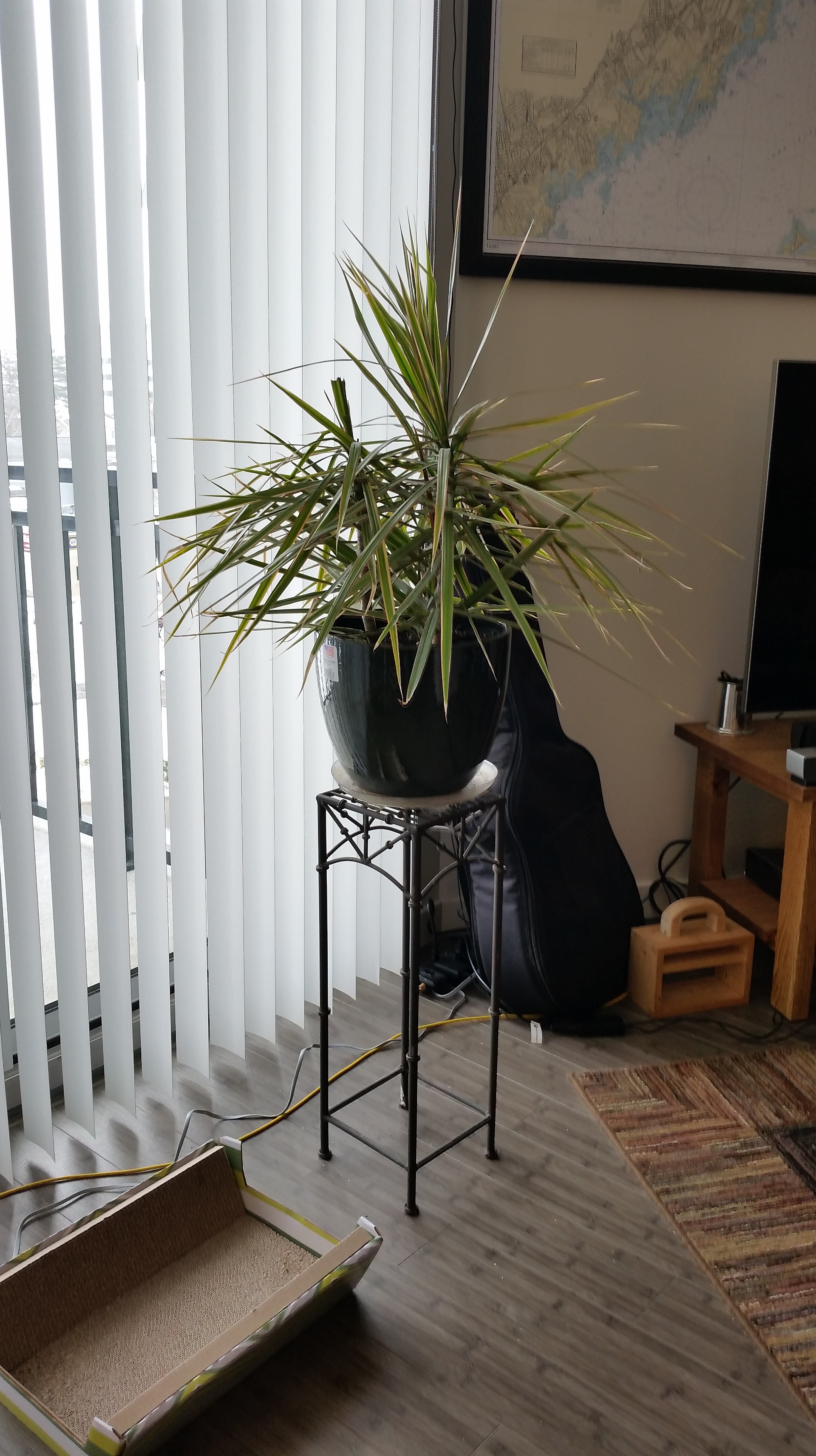
This is my current, temporary solution.

In case you are wondering, this is my current, temporary solution.  River ate the crown off the left stem, which was the impetus for this particular project.

Now I just have to build the thing. I’ll post pictures when it’s finished.

JPG

A Time to Revisit

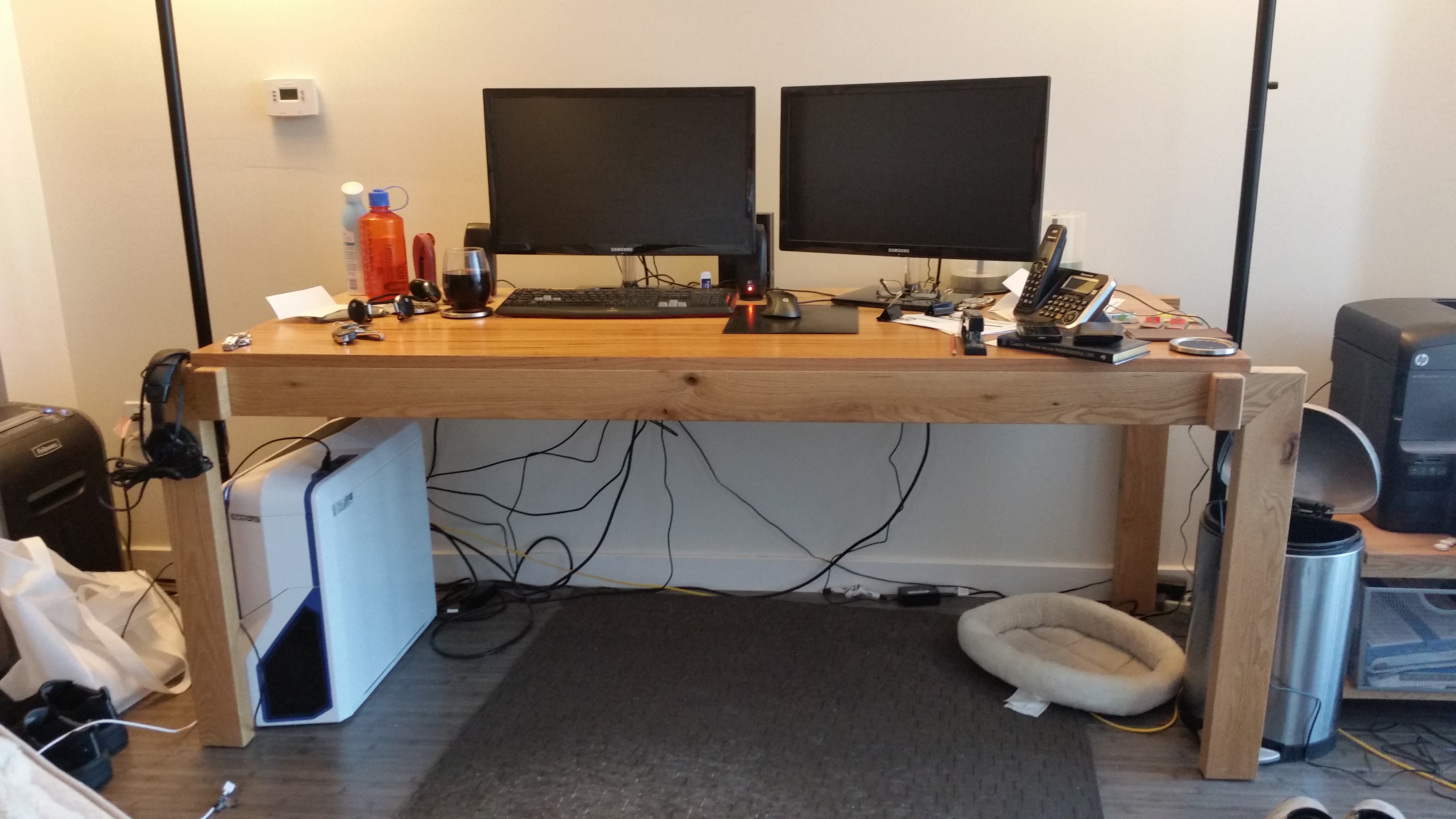
It’s been a long time coming, but I think I’m ready.  I’ve progressed sufficiently in my woodworking that it’s finally time to revisit my red oak desk.  I still love the design (mitered half lap joints continue to be a personal favorite) and I’m quite satisfied with the overall size and shape (which is why the revisit hasn’t been a high priority), even the joints were cut almost entirely with a plunge router.  I don’t even think I owned a tenon saw at that point.

wpid-20150222_155621.jpg

I’m very proud of the piece, despite being made entirely with power tools.

There is no real need to revisit the piece.  I just think I can do it so much better now, almost two years later.  And I’d love another crack at some of the design elements.

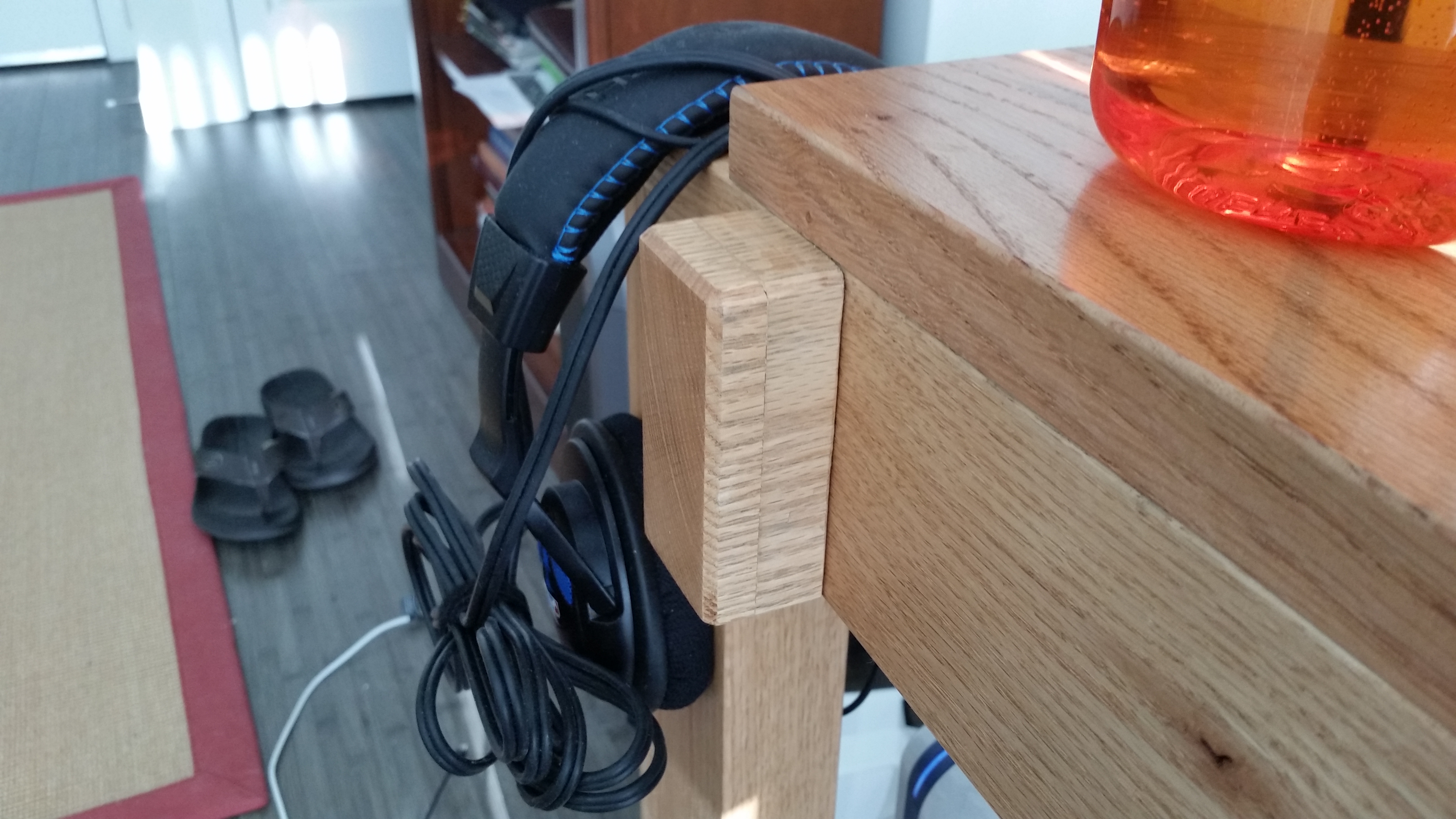
The biggest design change I think will be to thin out the frame pieces a bit, which are currently full-width red oak 2x4s.  3/4″ or so off the width will create a slightly more delicate feel (without any real compromise to strength).  I’d also like to tweak the shape and increase the size of the exposed ends of the cross-rails.  I’ve had to reinforce them once already and, although they are holding well, I worry that one day they’ll snap off again.  There are some execution-related flaws as well, but they are pretty well hidden from day to day view.

wpid-20150221_083449.jpg

I apparently used to not know a ton about grain matching.

The tabletop (which is quartersawn and well-jointed) is not permanently affixed and is in fine shape, so I’ll just reuse it as is.  Also, I have quite a bit of air-dried, rough-sawn red oak stock available, so I won’t need to salvage anything from the existing desk (meaning I can build the new frame at my leisure).  Plus, it will give me a chance to use the new planing slab.

wpid-20150222_162702.jpg

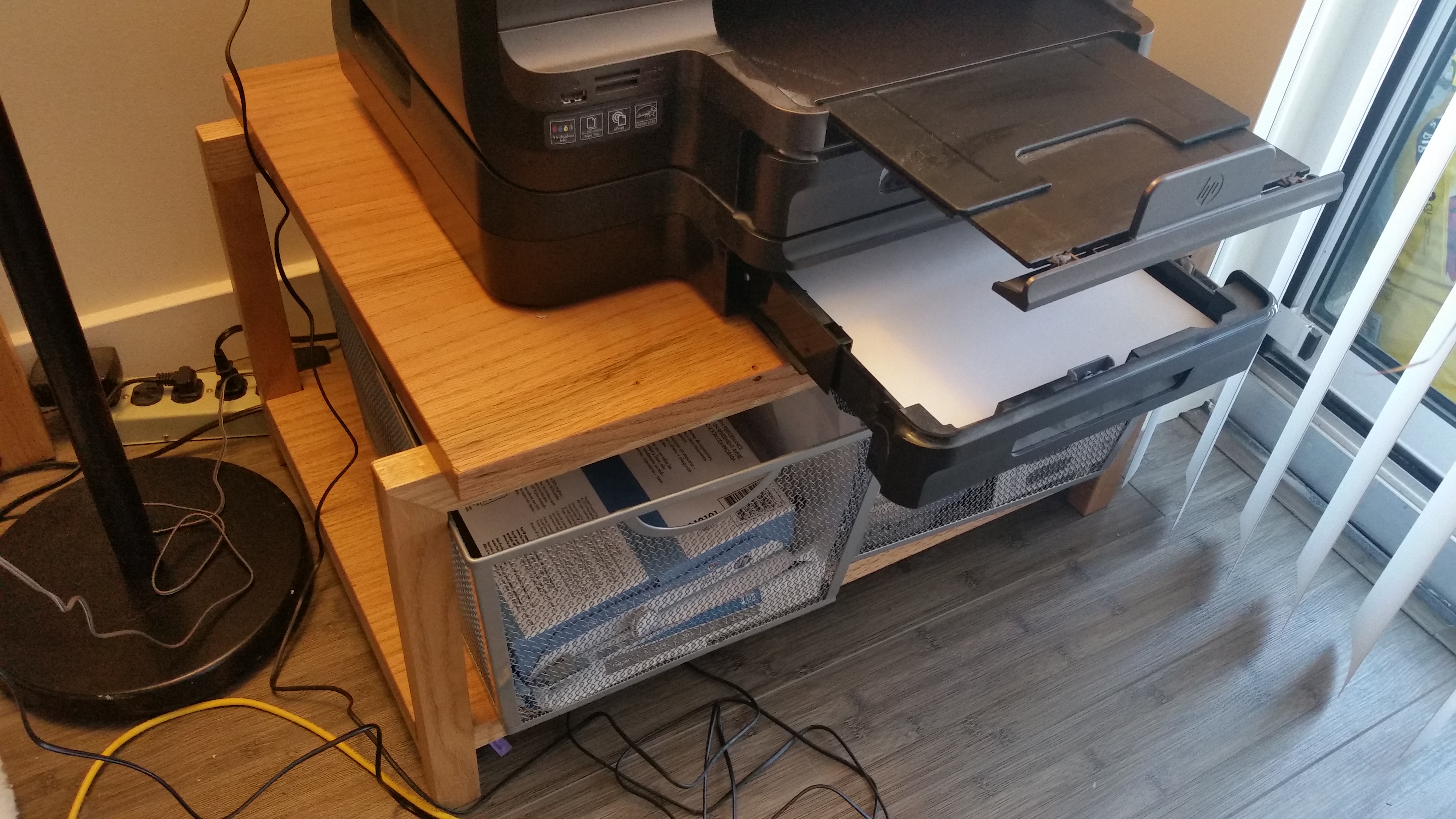
There is also a matching printer stand that fits two metal baskets on the bottom shelf (because I didn’t know how to make drawers back then).

There will be significant stock preparation involved, and I have other projects in the works already, so the desk revisit will likely take a while.  I’ve already sketched a few possible design tweaks, which I will share when I discuss the build.

JPG

Now, About That “Mostly”

Whenever someone asks me what I do in my free time, after the involuntary “free time, that’s funny”, I undoubtedly mention that I like to make things out of wood (and write about it).  I think that may be an understatement.  Sometimes, all that keeps me going day-to-day is the fantasy of one day having the time and the space to have a studio/workshop where I design and build furniture on my own schedule.

But, for now, woodworking doesn't (and doesn't have to) pay the bills.  But it does pay significant emotional and intellectual dividends.

But, for now, woodworking doesn’t (and doesn’t have to) pay the bills. But it does pay significant emotional and intellectual dividends.

The next question is usually about types of furniture I like to make.  “Oh, tables, benches and chairs, mostly” I’ll say, careful to also mention that I don’t particularly enjoy casework (in part, because sheet goods are gross).

Now, about that “mostly”…

I don’t very often talk about my obsession with pet furniture and plant furniture.  In truth, I spend more time perusing the internet for cat perch ideas and plant stand designs than I ever spend scouring human furniture catalogs.  Store-bought pieces are fine (and I’m certainly not taking commissions on cat perches or indoor planters), but anything handmade by me is not going to break down or come loose.  When it comes to my kitty and my dragon trees, that’s the most important thing.  I know lots of pet owners and indoor plant aficionados who would agree.

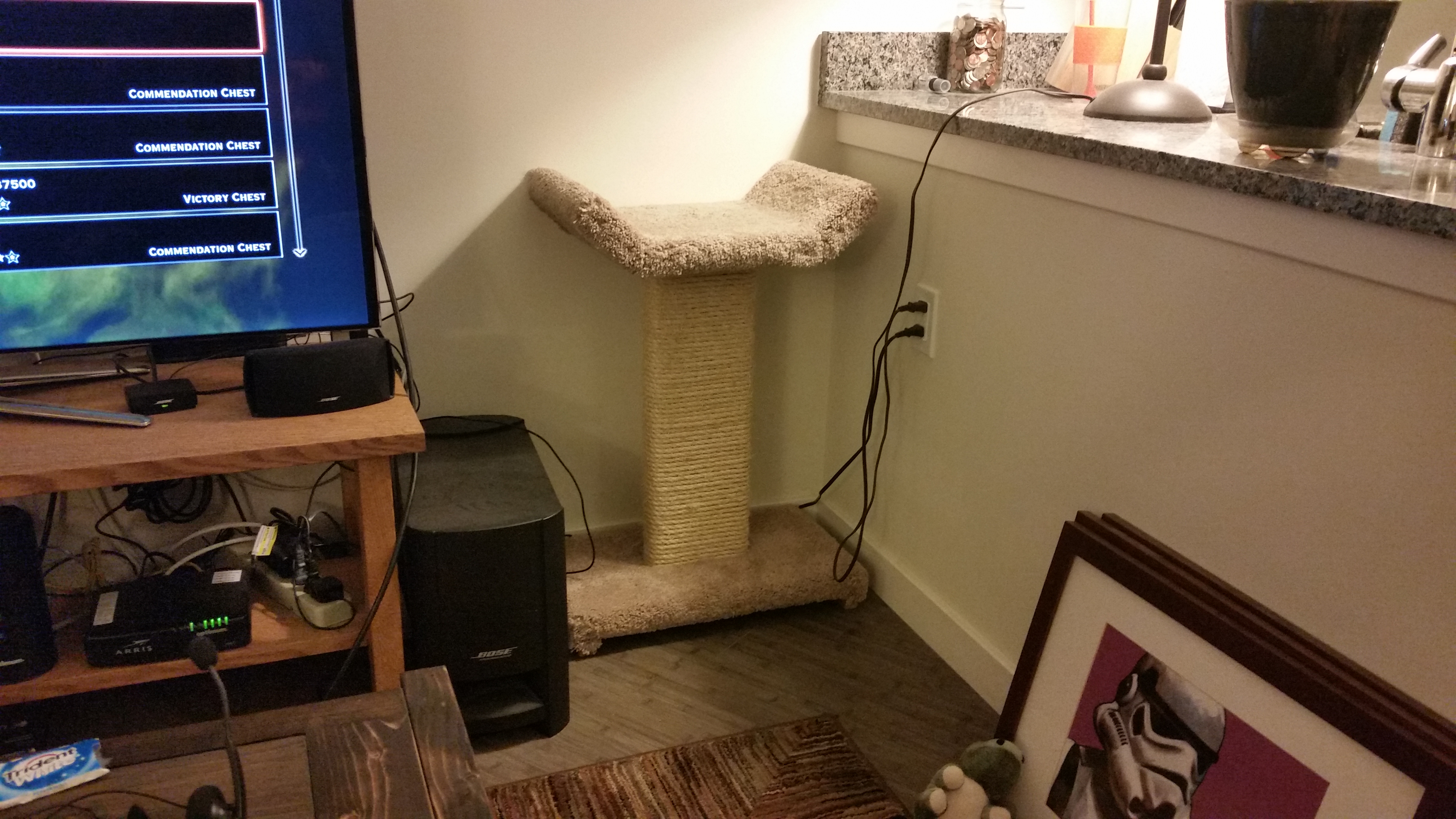
This is made from 8/4 red oak offcuts.  Call me old fashioned, but I believe a piece of furniture should outweigh the load its bearing.

This is made from 8/4 red oak offcuts.  Call me old fashioned, but I believe a piece of furniture should outweigh the load its bearing.

I’m not saying I’ll ever actually open up a “non-humans only” furniture store.  I’m just saying it would be awesome and hilarious.  I’m sure my parents would be proud.

JPG

Jointer Plane Envy

It’s getting to that point: I think I need a jointer plane. I’ve survived quite well for a while now jointing (and doing almost everything else) with my No. 5 1/2 jack plane.  A jack plane really is more than enough for all normal woodworking tasks (as I’ve said before), but it would be pretty awesome though to have a real try plane. The extra seven inches of length would make all the difference in the world.

wpid-20150218_205822.jpg

That’s what she said?

I will first attempt to clean up an old corrugated Craftsman that was gifted to me last year. But I know myself, and this exercise ends in me splurging for a premium plane. Unlike other size planes where I’m happy to flatten and tune a mid-priced brand, I would rather spend the money for an already true, flat and square sole. I’m leaning toward the Veritas bevel-up model, about which I’ve heard good things.

No matter what, I bet agonizing about it will earn me another few more months to figure out where to keep the thing in my tool chest.  Hollar at me if you have any other suggestions.

JPG

An Apology to Accessories

A few days ago, I wrote about how cleaning, honing, sharpening and project planning just wasn’t as fulfilling as actually making things. Although I stand by that statement, I think it may have sounded more negative than intended.

When I first started woodworking, for good or for ill, I was focused on acquiring “tools” (as most people understand the word). Things that cut. Things that shape. Things that go ” whirrrrr” at various pitches (which nowadays is just me making sound effects for my router planes and braces).

In a brief moment of calm over the weekend (I did not, by the way, get any ripping done), I was rummaging through my toolchest in hopes of finding more excess to trim. I was struck by how few “tools” I actually own. I won’t go through the litany again, but in sheer number and volume, it’s not much (and certainly my “tool” collection hasn’t grown significantly since establishing the apartment workshop several months back).  In reality, there is so much more to a workshop than “tools”.

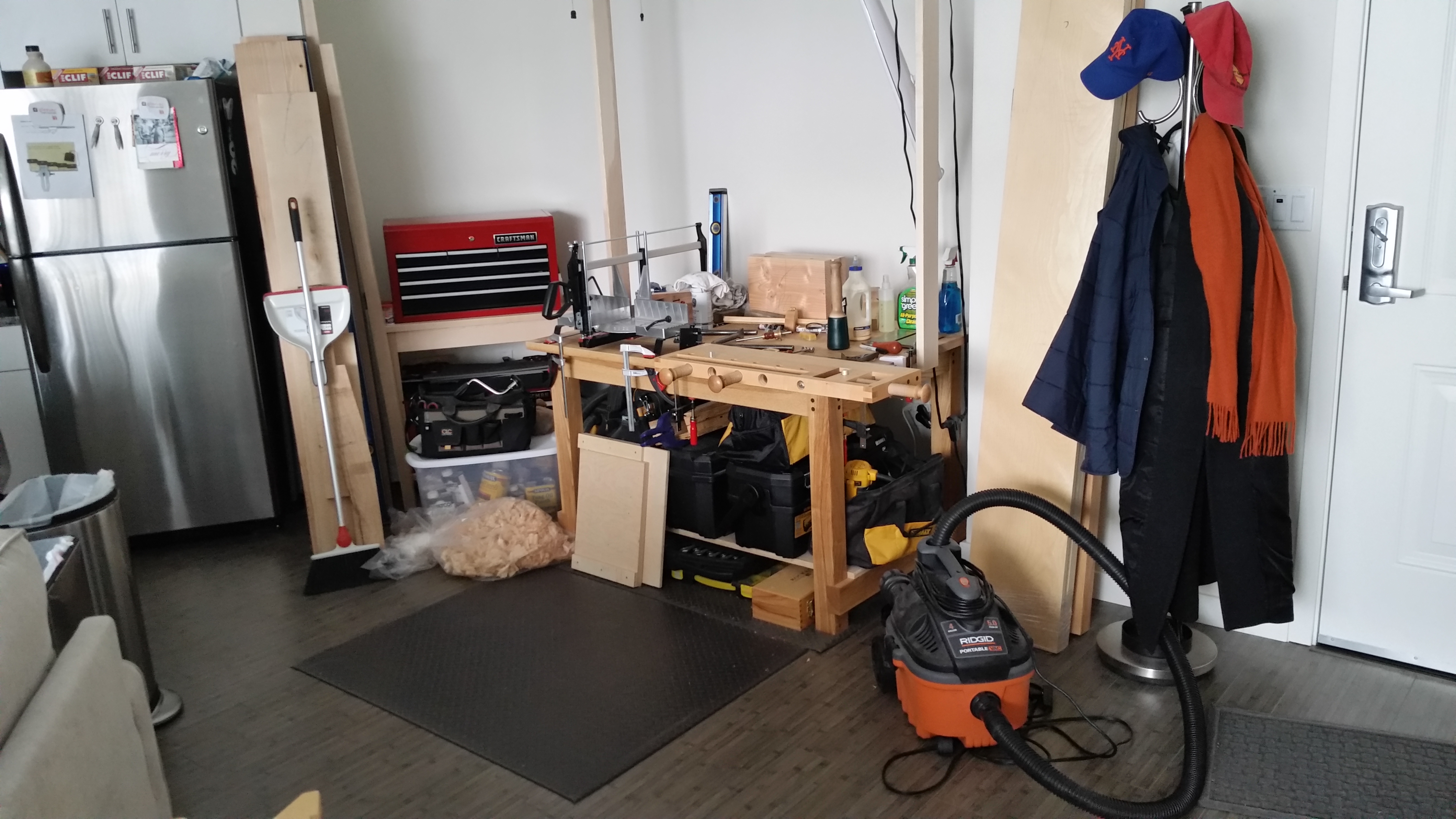
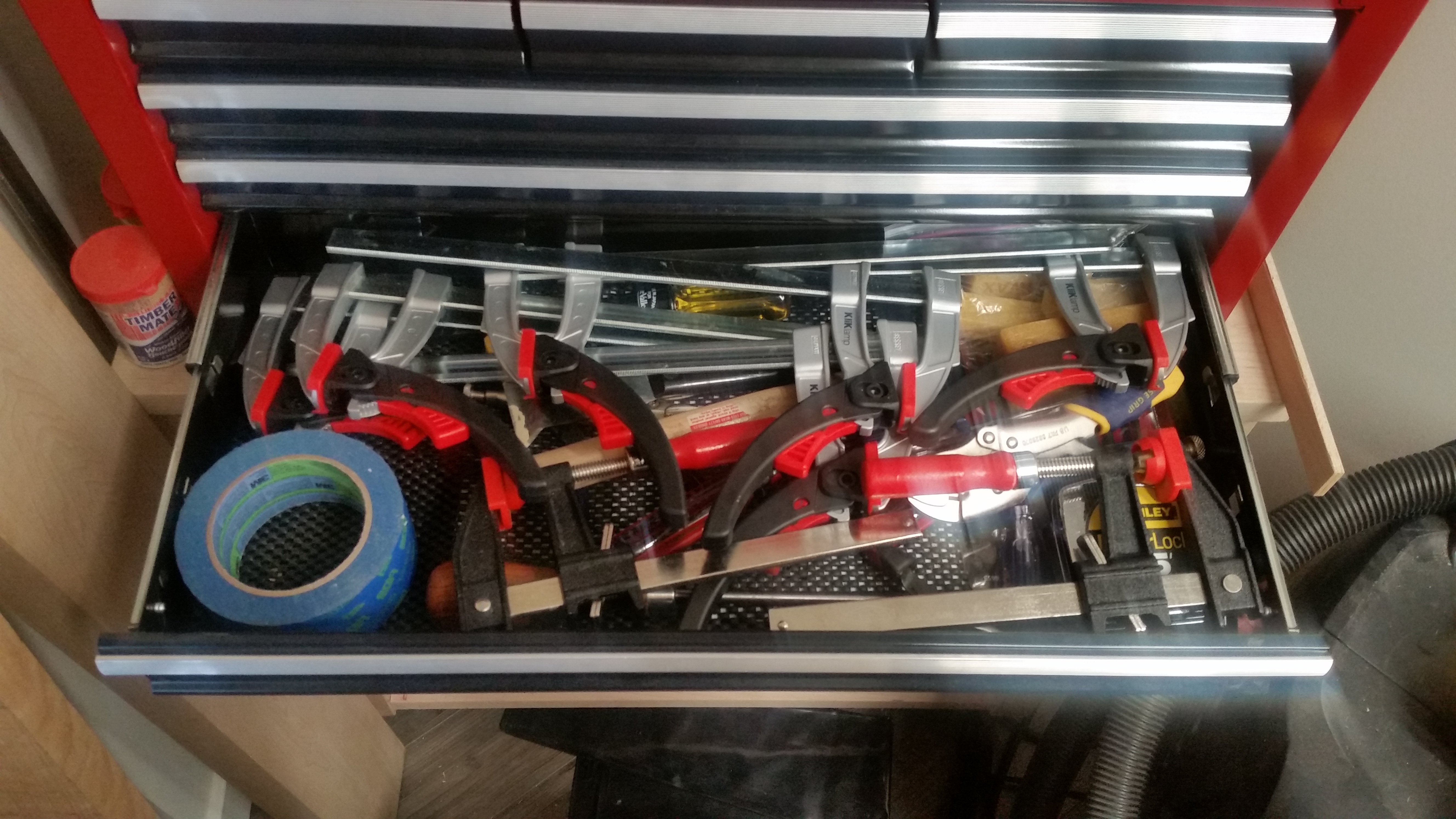
The real heroes of my apartment woodworking shop.

The real heroes of my apartment woodworking shop.

A good portion of my shop equipment is not “tools” (as most people understand the word), but accessories for sharpening, setting up, maintaining and protecting my “tools”.  Accoutrements that allow my chisels, knives, planes, saws and squares to consistently perform at a high level.

And clamps. Lots and lots of clamps.  Always more clamps.

And clamps. Lots and lots of clamps.  Always more clamps.  In soft focus.

Learning to use these support items effectively is the other half of woodworking.  Dull, poorly set tools are as much a threat to safety and success in the workshop as poor technique.  So while I will enjoy the making more, I will also be thankful for the vises, sharpening stones, files, gauges, blade guards, rust prevention chemicals, and that sort of thing that make the making possible.

In sum: sharpen early and hone often; lubricate and polish regularly; protect edges always.  Your tools and your projects will be better for it.

JPG

It’s Been a While

It seems like forever since I actually made something. Work has been (continues to be?) especially hectic lately, and it’s not like I can chop mortises at 1am, so its been mostly shop admin at very odd hours. Cleaning, honing, sharpening, planning; all great and necessary, but not exactly the most fulfilling, activities. Only a few of projects remain on my current to-do list (one more footstool, a pedestal plant stand and a behind-the-couch console table), but each has been on the to-do list for some time.

I do so much lapping lately, I'm starting to feel like a metalworker, not a woodworker.

I have a couple different chisels in various stages of obsessive lapping.

What’s the point of perfectly flat, mirror polished chisel backs without mortises to chop or tenons to pare? Who cares about refining saw sets if there is no rough stock to rip down? Sharp and well set tools are their own virtue, but the making of things with those tools is still the most important part to me.

So here is my plan for the weekend.  I have some leftover home center Douglas Fir and a bunch of other scraps of ash, oak and maple.  I will hopefully find a few hours this weekend in between work stuff to rip down a good portion of my remaining rough stock.  That way, when I finally get the time to make something, I’ll be ready to rock.  Er, join wood.  I hope.  My tools are certainly ready.

JPG

What Now? (or, Planing Slab, Part 4)

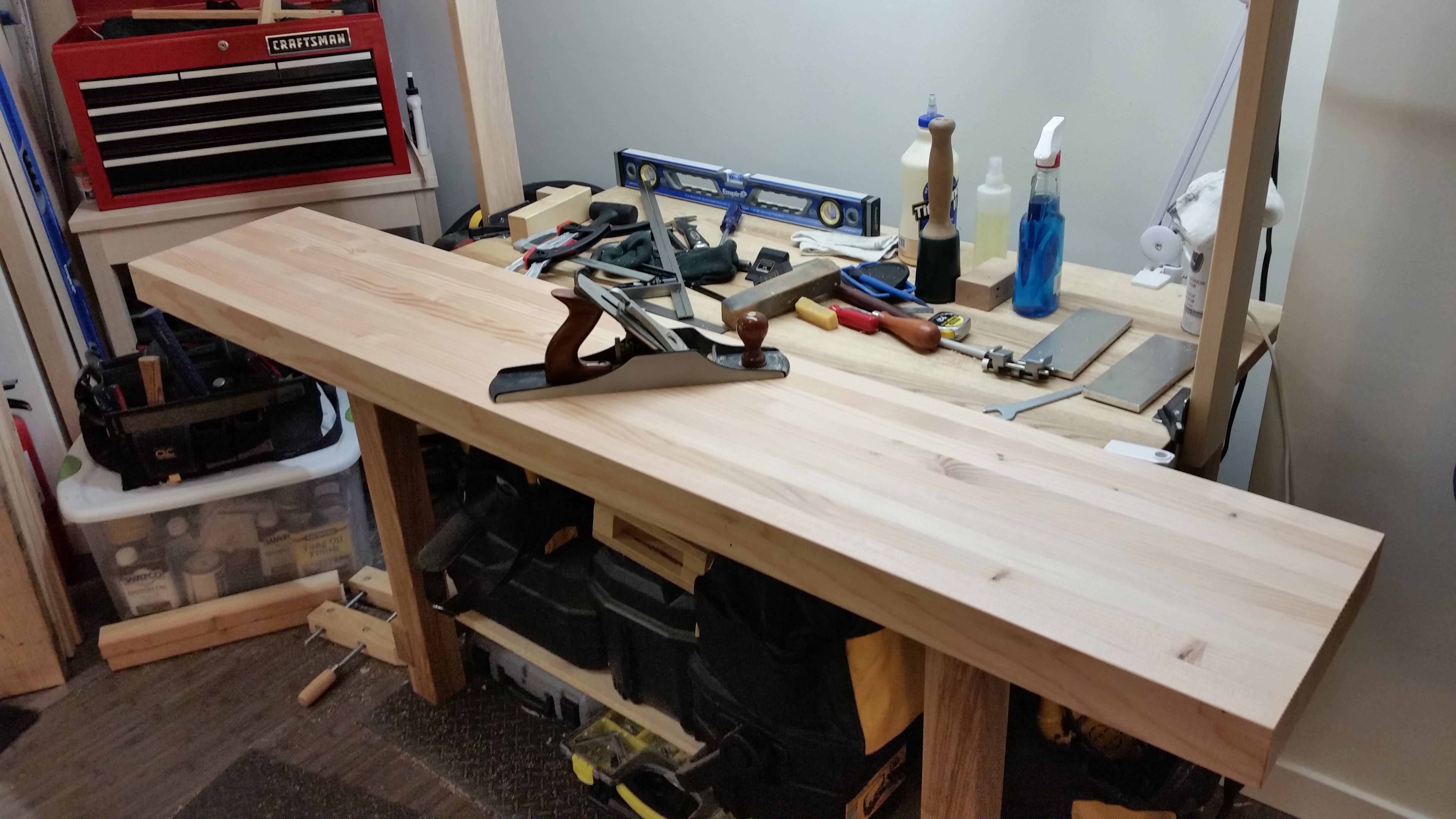
If you’ve been following the saga, you know I now had a relatively S4S planing slab.  All that remained was some final flattening/smoothing, installation of the Veritas inset vise and dog holes, and sealing with a coat or two of Danish Oil.

I never bothered flattening the slight bow on the front edge.  I just knocked down the splinters with some 220 grit sandpaper.

The final dimensions are a smidge under 72″ wide, 13″ deep and 2 3/4″ thick.

Truth be told, not a ton of final flattening was required after skip planing.  The back seven boards of the slab are perfectly flat along their length, and although there ended up being about 1/32″ of hollow along the entire length of the front two boards, there is no twist across the entire slab.  I made the executive decision (starring Kurt Russell) that the miniscule hollow wasn’t worth agonizing over.  Therefore, it was time to install the Veritas inset vise.  After much thought, I determined it would be best to install the vise centered over the width with a single strip of in line dog holes.  More dog holes could be bored as needed.

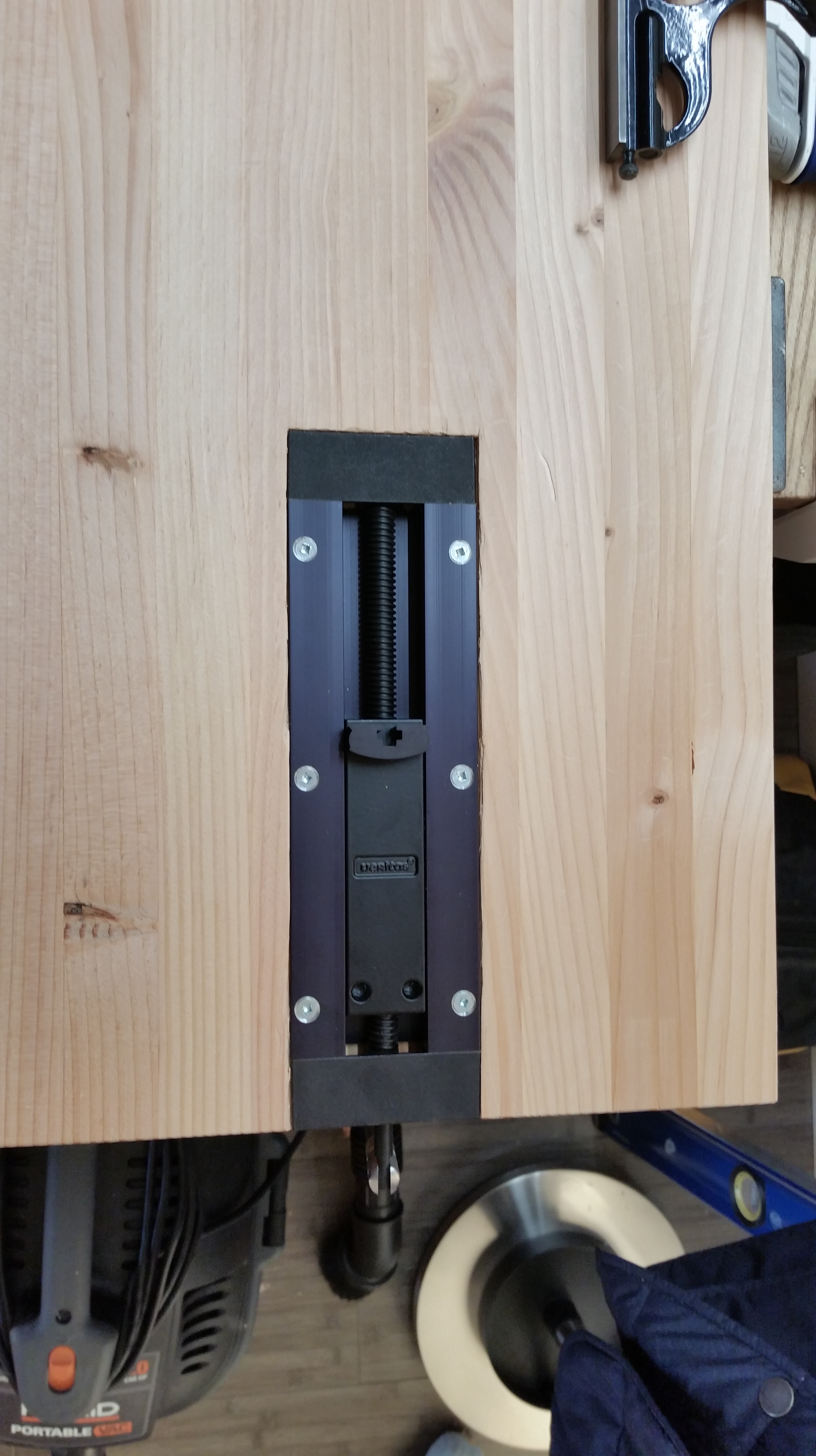
The inset vise requires a two-stepped recess, with the bulk of the vise sitting inside a 29/32″ deep recess and the wings (where the screws attach) sitting inside shallower, 1/8″ deep wing recesses.  I seriously considered using a power router at this point.  I could have (should have?) marked out the entire recess, hogged out most of the waste with a 1/2″ upcut spiral bit on a full size router and cleaned it up by hand with a chisel.  Instead, I did it all by hand.  After marking and carcass-sawing down the sides of the main recess, I hacked out the waste with my new Narex 1 1/4″ bench chisel and cleaned up the bottom with a large router plane.

This took way longer than it needed to.

This took way longer than it needed to, but it was good practice (I think?).

The good news was, once the main recess was cut, I could mark the wing recesses directly off the vise itself.  The bad news was, at 1/8″ deep and running with the grain, there was no completely clean way to remove the waste and leave crisp corners on the wing recesses (I opted for the large router plane, which did an adequate job, albeit slightly rough).  After a while, the vise was fully installed and, remarkably, the jaws are perfectly square to the back reference edge.
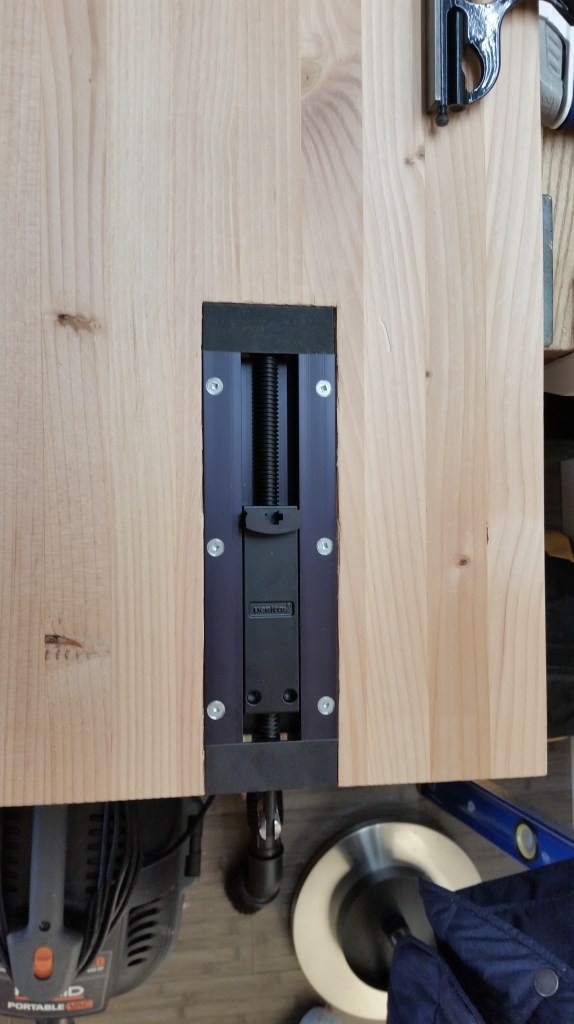
The lack of crisp corners will haunt me forever, or at least until I have to reflatten the board and recut the recess.

But the lack of perfectly crisp corners will haunt me forever (at least until I reflatten the slab and recut the recess).

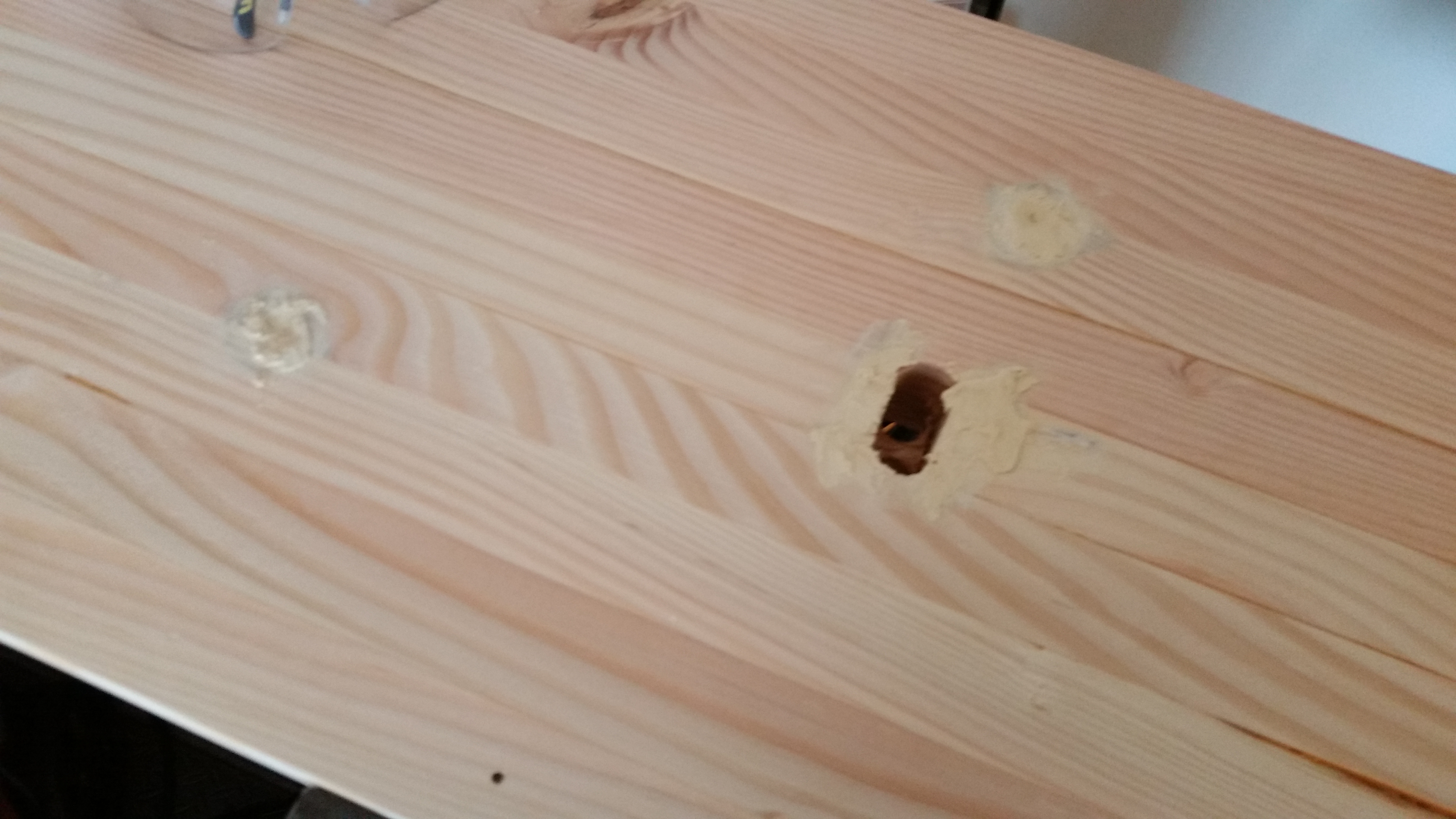
The 3/4″ dog holes were interesting to bore.  I have been using the Rockler forstner bit guide with my handheld drill for a while now, but the slab was too thick to make it all the way through.  After starting the hole straight with the guided forstner bit, I had to switch to my beefy brad point bit after the drill chuck bottomed out on the guide.  I went slow, but I still had a little bit of blowout on the underside, easily solved with water-based putty.  I filled some other holes as well and left them to dry overnight.
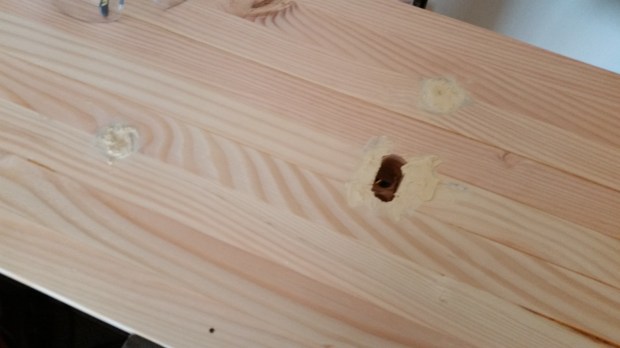
This is actually the vise exhaust port, but still.

This is actually the inset vise exhaust port, but still.

Nearing the end, I hit everything with a quick 220 grit orbital sanding, slapped on two thick coats of natural tint Danish Oil and leaned it up against the wall.
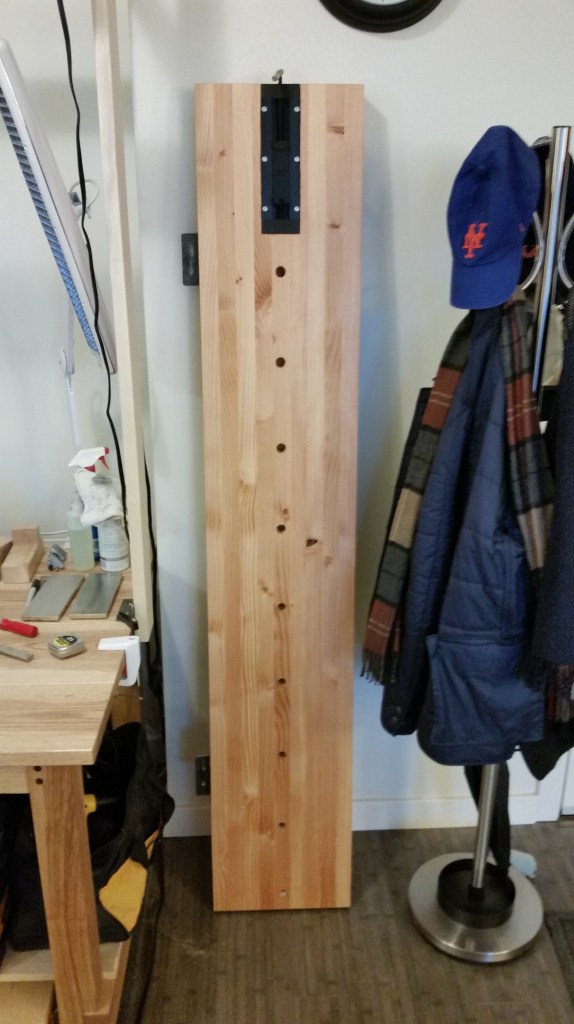
A place for everything and everything in its place.

A place for everything and everything in its place.

So there it is: the finished planing slab.  From home center douglas fir construction lumber to a sufficient worksurface for planing longer, thinner boards, all in about 30 shop hours (not including drying time).  I think it was excellent practice for eventually making a proper woodworking bench (maybe something in white ash and walnut) and I am glad now to have it.

Now all I need is to pick a furniture project that requires planing longer, thinner boards so I can actually use the thing.  I will report back.

JPG
Sharp Enough, From Now On

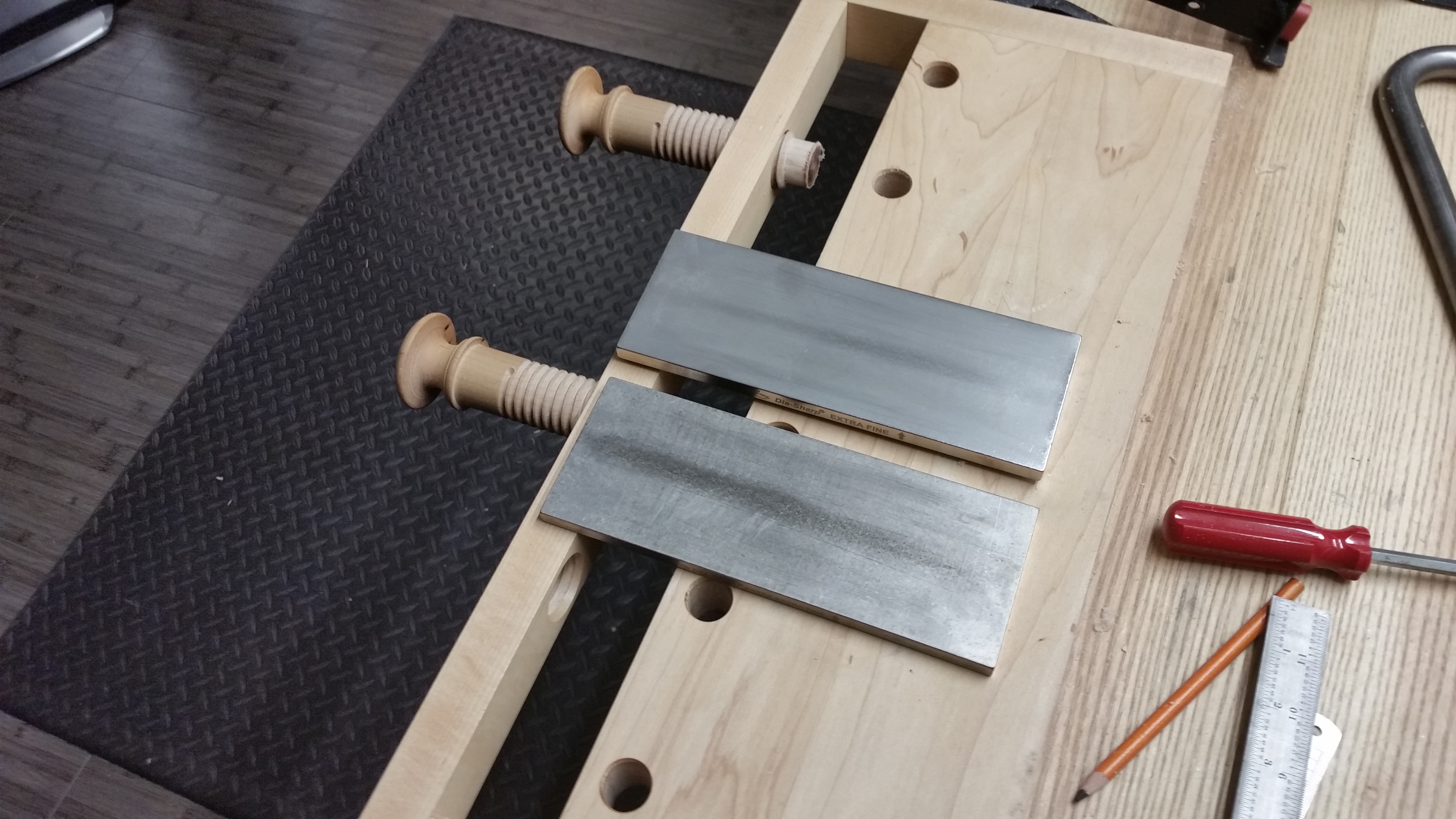
I use diamond plates for hand-sharpening (with window cleaner as lubricant).  Specifically, I use DMT Dia-Sharp continuous diamond plates and I currently own four: coarse (320 grit), fine (600 grit), extra fine (1200 grit) and extra extra fine (8000 grit).  I am truly happy with only the coarse and fine.

I don’t know if it’s the wheel on my sharpening guide or bad manufacturing luck, but both the extra fine and extra extra fine plates have developed a stripe down the center where the grit has worn almost completely off.  This happened almost immediately with the extra extra fine and took about a month of heavy use with the extra fine.  I try to change up which parts of the plate I use, but for thick plane irons, I have no choice but to run right down the center and the difference in grit leaves a dull hump in the center of the irons.

DMT, if you are listening, I am not particularly happy with these two diamond plates.

DMT: if you are listening, I am not particularly happy with these two diamond plates.

So I am trying something new.  Rather than purchase replacements (new territory for me, I know), I have decided that from now on, my plane irons are only getting sharpened to 600 grit (i.e., on the fine plate).  After re-watching Paul Sellers’ Sharpening to 250 Grit video a couple times over the last few days, I think it will be okay (I sharpen pretty often as is).  I’ll still do my chisels and router plane irons to 1200 grit on the extra fine plate (since I can run them up and down the remaining grit on the sides).

I don’t really even use the 8000 grit plate anymore.  Given how proactive I am with re-sharpening, I haven’t found the extra effort makes much of a difference on edge retention.  And I think I remember hearing somewhere that the edge dulls to a lower grit pretty quickly anyway, so what’s the point?

We’ll see how it goes.  If nothing else, it will cut the weight of my tool chest by a diamond plate’s worth of ounces.

JPG

Saying Goodbye (For Now) to Old Friends

Yesterday, I said farewell to some of my oldest and most trusted tools: my full size router set, cordless jigsaw and cordless circular saw. They now live in storage in my brother’s basement.

These are some of my original tools, from the before times when everything I knew about woodworking came from Norm Abram.  Back before I knew I wanted to do hand tool woodworking almost exclusively.  I consider many of my early tool purchases impulsive wastes of money, but not these.  If (when?) I have the space again, these tools will be back in the shop.

Godspeed, gentlemen.  We shall meet again!

Godspeed, gentlemen. We shall meet again!

My quest to simplify my woodworking existence continues.  I hadn’t touched any of these tools since well before I moved into my apartment over 4 months ago.   My finishing supplies bin takes their place under the worktable.

That brings total power tools remaining in my apartment woodworking shop to: compact router, cordless drill, random orbit sander and Dremel rotary tool.  Not sure there is anything left to cut at this point.  I have thought about giving up my WorkSharp 3000 sharpening station as well, but I never know if I’ll need to grind an edge back to life.

Goodbye for now, old friends!

JPG