woodworking tools

About Damned Time

In a vulnerable and impressionable state the other day, I splurged on a new scrub plane. I’ve mostly gotten my retail therapy habit under control as of late, but in this case, the price point was too good to resist.  I weighed the benefits of merely buying an extra iron for my No. 4, but without a bench grinder in my apartment, this seemed a less attractive option.

This is my favorite part of woodworking.

This is my favorite part of woodworking.

I’ve been managing well without a true scrub plane for a while. Lately, all my traversing is done with an exaggerated camber on a No. 4.  This is perfectly fine for pines and softer hardwoods, but some upcoming hardwood projects (real hardwoods: oak, ash and maple) made it time for an upgrade. I’ll straighten the iron on my No.4 so it can return to general purpose/shooting duties.

What drove me over the edge, though – aside from over-tiredness and crushing existential dread – was taking down the width of several long boards, where the waste was not thick enough for hand-sawing away but was too much for even a heavy-set bench plane. So I splurged.

This is my first Lee Valley/Veritas plane.  I own several of their saws (as well as some winding sticks, wheel marking gauges and other miscellany) and am always impressed with their quality and pricing.  I was nonetheless blown away by how little tuning was required.  Right out of the box, the sole was dead flat.  As was the iron, which was already ground to radius (thankfully).  After a mineral spirits wipedown to remove the shipping grease and a quick coat of T-9, I assumed all the plane would need is a secondary bevel on the iron before taking shavings.
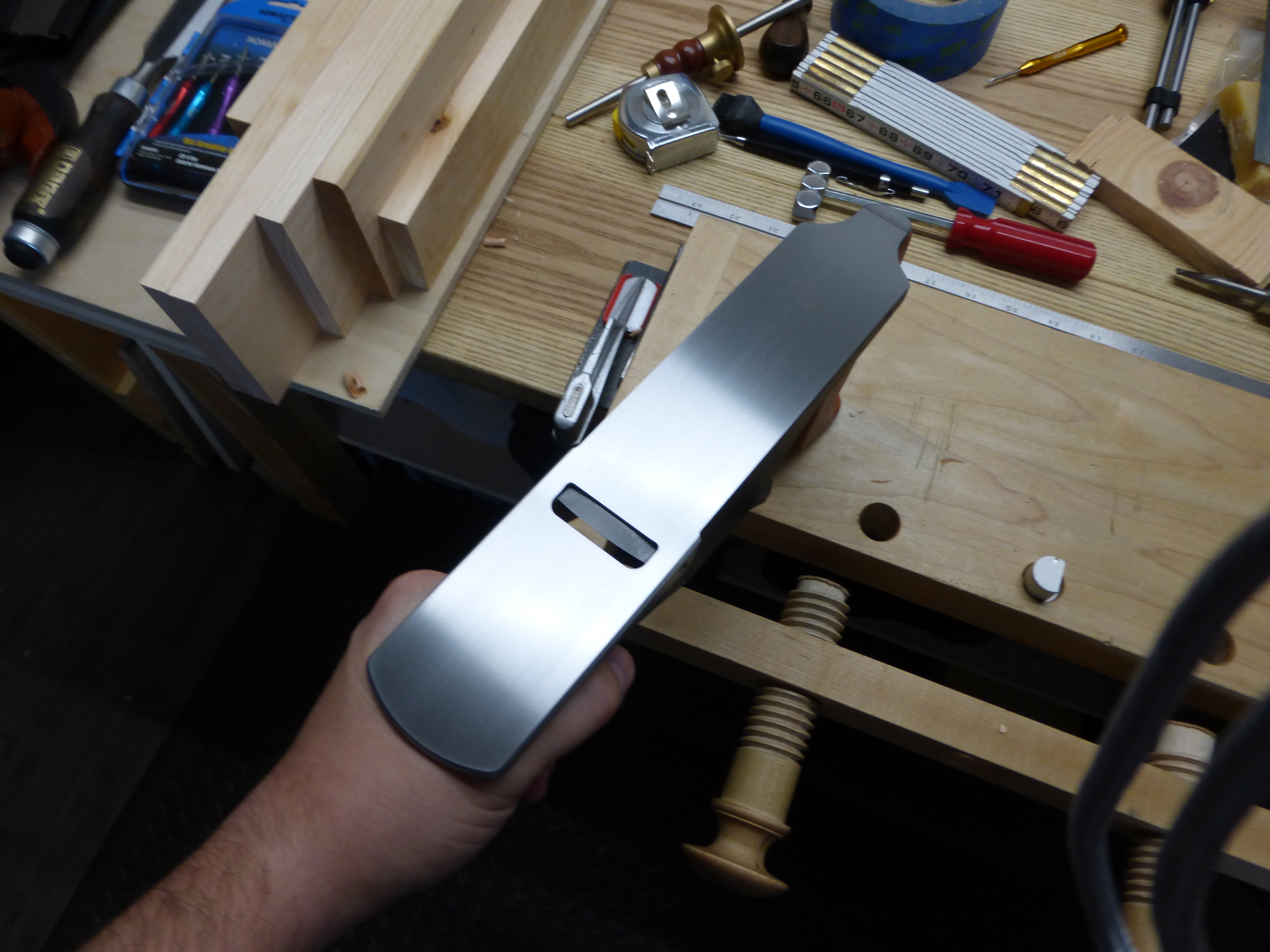
The quality of machining is a joy.

The quality of machining is such a joy.

Christopher Schwarz did a great blog post on scrub plane iron sharpening a while back that demystified the process.  I am always grateful for his wisdom.  A quick thumbnail test, though, revealed the iron was already rather sharp.  I could polish it further, but “well enough alone” is the rule of my apartment woodworking shop.  I literally just had to center the blade and tighten down the set screws before the plane was ready for use.

Overall, so far so good.  I will post a follow-up with some pictures once I’ve had a chance to take shavings.

JPG
New Block Plane

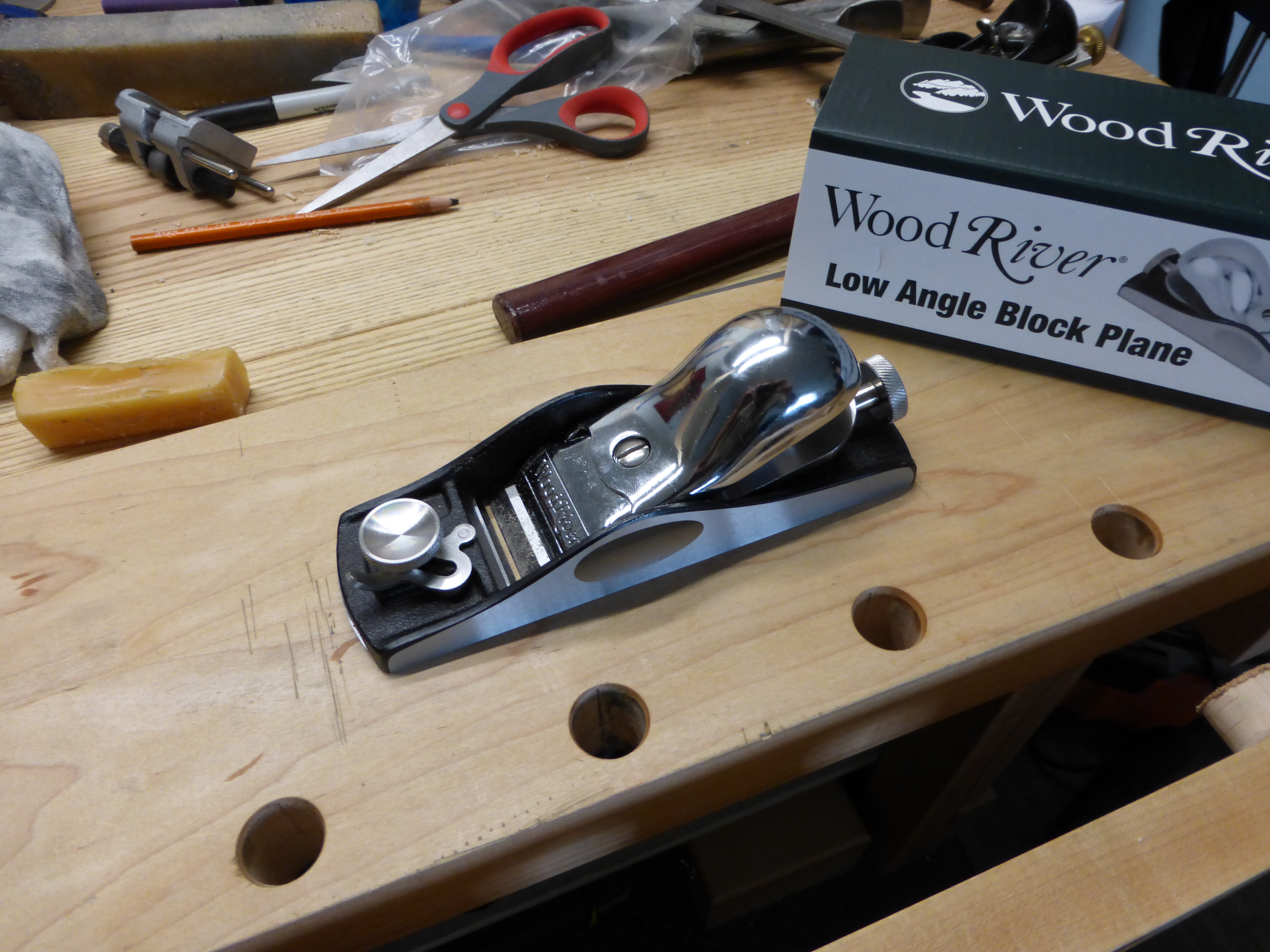
I finally caved and replaced my box-store block plane with a slightly more upscale version.  It’s not an everyday tool in my shop, so I didn’t splurge for an ultra premium block plane.  But I was frustrated enough with the lateral adjustment capabilities of my old block plane that it was time for a change.

P1000082

I have brand loyalty because I don’t mind a little tuning.

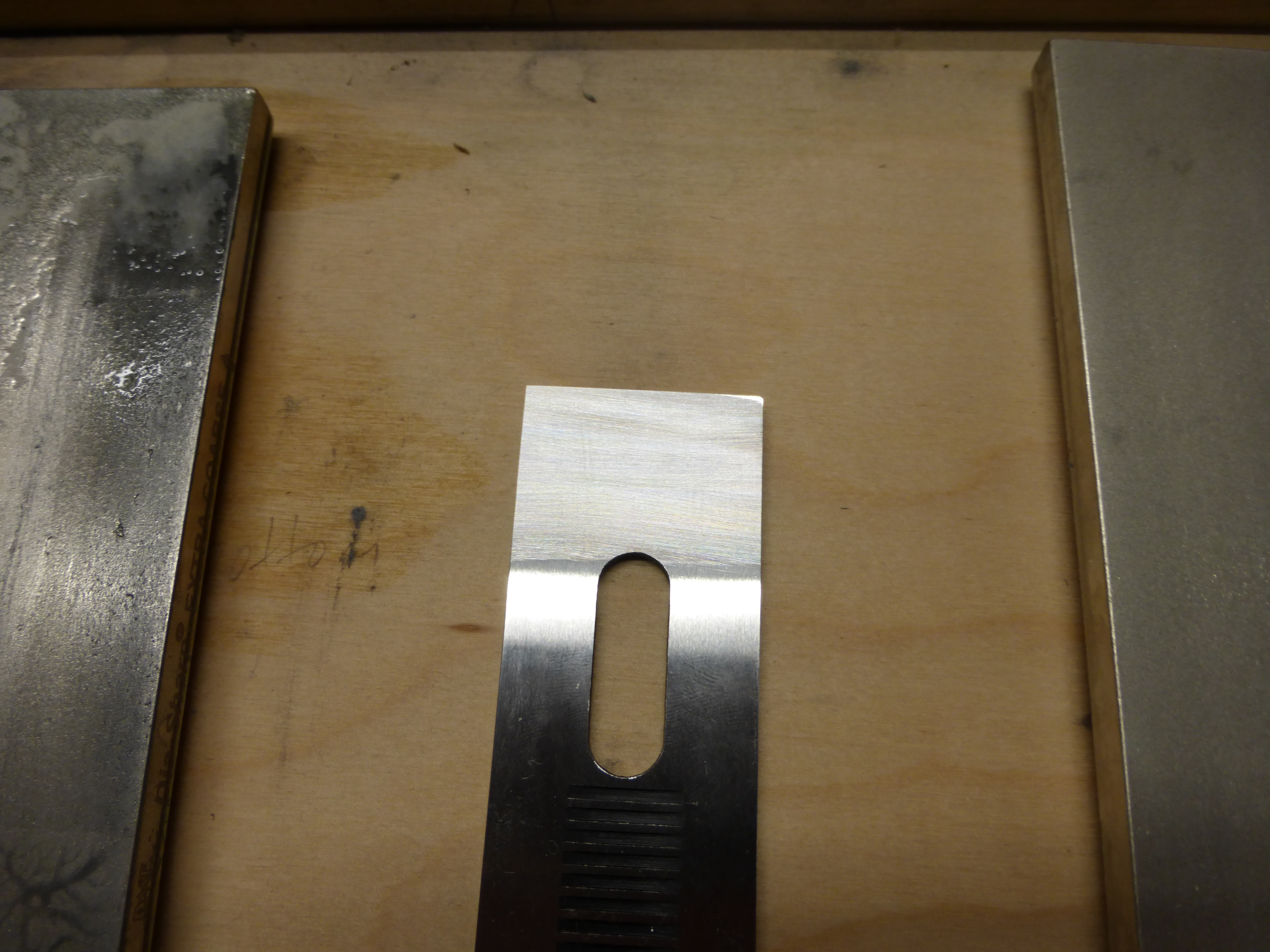
From unboxing to finish, total honing time was about half an hour to clean up the plane (most of which was flattening on the 220 diamond plate).

P1000080

Just about done in this picture.

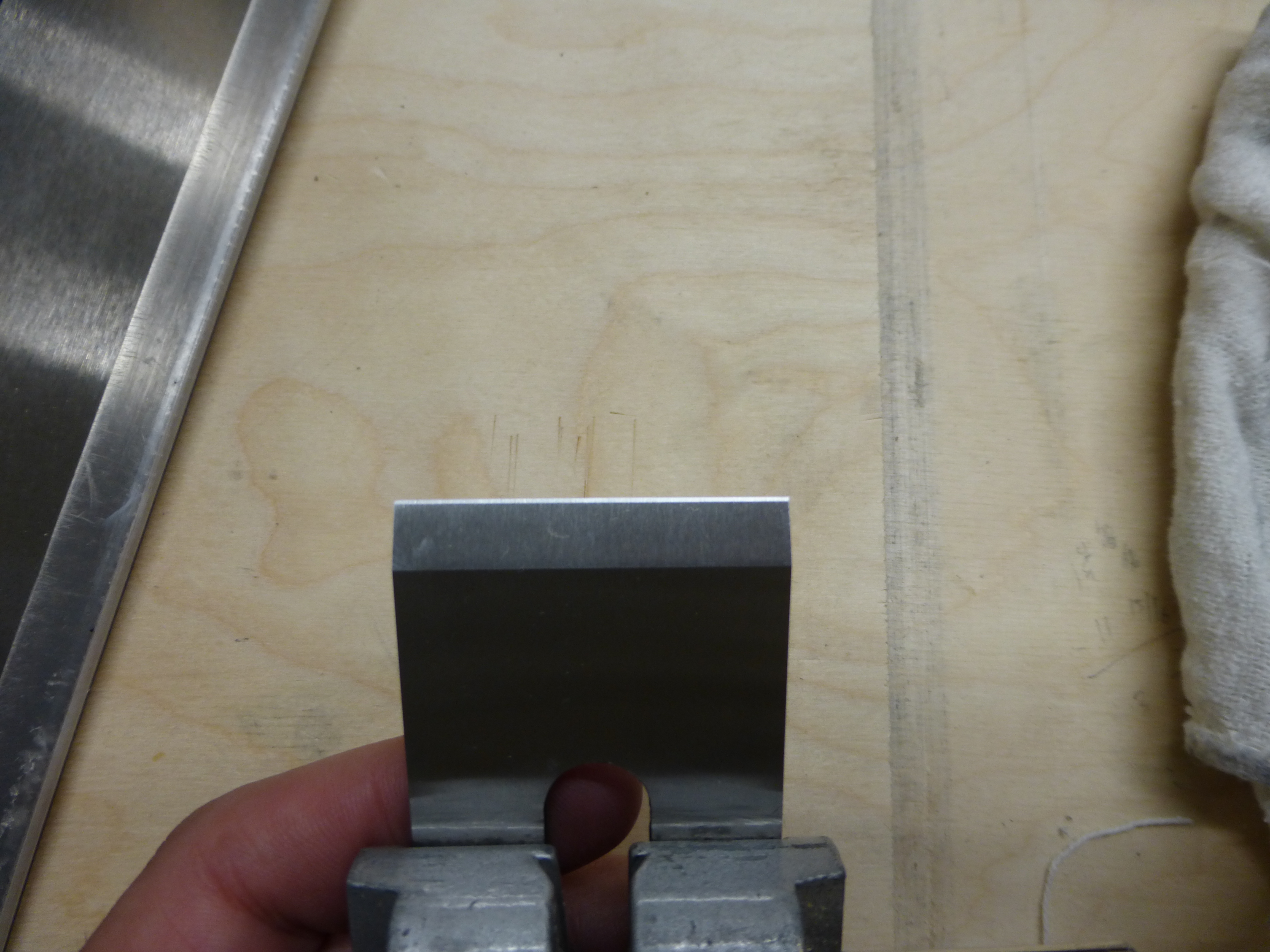
I’m pretty pleased with the machining on this particular tool.  The sole is pretty flat and the iron was ground square (both rarities for this brand, I will admit).  A couple swipes at 30 degrees left a razor-sharp secondary bevel on the freshly-flattened iron.

P1000081

Fastest sharpening job ever.

There is no lateral adjustment lever, but there is plenty of clearance around the knuckle cap for a hammer tap.  The new block plane is also longer and heavier than my old one (it’s about the size of a No. 1), but the knuckle cap gives it a better feel in the hand.  Overall, I’m happy so far, even if I’ve only taken a few end grain shavings to test blade sharpness.

JPG

An Obvious Downside

I’ve mentioned a couple times that my main source of cheap pine is off-cuts from tongue-and-groove pine siding.  I’m running a bit low, but I’ve managed to make a three-foot tall stack of 36″ to 48″ long boards last for most of a year.  While the material is fluffy and easy to work, it isn’t exactly stable, and most of the time, is significantly twisted and cupped (thankfully, not often bowed).  This presents an obvious problem: final board thickness.

Before preparation, any given piece is only about 11/16″ thick, and the “raw” board can have almost 1/8″ of cup/twist or more.  This means that after flattening and straightening to S2S, I’m often a barely a shade over 1/2″ on some parts of the board.  Passing the piece goes through the thicknesser takes it down to a hair over 1/2″ all around at S4S.

P1000072

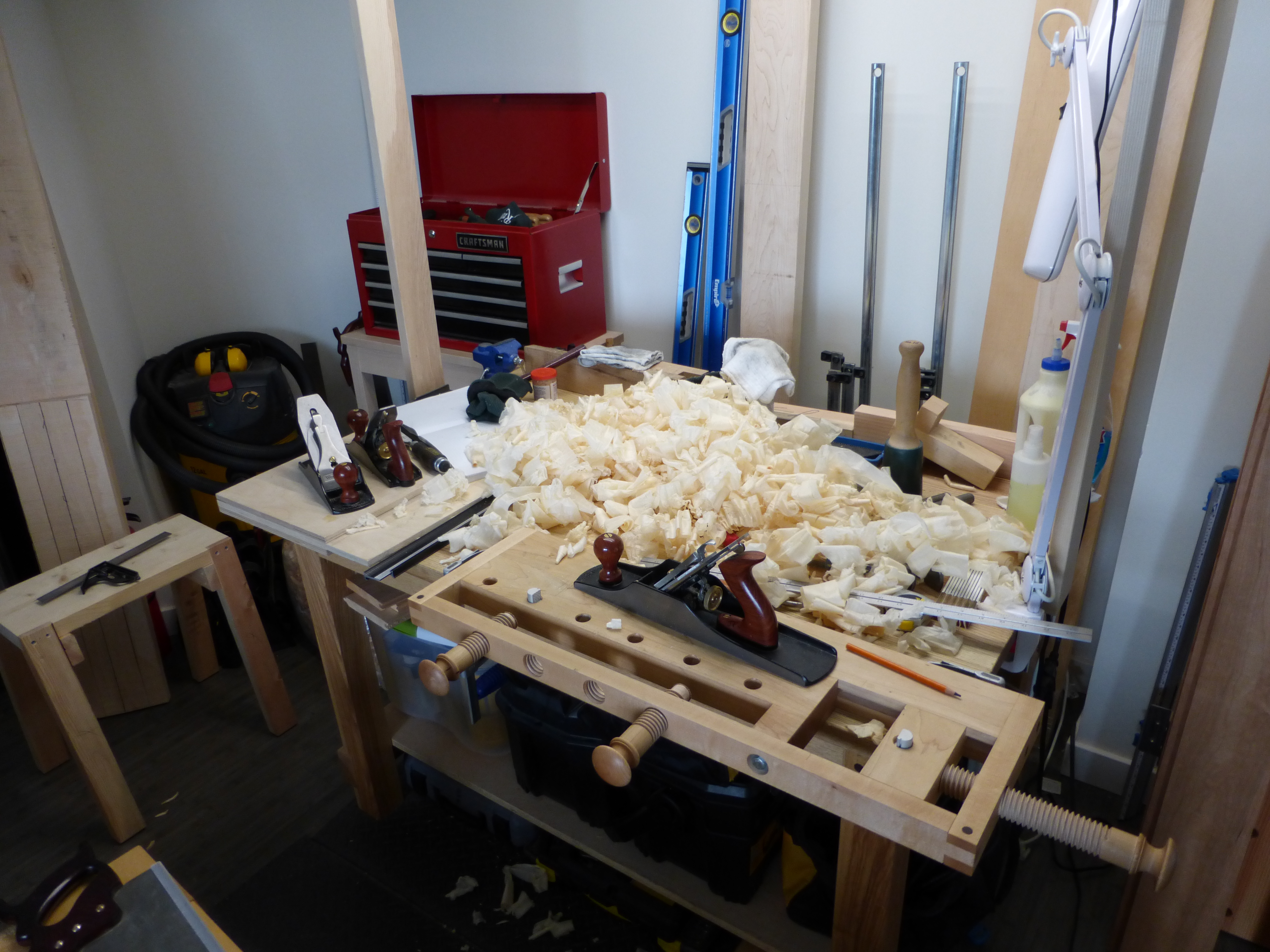
This pile of shavings is from S2S’ing only two 19.5″ x 4″ boards.

This is why I’ve gotten in the habit of only S3S’ing these boards when the project can allow for it.  For example, the bottom shelf of the toy workbench was made of four such boards.  The underside of that shelf will never be visible, so I left the extra mass in the boards by only S3S’ing them.

P1000066

That’s a machinist granite slab adding clamping pressure.

I also use this trick when I need an inside tenon shoulder or when a board is too wide for my thicknesser, in each case where the inside face will otherwise be concealable.

This trick isn’t available in some applications, however.  For instance, I can’t attach drawer runners to the twisted inside face of a side rail (like for the angled leg side table) and the underside of a tabletop should be trued to mate well to the table frame.  I guess you could technically use rabbets to solve each problem, but that seems like even more work than just thicknessing properly.

I haven’t disassembled much antique furniture, but I find it difficult to believe I’m the first person to cut this corner when possible.  I think this shortcut thing is becoming a running theme.

JPG

To Make or Not to Make

As I’ve mentioned before, one of the things that keeps me from splurging on new tools is space. Case in point, I’d love to own a plow plane, but I have absolutely no idea where to store the thing so it won’t get dinged constantly.

Maybe I could make a lidded box to keep it safe.  Maybe I’ll make a plow plane myself so I don’t care if it gets dinged. Maybe I’ll just suck it up and keep using a compact plunge router.

JPG

Shortcuts That Make Sense

I think I first heard the expression when I read the Fellowship of the Ring for the first time as a teenager:  “Shortcuts make long delays”.  I always took that expression to heart and I try not to cut corners in my woodworking (other than breaking the arrises). Sometimes, though, shortcuts make sense.

For instance, I rarely cut through tenons.  Unless they are for a specific design element, or the wood is particularly thin in the first place, through tenons just aren’t necessary  They look cool, and I guess a through tenon might add strength in the right situation, but why do the extra work if you don’t have to?  For that matter, why cut a full length stub tenon when a shorter stub tenon will do just fine?

Side rails to keep the legs rigid and square.

Test-fitting the side rails for tight fit between the shoulders and the legs.

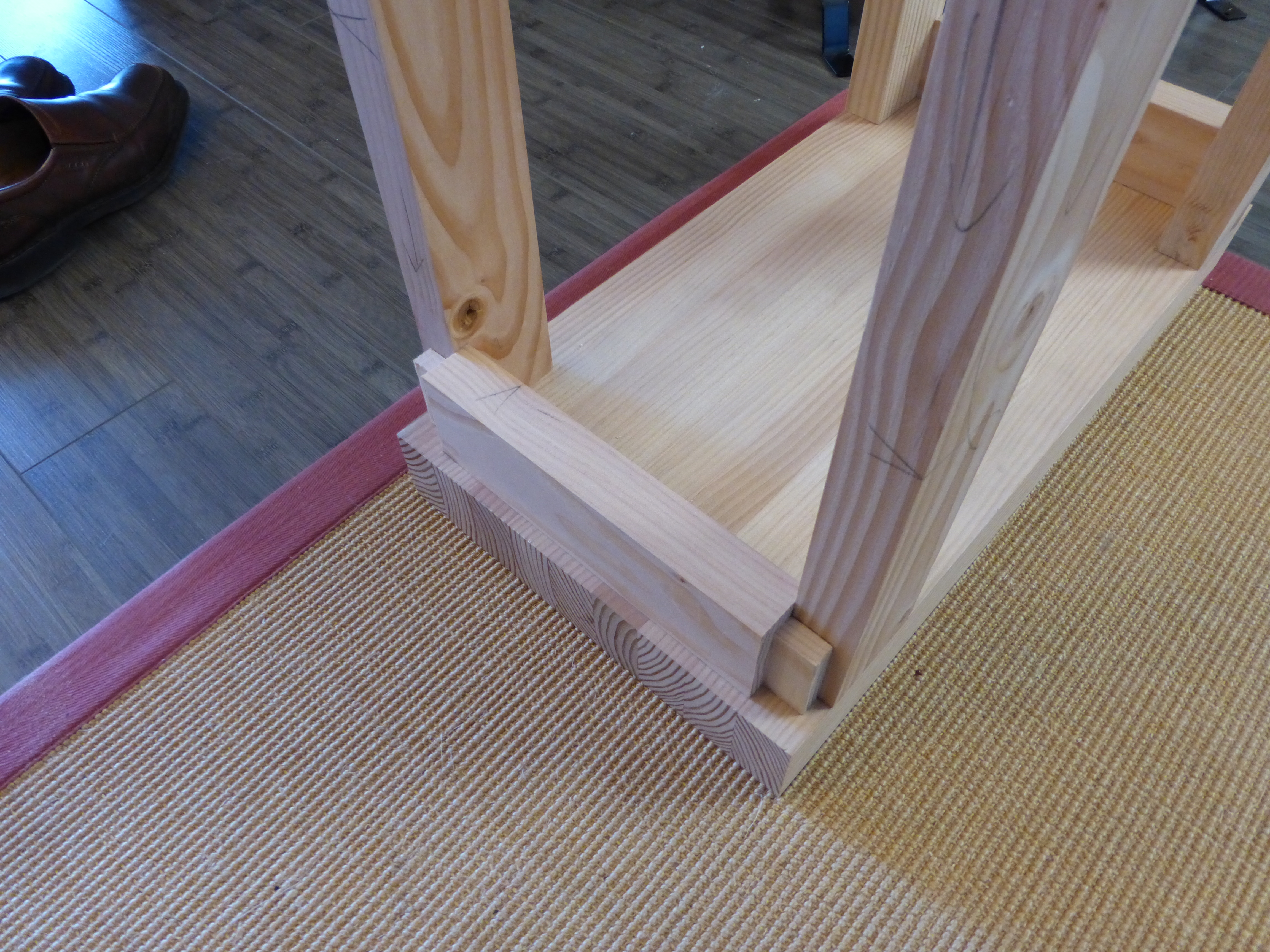
On the mini workbench, I had cut some 1.125 inch tenons on the side rails (see above).  Then I looked at the thickness of the legs themselves (1.5 inches) and the position of the rails (flush to the underside of the bench) and determined that a .75 inch stub tenon would be more than sufficient.  A .75 inch tenon would translate into a mortise that I could chop in a single pass back and forth, saving time overall.  So I hacked half an inch off each of the tenons.

So I hacked half an inch off the tenons.

It’s not lazy; it’s efficient.

The side rails will still do their job  with the shorter tenon (i.e, keeping the legs rigid and square front to back), but that’s more a function of the tight fit between the tenon shoulders and the leg than a function of the dept of the mortise.

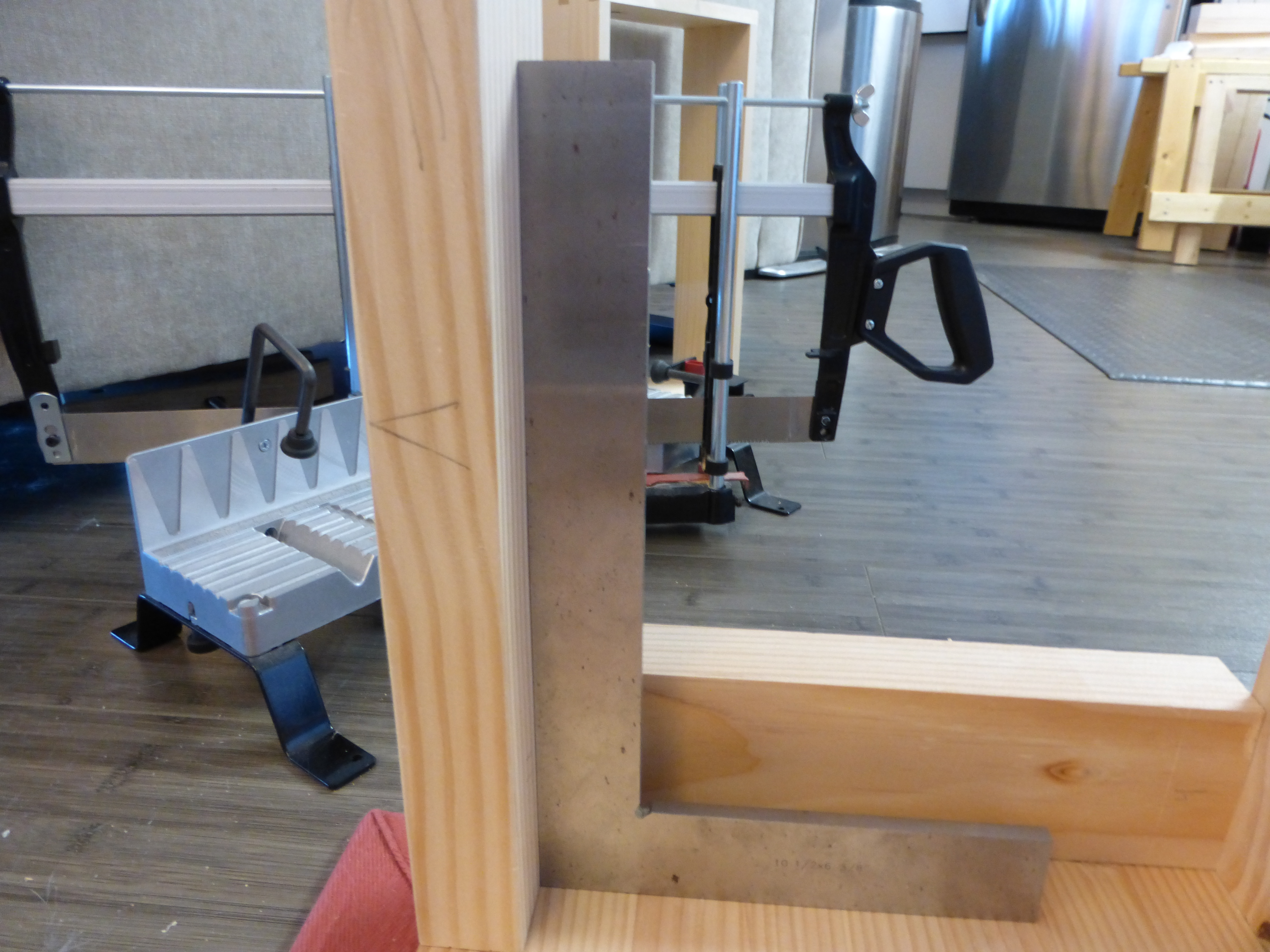
Stub tenon or not, that's a tight fit.

Stub tenon or not, that’s a tight, square fit.  And yes, I keep my miter box on the floor.

Speaking of shortcuts, I have also decided I’m not going to mortise the front and back rails into the legs.  Instead, I will half-lap and screw them into the insides of the legs, mainly because I’d like the ability to remove or re-position the slatted shelf if necessary in the future.  Mortising those rails into the legs would make that much harder.  Plus, it will save me a bunch of time (and I really enjoy the ease of cutting half-lap joints).

So next time you’re planning out a woodworking project, think long and hard about any available efficiencies.  I’m not saying scrap the corner dovetails on your tool chest in favor of nailed rabbet joints (although that would be perfectly fine if done correctly).  But I am saying don’t go overboard if you don’t need to do so.

JPG

Straight and Square is Not Just for Wood

Working on a couple different planing-intensive projects has brought to my attention that I had somehow ground most of my plane irons and chisels out of square.  Again, I blame my Work Sharp 3000, which I really like but have never really gotten the hang of fine tuning.  If anyone is aware of a how-to for micro-tuning a Work Sharp 3000, please send me the link.

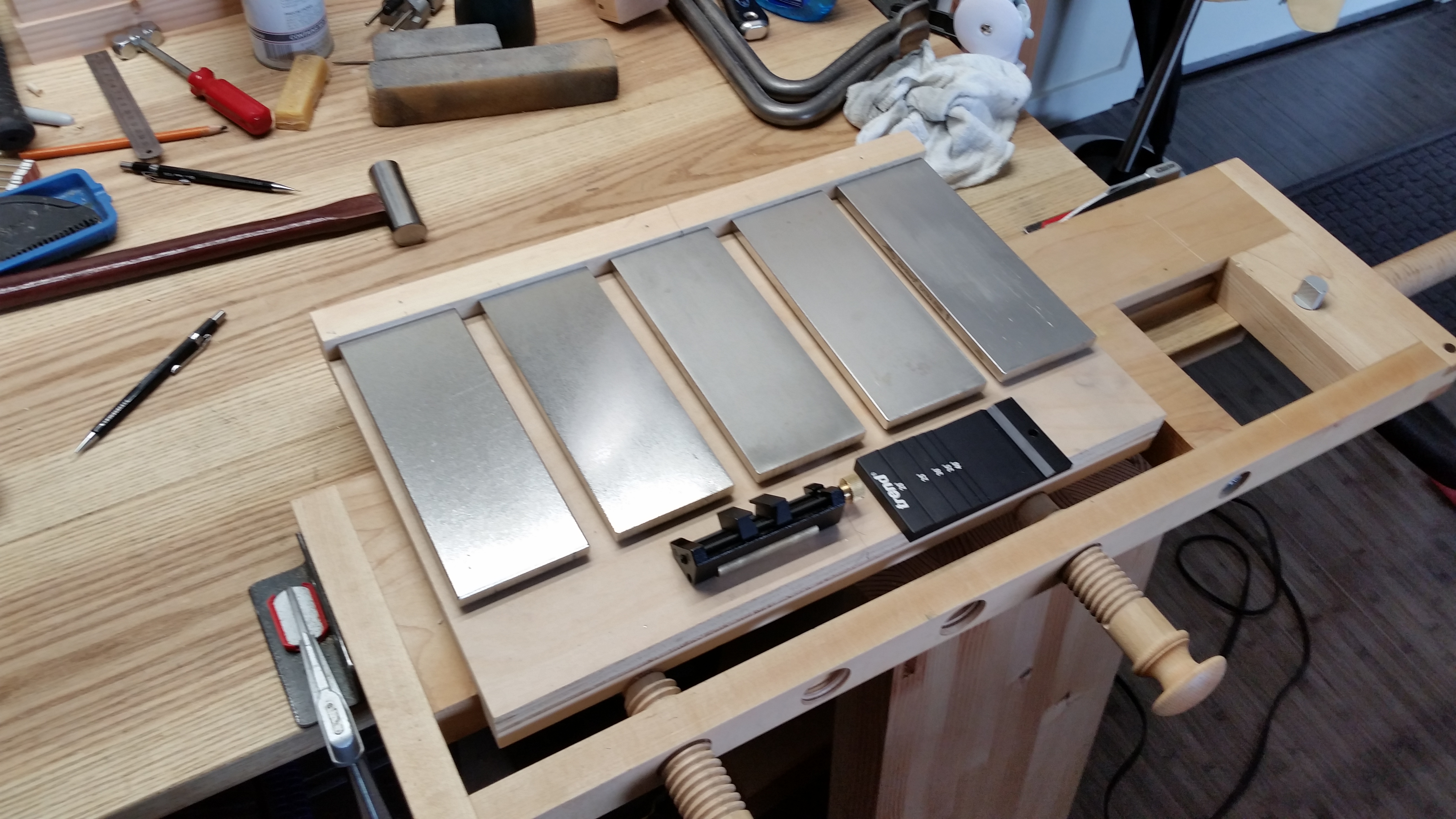
So, the last couple days I have been hand-grinding everything back into square.  I had to dust off my coarser diamond plates, as well as a wide-wheel sharpening guide that I’ve had for a long time, but abandoned a while ago when I picked up one of the eclipse-style sharpening guides.  My reasoning was the narrower wheel on the eclipse-style guide would make tipping a plane iron (to create a camber) easier.  It also apparently made tipping a chisel without realizing it easier.

Wide wheel = stability.

I also made another bench-hook style holder for my plates because I am sick of wiping slurry off my Milkman’s Workbench.

So going back to the wide-wheel sharpening guide with greater stability makes sense for re-grinding square.  I could certainly do it with the eclipse-style guide, but I’d rather eliminate user error altogether (which got me into this mess in the first place).

I do add micro-bevels by hand, though, so there is plenty of opportunity for user error slightly later in the process.

JPG

The Tintinnabulation of the Plane

It occurred to me the other day that I’ve never actually used the lateral adjustment lever on any of my hand planes.  One of the first woodworking videos I ever watched was Super-Tune a Hand Plane by Christopher Schwarz and I guess I got in the habit of doing all blade adjustment by hammer tap.

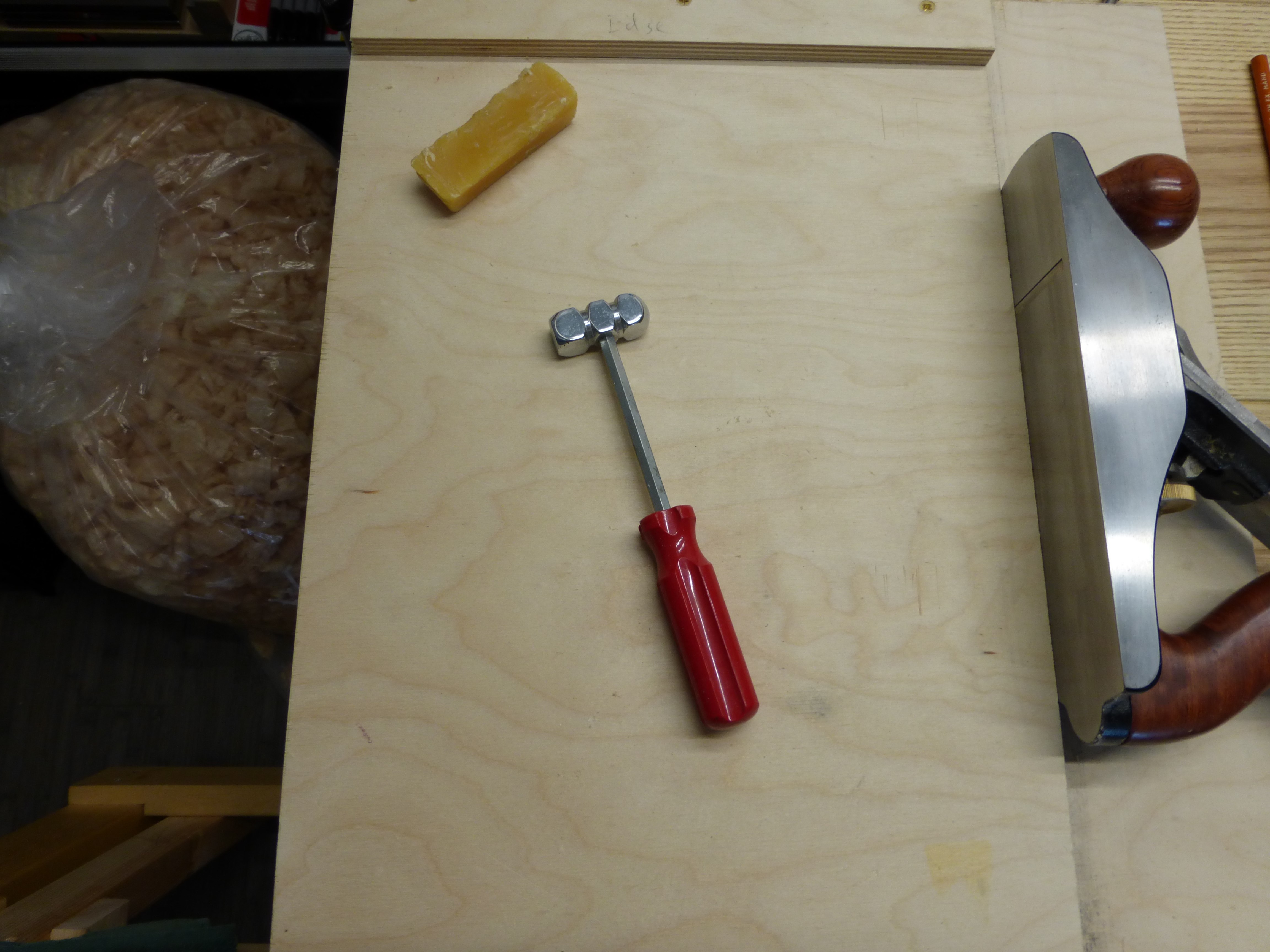
I think I stole this one from my father's toolbox.

I think I stole this one from my father’s toolbox.

Given all the smoothing and shooting I’ve been doing lately for the mini-workbench project (both with my No. 4 and my No. 4 1/2), I have gotten quite a bit of practice at resharpening and plane setting.  One thing I noticed is that my plane irons were apparently ground out of square (I blame the wide blade attachment on my Work Sharp 3000).  After some clean-up in that respect, getting perfect set after a resharpen is much quicker.

I’ve also been more diligent about lubricating the plane sole (see the beeswax above).

It’s the little things, I guess, that increase efficiency.

JPG

Some Slight Hypocrisy

A while back, I decided to abandon super fine sharpening stones because my 1200 and 8000 grit diamond plates had worn unevenly and were ruining my plane irons. After much consideration, I have relented and picked up another 1200 grit plate for plane iron sharpening.

I did so not because sharpening only to 600 grit didn’t get the job done. On the contrary, I would defy anyone to notice the difference from a more highly polished iron.

I reacquired a 1200 grit plate because I was removing far too much material during routine sharpening. Even a couple of swipes to dress up an edge was eradicating the slight camber I put on my irons, turning routine sharpening into a grinding-level ordeal. Micro bevels became nigh-impossible and the ruler trick was rendered useless with the heavier grit.

I will say that all my irons are flatter than ever after two months of sharpening only to 600 grit, but I am hoping that the finer stone will bring routine sharpening back to an under-two minute endeavor. And that’s the point, right? Making it easier?

JPG

Jointer Plane Envy

It’s getting to that point: I think I need a jointer plane. I’ve survived quite well for a while now jointing (and doing almost everything else) with my No. 5 1/2 jack plane.  A jack plane really is more than enough for all normal woodworking tasks (as I’ve said before), but it would be pretty awesome though to have a real try plane. The extra seven inches of length would make all the difference in the world.

wpid-20150218_205822.jpg

That’s what she said?

I will first attempt to clean up an old corrugated Craftsman that was gifted to me last year. But I know myself, and this exercise ends in me splurging for a premium plane. Unlike other size planes where I’m happy to flatten and tune a mid-priced brand, I would rather spend the money for an already true, flat and square sole. I’m leaning toward the Veritas bevel-up model, about which I’ve heard good things.

No matter what, I bet agonizing about it will earn me another few more months to figure out where to keep the thing in my tool chest.  Hollar at me if you have any other suggestions.

JPG

An Apology to Accessories

A few days ago, I wrote about how cleaning, honing, sharpening and project planning just wasn’t as fulfilling as actually making things. Although I stand by that statement, I think it may have sounded more negative than intended.

When I first started woodworking, for good or for ill, I was focused on acquiring “tools” (as most people understand the word). Things that cut. Things that shape. Things that go ” whirrrrr” at various pitches (which nowadays is just me making sound effects for my router planes and braces).

In a brief moment of calm over the weekend (I did not, by the way, get any ripping done), I was rummaging through my toolchest in hopes of finding more excess to trim. I was struck by how few “tools” I actually own. I won’t go through the litany again, but in sheer number and volume, it’s not much (and certainly my “tool” collection hasn’t grown significantly since establishing the apartment workshop several months back).  In reality, there is so much more to a workshop than “tools”.

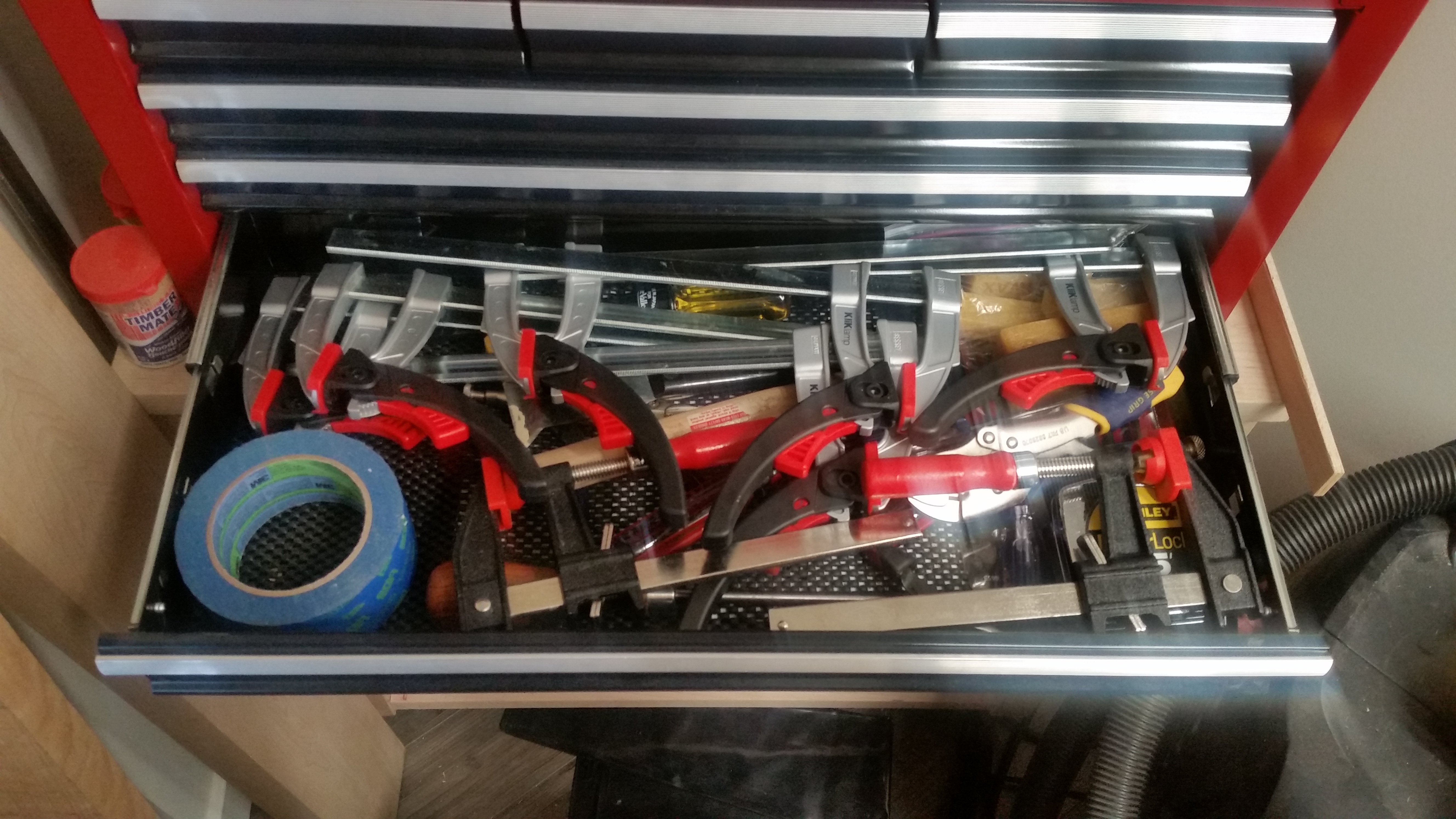
The real heroes of my apartment woodworking shop.

The real heroes of my apartment woodworking shop.

A good portion of my shop equipment is not “tools” (as most people understand the word), but accessories for sharpening, setting up, maintaining and protecting my “tools”.  Accoutrements that allow my chisels, knives, planes, saws and squares to consistently perform at a high level.

And clamps. Lots and lots of clamps.  Always more clamps.

And clamps. Lots and lots of clamps.  Always more clamps.  In soft focus.

Learning to use these support items effectively is the other half of woodworking.  Dull, poorly set tools are as much a threat to safety and success in the workshop as poor technique.  So while I will enjoy the making more, I will also be thankful for the vises, sharpening stones, files, gauges, blade guards, rust prevention chemicals, and that sort of thing that make the making possible.

In sum: sharpen early and hone often; lubricate and polish regularly; protect edges always.  Your tools and your projects will be better for it.

JPG