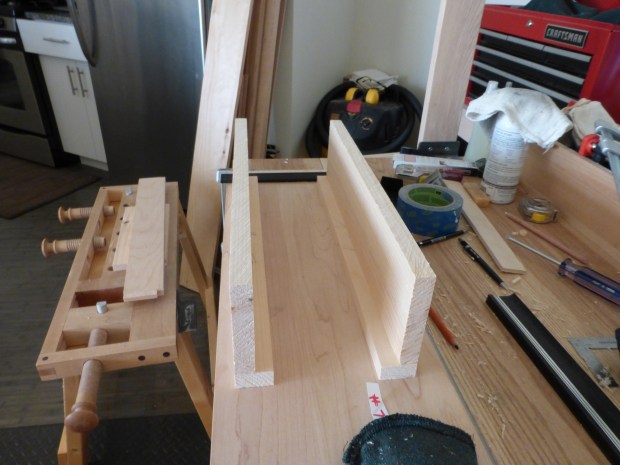
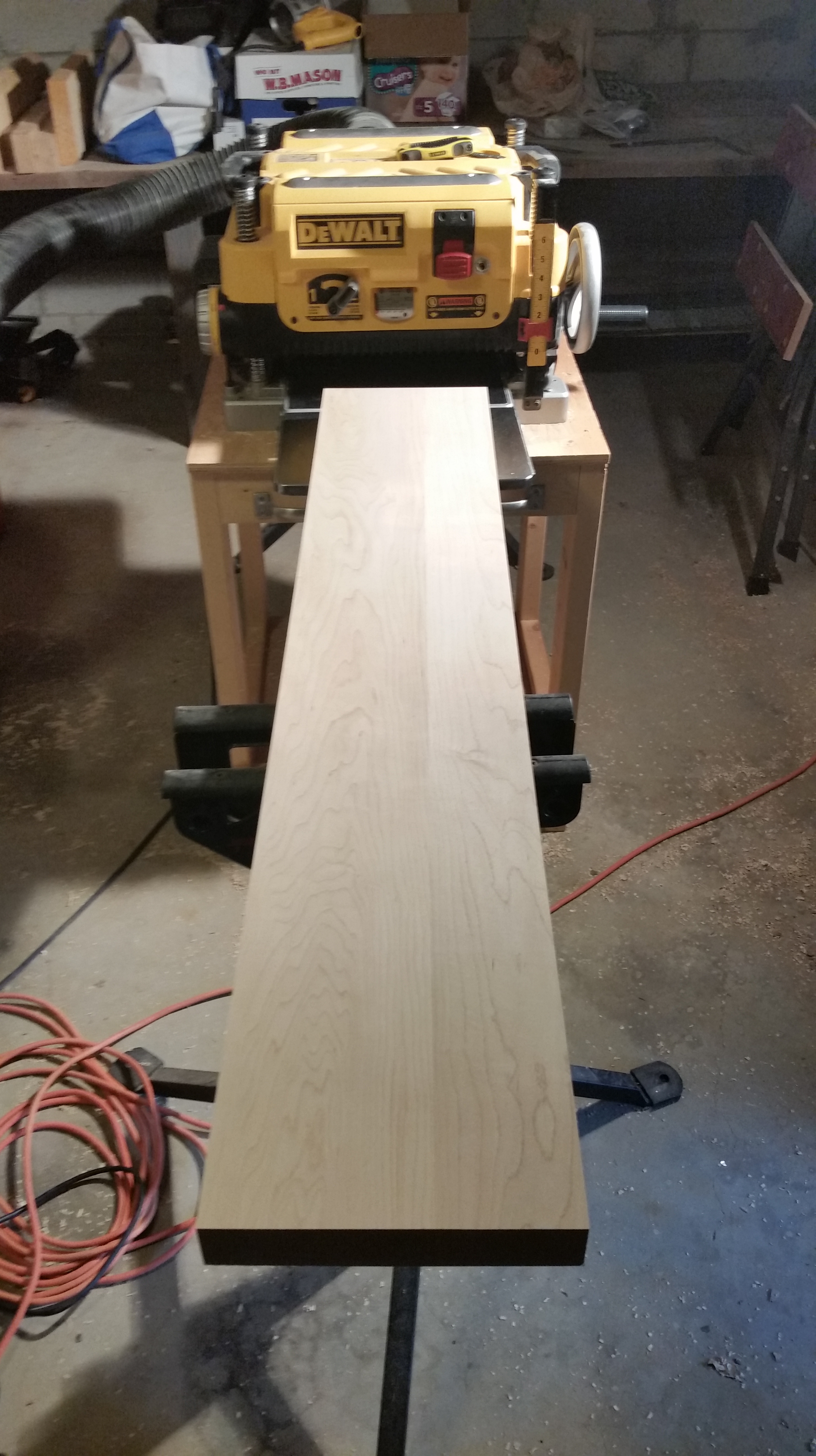
big projects

Nothing Too Extreme

While I wait for the Douglas Fir posts to dry out and become the top rails for my new sawhorses, I’ve doing a little bit of shaping around the edges. Literally.

One design element I’ve noticed in most saw horses of this style are the beveled feet.  Although the rake varies, very rarely are the feet left four square.  So I went with the crowd.

P1000306

Subtle on its own, but noticeable in comparison.

Each bevel is about 3/8″ deep and 7.5″ long, but the measurements are not exact.  I am sans band saw, so all work was done with a No. 4 set as heavy as I could.

The most surprising part was the ability to work in both grain directions.  My No. 4 is by no means supertuned for smoothing, but it was sharp and I was able to work in both grain directions with only slight tear out.  And a couple final passes with my No. 4 1/2 in the correct direction cleared all of that up.

It’s nice when something actually works right the first time.  I’m pleased enough with the shape of this first foot that it will become the pattern for the other three feet.

JPG

Where We Last Left Off

Things went better than expected with the laminated feet for the prototype Japanese-style sawhorse prototype.

wp-1454183697242.jpg

About as well as could be hoped, judging by the facial expression.

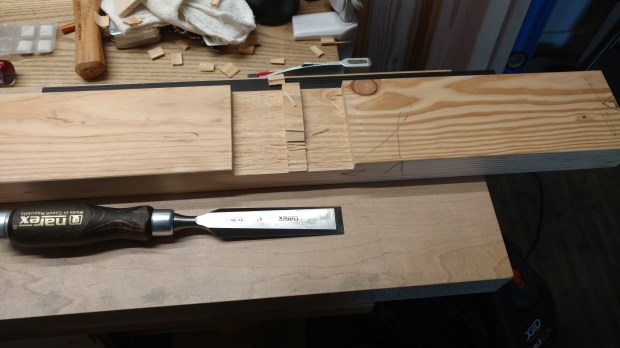
Before I hit the thickness planer this weekend, I did in fact cut the dadoes that will end up being the mortise in each laminated foot.  When cutting wide dadoes, I like to leave a bridge section in the middle on which to register the sole of the router plane.  I don’t know why, but this time before thicknessing I left the bridges in one foot and removed the bridges in the other.  There was no difference in the thicknessing result, FYI.

In any event, the bridge is easily chiseled away after the majority of the dado is proper depth.

wp-1454183704492.jpg

Like so.

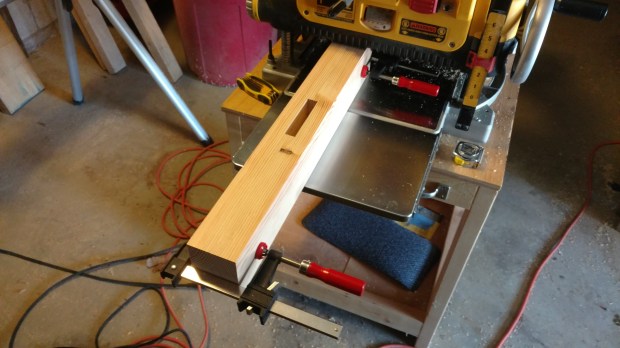
I also tried something new, which I will call “gang-thicknessing”.  Having taken the time to square up each edge to the reference face, I clamped the foot assembly together before sending it through the thicknesser.  It goes without saying that you should ensure the metal clamps are clear of both the cutter head and the sides of the machine before doing this.  But if done right, it will ensure assembled foot is parallel (and each foot is exactly the same height).

wp-1454183693176.jpg

Again: CLAMPS CLEAR OF THE CUTTER HEAD AND THE SIDES!

The sides and top of each foot still need dressing to remove any plane tracks, but I am very pleased with how it all came together.  I have also dimensioned the rest of the prototype parts (legs, stretcher, top rail) and hope to finish the joinery in the next couple days.  Meanwhile, the feet are glued up and drying.

wp-1454185115417.jpg

Other than the knots, it kind of looks like LVL, doesn’t it?

JPG

I am a Terrible Hypocrite

But what else is new?

Less than a week after swearing off the old planing slab, I decided to rehab it anyway.  I need a suitable work surface for the upcoming workbench build, and it just so happens that my best option had been lurking in the background of the shop.

It also just so happens that I need a pair of sturdy sawhorses as well.  So when I stumbled upon some awesome internet plans for Japanese-style saw horses, I knew it was time to get the slab back in shape.  After flattening and straightening by hand (seen above), the slab was skip-planed to just over 2 7/16″ thickness.

wp-1451785191790.jpg

It’s been almost a year.  This thing had better not move anymore…

With a usable work surface of 71 1/4″ x 12 1/4″ (net of the heavy roundovers hiding some edge fracturing that occurred during flattening), the slab is not quite full size for a Japanese-style workbench (at least not according to this article).  But it should be good enough for preparing the legs and rails for the new workbench.  I even reinstalled the inset vise.

In lieu of a joined planing stop, I utilize an aluminum planing stop like the one I currently use on my smaller maple slab.  I also think I’ll skip the sliding dovetail on the cleat and just friction fit a cleat into a dado (with some beefy screws as reinforcement).  Seems like the sensible thing to do.

wp-1451857108306.jpg

The planing stop is not yet hack-sawed to width.

One day, I may lag bolt the slab to a trestle base and add a tool tray, but in the meantime, I just need some Douglas Fir 4×4’s for the new saw horses.

JPG

New Year’s Resolutions

There are (literally) big things in store for 2016 at The Apartment Woodworker.  I have only one New Year’s Resolution this year.

P1000288

And it rhymes with “Killed a Teal Smirk Wench”.

I always meant to build a frame for the original planing slab.  But after standing in the corner for so long, it needs so much reflattening it would be less than 2.25″ thick.  Not nearly enough for a stout benchtop.   Plus it’s only 13″ deep and 70″ wide.  I see it being reclaimed to make a dedicated sharpening station or something like that.

The lumber above is enough Douglas Fir to make four post legs (each approx. 4.5″ x 4.5″) and four rails (each approx 7″ x 3″), with much left over for appliances and such.  Only the bottom 6 boards are actually new; the rest are just for weight while the new boards acclimate.

More details to come, but for now, it’s a month or two of refining the design while waiting for dry wood.  When the time comes, I will hit up the home center again for Douglas Fir 2×4’s to laminate an approximately 84″ x 21″ slab top.

Happy New Year’s, everyone.

JPG

Would You Believe It?

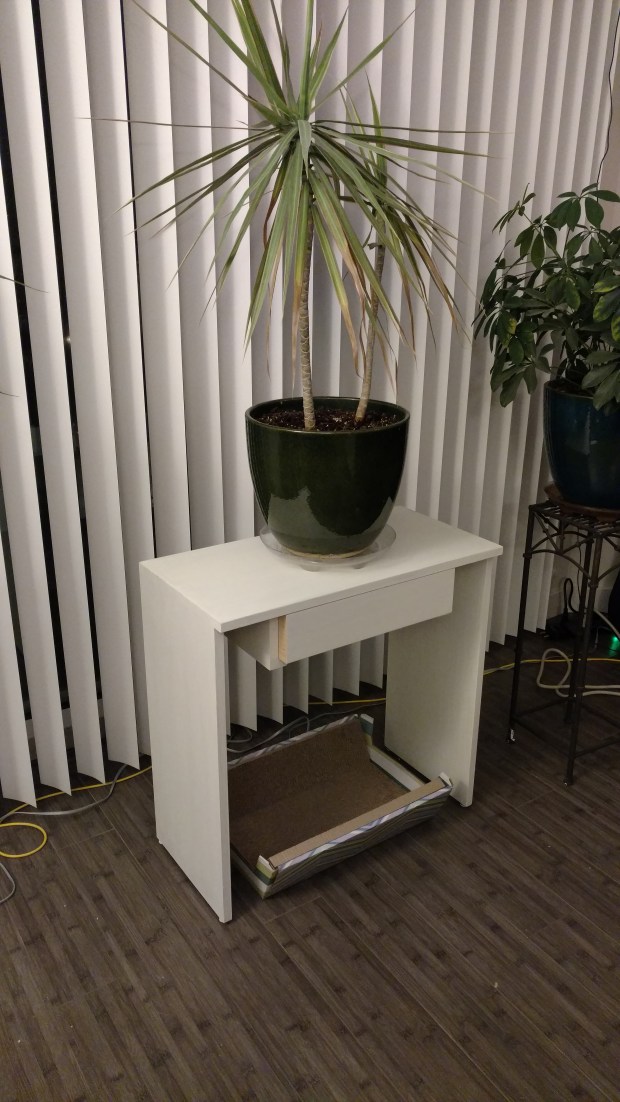
Crossing another one off the list is such a great feeling.  I’m very pleased with how the plant table ended up.  It was my first experience with Milk Paint, but it certainly won’t be my last.

wp-1450629633464.jpg

I have since touched up the drawer sides to cover the exposed wood.

Start to finish, each coat took about an hour to apply.  First, a thick base coat of Seagull Grey (which got me a strange retweet from someone on Twitter who apparently retweets every bird-related tweet; very meta). Second, a thinner top coat of Antique White.  Both from General Finishes, purchased off Amazon.

It’s a smaller piece, but it’s quite open, which meant full coverage on every surface, both inside and out.  Only the drawer has any bare wood, as it would not have fit the runners with the extra thickness from the paint.  A good problem to have, I guess.

Milk Paint is easy to apply, dries quickly and seems to be rather forgiving.  A light touch with 320 grit knocked down the nibs and I even got a bit of a distressed look around the dovetailed corners.

I have much of both colors left over, so I expect several upcoming projects will be Seagull Grey or Antique White.

JPG

I Think She’s Ready for a Paintjob

After much delay, the drawer for the dovetailed plant stand is done. It’s about time, too, as the table has been finished for a while.

P1000284

It’s so hard to get things done.

I think part of the delay was caused by apparently sharpening the 1/2 inch blade on my router plane slightly out of square.  That made the rabbets on the drawer a PITA to get perfectly parallel.  In the end, the glue up/nailing took some coercion.

The drawer fits snugly on the sides, with no wracking whatsoever.  I imagine it will wear down against the runners overtime , so I set the nails slightly.  The vertical fit is not so perfect: about 1/16 inch between the top of the drawer and the underside of the tabletop (due to removing the slight twist in the fully-assembled drawer).

P1000283

But the balance is good, even when fully-opened.

I don’t have a picture, but the 1/4 inch birch ply drawer bottom fits into a groove I plowed with my router plane.  It was also a PITA, but you make due in an apartment woodworking shop with what you have.  The router plane fence attachment worked fine, but the fence itself could be wider.  I’ll attach a wood extension.

I ultimately decided against adding a veneer to cover the rabbets, partly because of laziness but mostly because the piece will be finished with Milk Paint.  I think a base coat of Seagull Grey, a single top coat of Antique White, and some paste wax will do just fine.

It’s a function piece, after all.

JPG

A Short Time Ago, in an Apartment Pretty Close By

Last weekend weekend, I cut dadoes. Two, to be precise.  Of the stopped variety.  To install the drawer runners in the dovetailed plant stand.

P1000276

All dado bottoms flattened with a Veritas router plane.

There was a time when I would not have hesitated to strap a parallel guide clamp on the work and plunge-router the whole thing. A time not too long ago. A time I do not miss one bit.

The dado on the above right was cut with a 1 1/4 inch chisel.  After marking and chopping to depth one side, I then scribed the other side of the dado against the mating piece.  Knowing the vertical chisel chops would compress the fibers and move the knifewall, I intentionally marked the other side of the dado a bit narrow (1/64 or so).  The end result was a wonderfully fitting joint.

P1000274

No reinforcement yet.  Only friction.

The dado on the right, however, was cut differently.  At the time of day (about 6am Eastern), I couldn’t be chopping with a chisel.  I live in an apartment, after all.  So instead, I scribed deeper and deeper knifewalls with the marking knife to get to depth.  This meant that, without the compression from the vertical chisel chops, the narrower scribe line on the other side of the dado was never compensated for.  I ended up planing the mating piece to fit the dado.  It’s still a very snug joint, just with a different approach.

I have since glued in the runners into place, with a bead of hide glue along the long grain bottom of the dado.  While I suspect this will be enough, I will also reinforce with some nails or buttons.  The drawer is almost done too; I’m merely figuring out the best way to fit the drawer bottom (without a plow plane).

Then it’s time for assembly.

JPG


I Love It When a Plan Comes Together

Or, rather, a lack of plan.  Over the weekend I finished the bulk of a console table which will support two medium-sized plants.

IMG_20151122_140552322[1]

Out of River’s reach!

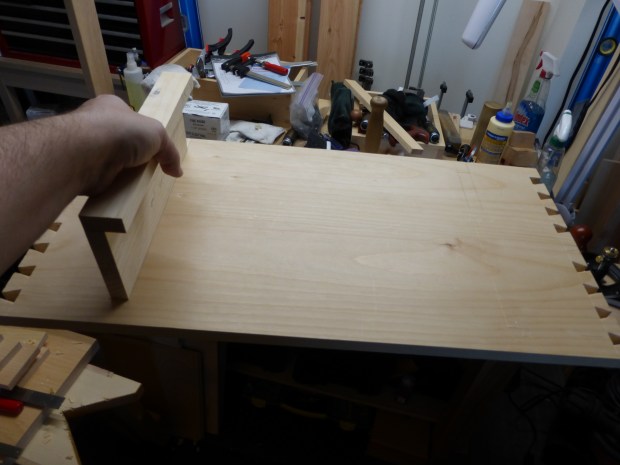
It’s a super simple build and I never even made a drawing.  Three pine boards, joined at the corners by dovetails.  I added a single rail that is [haunched] stub-tenoned to the sides.  After gluing, I plan to pin the stub tenons with some cut nails, which should be a sufficient substitute for drawbores.

IMG_20151122_140531517[1]

It’s like adding an apron to a workbench.

I think with thicker material I could have done without the rail.  But the boards are less than 3/4″ all around and wracking under the load of two heavy plants is a big concern.  Also, the rail will serve as a drawer stop (more on that below).  I’ve only done a dry fit so far, and the thing is solid as a rock under load, thanks to the tightly-fit dovetails.

IMG_20151122_142855_01[1]

Way more tails/pins than I’m used to, but I think it’s my finest work so far.

Perusing ideas for attaching the drawer, I came across a Lost Art Press CAD drawing for a staked table with drawer.  From the illustration, it looks like the wide and shallow drawer rides on two L-shaped runners that I assume are dadoed into the underside of the tabletop.   This should work well for my similarly wide and shallow drawer.

P1000251

I’m not inclined to over-complicate things.

I haven’t made the drawer yet, but I’d rather hang the runners first and then worry about drawer size.  In fact, I will cut the dadoes, assemble the carcass, then attach the runners, then worry about the drawer.  I think that’s the right order.

And the drawer, for variety, will be rabbeted and nailed, rather than dovetailed.  With a wider drawer front to cover the runners.

JPG

Medium Tool Chest Retrospective

I didn’t keep track of how many build hours the Medium Tool Chest took, but I can’t imagine it was more than 75 (not including travel time to and from my thickness planer).  I enjoyed the making, but as you all probably know, I won’t be using the chest for my woodworking shop.  It’s just not the right size for my set of tools.

I ordered one more hinge for the top.

I ordered one more hinge for the top.

I think, though, I’ve caught the tool chest bug (slightly more manageable than the workbench bug?).  So my next tool chest will be a custom size more like to the Anarchist’s Tool Chest than the current one.

I learned quite a bit from the project, though.  Some of it is apropos of an apartment woodworking shop, and the rest is just a workbench confessional.  Here goes:

1.)  Cut Nails are awesome.  They hold well and look great.  I think my previous aversion to metal fasteners was mostly because I’d never used real nails before.  I still dislike screws, though.  Even flathead.

2.)  Hand-cut Rabbets are fun.  The tool trays are both rabbeted/glued together (because I’d had enough of dovetailing by the end).  I didn’t own a fillister plane at that point, so I ended up splitting the rabbets (just like you’d split a tenon) and then fine tuning to depth with a router plane.  End result: parallel, uniform rabbets all around.

3.)  Never skimp on flattening.  I thought the oak bottom for the lower tool tray would pull the tray carcass into wind, but I was wrong.  7/16″ oak just isn’t rigid enough to straighten out 11/16″ pine.  I should have flattened and/or thinned the tray carcass boards before joining.  As a result, the lower tray rocked, even when full of heavy tools, which took some flattening.

4.)  Measure twice – cut once.  The upper runners for the tool trays are 1/4″ shorter than they should be.  Because and only because I set my combination square wrong and didn’t check it again before ripping them down.  Sometimes we all need a reminder of the oldest woodworking adage.

5.)  I really do need a larger workbench.  The Milkman’s Workbench is great, but I made the transitional slab (with Veritas planing stop) to handle the longer stock in a (sort of) vice-less approach.  It’s worked well so far, in conjunction with a DIY moxon vise.

Like I always say: now what?
Mine’s Bigger

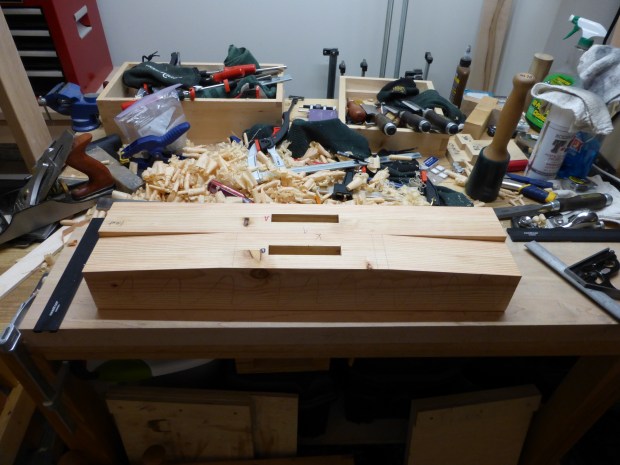
I had a modicum of free time last week, so I took the opportunity to laminate the main benchtop of my new clamp-on workbench.  At 48 inches long, the workbench is essentially the same length as the dining table to which it will clamp.

For a size comparison, that's my current clamp-on workbench in the bottom of the frame.

For a size comparison, that’s my current 31″ clamp-on workbench in the bottom of the frame.

In many ways, this new workbench is the spiritual successor to the planing slab that I unsuccessfully made out of home center douglas fir last year, although not nearly as long or heavy.  I’m hoping that with the inset vise (rather than a proper wagon vise), I’ll have about 44 inches between the dogs.  Compare this to 24 1/4 inches on the Milkman’s Workbench pictured above.

In addition to being much longer, the main benchtop is significantly deeper.  My Milkman’s Workbench has a main benchtop of 6 1/2 inches, and an overall depth of 9 3/8 inches including the face vise.  Compare the new workbench, which will have a main benchtop of 8 13/16 inches deep (I lost just 3/16 inches of nominal depth to jointing).  Add to that about 1 1/2 inches of inner front vise chop and another 5 1/2 inches of fully-extended front vise outer chop and I will be able to support almost 16 inches of work over the length of the front vise.  I plan to make a peg-held support for the right side of the bench so I have full support over the full 48 inches.

wpid-20150926_124501.jpg

Grainy work dungeon photo!

All of this is now dependent on how well I hang the front vise.  I plan to cut dadoes in the underside of the main bench to accept the screws.  Then it’s just a question of drilling holes perfectly straight through the outer chop (without a drill press) and figuring out how to seat the collets into the inner chop perfectly in line with the outer chop holes.

Simple, right?

JPG