woodworking

Acute Sense of Longing

I left my No. 4 and my No. 7 hand planes at my parents’ house last week so they’ll be there when I pick up the workbench build again on Saturday.  That means the only bench planes remaining in my apartment workshop (other than a block plane) are a No. 4 1/2 smoother and a No 5 1/2 jack plane.  The shop feels positively undermanned.

Once my go-to bench plane, it’s been a long time since I’ve even touched the No. 5 1/2 (having been pretty much entirely replaced by my No. 7).  And the No. 4 1/2 has always been exclusively for final smoothing (an excellent luxury if you can swing it).

All of this is a roundabout admission. I had hoped to put together another “Basic Projects” installment this week, but I feel absolutely lost without at least my No. 4.  I just couldn’t psych myself up to make anything.

Everyone’s got a favorite, after all.

JPG

More Progress

Sometimes, my design ideas are too ambitious for my contemporaneous skill set.  If so, I leave the design on the shelf for and come back to it.  Such is the case with the angled-leg plant stand I designed a while ago.

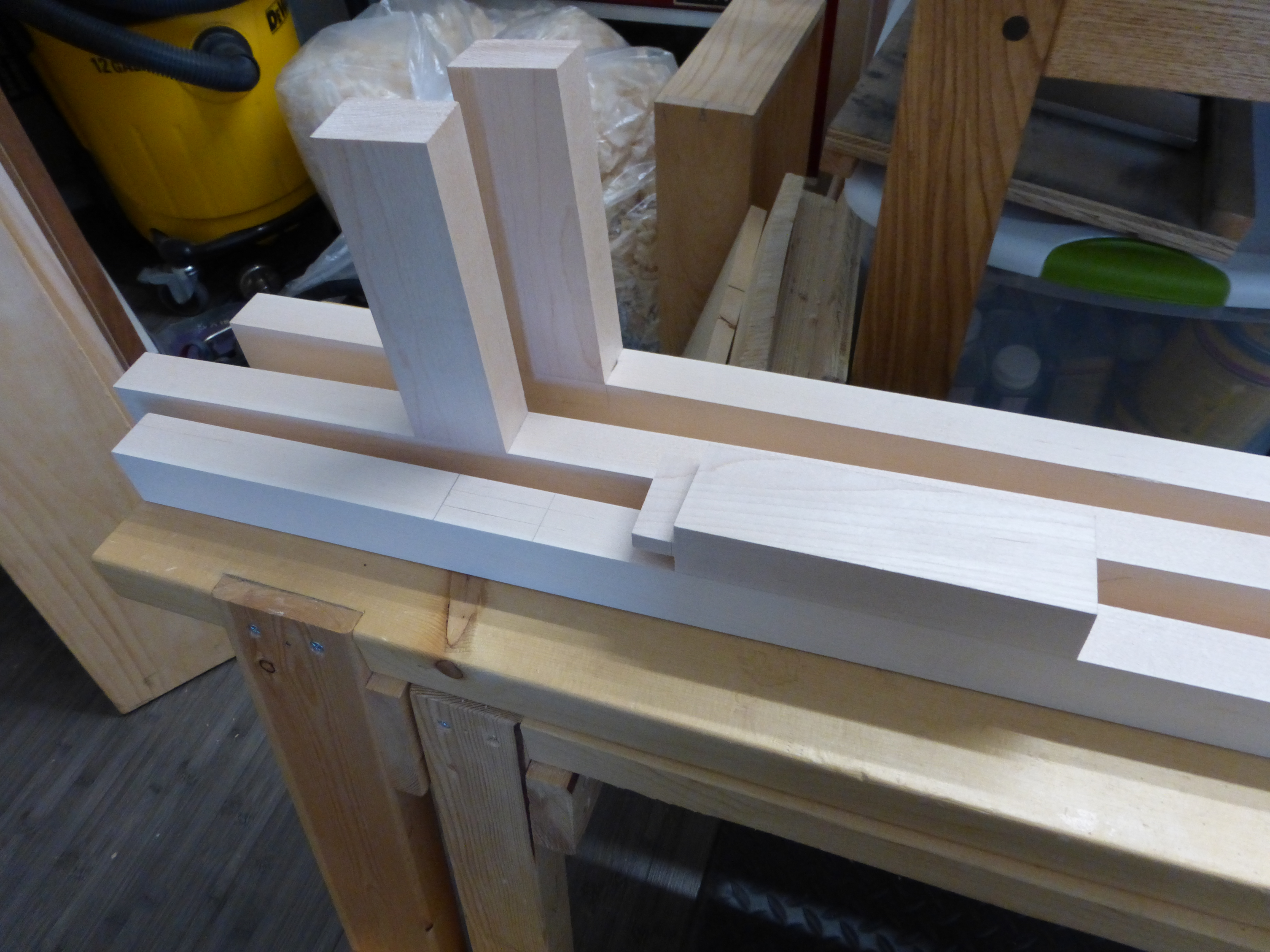
So the other day, thoroughly sick of flattening a recently glued-up panel, I decided to cut the angled tenons for the plant stand rails.  After some trial and error at full size, I decided a leg rake of 2.5° was aesthetically better to me than the as-designed 5° angle.  Though marked at the correct angle from a sliding bevel, the crosscut tenon shoulders were not perfect.  I had to use a shoulder plane to tweak the angles, but after a while, each rail seated nicely into a test mortise on one of the legs.

P1000224

I cannot stress enough how hard this maple is. I had to resharpen my shoulder plane while tweaking the angles.

There is still one more mortise to chop, and then I have to figure out how best to shape the center hub of the plant stand.  But all in all, as I’m fond of saying, “progress is important”.

JPG

Rift- and/or Quarter-sawn Pine

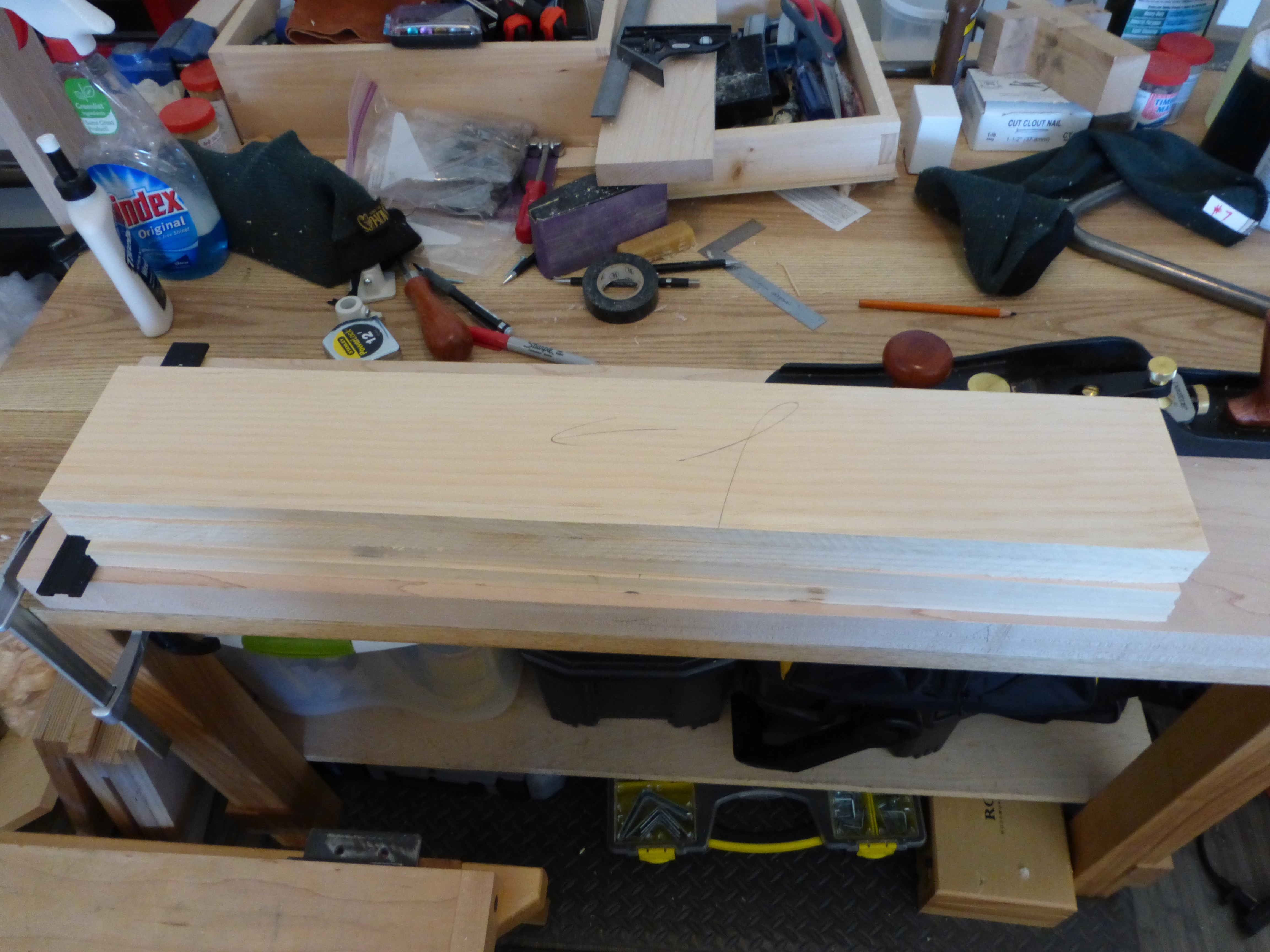
I finally got around to preparing the stock which will comprise the main panel of the medium tool chest lid. In order to minimize movement, I will be laminating the lid from four pieces of rift- and/or quarter-sawn pine.  I say “and/or” because I don’t really know where the transition point between the two lies.  Suffice to say, it’s not flat-sawn.

P1000220

If someone would like to explain an empirical difference between rift-sawn and quarter-sawn without needing a chain of custody on the tree, please do so in the comments.

The loveliest part about non-flat-sawn lumber is how it resists warping.  After flattening and thicknessing, the 3/4 inch nominal stock is still 11/16 inch in thickness.  This means that, straight off the saw bench, there was no more than 1/32 of twist across roughly 30 inches of length on any of the four boards.

It's almost a shame this will be painted.

It’s almost a shame this will be painted.

The stock for the dust seal around the lid has been ready for a while, so it’s just a question of getting the panel glued up and fitted to the chest itself.  I have already cut both sets of tails on the side seals and one set of pins the front seal (on the show corner) and the lid itself will come together quickly once the panel is fitted.

I’m just looking forward to clearing this project and giving it to the recipients.

JPG

Happy Birthday to TheApartmentWoodworker.com!

Exactly one year ago today, I entered the “writing-about-woodworking-on-the-internet” scene.  Though (not?) much has changed since then, the goal here at http://www.TheApartmentWoodworker.com remains the same: show that meaningful woodworking can be done in a small space with a few simple hand tools and some basic know-how.

I am grateful to all of my readers for making this first year so enjoyable and successful.  I have much to say (and would be shouting it at the void regardless) and knowing that what I write can help people enjoy the craft is a significant reward.  Thank you all for reading.  I am glad to have you as part of the Apartment Woodworker family.

There is still much to do and say.  Here is to the next year!

JPG

Free-Hand Sharpening Follow-up

While free-hand sharpening the iron on my No. 5 1/2 jack plane, something occurred to me. The depth adjust on that particular plane has always been tight. No matter how well-oiled the screw or how deep or shallow the frog set, advancing the iron for a deep cut becomes finger-crushing work.

Then, when I was looking for a link to the ruler trick for my previous post, it dawned on me. The bevel on the iron was entirely hand sharpened to about 35 degrees. Meaning the heel of the bevel stuck out further than the factory grinding. Meaning it was butting up against the throat.

So I slapped the iron into a honing guide at 25° and ground the heel of the bevel back down. Now the plane advances smoothly and I didn’t even have to resharpen the edge, as it was well clear of the grinding.

image

Like so

So I guess now I have a hybrid approach for plane iron sharpening. First grind to 25° by guide, then free-hand hone the cutting edge at 35° or so (30° for bevel up tools).

JPG

Necessity versus Generosity, or Why I Make Things

A Venn Diagram of my woodworking motivations would consist of two, significantly overlapping circles: necessity and generosity.  It turns out (unsurprisingly) my joy is in the making and I don’t form great attachment to the finished piece.  So unless there is a concrete need on my end, odds are high the final product is going right out the door (usually to someone who has a concrete need on their end) and I will move on to the next project.  Some examples may help.

Necessity:

When I vacated my previous apartment for my leave of absence, I gave away almost all of my furniture, including my living room set (which I had acquired prior to taking up apartment woodworking).  I did this on purpose, so I would have to build myself a coffee table, side table and media console while I was on my leave of absence. They had to be ready for when I moved back down full time to Connecticut because, otherwise, I would have an unfurnished living room, which is no fun at all.

Be it an original design or a reverse-engineering from a high end furniture retailer (I subscribe to all the catalogues), each piece is custom fit to my needs. As soon as my needs change, the piece goes out the door.

Generosity:

I enjoy making footstools.  They’re really just tiny tables (usually for tiny people, like my niece and nephew).  The stock preparation is manageable (the biggest piece is usually 14″ x 11″ or so, at most) and the joinery is straightforward (dovetails and/or mortise/tenon).  As an added bonus, they are meant to be literally stepped on and are usually stored on the floor (probably in the bathroom) for their entire working life, so a stray tool mark or other aesthetic imperfection is (relatively) meaningless.  As a result, footstools make excellent scale test models for design elements in future projects.

I’ve made other pieces as gifts (benches, side tables, storage containers, other things), but footstools continue to be the most popular.

In the end, though, be it necessity or generosity, I don’t think the reasons matter.  Like I said, it is the making I enjoy most, not the having of the thing that I made.

JPG

A Dovetailed Box

Over the last couple weekends (in what little free time there was), I have been making a simple dovetailed storage container for my car.

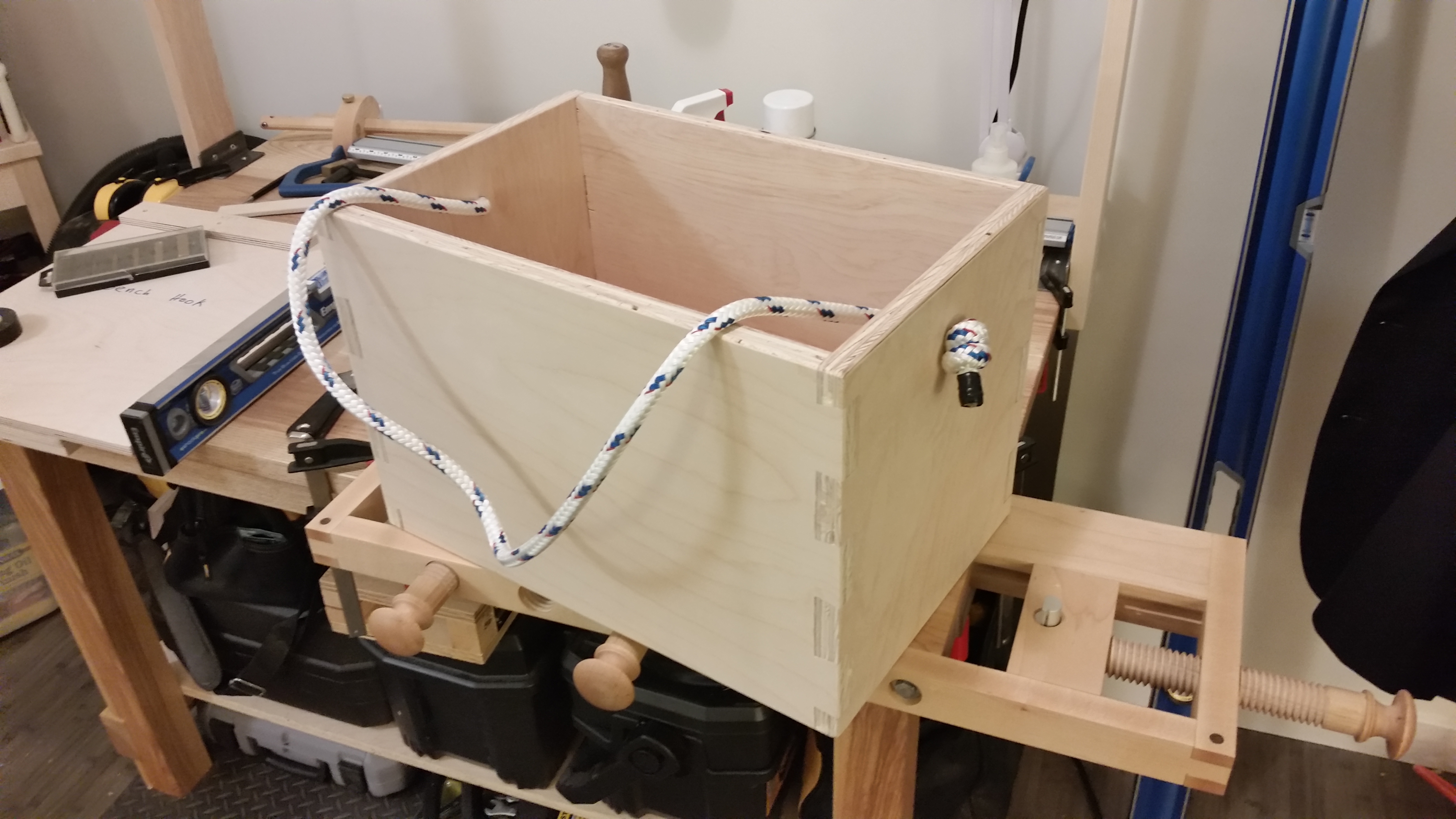
Not winning any awards, but definitely sturdy enough to hold a pair of aquasocks, a multi-tool, a portable air compressor, an emergency water bottle and some miscellaneous supplies.

Not winning any awards, but definitely sturdy enough to hold a pair of aquasocks, a multi-tool, a portable air compressor, an emergency water bottle and some miscellaneous supplies.

I’ve been meaning to replace with something more permanent the heavy duty cardboard file box I use in my car to maintain organization of odds and ends. Finding myself with some leftover 3/4 birch plywood, I decided it was time to dovetail a box.  I don’t cut dovetails often and I like these little, non-critical projects to keep my skills up.  Mostly, though, this project was good opportunity to test the capabilities of the Milkman’s Workbench in a situation where perfection is non-essential. Spoiler alert: it performed admirably, as advertised.

Just to be clear, I’m not here to teach you how to dovetail.  If you are looking for instructional videos, there are wonderful dovetailing tutorials all over teh interwebs (I highly recommend Paul Sellers or Rob Cosman).

Dimensioning:

I want to say from the get-go that plywood is not ideal for dovetailing (I rarely use the stuff anyway) and dimensioning sheet goods with hand tools is almost more trouble than it’s worth.

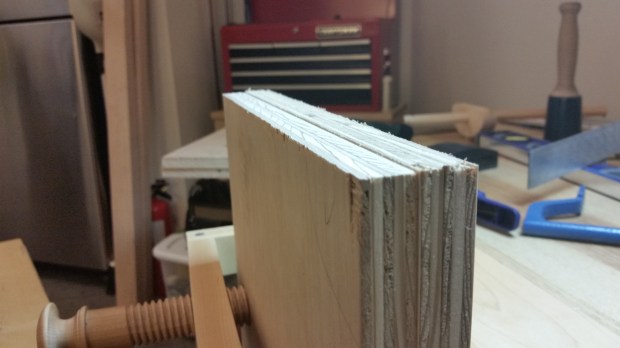
I typically rough cut sheet goods with a jigsaw and use a flush trim bit and a straightedge clamp to clean up and square the edges, but I am inside again and plywood dust is gross.  Instead, I rough cut four pieces by hand (2 sides and 2 ends) and planed straight and square with a #4 bench plane one end piece and one side piece to use as patterns.  I then lined up the factory edges and used double-sided tape to attach the pattern piece to the second rough cut piece (show-side to show-side, which will be important later).  Using the affixed pattern piece as a guide, I planed down most of the overhang on the rough piece to approximately 1/32″ (to have as little waste as possible) and cleaned up the final edge all around with a flush trim router bit.
wpid-20141026_202006.jpg

Less waste to remove means less gross dust to clean up.

The bottom piece, which is 1/4″ plywood from the craft store, floats in housing joints in the assembled box and is just hand ripped reasonably square and straight and fine tuned with a block plane.

Joinery:

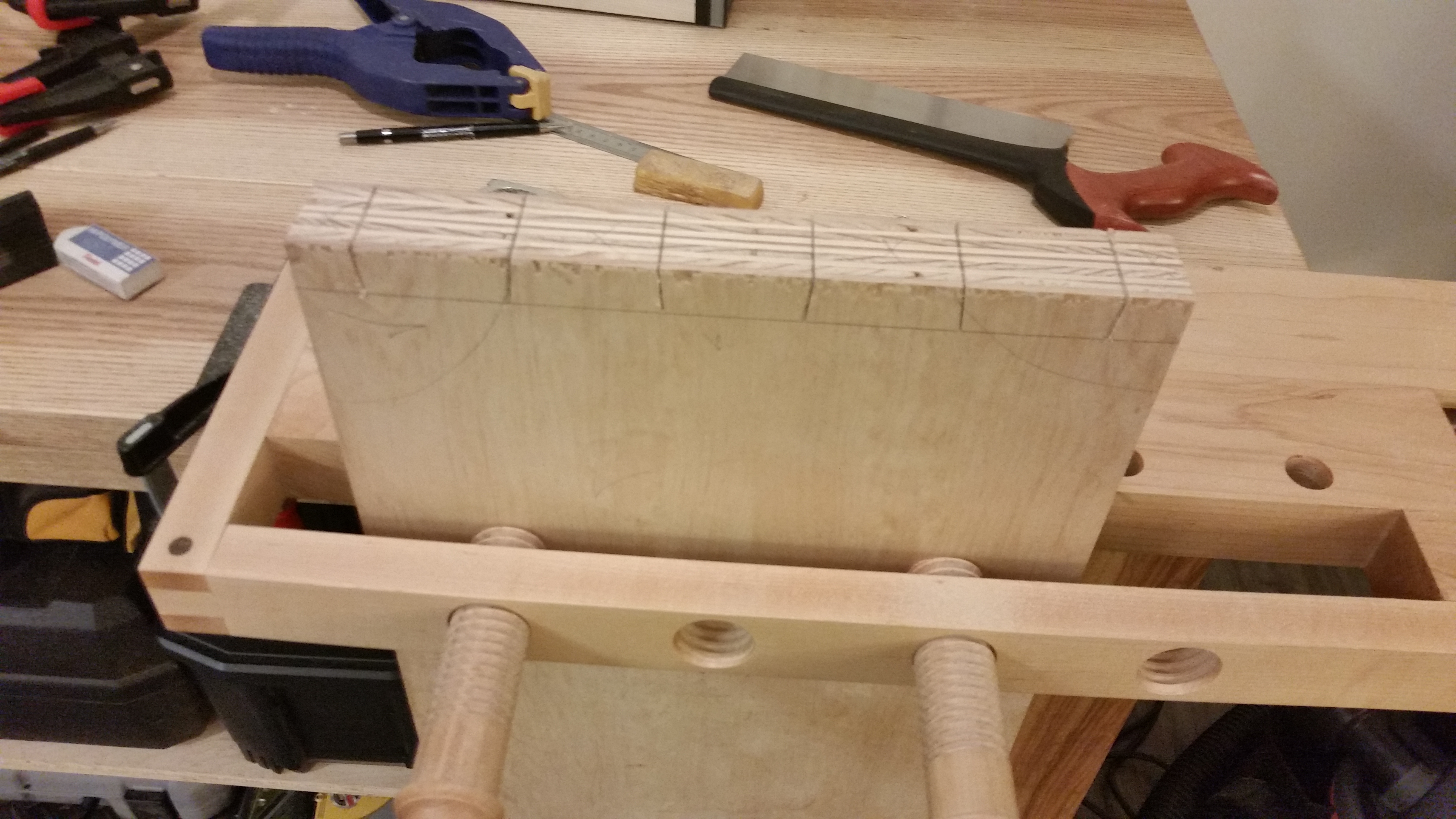
There shouldn’t ever be a ton of stress on the glued up joints, so at a little under 12 inches high overall, I went with three tails per corner.  I’m a “tails first” kind of guy and typically I prefer to hog out most of the recess waste with a coping saw (then chisel down to the line), but go with what works for you.

wpid-20141101_184513.jpg

Layout is simple with a decent dovetail marking guide. I use the Veritas version.

I did not separate the now-identical side pieces prior to sawing the tails.  I had a good reason, however: supporting the show-side to prevent blowout is critical when dovetailing plywood.  By leaving the pieces affixed, the show-side of each piece acts as a backer board for the show-side of the other.  As an added bonus, the tails you saw are (hopefully) identical.   Plus, I find working on the wider stock makes sawing perpendicular easier (on plywood, you should also eyeball perpendicular against the layer lines).  All in all, it saved some time and, again, not a museum piece here.  I note that this trick does not work for cutting pins when you cut the tails first; you will need to separate the pin boards.  It may work if you cut pins first (I think the pins may be asymmetrical, which may be a neat design element), but I haven’t tried it.

Tails first.

Tails first.

A coping saw and a chisel made quick work of the first set of recesses between the tails.  All of a sudden, just after I finished sawing the second set of tails, the double sided tape gave way and I had to finish up the tail boards individually.  I also decided to put down the coping saw and chiseled out the remaining pin recesses (more on that later).  Beware cracking the veneer when chopping out the waste with a chisel.

I then scribed and sawed the pins in the usual way, also using a chisel to cut the tail recesses.

Not bad for plywood

Not bad for plywood and being out of practice.

I routed the 3/8″ deep housing joints for the bottom piece with a 1/4″ up-spiral bit and a fence (dust extraction works much better in this router orientation) and tweaked the fit of the bottom piece with a block plane.

Assembly, Gluing and Finish:

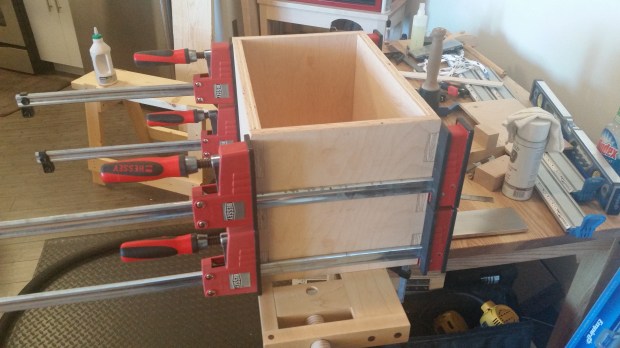
A backer board also comes in handy when seating the joints during final gluing.  I always use a piece of wood to cushion against the mallet blows when seating joints and the support for the tails guards against chipping and blowout if/when the joint is a little on the tight side.  Unlike solid wood, plywood de-laminates and cracks instead of compressing, even when lubricated with glue, so the extra support goes a long way.  There is a chance the box might get wet, so I opted for overkill with Titebond III.
wpid-20141115_133305.jpg

Mechanical joints mean single-direction clamping pressure.

After the glue had dried, I flushed any protruding pins or tails and trued the base of the box.  Then I softened all corners with a radius plane and plugged any large gaps in the exposed plywood “end grain” with some water-based wood filler.  No finish required.  It’s not pretty, but it’s not meant to be pretty.  Everything then got a quick 220-grit orbital sanding to remove the pencil marks.

wpid-20141115_202712.jpg

Sitting on my saw bench, “clamping” the work with my feet.

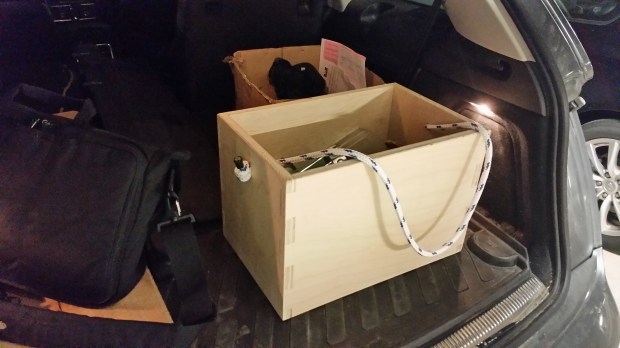
I had the idea of threading some 7/16″ nylon line from the boating supply store to make a rope handle.  I tested a couple different lengths and finally settled on a single strap that I could sling over my shoulder (as opposed to individual handles on the ends).  I hope I don’t regret the shortcut.

Conclusions:

I’m pretty satisfied with the box; it is solid and it holds stuff.  Truth be told, it’s been done for about a week.  I am just staggering posts.
wpid-20141124_082621.jpg

There are gaps. It happens. I’m not looking for a critique of my dovetailing.

Next time I dovetail plywood (I still owe my father some marine plywood drawers for his Frers 33), I am definitely skipping the coping saw. It works fine for solid wood, but is tough to control in plywood (with the multi-directional grain of the layers and all) and the veneer can tear easily.  Not to mention the awful screeching sound.

The Milkman’s Workbench worked quite well for this project.  Early on, it became clear the grip of the front vise screws wasn’t great until turned so tightly they mar the work, so I added leather pads to the ends of the front screws.  This improved holding power at much softer clamping pressures and work slippage nearly disappeared (although with increased grip, the work rotates a bit when the screw is engaged).  Front vise flex decreased dramatically as a by-product of lower clamping pressures as well, and I recommend anyone using a Milkman’s workbench take the time for this easy upgrade.  After a few more months of use, I will do a full retrospective on the bench’s total functionality.
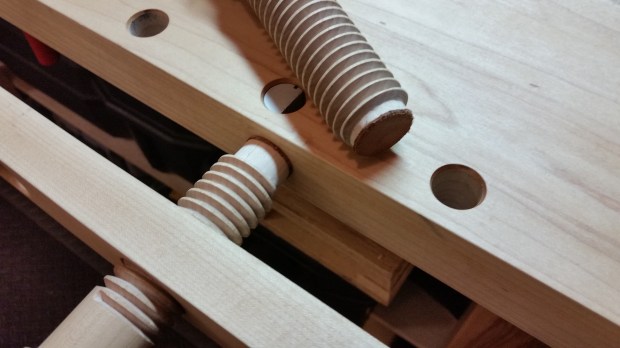
Much gripper.

Much gripper.

As I was working, though, I started fantasizing about making a significantly larger version of the Milkman’s workbench.  Something with at at least 36″ of maximum clearance between the widest dog and the wagon vise and not less than 30″ of front vise inside clearance.  This would mean 40″ plus of total workbench (and probably a third screw in the front vise); my workshop table is slightly over 50″ long and should easily handle a clamp-on bench of this size. I would probably make the main bench deeper too (for a larger chopping surface) and maybe abandon current front vise configuration for something more like a moxon vise…

Several hours with pencil and graph paper later, it became abundantly apparent that what I really need is not a larger Milkman’s Workbench, but rather a planing slab (like a Japanese workbench, maybe with some dog holes and a Veritas inset vise). Something around 18″ x 60″, made of laminated pine framing timbers.  I guess I know what my next project will be after I finish those footstools for my brother’s new house.

Also, I can’t say it enough: plywood dust is gross.

JPG
Because sometimes what we really mean is “unplugged”

Hand tool woodworking is great.  It’s relatively quiet, can be done with minimal shop space, and the results are often better than anything produced solely or mostly by machine.  I consider myself a hand tool woodworker, although I admit sometimes I reach for a plunge router, cordless drill or an orbital sander.  I also own, and frequently use, a thickness planer to surface the remaining two faces of a board that I’ve hand straightened and squared.

Net net, if I’m deviating from my basic set of saws, chisels and planes, there are meaningful efficiencies at work.

That having been said, I have a new addition to the shop. The Nobex Champion 180 miter box, with Ikeda blade.

Perpetually on backorder at  www.leevalley.com for a reason.

Perpetually on back-order at http://www.leevalley.com for a reason.

I know it’s technically not a power tool, but it is also not an essential tool for hand tool woodworking.  I can mark a knifewall and saw/shoot down to the line. I get it.

I wanted the convenience and the speed of a precision miter box.  Accurate saw cuts mean less time at the shooting board, so I can get back to the fun part, cutting joints.  Plus, I miss my 14″ double bevel compound miter saw and this should be a pretty solid replacement.

I have only cut a few pieces of wood so far, but I have some initial reactions.  First, the unit was much easier to assemble than expected (although there were a few extra pieces [two random hex nuts], which is distressing).  Second, the unit feels sturdy and the Ikeda blade is super sharp (already cut myself).  Third, the blade should definitely be lubricated prior to use.

My brother and sister-in-law requested that I make some footstools for their new house (they left the last footstool, which matched a vanity sink I also made, at their old house), so I will have an opportunity to further the miter box.  I have also been thinking about making some picture frames; not out of necessity, but as practice for cutting mitered halflap joints by hand (which is a favorite design element in exposed joinery).

Edit: After a couple days of use, I am very happy with the saw. I still have to shoot the ends of each board (the blade is ever so slightly canted to the left, which is probably user error), but it is always a slight cleanup, not a major straightening.

JPG

Let There Be Light!

“See the line; cut the line.”  It’s the basic premise of hand tool woodworking.  It seems like everyone is so focused on the latter (cutting the line) and no one cares about the former (seeing the line).  I would like to change that, because no one should struggle through the literal and metaphorical darkness.

In my experience, an ample source of clean and bright light is just as important to quality and safety in woodworking as sharp tools, solid workholding and proper technique.  With a little bit of planning, you too can drive away the dark and see what you’ve been missing.

wpid-20141122_175003.jpg

You can’t cut what you can’t see, and quality shop lighting goes a long way in improving your woodworking, even in an apartment.

Up front, I want to say that you do have choices when it comes to shop lighting.  I use LED lighting because when it comes to efficiency, durability, simplicity and safety, LED in my mind is head and shoulders above incandescent or fluorescent equivalents.  If you’re looking to illuminate a workbench tucked away in a corner, without having to change bulbs or wire permanent fixtures, then hanging LED bar lights are the way to go.  If you are looking for tips on lighting your 1500 square foot production workshop, you are clearly on the wrong website.

Okay, now that’s over, let’s talk about goals.  My shop lighting goal is (and has always been) to have bright, white light shining directly on my work surface(s) without shadows or obstructions.  Ideally, I’d have a north facing window and a high ceiling with plenty of clearance and wooden studs directly above my workbench.  That way, I could hang two Lithonia 120V LED light bars over the workbench and be done with it.  I had this setup in Vermont (plus an LED task light for joinery and sharpening tasks) and it worked great.

In my current apartment, though, my windows face east (which is a nightmare in the mornings) and, although I have 12 foot ceilings, everything is concrete and drywall with nary a wooden stud to be found.  I only need to hang one bar light given my smaller work space, but I am just not comfortable using drywall anchors or drilling into the concrete [i.e., losing my security deposit].  The LED task light alone was not cutting it and I needed to get creative.  The solution turned out to be easier than I could have hoped.  I built an arbor.

wpid-wp-1416699117890.jpg

Sometimes the best ideas are born of lazy necessity.

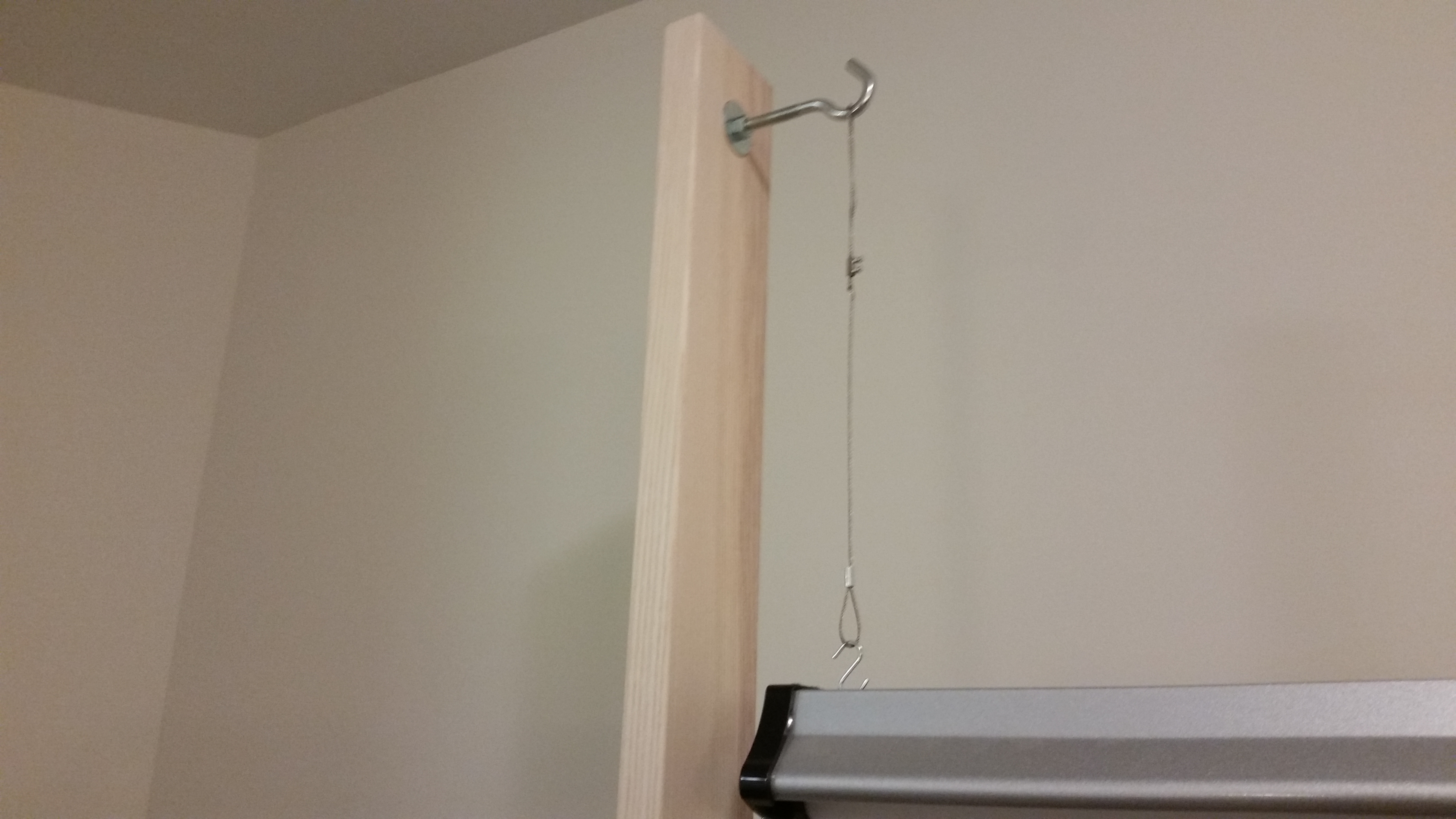
Take some leftover 6/4 ash (ripped and planed into two approximately 60″ x 3.25″ x 1″ pieces), add in couple of angle irons (left over from the Milkman’s Workbench supplies) and a pair of threaded screw hooks (hardware store specials), clamp to opposite sides of the table and hang a bar light.  Done and done.  No finish, no flair: just bright, clean light directly on the work surface.  I might one day scrap the screw hooks and make a cross bar that fits in bridle joints on the supports, but for now, good enough is good enough for me.

wpid-20141122_183002.jpg

It’s that simple.

The best part is, because they’re just clamped to the table, I can move the supports around if I need the clearance or want to focus the light on a particular part of the work surface.  Plus, the whole thing is portable, relatively speaking.

wpid-wp-1416699141096.jpg

Nothing permanent here.

With very little effort, I now have a well-illuminated work surface.  My task lamp can be tucked out of the way until needed for close up work and the whole project took about 2 hours (not including the drive to my parents’ house and back to use my thickness planer).

Quality shop lighting makes tasks like reading grain direction and inspecting the camber on a freshly-sharpened plane iron a snap.  You’re also less likely to miss a spot when planing or applying finish or wander over a layout line if the work is brightly lit.

So before you cut the line, spend some time making sure you can see the line.  Drive away the dark in your workshop and see what you’ve been missing.

JPG

What hand tools should a beginner woodworker buy first?

For the last few weeks, in what little spare time I’ve had, I have agonized over one question: “What hand tools should a beginner woodworker buy first?”  I tried (and hopefully succeeded) in answering that question over the last few “Bare Essentials” posts.  In response to a question from a colleague, though, and for the TL;DR crowd out there, I thought I would take one more stab at it.

It’s a tough question and there is no easy answer, of course.  Partly, because the answer depends on what kind of woodworking the beginner wants to do; partly, because each person’s budget and/or available space vary.

So, instead, I will answer an easier question: “If I had a time machine, what basic set of hand tools would I have bought my past self as a birthday present when I was a beginner hand tool woodworker?”  I know it’s cheating, but, after all, the paradoxes largely resolve themselves and this is my website.

Basic Tools

Happy 30th Birthday, Past-James!

The picture above is for (literally) illustrative purposes only.  I thought it would be fun to fit everything in a single camera frame, but I don’t actually own one of the tools I recommend (a No. 5 jack plane) and I apparently forgot to include three others in the picture (low angle block plane, 600 grit diamond stone, saw files).

I am sure my views will evolve over time, but for now, here is what I believe should have been the first tools I owned as a beginner hand tool woodworker (with the goal of making tables and chairs):

Safety: Eye protection (ALWAYS!)
Bench Chisels: 1/4″, 1/2″, 3/4″, 18 oz. mallet
Hand Planes: #5 jack, low angle block
Hand Saws: rip cut panel (8-10 TPI), rip cut tenon (8-12 TPI)
Marking and Measuring: 12 inch combination square (the best you can afford), 12 foot tape measure, double bevel marking knife, mechanical pencils
Sharpening: 600 grit diamond plate, 1200 grit diamond plate, eclipse-style honing guide, saw files
Other: spray lubricant, screwdrivers, deadblow mallet, 2x 12″ bar clamps, 2x 8″ bar clamps, 24″ straightedge, 50″ straightedge clamp, blue tape

These tools (plus a regular claw hammer, a power drill, wood glue and some sand paper) should give a new hand tool woodworker everything absolutely required to get started cutting joints and making things out of wood.   Remember to stick to your budget and always do your safety, technique and sharpening research ahead of time.

I started out working on a WorkMate Portable Workbench, but any stout surface you can clamp material to (such as a sturdy dining table) is just fine.  I recommend laying down some hardboard or plywood to protect any finished surfaces from tool marks and marring, though.

Note: if you are interested in brand recommendations for the above, please leave a comment or email me.

JPG