Author: The Apartment Woodworker

The Apartment Woodworker is a weekly blog with insights, projects and tips for making the most of woodworking with hand tools in confined spaces.

The Immediacy of Pencil and Ruler

I commute to work, which means I spend a significant portion of each weekday on the train (up to 2.5 hours in the aggregate). Before I started woodworking, most of my train time was spent reading documents and catching up on emails.  Now, I try to bang out a new blog post (like this one) or put pencil to paper for a new furniture design whenever I can.

A while back, I started keeping a black composition notebook – like the ones for middle school creative writing class – with graph paper (instead of ruled) for my designs.  I’ve tinkered with Sketch-Up and other computer-aided design software before, but I keep coming back to the immediacy of pencil and ruler on graph paper.  That way, I transcribe the idea before the inspiration fades.

wpid-20150512_104012.jpg

The fastest design program of all!

Each design gets dated and in truth few actually get built. But it’s nice to have a tangible record of the varying levels of woodworking inspiration that hit me.  Each page is a snapshot of my small-space woodworking journey, telling the story of how my sensibilities and style have evolved over the past few years.  I may never get around to making most of these pieces, but that’s okay.  Many of my favorite or best (often not the same thing) designs are amalgamations of past ideas, gleaned from old sketches and made fresh.

A few plans are further refined before going into a binder I glibly refer to as my “portfolio”.  These designs I truly intend to revisit and execute one day.  When I free-build a piece of which I am particularly proud, I will reverse engineer a design to also include my portfolio.  In this way, I have for myself a neat repository of my best and favorite pieces.

JPG

Glossary of Terms

There are so many woodworking terms. For joints. For tools. For techniques.  Where does a person begin?

Before I took up woodworking a few years ago, I didn’t know a damned thing about it.  I started on YouTube and worked backward. Wikipedia was helpful, as was my first woodworking book (Working Wood 1&2 by Paul Sellers). Now over three years into my apartment woodworking sojourn, my knowledge has grown along with my vocabulary.

I have recently been made aware that woodworking jargon can create a barrier to entry. Knowledge that I take for granted is not universal.  So going forward, in an effort to make the site more approachable – and because I think it will be fun – every defined term appearing in a post will be included in a new page entitled “Glossary of Terms”.

The page went live yesterday.  Please feel free to critique my definitions, as most are from memory.

JPG

An Obvious Downside

I’ve mentioned a couple times that my main source of cheap pine is off-cuts from tongue-and-groove pine siding.  I’m running a bit low, but I’ve managed to make a three-foot tall stack of 36″ to 48″ long boards last for most of a year.  While the material is fluffy and easy to work, it isn’t exactly stable, and most of the time, is significantly twisted and cupped (thankfully, not often bowed).  This presents an obvious problem: final board thickness.

Before preparation, any given piece is only about 11/16″ thick, and the “raw” board can have almost 1/8″ of cup/twist or more.  This means that after flattening and straightening to S2S, I’m often a barely a shade over 1/2″ on some parts of the board.  Passing the piece goes through the thicknesser takes it down to a hair over 1/2″ all around at S4S.

P1000072

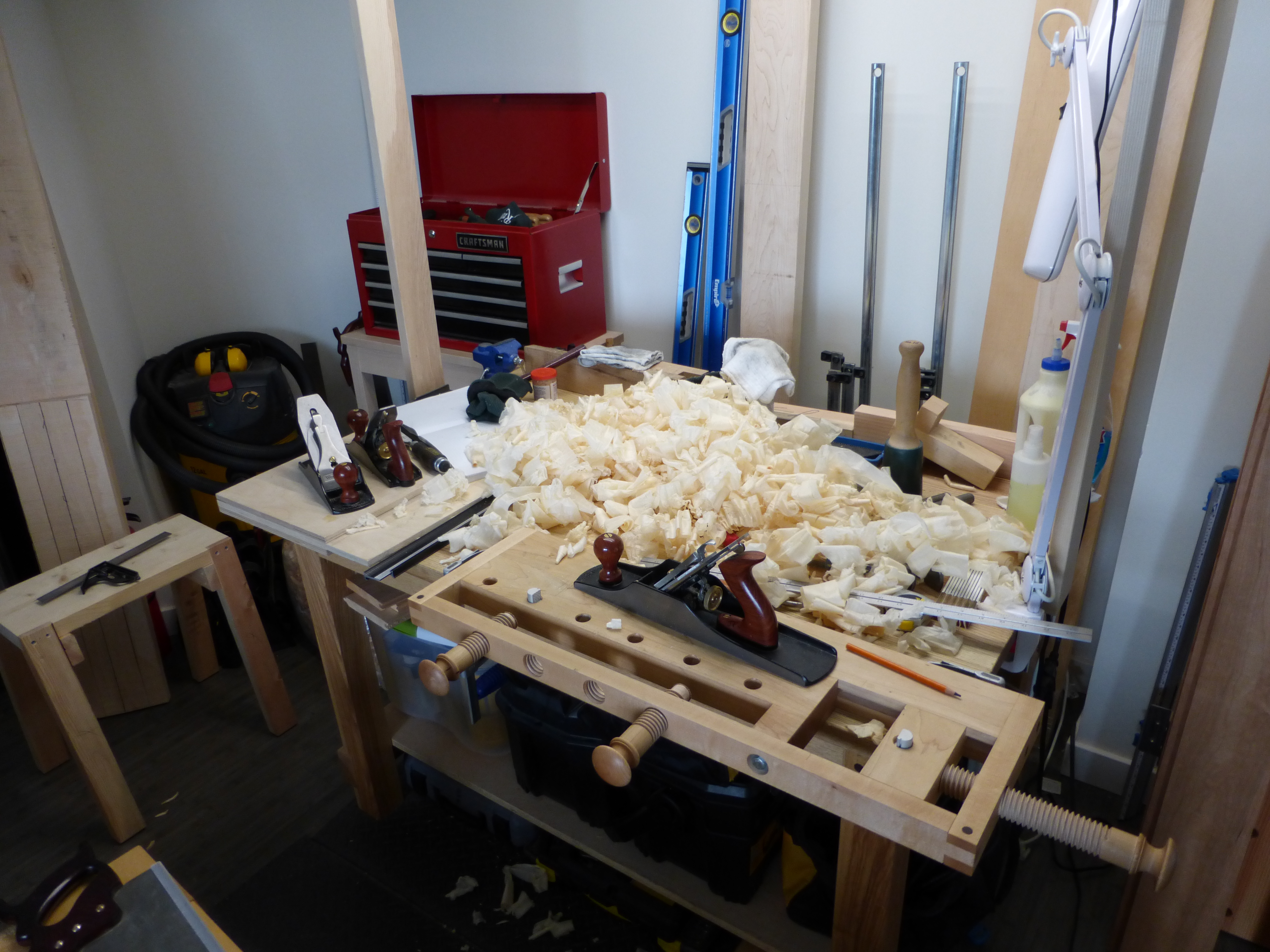
This pile of shavings is from S2S’ing only two 19.5″ x 4″ boards.

This is why I’ve gotten in the habit of only S3S’ing these boards when the project can allow for it.  For example, the bottom shelf of the toy workbench was made of four such boards.  The underside of that shelf will never be visible, so I left the extra mass in the boards by only S3S’ing them.

P1000066

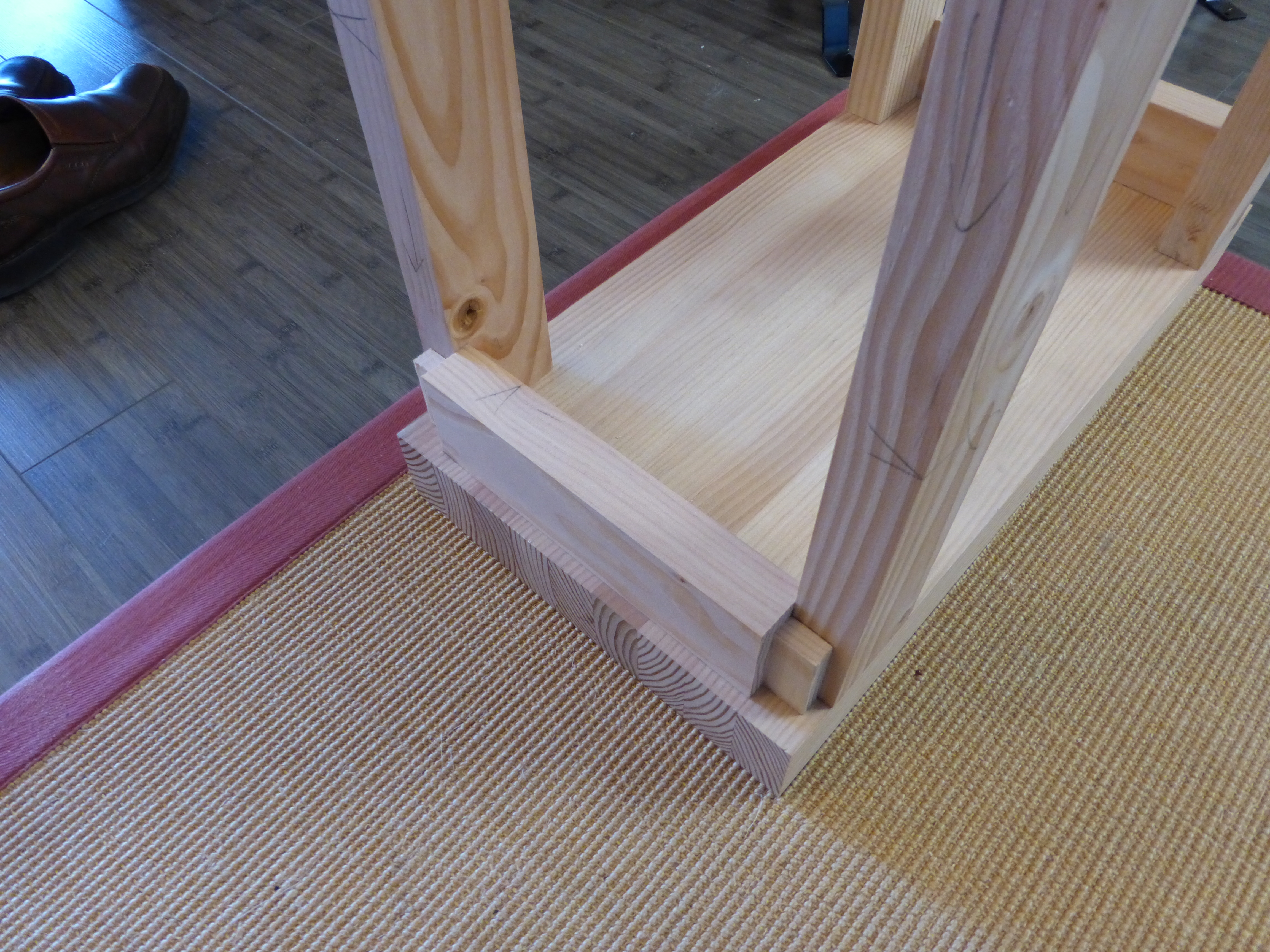
That’s a machinist granite slab adding clamping pressure.

I also use this trick when I need an inside tenon shoulder or when a board is too wide for my thicknesser, in each case where the inside face will otherwise be concealable.

This trick isn’t available in some applications, however.  For instance, I can’t attach drawer runners to the twisted inside face of a side rail (like for the angled leg side table) and the underside of a tabletop should be trued to mate well to the table frame.  I guess you could technically use rabbets to solve each problem, but that seems like even more work than just thicknessing properly.

I haven’t disassembled much antique furniture, but I find it difficult to believe I’m the first person to cut this corner when possible.  I think this shortcut thing is becoming a running theme.

JPG

Blasphemy (Not Really)

With an inspired idea in-hand, I have finished my design for a bedside table that I am hoping will be the first piece of a full bedroom set (or maybe a living room set, depending on my mood). It will heavily employ my favorite joint (the mitered half-lap) and be two-toned, probably in cherry with a lighter wood tabletop and shelf (both of which will float). I might add a drawer at some point, but that is not critical to the design.

The most beautiful joint of all.

The most beautiful joint of all.

While creating a cut list, it occurred to me the table will essentially have a face frame (two, in fact: front and back). Being a hardwood-only woodworker (except for drawer bottoms and the odd storage container), I don’t do much casework. To me, “face frame” might as well be a euphemism for “way to hide the end grain of sheet good carcasses”. Veritably one step up (barely) from stick-on edge banding.  In this piece, though, the face frames are meant to hide the end grain of the hardwood tabletop and shelf.

I usually don’t mind exposed end-grain (there will be, after all, visible end grain in each of the mitered half-lap joints). I certainly remember reading somewhere that masking end-grain was a much more dire endeavor in eons past. But for some reason, it feels correct to hide the end-grain in this project.

wpid-20140909_093210.jpg

Lots of exposed end-grain here.  And here.  And here.  Everywhere, really.

I’m hoping to get some stock preparation done this weekend if I can make it to the lumberyard on Saturday. Maybe I will first mock up a face frame in pine to confirm dimensions. I don’t do prototypes often, but it makes sense in this instance.

JPG

A Toy Workbench

I’ve alluded to it several times, but I finally finished over the weekend the toy workbench for my niece and nephew.  Although it took much longer than expected (due to my sloth, mostly), I am unequivocally pleased with the result.  At 23.5″ long, by 12.5″ deep and 23.5″ high, the piece is not exactly in proportion to a full size workbench (which was the original goal), but nonetheless will serve its purpose.  If anything, it’s a bit tall for my nephew currently, who should grow into it within the next year.

In all its, ahem, unfinished glory.

In all its, ahem, unfinished glory.  I expect my brother and sister-in-law will paint it.

Right away, I knew this project was something special when the laminated benchtop came together so easily. I took great care to S3S each piece for the lamination, so it was a snap to glue up all nine pieces at once and then flatten the slab once the glue dried.

I learned my lesson from the planing slab project.

I learned that lesson the hard way during the planing slab project.

Constructed mostly of leftover home center Douglas Fir, much of the stock that went into the bench is quartersawn or riftsawn (three legs and both stretchers being the exceptions), so it should be a pretty stable piece for a long time.  The joinery throughout is solid and relatively simple:

  • The legs are stub-tenoned and glued into the underside of the benchtop (drawbores felt a little extreme for a toy workbench).
  • The side rails are flush (but not glued) to the underside of the benchtop and stub-tenoned and glued into the legs.
  • The front and back stretchers are half-lapped to the legs and affixed with with glue and a single No. 10 wood screw.

The shelf, which after much agonizing I glued and nailed to the underside of the stretchers (shortcuts do make sense, sometimes), is off-cut pine siding (rather than Douglas Fir), planed S3S.

All in all, the toy workbench weighs about 40 lbs. It would have been heavier, but I lost some thickness on the benchtop slab on account of chopping mortises on the wrong side.

I would be greatly surprised if it’s not still around for my grand-nieces and grand-nephews.  And now I have some practice for when I make the real thing.

Ebbs and Flows

I’ve been stuck in a creative rut. Sure, I’ve completed plenty of woodworking projects over the last few months, but I haven’t designed anything I find intellectually stimulating in a long while.  But today, I broke my drought. And surprisingly, this piece will be for my use.

The design is not quite finalized yet (I freehand sketched the plans on the train and I need to confirm I have the correct lumber available), but I already have enough to build off. I think this one may go in the portfolio. I’m excited. For the first time in far too long.

JPG

To Make or Not to Make

As I’ve mentioned before, one of the things that keeps me from splurging on new tools is space. Case in point, I’d love to own a plow plane, but I have absolutely no idea where to store the thing so it won’t get dinged constantly.

Maybe I could make a lidded box to keep it safe.  Maybe I’ll make a plow plane myself so I don’t care if it gets dinged. Maybe I’ll just suck it up and keep using a compact plunge router.

JPG

Shortcuts That Make Sense

I think I first heard the expression when I read the Fellowship of the Ring for the first time as a teenager:  “Shortcuts make long delays”.  I always took that expression to heart and I try not to cut corners in my woodworking (other than breaking the arrises). Sometimes, though, shortcuts make sense.

For instance, I rarely cut through tenons.  Unless they are for a specific design element, or the wood is particularly thin in the first place, through tenons just aren’t necessary  They look cool, and I guess a through tenon might add strength in the right situation, but why do the extra work if you don’t have to?  For that matter, why cut a full length stub tenon when a shorter stub tenon will do just fine?

Side rails to keep the legs rigid and square.

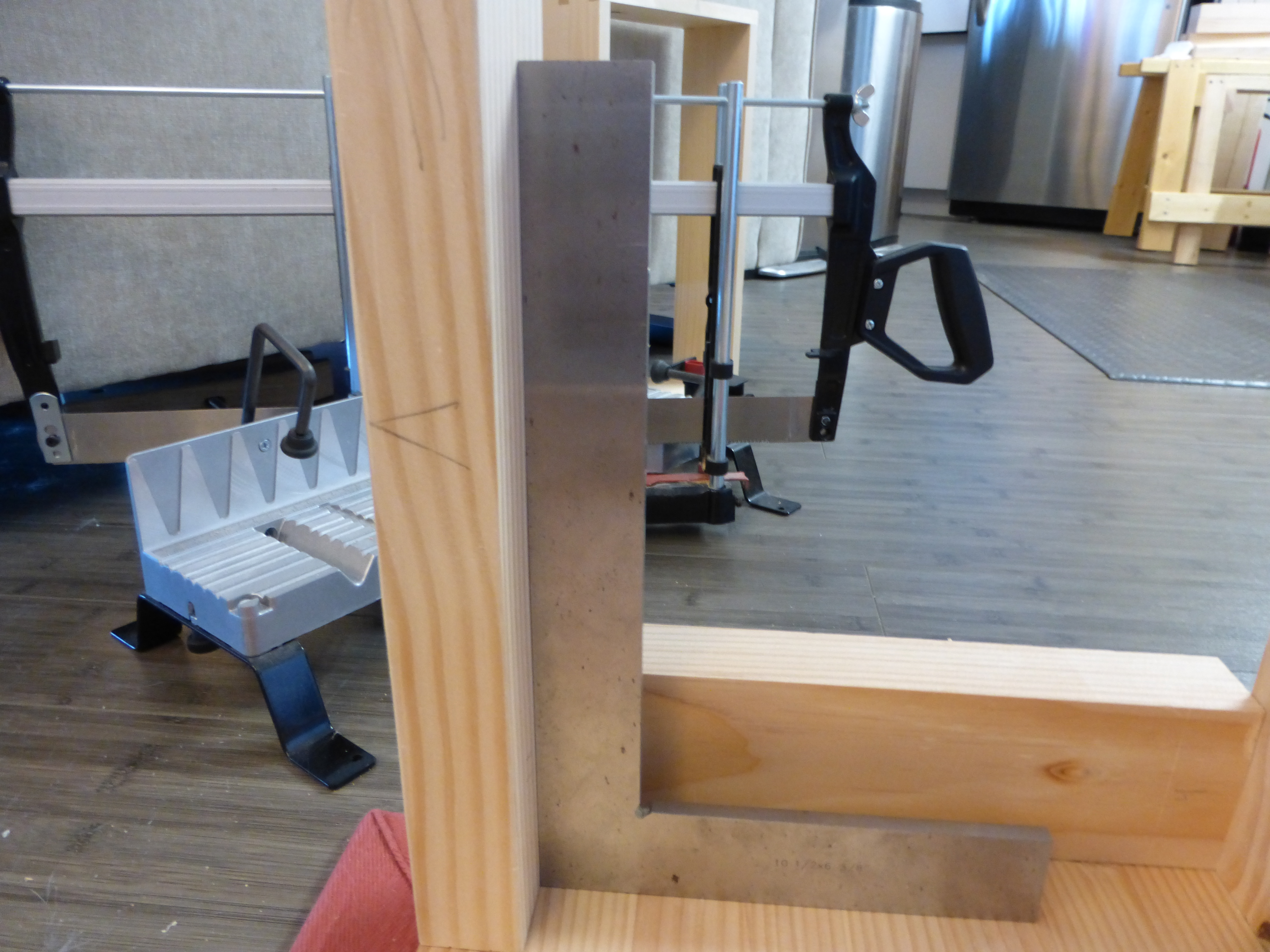
Test-fitting the side rails for tight fit between the shoulders and the legs.

On the mini workbench, I had cut some 1.125 inch tenons on the side rails (see above).  Then I looked at the thickness of the legs themselves (1.5 inches) and the position of the rails (flush to the underside of the bench) and determined that a .75 inch stub tenon would be more than sufficient.  A .75 inch tenon would translate into a mortise that I could chop in a single pass back and forth, saving time overall.  So I hacked half an inch off each of the tenons.

So I hacked half an inch off the tenons.

It’s not lazy; it’s efficient.

The side rails will still do their job  with the shorter tenon (i.e, keeping the legs rigid and square front to back), but that’s more a function of the tight fit between the tenon shoulders and the leg than a function of the dept of the mortise.

Stub tenon or not, that's a tight fit.

Stub tenon or not, that’s a tight, square fit.  And yes, I keep my miter box on the floor.

Speaking of shortcuts, I have also decided I’m not going to mortise the front and back rails into the legs.  Instead, I will half-lap and screw them into the insides of the legs, mainly because I’d like the ability to remove or re-position the slatted shelf if necessary in the future.  Mortising those rails into the legs would make that much harder.  Plus, it will save me a bunch of time (and I really enjoy the ease of cutting half-lap joints).

So next time you’re planning out a woodworking project, think long and hard about any available efficiencies.  I’m not saying scrap the corner dovetails on your tool chest in favor of nailed rabbet joints (although that would be perfectly fine if done correctly).  But I am saying don’t go overboard if you don’t need to do so.

JPG

Necessary Supplies

This weekend, I finally made it up to Vermont to grab the remainder of my lumber and I am so glad I did.

In addition to the reclaimed pine (which I left up there for use in a kitchen table for my mother), I apparently had a sizable amount of hard maple and red oak, some dimensional cherry I had forgotten about and (most amazingly)  a couple board feet of 12/4 ash that must have been off-cuts from my dining table project.  Not to mention another 40 board feet or so of pine siding off-cuts (more dovetailing practice!).  I’m fairly confident that I won’t need to buy any new lumber for a while.

One of the more interesting finds was a set of four, shaped pine legs that were set aside from the bulk lumber.

Super random!

Super random!

At approximately 23″ tall, I think they were part of an abandoned side table project (which in all likelihood began as shaping practice).  I’m happy to re-purpose them (and some of the pine siding off-cuts for rails and tabletop) into a little table.  It will be a nice little project for my week off.

JPG

Straight and Square is Not Just for Wood

Working on a couple different planing-intensive projects has brought to my attention that I had somehow ground most of my plane irons and chisels out of square.  Again, I blame my Work Sharp 3000, which I really like but have never really gotten the hang of fine tuning.  If anyone is aware of a how-to for micro-tuning a Work Sharp 3000, please send me the link.

So, the last couple days I have been hand-grinding everything back into square.  I had to dust off my coarser diamond plates, as well as a wide-wheel sharpening guide that I’ve had for a long time, but abandoned a while ago when I picked up one of the eclipse-style sharpening guides.  My reasoning was the narrower wheel on the eclipse-style guide would make tipping a plane iron (to create a camber) easier.  It also apparently made tipping a chisel without realizing it easier.

Wide wheel = stability.

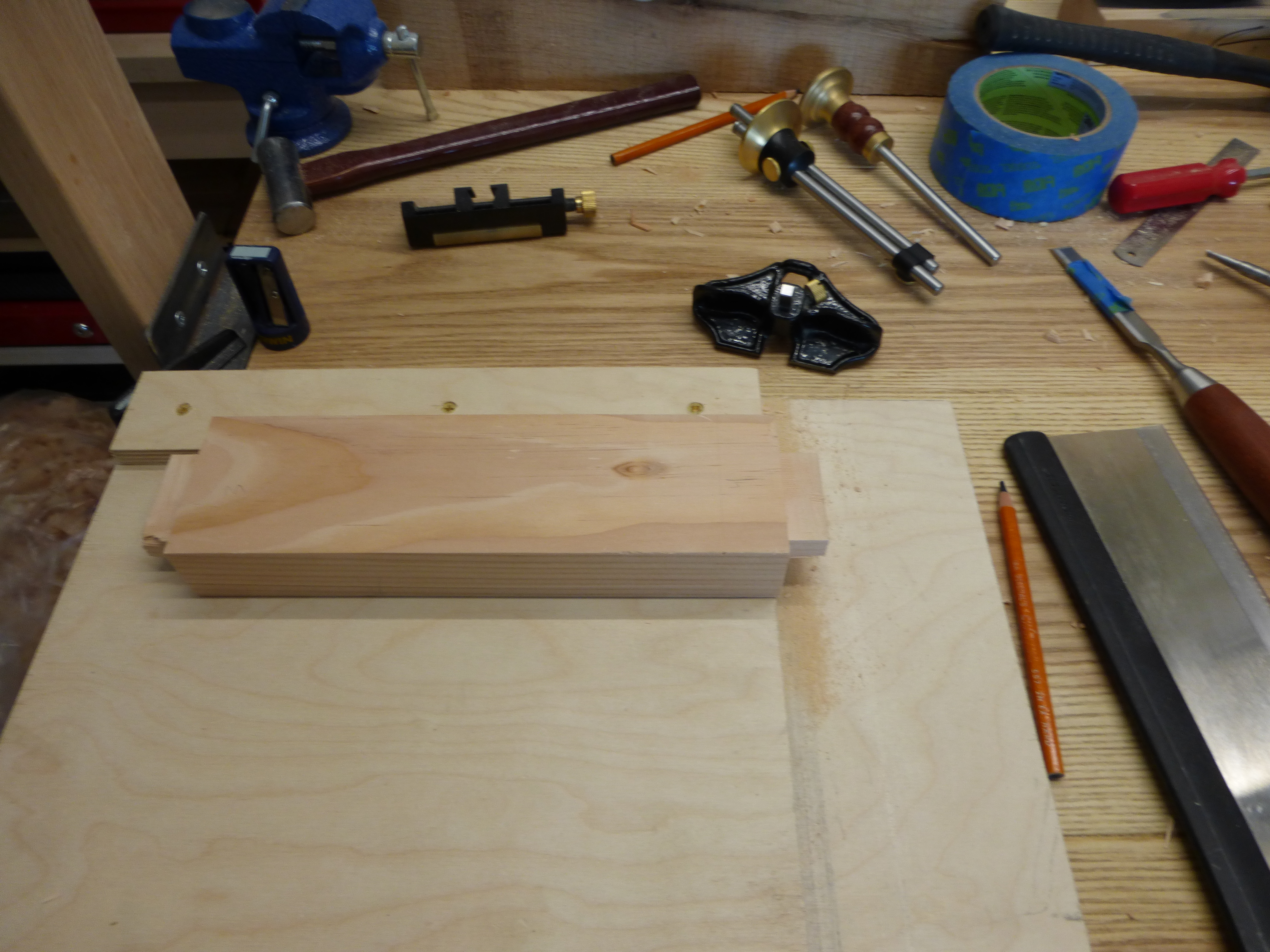
I also made another bench-hook style holder for my plates because I am sick of wiping slurry off my Milkman’s Workbench.

So going back to the wide-wheel sharpening guide with greater stability makes sense for re-grinding square.  I could certainly do it with the eclipse-style guide, but I’d rather eliminate user error altogether (which got me into this mess in the first place).

I do add micro-bevels by hand, though, so there is plenty of opportunity for user error slightly later in the process.

JPG