small space woodworking

I Had Almost Forgotten

It’s been a struggle putting together a design for a workbench.  Not because I don’t know what I want to make, but because I need to figure out the best way to make it by hand from construction lumber.  I have about 60 linear feet of Douglas Fir 2×10’s that will become the frame, and I plan to laminate over a dozen Douglas Fir 2×4’s for the top, but creating a step-by-step plan has been elusive.

And for me, that means taking a step back from the theoretical and diving into some practical research.  And what could be a better practice run than those Japanese-style Saw Horses I’ve always wanted?  And what better place to start than the feet, which are a perfect scale analogue for the laminated workbench legs?

Each foot is approximately 24″ long and consists of two boards.  I don’t have any 2×4’s, but I do have some 2×8’s and a panel saw, so here we go!

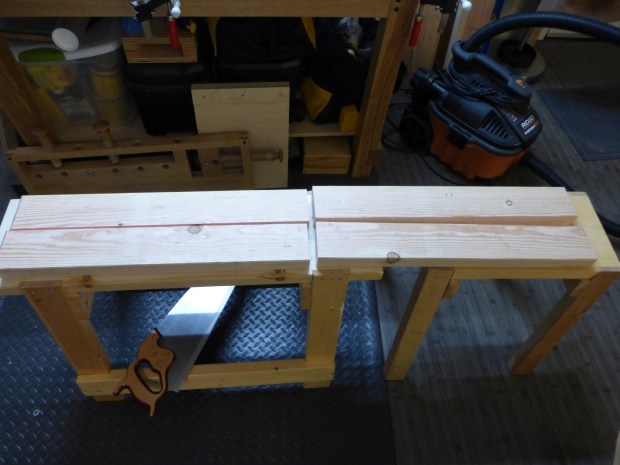
Step one: rip a 48″ 2×8 into two lengths of 2×4, then crosscut to 24″ each and reassemble in sequence.

P1000303

Hand sawing gets the blood pumping.

Step two: carefully mark where the boards meet, and stack each right board on top of the corresponding left board without changing orientation.

P1000305

This ensures consistent grain direction, just like a single board.

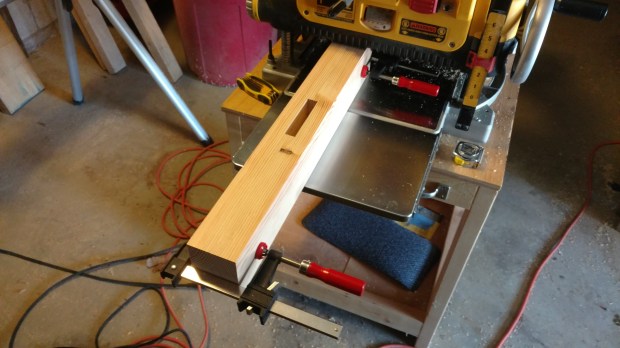
Step three:  surface plane the two faces where the boards will meet, then square up one edge to each reference face.

IMG_20160128_204049456[1]

And mark carefully.

Step four: thickness plane each board to S4S and prepare for glue up.

[Picture not found…yet.]

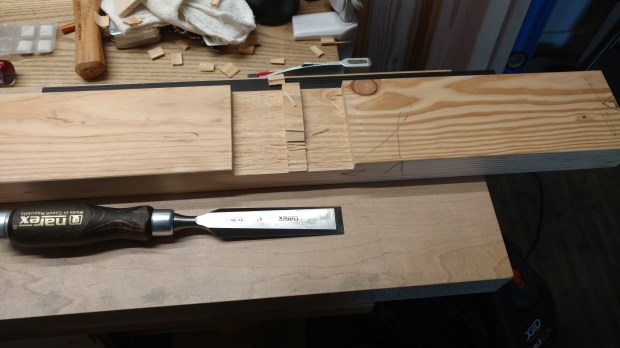
Before I actually glue up the feet, though, I should create the mortises for the legs by cutting dadoes in the reference faces.  The bottoms are already square to those reference faces, so there is no reason I can’t cut those joints in advance of thicknessing.

The legs, btw, will be made from approximately 30″ of Douglas Fir 2×6.  But that, along with the top and bottom cross rails, is for another day.

JPG

Some Scattered Thoughts

Sometimes, I regret spending the first year or so of my woodworking life using primarily power tools. I ponder how much further along I’d be in my hand work and sigh.  Sunk costs, I guess.  But more than that, I wonder how awesome it would have been to learn on a proper workbench.  I started on a Black & Decker Workmate 425, so it could have been worse.

But then what is the right type of workbench for a new apartment woodworker?  While I love my Milkman’s Workbench, and am glad to have made it, it’s not my go-to workbench anymore.  And I certainly did not have the skill to make one just starting out (not to mention the PWW article had not even been written yet).  So what would I do?  I’d buy another Black & Decker Workmate 425, of course, and start on my basic set of tools.

But then, I would buy four, eight foot long Douglas Fir 2x4s and laminate a 48″ x 12″ slab.  Which I could then dress by hand, drill some dog holes for a planing stop and clamp to a sturdy table with angle iron.  Then I’d use that surface to make a DIY moxon vise from veneer press screws and some red oak or maple 2×4’s and have all the workholding I could need for a while.  Then I would use the moxon vise to make a shooting board.

I’m not just spitballing here.  I woodwork almost exclusively on a 48″ x 9″ x 1.5″ maple slab, a shop-made moxon vise with 24″ between the screws, and a plywood shooting board.  And it works for me.

JPG

A Rare How-To

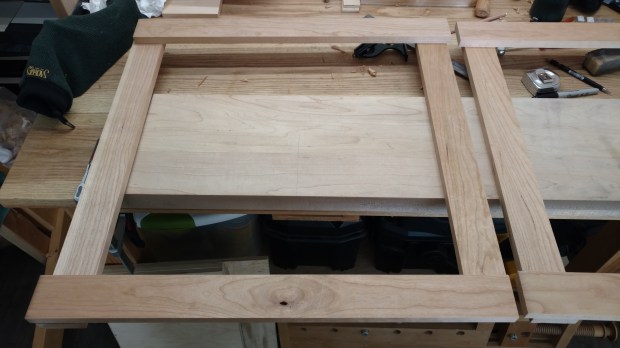
If you follow me on Twitter, you may know that I spent most of #blizzard2016 hand-cutting mitered half lap joints for a cherry side table.  The finished piece will have eight such joints, and although I’m only about halfway through the first of two frames, I’d like to reflect a bit on the process.

wp-1453653657899.jpg

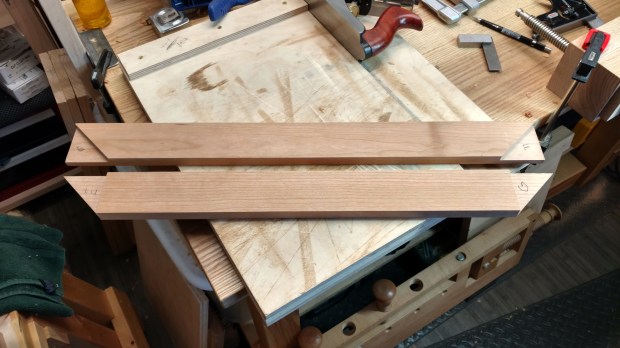
The goal is to have four each of these.

First off, some defined terms.  For the duration of this post, I will refer to the lower piece in the picture above (the E-G piece) as the “Angled Piece”.  The upper piece in the picture (the E-F piece) will henceforth be known as the “Recessed Piece”.  I’m sure they have proper names that have no relevance to what I’m about to say.

On each Angled Piece, there are three cuts to make.  The first two apply to all lap joints: a shoulder crosscut and a cheek rip cut.  The third is unique to the mitered half lap: a 45° miter cut across the face. My preferred order is (i) cheek, (ii) shoulder, (iii) miter, but whatever you do, always make the cheek rip BEFORE you cut the miter.   Otherwise, you will lose your guiding kerf on the rest of the rip as you get to full depth.

P1000295

Don’t be a hero.  Start with the easy cut.

Once all three cuts are made, and after the cheek is flat and parallel to the face (whether off the saw or by router plane), it’s time to square the shoulder to the reference edge by paring down to the knife line.  Then is the most critical step: true the miter to 45° using the same reference edge to which the shoulder was squared.

When I cut the first joint, I thought to just straighten the miter, transfer the mark to the Recessed Piece and leave well enough alone.  After all, it doesn’t have to be perfect; it just has to be consistent.  Since my shoulder was square, this would have worked fine, assuming I sawed perfectly and my full knife line was intact.  But alas, the saw jumped out of the kerf and took part of my knife line with it.  So fitting the joint became trial and error angle finding with a shoulder plane.

If you instead true the miter to 45°, go ahead and still use the Angled Piece to transfer the mark to the Recessed Piece (it’s easier than using a combination square).  But if you saw less than perfectly, you can always fall back on just truing the mitered recess to 45°.  With a straight edge on the Recessed Piece and a square shoulder on the Angled Piece, everything will come together perfectly either way.

P1000302

Like this, but without half an hour of shoulder planing.

One more thing: depending on how much material you remove from the miter on the Angled Piece getting it to 45°, you may need a couple passes on the shoulder to bring it back in plane with the end of the miter.  Otherwise, your inside corners won’t meet right at the miter.

JPG

Finding the Hole(s)

It’s pretty snowy out, all of a sudden.  And I’m using the quiet time to get some things done in the shop.  Sharpening and plane making in the early am, then onto other tasks.

On my list for a while was drilling a few more dog holes in the maple planing bench.  Not actually for bench dogs, but for aluminum planing stops.  Extremely low-profile, they come in several lengths (and can be hacksawed to exact measurements).  I’m sure I’ve talked about them before, but I could not live without them in my apartment woodworking shop.

wp-1453569811248.jpg

Not sure if others sell them, but all mine are from Lee Valley/Veritas.

The pegs (which come in 3/4″ or 20mm) slide in a track on the underside of the stop, so they fit in a variety of dog hole configurations.  And the pegs are shallow (less than 1 1/2″): perfect for a clamp-on workbench made of 8/4 maple.

In addition to their utility for surface planing (seen above), I have found these planing stops to be quite useful as bench hooks. Two more holes to the right side of the bench now make a crosscutting bench hook (see below).  And because my plywood shooting board/bench hook is too deep for this particular bench, I no longer have to unclamp the whole bench every time I want to cut a tenon shoulder.

wp-1453569834524.jpg

And it saves me from always digging out the saw benches.

There are actually three more holes to drill.  One centered in the far right for a holdfast.  And two more along the back edge on the left side of the bench to form a perpendicular for traversing and general bracing.  Everything is measured and marked; I’m just taking it slowly today.

Hope all my east coast readers are staying off the roads.  It’s not too bad out here, but pretty blustery.  I can only imagine what it’s like further north.

JPG

An Oft-forgotten Step

There is much in the process from a pile of lumber to a piece of furniture.  More than just stock preparation and joinery, anyway.

wp-1453300762584.jpg

Although each are integral unto themselves.

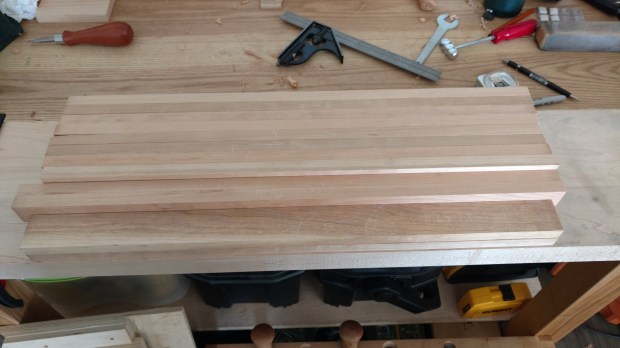
One of the most important steps to my creative process is initial parts layout.  In any piece where the grain will be visible, before any lines are scribed or joints cut, I always lay the pieces out on the bench and read the grain.  Then I arrange the parts in a way that is (i) most aesthetically pleasing and (ii) works for any unique considerations in the piece.

wp-1453299325394.jpg

Like this.

From past experience, I know the vertical pieces in an assembly like this should be the most stable pieces.  This means the four straightest, tightest grain boards become the stiles of the side frames.  Once assembled, these two frames will then be joined with several cross rails, which (together with the tops of the frames) should also be as stable as possible.  Whatever is left can be the lower rails and the drawer runners.

Assuming everything is joined squarely (a big assumption, sometimes), the piece then has the best chance of resisting twisting after final assembly.  And it doesn’t hurt that the cherry in question is as dry as anything I’ve ever worked with.

JPG

Basic Project: Sushi Tray

As a new segment here at The Apartment Woodworker, I will be documenting some of the smaller projects I find interesting and which I think are good for skill-building.  I’m not one for CAD, so the focus will be on the (sometimes extremely) limited set of hand tools these projects require.  There may be basic cut lists as required, but most of it will be rough dimensions.

This isn’t about teaching people how to woodwork.  There is a body of instructional material out there far better than I’m capable of producing.  Just Google “Paul Sellers the three joints” and go from there.  The goal here is to inspire people to pick up some hand tools and make something, without breaking the bank on a tool collection or materials.  So without further ado:

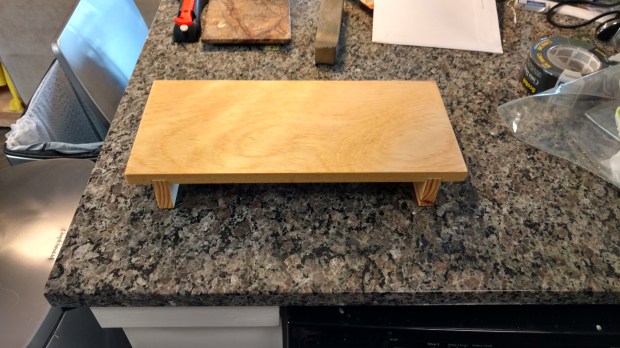
I love sushi (specifically, spicy salmon rolls).  I’ve always wanted wood sushi trays (I see them called “geta”).  So I recently decided to build a prototype.  I like this project because it requires friction-fit dadoes, which are my favorite joint to cut.  Mine was built from scraps, so I’ll make more as I have the materials.
wp-1452377922651.jpg

As far as first tries without plans, it’s not bad.

It’s true that similar items retail for under $20 each on Amazon.com.  But you know what also costs under $20?  An eight foot select pine 1x 8 from the home center, and you can get four trays out of a single board.  You’ll need some food-safe finish (like butcher block oil) and food-safe glue (like Titebond II), but that’s still about half the cost of paying someone else to make you a set of four.

Use harder, food-safe cutting-board woods if you’d like, but they probably aren’t necessary for the amount of abuse these will take.  That having been said, everyone has allergies, so go with whatever food-safe wood works for you.  And regardless of wood, I also like to surface plane every board I get from the home center.  I have no idea what kind of gunk it’s been exposed to, so I always feel more comfortable with clean fibers showing.

The essential tools for the project are as follows:

  • 1/2 and 3/4 chisels, plus mallet
  • No. 4 or No. 5 bench plane
  • 9-14 TPI Rip cut saw (panel or tenon is fine)
  • Combination square and marking knife
  • Tape measure
  • Sandpaper
  • Food-safe glue (I used Titebond II)
  • Food-safe finish (I used Goddard’s butcher block oil)

Optional tools (which will make the work easier) are:

  • Router plane (any size will do)
  • Wide chisel (1″+)
  • Shooting board (if you don’t have one, walk away from this project right now and make one)

The top is made from a 15″ length of 1×8.  The feet are made by ripping a 7.5″ length of 1×8 into thirds and squaring everything up with a bench plane (you need two feet per tray).  There is no magic to the height of the feet, but anything between 2″ and 3″ should be fine.  For aesthetics, the feet are slightly longer than the top.

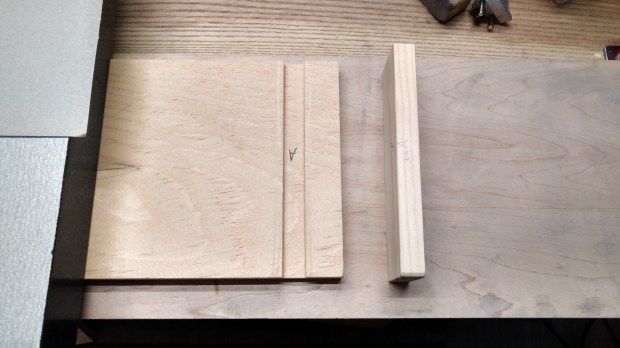
There are two dadoes on the underside to accept the feet.  Because the top has a 2:1 ratio, for symmetry I started the dados 2x their thickness from the outside edges (in this case, about 1.5″).  Each dado is supposed to be 1/4″ depth, but if you’re like me, you always end up deeper because of errant depth chops on the sidewalls.  If you have a router plane, awesome.  If not, pare the dadoes with a chisel (and go slow, being careful about uniform depth).  None of the above measurements are requirements, but I have found that dado depth probably shouldn’t be more than 1/2 the thickness of the top piece.
wp-1452356031714.jpg

And be sure to label your parts.

Break the corners everywhere (except where the feet fit in the dadoes) with a plane or sandpaper.  A bead of glue on the floor of a friction fit dado is more than enough for a permanent joint.  If you need to, drive the feet home with a mallet and a piece of scrap and leave them for an hour.  Then lightly sand the top, clean off the dust and finish all over with a thick rub of butcher block oil (the pine will be thirsty).  After a wash or two, reapply more butcher block oil to the top face.  It should be good for many uses after that.  And if you used a PVA glue, it should be dishwasher safe.

And that’s it.  Repeat as many times as you like.

Congratulations! You now have practice hand-cutting open dadoes, which you will use in woodworking forever.  And the trays are quite multi-purpose, working just as well for cheese and crackers or as coasters.

I hope this has been informative.  If not, keep it to yourself.

JPG

The Clamp I Use Most

Apartment woodworking is mostly about making due.  But that can be said about much of woodworking.  And finding the right tool for the job is important regardless of square footage.

wp-1452356025178.jpg

The clamp I use the most is not a clamp at all.

I’ve talked about alternative clamping styles before.  I’ve even showcased the machinists granite slab as a clamping apparatus before.  The reality is, sometimes a heavy, flat rock is much easier than an actual clamp.

When (for example) I need to glue back down some face grain that split while cutting a dado, I could use a parallel jaw clamp.  Or I could just put a big rock on top of it.  More times than not, I opt for the latter.  Because if I’ve done my job and my joints are square, weight is as good as mechanical clamping pressure.

Speaking of dadoes, these are for a three-board sushi tray from leftover pine.  If the sizing is okay (about 7″ x 15″), I will likely make a couple more from a tougher wood.

wp-1452356031714.jpg

No stopped dadoes, this time.  My masochism knows some bounds.

Have a great weekend, everyone.

JPG

I am a Terrible Hypocrite

But what else is new?

Less than a week after swearing off the old planing slab, I decided to rehab it anyway.  I need a suitable work surface for the upcoming workbench build, and it just so happens that my best option had been lurking in the background of the shop.

It also just so happens that I need a pair of sturdy sawhorses as well.  So when I stumbled upon some awesome internet plans for Japanese-style saw horses, I knew it was time to get the slab back in shape.  After flattening and straightening by hand (seen above), the slab was skip-planed to just over 2 7/16″ thickness.

wp-1451785191790.jpg

It’s been almost a year.  This thing had better not move anymore…

With a usable work surface of 71 1/4″ x 12 1/4″ (net of the heavy roundovers hiding some edge fracturing that occurred during flattening), the slab is not quite full size for a Japanese-style workbench (at least not according to this article).  But it should be good enough for preparing the legs and rails for the new workbench.  I even reinstalled the inset vise.

In lieu of a joined planing stop, I utilize an aluminum planing stop like the one I currently use on my smaller maple slab.  I also think I’ll skip the sliding dovetail on the cleat and just friction fit a cleat into a dado (with some beefy screws as reinforcement).  Seems like the sensible thing to do.

wp-1451857108306.jpg

The planing stop is not yet hack-sawed to width.

One day, I may lag bolt the slab to a trestle base and add a tool tray, but in the meantime, I just need some Douglas Fir 4×4’s for the new saw horses.

JPG

New Year’s Resolutions

There are (literally) big things in store for 2016 at The Apartment Woodworker.  I have only one New Year’s Resolution this year.

P1000288

And it rhymes with “Killed a Teal Smirk Wench”.

I always meant to build a frame for the original planing slab.  But after standing in the corner for so long, it needs so much reflattening it would be less than 2.25″ thick.  Not nearly enough for a stout benchtop.   Plus it’s only 13″ deep and 70″ wide.  I see it being reclaimed to make a dedicated sharpening station or something like that.

The lumber above is enough Douglas Fir to make four post legs (each approx. 4.5″ x 4.5″) and four rails (each approx 7″ x 3″), with much left over for appliances and such.  Only the bottom 6 boards are actually new; the rest are just for weight while the new boards acclimate.

More details to come, but for now, it’s a month or two of refining the design while waiting for dry wood.  When the time comes, I will hit up the home center again for Douglas Fir 2×4’s to laminate an approximately 84″ x 21″ slab top.

Happy New Year’s, everyone.

JPG

Merry Christmas and Whatnot

In these United States of America, whether or not you actually celebrate Christmas, you likely have it off from work.  My family does celebrate, and my office is closed, so I will spend most of the day driving around my tiny slice of the cosmos.  First having lunch with my parents and my one extent grandparent at my aunt and uncle’s house, and second going to dinner and presents at my brother and sister-in-law’s house.  With woefully little time in the shop.

We have a rule in my family: if you don’t ask for it, you don’t get it.  My Christmas wish list was pretty much just woodworking hand tools.  I’ll post the tool-pron later once I’m back in the shop (read: home).

Happy Holidays to everyone.

JPG