woodworking in an apartment

A Strong Finish

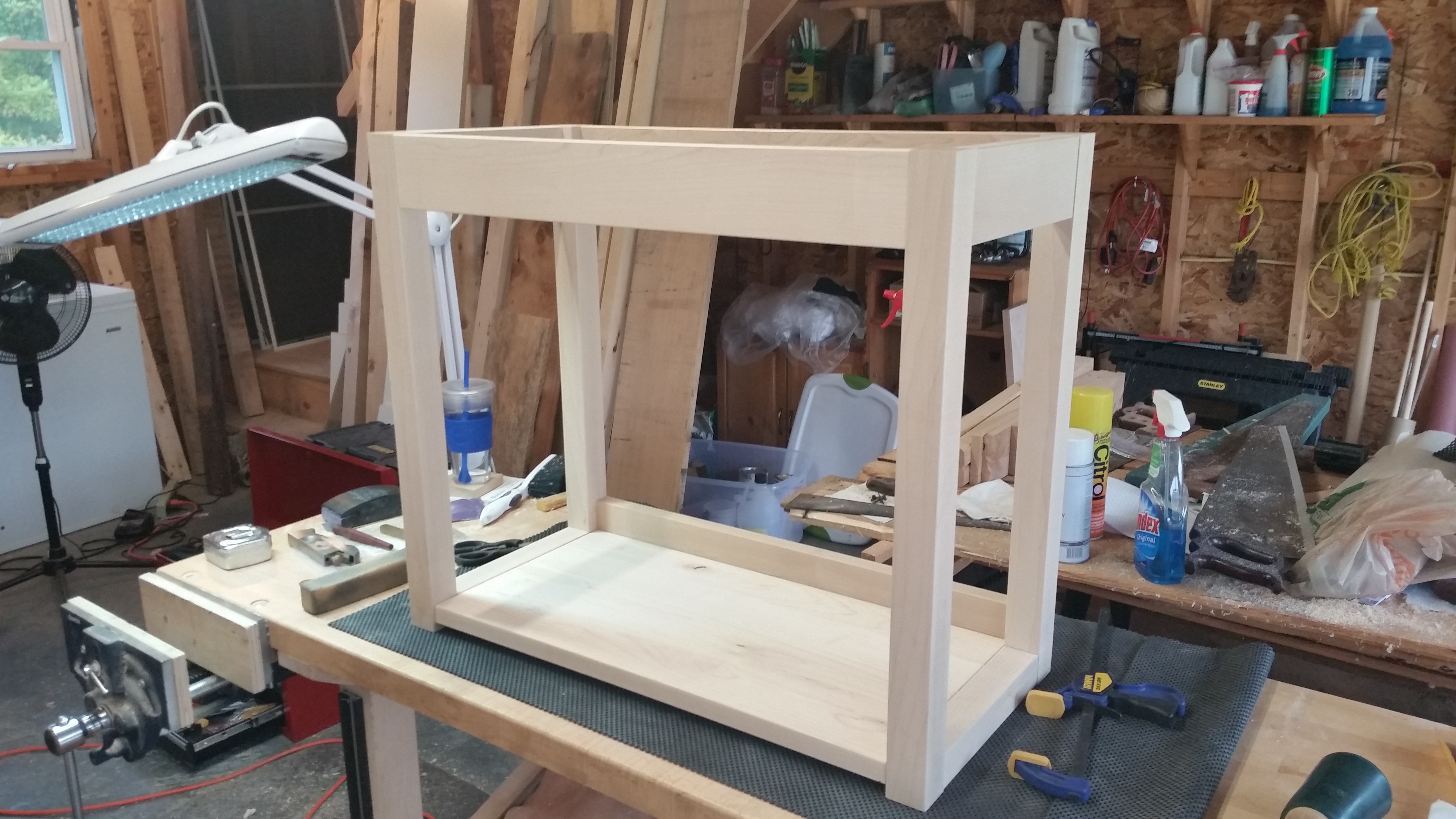
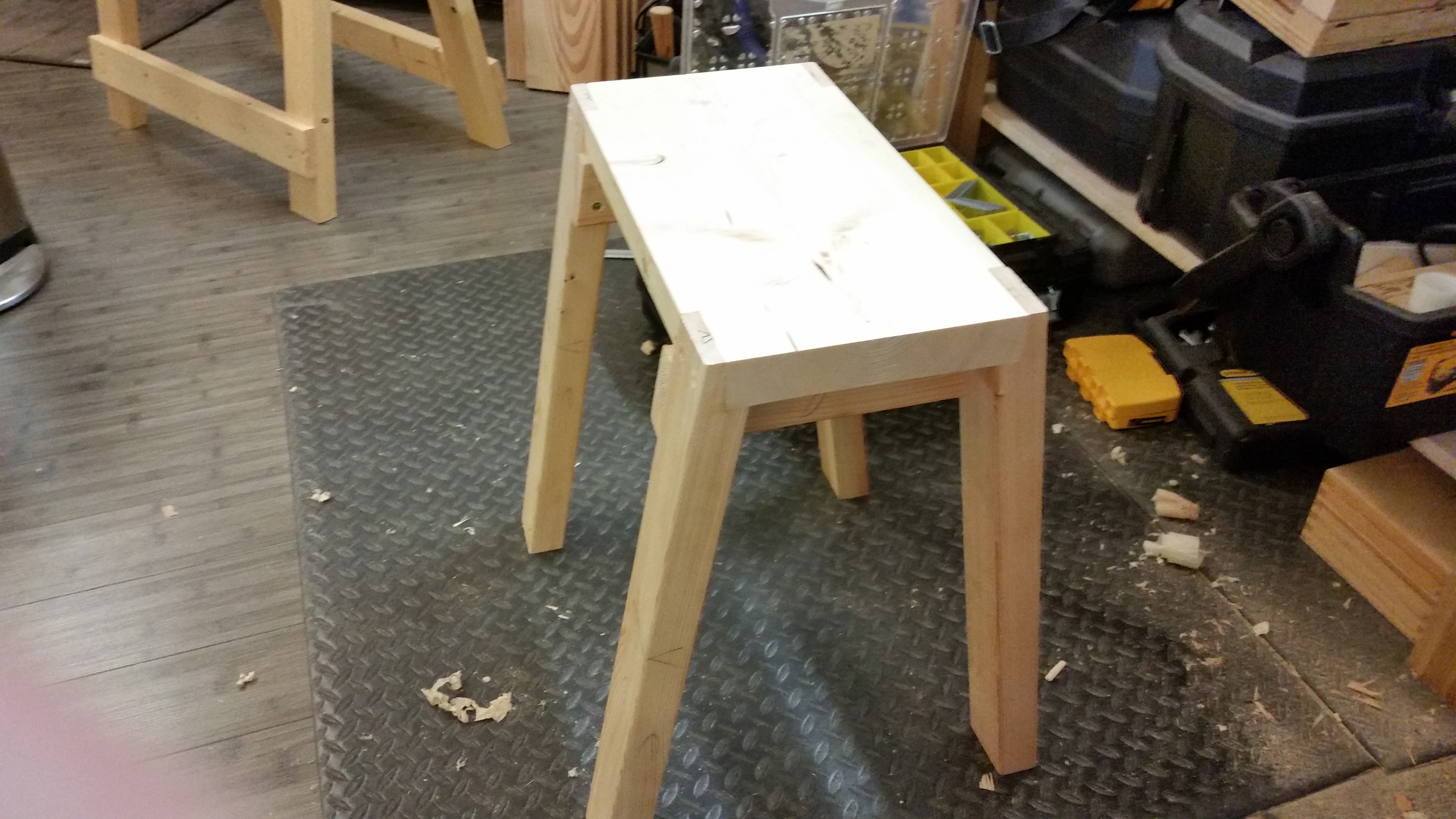
Remember those dovetailed white ash footstools I made for my niece and nephew a while back?  My brother recently painted and stenciled them and sent me a picture of the (literally) finished products.

Neither of those colors exists in nature.

Neither of those colors exists in nature.

I have to say the footstools came out quite beautifully.  Although paint is not really my thing (I prefer Danish Oil), the finish certainly fits the application and I am happy to see some of the grain and joinery still shows through. I find the colors a bit gender cliche, but it occurs to me the cliche likely evolved because color coding is the most expedient way to settle arguments among children. With the combination of substantial joinery and heavy duty finish, I am certain the footstools will endure.

I still owe my sister-in-law one more footstool (for the kitchen), but I am almost out of spare white ash. I think I have some extra quartersawn red oak offcuts I can scrounge, though, and red oak is close enough in hardness and texture to white ash to work in a mixed stock piece. Going to keep the parsons design of the two footstools pictured above, but I will change up the detail a bit.

JPG

Some Winter Cleaning

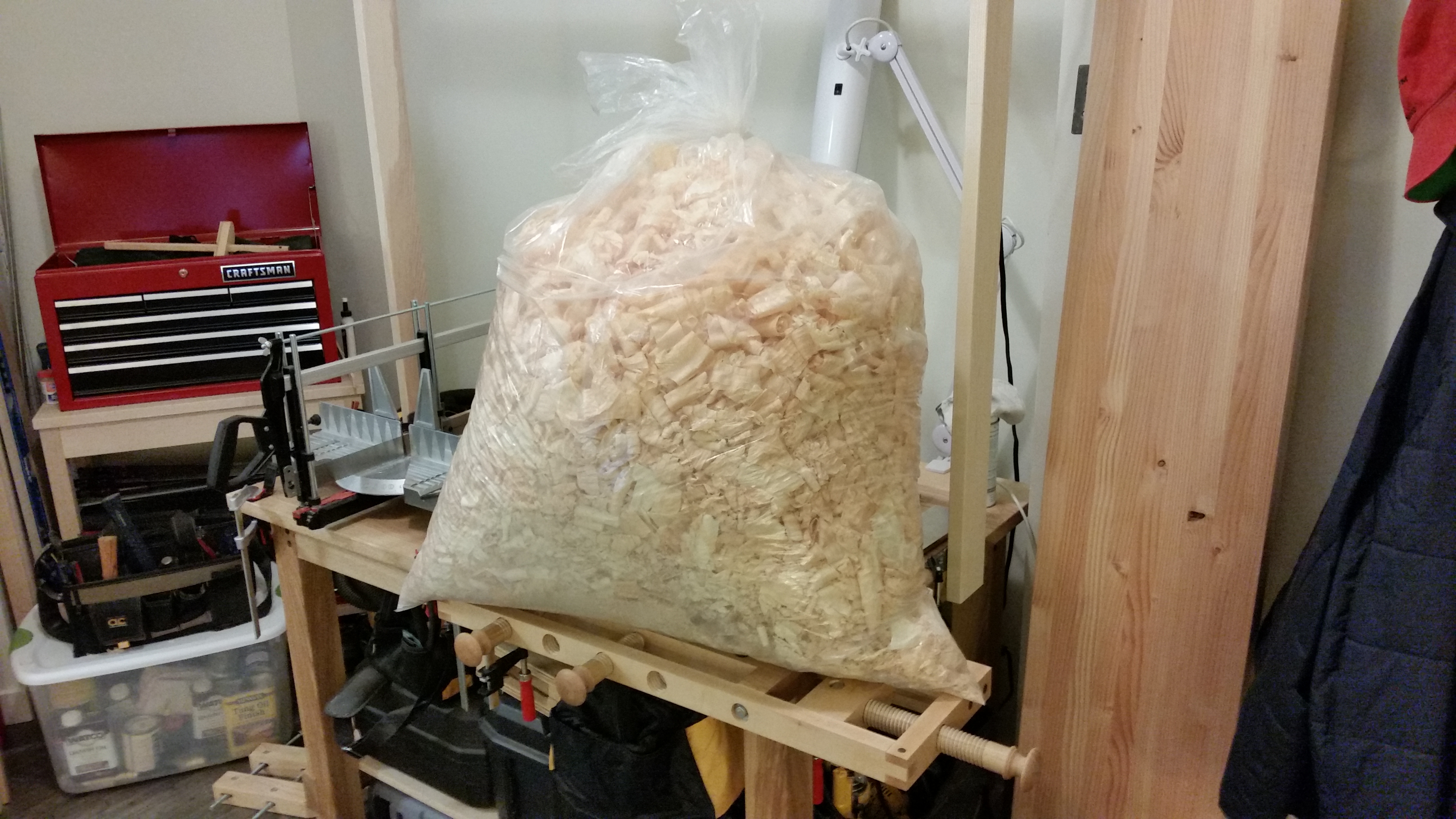
I set up my apartment woodworking shop just over three months ago, and I’m proud to report I just filled my first drum liner full of shavings!

image

I can think of no better representation of what I do.

Admittedly, most of those shavings are planing slab Douglas Fir (with some light arbor and footstool Ash mixed in), but still. With the planing slab nearing completion, I’m just about all full up on shop furniture – at least until I decide to make room for a moxon vise.

Drum liner number two is where it starts to get interesting. But I have absolutely no idea what to make next.

JPG

The Strong, Silent Type

I recently received an email from a follower (who runs an excellent, albeit way over my head, chronicle of his custom Triumph TR6 called Bowtie6) that made me realize I had completely neglected the second most important piece of furniture in my apartment woodworking shop.  I spent so much time rifling through my tool chests, but I gave nary a mention to the rolling tool cart I built specifically to support those tool chests.

wpid-20140917_093911.jpg

The white part keeps the red parts off the floor.

Constructed entirely of hard maple, the rolling tool cart is custom dimensioned to fit the top chest and intermediate chest.  It’s rock solid, relatively compact and was never intended to be flashy.  There is no finish on the piece (I could never settle on a color and it’s waterproof anyway).  And, just by luck, the whole assembly fits very nicely into a corner in my apartment near the workbench.

I’d like to think much thought went into the design.  For example:

  • the top chest sits (unbolted) on the top, with the handles comfortably at 36″ high (the exact height of my elbows) for ease of lifting
  • there is enough tabletop around the top chest for storing glues and putties (and other odds and ends that have no place on a bench top during a project)
  • the gap between the intermediate chest (also unbolted) and the top rails is almost 10 inches high, giving me ample room to store my machinists granite slab and my panel saws
  • the bottom shelf is slatted and floats free in rabbets in the lower rails for maximum flexibility as the piece settles under the weight of the tool chests
No one will ever know

I think aesthetics are sometimes lost on shop furniture projects.

As always, after a few months of use, there are some things I would change, in retrospect:

  • the casters are not nearly large enough to make the cart mobile, which is fine while the cart sits stationary in my apartment
  • I should have added dowels at the tops of the posts to secure the tabletop, which is currently glued directly to the frame and further secured with glued-in wood blocks (like corner brackets)
  • I measured the intermediate chest wrong and had to cut shallow dadoes in the posts to accommodate the lip of the intermediate chest (which extends out slightly to permit stacking of intermediate and top chests)
  • I haven’t yet been able to bring myself to drive nails into the side for hanging my winding sticks and dovetail markers
wpid-20140916_160713.jpg

You can clearly see the dadoes and the tiny casters in this shot.

I built the rolling tool cart to be furniture quality (like everything I do) and I know I succeeded because my mother has already called dibs on the piece to use as a kitchen island.  If and when she finally confiscates it, I will swap in a set of larger, decorative casters and fit a middle shelf into the dadoes (there is a bright side, I guess).

In the end, like any good piece of shop furniture, the rolling tool cart does its job and fades silently into the background.

JPG

An Appropriate Soundtrack

One awesome byproduct of handtool woodworking is the ability to enjoy music while at the bench. I just Bluetooth my smartphone to a Bose Soundlink Mini and get to work.

The boombox of a new generation.

The boombox of a new generation.

I have noticed my musical tastes shifting as of late (electro-synth-pop really speaks to these old punk rock bones), but regardless of genre, I find a good soundtrack does wonders for pacing and rhythm of handtool tasks – not to mention providing cover noise for fooling the neighbors and leasing office.

My favorite albums for general woodworking right now are Brand New – Deja Entendu, Fall Out Boy – Save Rock and Roll, and Of Monsters and Men – My Head is an Animal.

If I’m traversing grain or chopping mortises, I might opt for some A Day to Remember, The Offspring or Alkaline Trio for the extra oomph and, if all else fails, I have a DMX/Beanie Sigel greatest hits mix at the ready.

Although I have an extensive collection of stand-up comedy albums, I shy away from them while woodworking, as a stray laugh can and will cause an otherwise straight cut to wander.

If anyone has recommendations for other good workbench music, I’m willing to grooveshark anything.

JPG

Sometimes, Careful Planning is Not Enough

Just about three months ago, I wrote an entry on the “dining” table I built to be the foundation of my apartment woodworking shop (post linked: here).  During its construction, I had envisaged the table (which, by the way, was reverse-engineered from a Restoration Hardware design) as a furniture-quality, rock-solid clamping surface with some much-needed storage space on the shelf below.

And it has not disappointed.

And, thus far, it has not disappointed.

I believe I executed pretty well on that concept.  There is no hint of wobble or bench-based chatter when I am hand planing, and I have (just barely) enough storage below for the powered odds and ends I thought I would use when I switched back to apartment-based woodworking (more on that another time).

During the design phase, I did my best to determine the perfect dimensions for what I’d need to do meaningful woodworking, but there was no way to solve for (or even predict) everything. I’m not saying I would necessarily change any of these dimensions, but, for example:

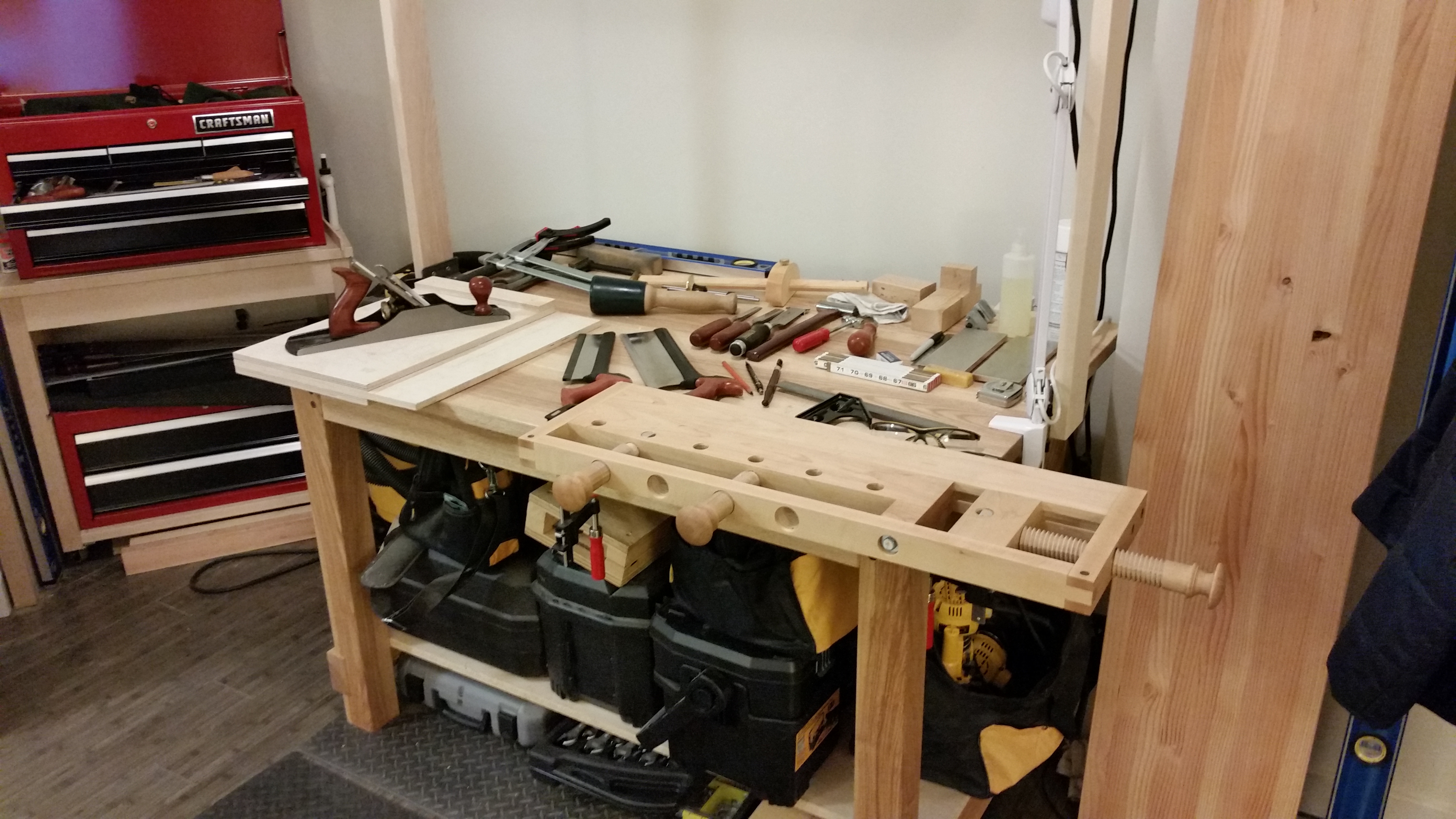
  • The height (at 31″) is just right for planing, with the top of the Milkman’s Workbench sitting at a very comfortable 33″ (I’m a little over 5’10” and all my planes are iron-soled, FYI), but I still need to craft a moxon-style vise to raise the workholding to a comfortable level for joinery.
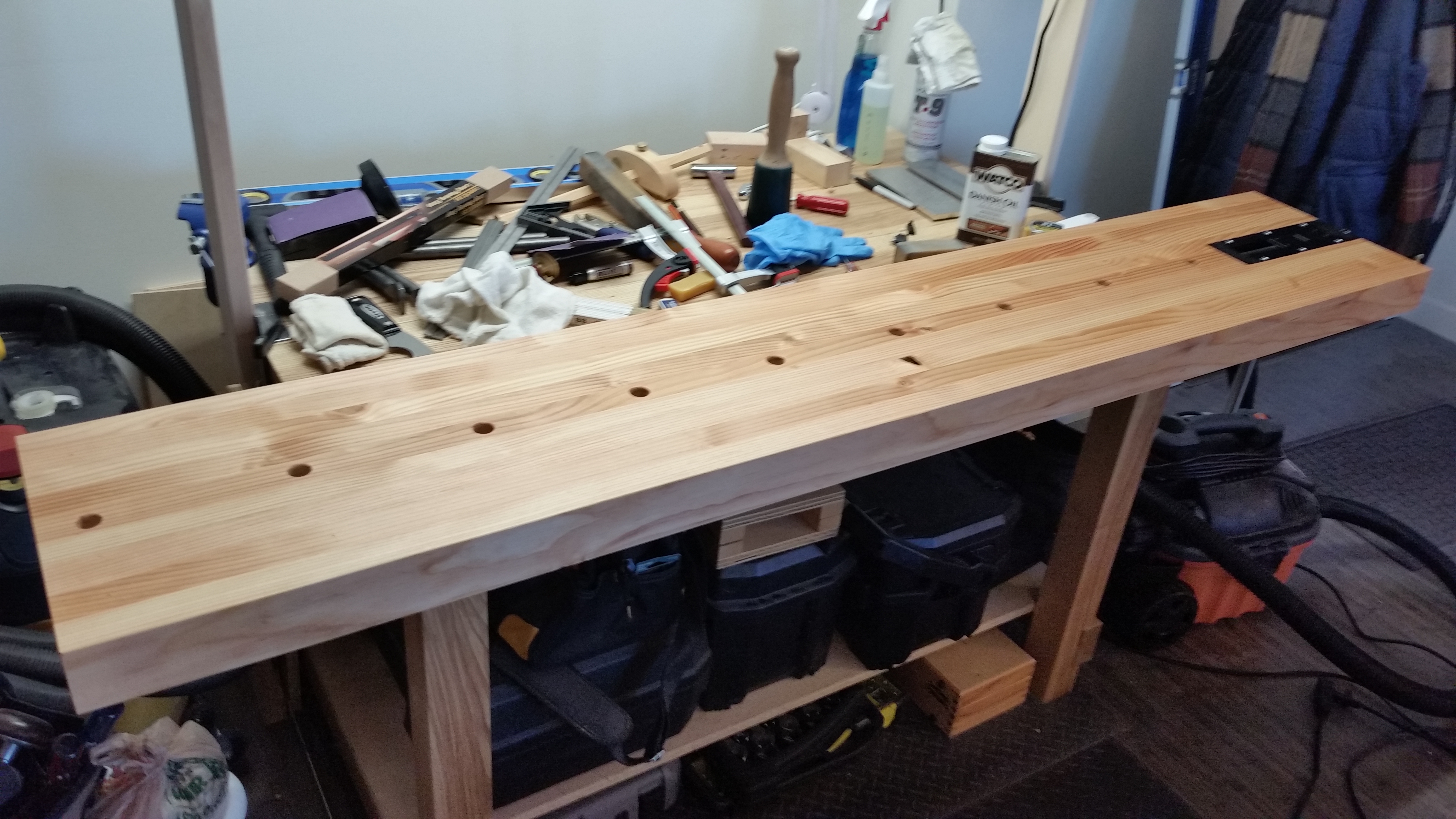
  • The top is wide enough (at 50″) to accommodate both the Milkman’s Workbench and a shooting board/miter box at the same time, but not nearly wide enough for planing longer, thinner boards (hence the need for a 72″ planing slab (seen above on the right, planed to final dimensions but still lacking dog holes and inset vise)).
  • The top is deep enough (at 34″) to splay out the tools needed for any particular project, but is sadly too deep for the reach of the boom on my LED task light (solved by locating the clamp-on base to the side, which now gets in the way of some cross-grain planing).
  • The overhang of the top in relation to the frame is wide enough (at 4″) for ease of clamping a variety of benchtop accessories on all four sides (e.g., Milkman’s Workbench, miter box, saw vise, task lamp base, soon-to-be planing slab), but anything less than a co-planar top eliminates the usefulness of the legs themselves as a clamping surface.

The point is, no matter how well you plan, no matter how much thought goes into the design or care goes into the execution, it is only a matter of time before the shortcomings and mistakes become apparent.  In making the best of a less-than-ideal situation, any solution to an existing problem could also be the genesis of a new, unforeseen issue.

And that, more than anything, is the essence of small-space woodworking.

JPG

A New Year, Indeed

2104 has been a great year for The Apartment Woodworker, and we’re only getting started.  Thanks much to all of my readers.

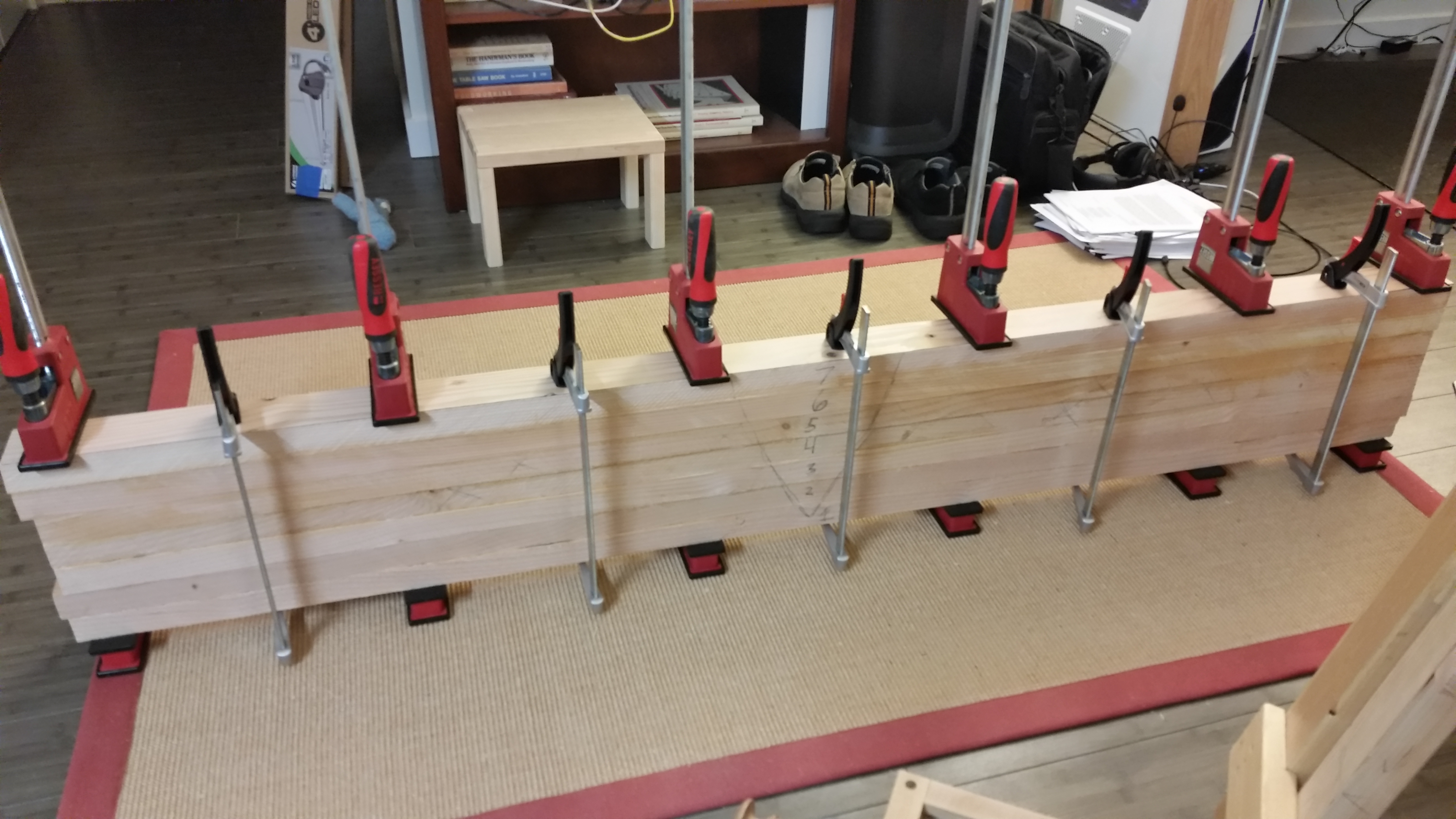
Things look to be busy Q1 of 2015, but I can promise there are several great projects and stories coming very soon.  The soonest may very well be the completed planing slab.

Only 2 more laminations to go!

Only 2 more laminations to go!

So stay tuned!  Happy New Year to all!

JPG

Holiday Cheer at The Apartment Woodworker

As the year wraps up, I find myself (as always) being very grateful for my loving and (mostly) supportive family and friends (especially Matty).  They indulge me in my eccentricities and manic woodworking fervor and I am very lucky to have such excellent and admirable people in my life.

Now, I would like to brag about the awesome woodworking gifts I received this Christmas.

From my parents, a 24″ imperial ruler blade for my Starrett combination square.  When not in use with the combination square, I expect it will live on the workbench as my go-to straightedge.  Its first combination square task, though, will probably be in connection with squaring the ends of the planing slab (as soon as I finish a couple more laminations).

A gorgeous piece of steel.

A gorgeous piece of steel.

Speaking of the planing slab, my brother and sister-in-law gave me not only a Veritas inset vise (for which I had asked), but also surprised me with the pivoting jaw and the low profile jaw as well (both of which were actually sitting in my Lee Valley online shopping cart ready for purchase).  Now i just need a Veritas planing stop and to settle on inset vise positioning.

I have a feeling this will quickly become my favorite vise.

I have a feeling this will quickly become my favorite vise.

All in all, a pretty awesome Christmas.  Thanks very much, family.

Happy Holidays to all!  I should probably get back to making the second footstool for my niece and nephew.

JPG

The Trusty, Underappreciated Rub Joint

I own lots of clamps, but an unfortunately low number reside in my apartment woodworking shop. As a result, as often as I can, I turn to the rub joint.

The Rub Joint: for when literally any amount of clamping pressure will do.

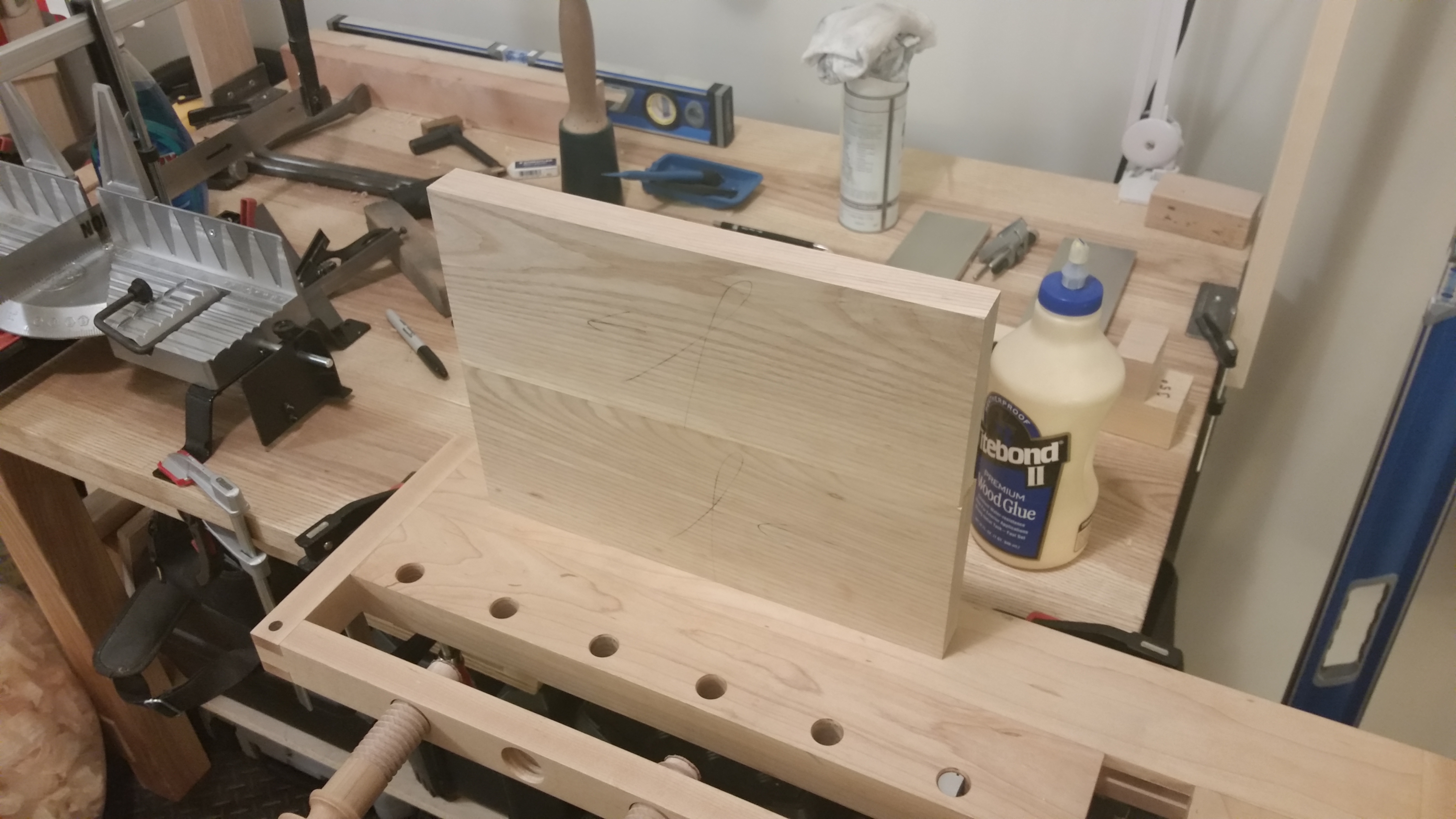
It’s a simple joint, really. A thin film of glue is applied to two jointed boards, which are rubbed together back and forth until the glue becomes grabby. The glued-up boards are then left to dry under gravity and atmospheric pressure only. It works well with other types of joints, but edge-jointing smaller tabletops (the above is for a footstool) is where the rub joint really shines.

There are three tricks to ensuring a proper rub joint, though:

First, the jointing must be crisp and square. Gaps in the mating surfaces are the bane of a good rub joint, even when using gap-filling adhesives, such as epoxy.

Two, there is such a thing as too much glue. Use only a thin film of glue, because without true clamping pressure to force squeeze out, the boards will float on a thick film of glue and the edges won’t meet in a strong, straight joint.

Three, leave the glued-up boards to dry on a flat, level surface. You’re using gravity and atmospheric pressure as your clamping force, so a flat, level surface to support the work will ensure the glue joint is perpendicular to gravity and atmospheric pressure as it dries.

A tight, strong joint with no clamps.

A tight, strong joint achieved without clamps.

A well-executed rub joint is just as strong and gap-free as a clamped joint. Once you master the rub joint, you too may find that sometimes, very occasionally, you can have too many clamps.

Or, you know, just can just use pinch dogs.

JPG

Nesting Saw Bench

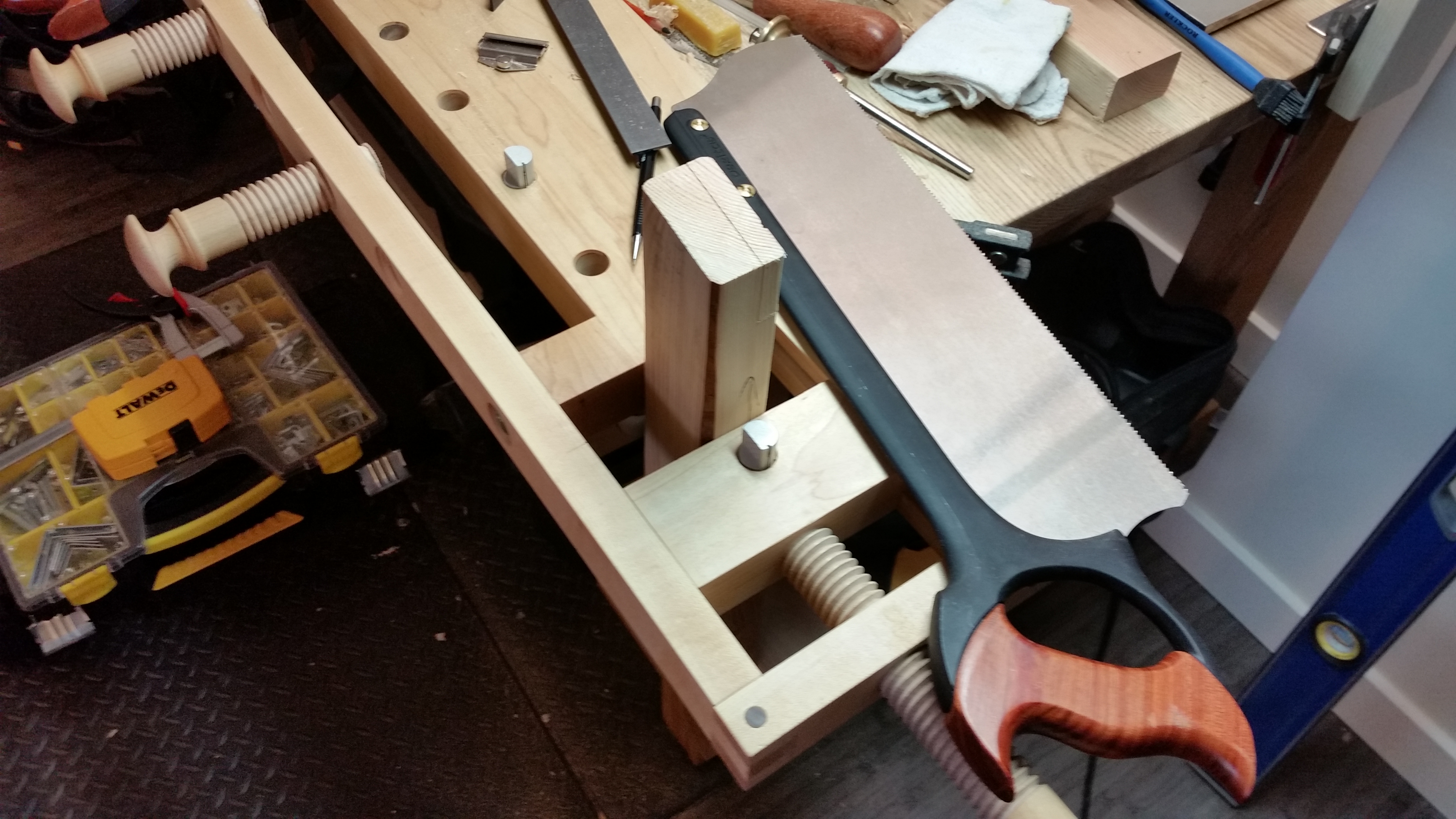
Been ripping a significant number of longer boards lately for the planing slab project, which motivated me to finally make a smaller, companion saw bench to nest inside my main saw bench (both are based on the Christopher Schwarz 2009 version).

wpid-20141220_133010.jpg

I’m psyched to use something other than a dovetail saw for joinery, for once.  Lap joints are the best.

All stock preparation and joinery only took a few hours and I am very happy with the result.  I just need to let the glue dry before I fit the stretchers and level the seams and feet.  Should definitely make ripping easier, as I can now support both ends of a long board won’t need to stop halfway through and flip it around anymore.

Also, I started using the wagon vise on my bench like a front vise for thicker stock that wont fit in the actual front vise.  Works well enough; still need to make an actual moxon vise at some point, though.  I guess I’ll add it to the to-do list.

wpid-20141220_122804.jpg

Small-space woodworking is all about improvising! 

Hope everyone has their holiday shopping wrapped up.  I’m one home center gift certificate away.

JPG

A Planing Slab In Process

Ever since the LED light arbor project (linked here), I have been searching for a reliable way to support 5-6 foot boards for face planing on my 4 foot worktable. For thicker stock, the overhang didn’t really matter; the work was rigid enough to support itself. On thinner pieces (less than 6/4 or so), although edge planing was usually fine, flex at the ends while face planing caused me to unknowingly plane humps into the work, no matter how sound my technique.

wpid-20141008_083040.jpg

Just not enough tabletop real estate for face planing longer, thinner stock.

After much debate (I even consulted Christopher Schwarz on the issue, whom I thank greatly for his quick response and prescient input and whose Lost Art Press I once again plug), I decided to laminate a planing slab (like a Japanese workbench). Made from inexpensive materials, the slab would be rigid and flat and could be clamped to my worktable with angle irons or leaned against the wall when not in use. It would also have a Veritas inset vise and dog holes for Veritas planing stops and holdfasts.

Rough sketch in hand, I went to the home center on a lazy Sunday and dug through the 2x10s for an hour or so (the 2x12s were so saturated they were almost too heavy to move on my own) and found 36 feet of the driest, straightest, clearest Douglas Fir 2x10s available (all from the bottom of the pile, sadly). In the parking lot, I used two lumber carts as saw benches and piled the six 6 foot lengths in the car.

Quite proud of myself for this one.

Quite proud of myself for this one.

Ever since, in my spare hours, I have been hand ripping 3 inch wide lengths, face planing the gluing surfaces and laminating the pieces, one at a time (Paul Sellers’ workbench playlist on YouTube is a great how-to for preparing dimensional softwoods for laminating into a bench top).  The whole lamination should be approximately 18 inches wide (which equates to about thirteen boards) , 72 inches long and 2.75 inches thick when finished. I think, though, that when the slab gets to be about 10 inches wide (seven boards or so), I will flatten the bottom by hand and skip plane it with my thickness planer. That way, I can more easily finish up the second half of the lamination, using the first half as an (albeit smaller) planing slab.

Only four more laminations to go and I'll have half a planing slab!

Only four more laminations to go and I’ll have half a planing slab!

Once I have the space, I will probably re-purpose the planing slab as the bench top for a proper workbench for lighter work (and maybe add a face vise). Until then, though, I am looking forward to having a real planing surface, so I will keep laminating.

JPG